a fairy tale between the city and the forest by atelier WHY
on the edge of the park, the area will be filled with tall trees to create a deep contrast with the urban context.
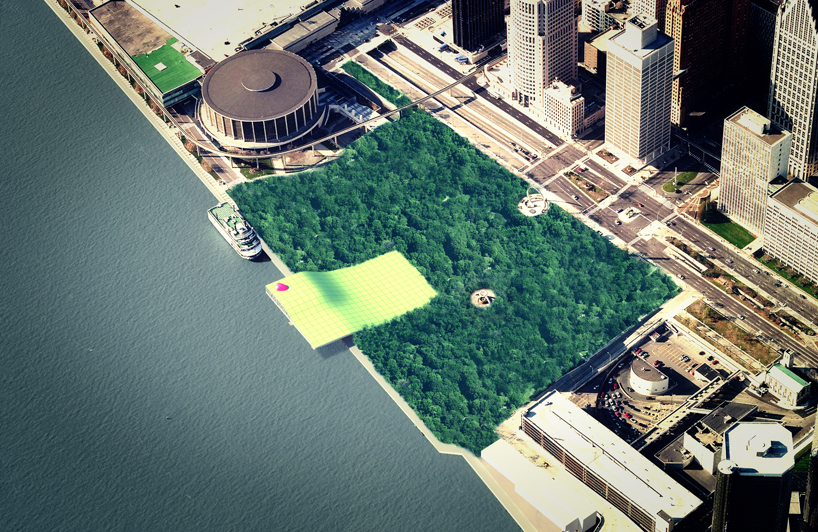
‘a fairy tale between the city and the forest’ by atelier WHYbird’s eye view
located on the edge of park as a competition held for the detroit waterfront by UPC of AIA, the area will be filled with tall trees to create adeep contrast with the urban context. in ‘a fairy tale between the city and the forest’ by south korean designers hyuntek yoon,
and soobum you of atelier WHY, people will not be able to notice what is going to be unfolded to them beyond the forest due to
the density of trees. this will arouse curiosity and poetic imagination in people as if they are in wonderland or in unknown world.
radically, it will be difficult to establish any attempts to control the movement of visitors such as signs and entrances or pedestrian roads on the street. people will meander slowly on small trails through the forest, which will be covered with soil and dirt without any determined direction. the density of the greenspace provides people who approach the park along the wide main streets or jefferson avenue with a strong reversal of perception in terms of scale.
 edge – forest wall
 concert in the forest
with the ‘concert in the forest’, soft sunlight fills the trails and a sweet classical melody from a grand piano resonates with the space to stimulate the emotional sensitivity of both musicians and spectators. the facilities are sophisticatedly designed to be in harmony with the forest’s contextual nature. first, concert seats are designed as if they are the wavy roots of big trees and are distributed naturally along the trails. there, concrete textured shapes create an atmosphere of an old forest that existed in fantasy lands or in fairytales. also, a thin bridge composed of a wood structure will string itself over a trail on which people can relax and enjoy the performances.
 section of the forest
 noguchi’s sculpture
isamu noguchi’s two sculptures will not be removed and will be used as historical and cultural spaces. the fountain, with its uniqueshape and material, will be moved down nine feet under the trail level and will be located within a sunken garden and a small amphitheater surrounded by another circle structure composed of a wood floor, spirals, and white curtains. the movement of the curtain will create a poetic atmosphere and remind visitors of the falling water of noguchi’s sculpture. also, the basement has commercial facilities such as restaurants and retail shops.
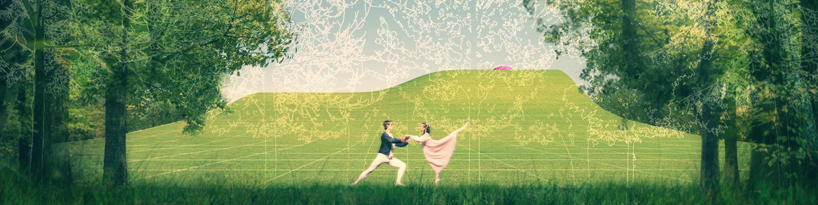 the knoll
‘the knoll’ is a multi-purpose void space contrasted by the trees. however, the opening will be filled with diverse activities. as a cultural venue, the area will be used as an exterior theater, public market, and for cultural activities. the venue can easily change its use depending on the activities, providing more spatial opportunities.
 forest and riverfront
integrated with the greenery and riverfront, people will experience a spatial transition from the forest to the great lake. ‘the knoll’ becomes part of the landscape, but at the waterfront, it is read as an iconic building itself. people will have vertical and horizontal experiences, as well as linear experiences. the image of space that people experience will depend on where they are located and what they are doing. this building will be used as a visitor center, small auditorium, and back of house for the location.
 under the knoll
providing a semi-exterior space like a canopy, this space will be used as a shelter and a foyer. in particular, in rainy and snowy weather, this space can be an alternative area of exterior space in the forest and in the knoll.additionally, it will be the most active space for night venues. the escalator is connected directly with the roof, transforming the spatial transition into a radical and extraordinary experience.
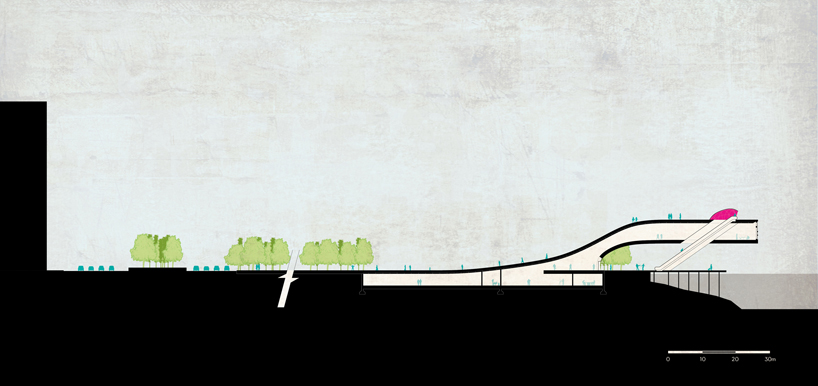 section of knoll
 plan of knoll
designboom has received this project from our ‘DIY submissions‘ feature, where we welcome our readers to submit their own work for publication. see more project submissions from our readers here.
shop
your own online design shop — no sales commission collected