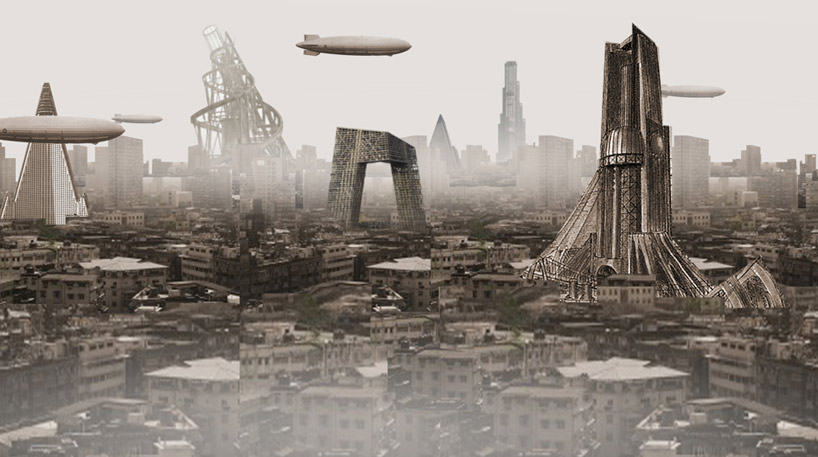
‘wall stalker’ by nathalie frankowski and cruz garcia all images courtesy wai architecture
nathalie frankowski and cruz garcia of wai architecture think tank have sent us in images of their project ‘wall stalker’.
a stalker is what people in arkady and boris strugatsky’s roadside picnic (1971) call a whole new profession of misfits that risk their lives in the zone (a mystical place of transcendental powers) to seize valuable things. a wall stalker then, is somebody who is taking the same risk to grasp whatever he can find in an equally mysterious wall.
wall stalker is an animated architectural narrative, in which the characters of andrei tarkovski’s 1979 film cталкер (stalker) (based on roadside picnic) become the protagonists of a three man exodus from a city of icons, in search for the essence of architecture.
 ‘wall stalker’ – the meeting
after opening with the title illustration, the first image of wall stalker shows an overview of egoville, the capital of ego in which the skyline is highlighted by a wasteland of desolated icons. this post-apocalyptic environment offers no hope for the three characters as they decide to break away from this city product of the cynicism of man, and reach for the legendary wall, where they believe the essence of architecture can be found. once the characters leave the city behind them, they find themselves melancholically traveling through a purgatorial landscape of post-iconic desolation. submersed in a forsaken desert with their last hopes about to evaporate, they finally spot the legendary wall they’ve been looking for. the mysterious presence of this mystical element becomes accentuated by its striking visual silence. free of any kind of symbolism and stripped of any ideological aesthetic, the wall only offering for the three exhausted men is its inherent inertness. after completing their intended journey, the new predicament of the three wanderers will be how to grasp the mythical ‘essence’ of the wall. from that moment on, their lives and the city will never be the same.
 ‘wall stalker’ – exodus
 ‘wall stalker’ – the last glimpse
wall stalker is a graphic journey through the fictional subconscious of architecture. using pieces of jan garbarek as acoustic background the architectural narrative is built around twelve chapters/ photomontages that depict the three men odyssey through the dialectics of architecture and the city they created. the compositions of the twelve chapters not only absorb into its plot tarkovski’s film but also pieces of el lissitzky, vladimir tatlin, paolo soleri, caspar david friedrich, and giambattista piranesi in the form of collage, in order to create a scheme full of symbolism while simultaneously being disconnected from any other plot.
wall stalker is divided into three parts with four chapters/photomontages in each. the first part is titled egoville and includes the capital of ego, the meeting i, exodus, and the last glimpse. the second part is named un voyage purgatoire and includes les portes du désert, sea of sand, the wanderer, and conquest and the third part is the wall, which includes the meeting ii, inquisition, no turning back, and blindness.
wall stalker is the first of a trilogy of architectural narratives of wai architecture think tank that explore the essence of architecture.
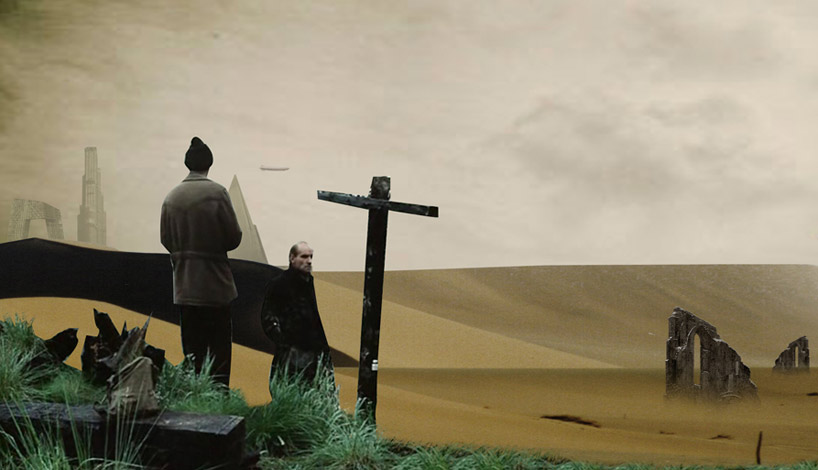 ‘wall stalker’ – les portes du desert
 ‘wall stalker’ – sea of sand
 ‘wall stalker’ – the wanderer
 ‘wall stalker’ – the conquest
 ‘wall stalker’ – inquistion
 ‘wall stalker’ no turning back
 wall stalker ‘blindness’
Wall Stalker from WAI Think Tank on Vimeo.
WAI ARCHITECTURE (9)
 Jan 12, 2014
 Oct 09, 2012
 Jul 14, 2012
 Sep 14, 2011
 Feb 19, 2011
PRODUCT LIBRARY
 Apr 02, 2024
 Mar 31, 2024
 Mar 21, 2024
 Mar 20, 2024