janet echelman interview
the american artist explains her work process in detail and explains how the different countries she has lived in have shaped her approach.
[FEATURED]
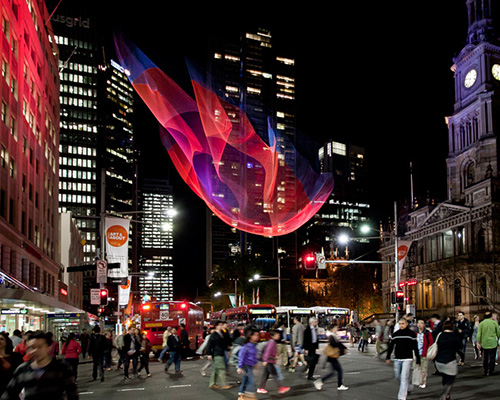
janet echelman interview ‘tsunami’ sydney, 2011image courtesy of janet echelman
earlier this year design 360° magazine spoke to american artist janet echelman. here she explains her work process in detail and how the different countries she has lived in have shaped her approach.
360°: what drew you to working with fish nets?
JE:it’s natural aesthetic capability to assume complex curvilinear forms, in terms of structural engineering, while also offering a distributed network where even if one point is not able to carry its load, the others still continue to function. after graduating from college, I went to the university of hong kong on a scholarship to study chinese calligraphy and visual art. this was great training for me, as I learned the importance of honing a traditional skill to create an expressive work of art. they say it takes 40 years of practice to make a calligraphic stroke in 4 seconds, and I now understand what that means. I spent the first decade of my career studying craft forms in asia, after hong kong I moved to the island of bali, indonesia, there I studied batik and other textile crafts while I had a grass-roofed studio and home on the rice fields in view of the volcanoes. ten years later, I discovered sculpting when I went off to india on a fulbright.
I was there to teach painting with a commitment to create large paintings, but my paints never arrived. so I decided to embrace what was there. every evening after working in the studio, I would walk on the beach and swim, just as the fishermen were bringing in their nets. it occurred to me that their nets were creating form without mass in a completely unique way. once I made some forms from the nets, I hoisted them into the air and discovered that they billowed softly and made the unseen dance of wind visible. my strategy is to let my work be choreographed by nature. then it is ever changing, renewed at every moment. I want people to relate to my work not as an observer to a discrete object, but rather as a relationship between two entities that are both changing at all times, which is what is revealed through this material.
for my newest commission I have expanded beyond the net-making technique. I’m using a completely new material: water mist combined with colored light, to transform the center of philadelphia.
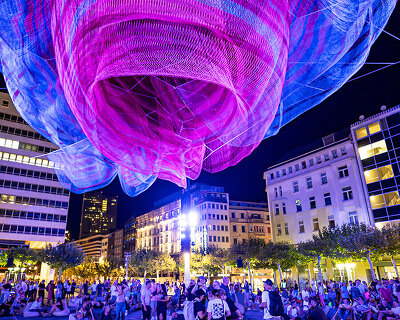
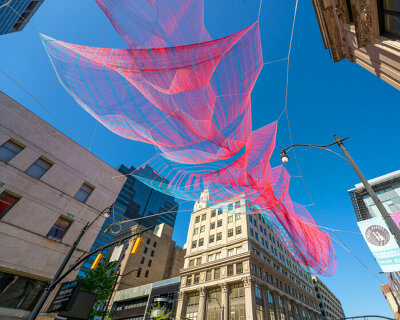
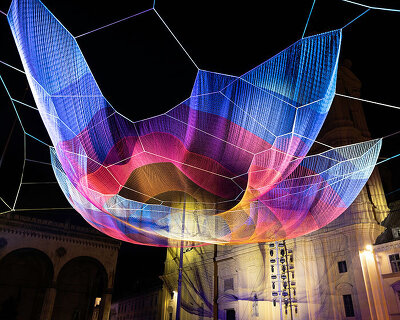
 ‘tsunami’ sydney, 2011tsunami 1.26, an aerial lace installation, was inspired by the 2010 chile earthquake’s ensuing tsunami and the 1.26-microsecond shortening of the day that resulted from the earthquake’s redistribution of the earth’s mass. image courtesy of janet echelman
 ‘tsunami’ sydney, 2011 image courtesy of janet echelman
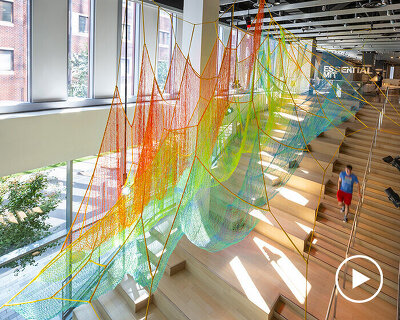
 ‘every beating second’, san francisco, 2011 artist janet echelman transforms the terminal with fictional nature that subtly engages viewers with real and imagined natural forces. her sculpture installation cuts three round skylights into the ceiling, from which descend delicate layers of translucent colored netting to create three voluptuous volumetric forms. image courtesy of janet echelman
 ‘every beating second’, san francisco, 2011 image courtesy of janet echelman
 ‘every beating second’, san francisco, 2011 image courtesy of janet echelman
most of your installation works are in large scale, were they handmade or machine-made? what do you feel are the pros and cons of machine-making?
when I began making these netted works, they were fabricated 100% by hand, made possible by my work with a group of 9 fishermen in south india. in fact, after my fulbright I spent some time in lithuania studying traditional lace making techniques there, and my permanent commission for their museum is also 100% hand-made.
all of my more recent works are a combination of machine and hand work. we utilize the machines for what they do best: making rectilinear panels with strong machine-tightened knots that can withstand a hurricane. we use hand-work specifically to create unusual irregular shapes and joints, and to make lace patterns.
are there any major difference between your outdoor and indoor installation works? the outdoor work is animated by nature, the ever-changing movement of wind enlivens the work into a living sculpture. I work with the movement of the sun throughout the day to create varied shadow patterns cast upon the ground, and upon people, who thereby become participants in the work.
the interior work is focused on the play of the soft forms in contrast to the architecture. in recent work i have cut curved holes in the ceiling and roof to create skylights as part of my interior work, thus joining exterior and interior. I love the challenge of both types of projects.
the softness and delicacy of your net installations make us think of a feminine image. can we see it as a kind of feminine element in your work?
I leave the interpretation of my work open to each individual, to create their own meaning. some viewers have given a feminist reading of the work, referring to the soft and fluid ways the work gains its strength through an ability to adapt, rather than by brute force. for me, personally, I do not think of this quality as either feminine or masculine, but as a human quality.
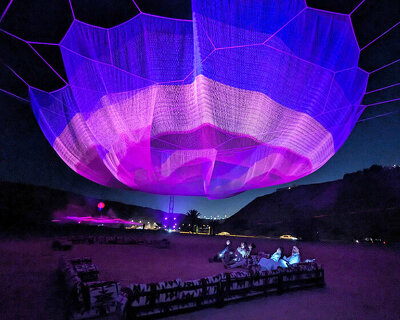
 ‘her secret is patience’, phoenix, 2009 this project makes visible to the human eye the patterns of desert winds. during the day, sunlight projects patterned shadow drawings onto the ground and pedestrians on their daily paths. at night, the colored illumination gradually changes color through the seasons. the large three-dimensional multi-layered form is created by a combination of hand and machine knotting of recyclable high-tenacity colored polyester that is replaced in new color variations at intervals. image courtesy of janet echelman
 ‘her secret is patience’, phoenix, 2009 image courtesy of janet echelman
 ‘her secret is patience’, phoenix, 2009 image courtesy of janet echelman
 ‘her secret is patience’, phoenix, 2009 image courtesy of janet echelman
 ‘water sky garden’, richmond, 2009 water sky garden transformed the plaza surrounding the richmond olympic oval, official venue for the 2010 vancouver olympic winter games speed-skating events, into a permanent art environment for the community. image courtesy of janet echelman
 ‘water sky garden’, richmond, 2009 image courtesy of janet echelman
 ‘water sky garden’, richmond, 2011 image courtesy of janet echelman
 ‘she changes’ porto, 2005 using color and material to invoke the memory of the site’s history as a fishing and industrial center, this three-dimensional multi-layer net floats over the cidade salvador plaza. this work is credited as the first permanent, monumental public sculpture to use an entirely soft and flexible set of membranes moving fluidly in wind. image courtesy of janet echelman
 ‘she changes’ porto, 2005 image courtesy of janet echelman
 ‘she changes’ porto, 2005 image courtesy of janet echelman
 ‘target swooping down… bullseye!’, madrid, 2001 image courtesy of janet echelman
 ‘target swooping down… bullseye!’, madrid, 2001 image courtesy of janet echelman
 ‘1.26’, denver, 2011 the city of denver asked the artist to create a monumental yet temporary work exploring the theme of the interconnectedness of the 35 nations that make up the western hemisphere. she drew inspiration from the nasa jet propulsion laboratory’s announcement that the february 2010 chile earthquake shortened the length of the earth’s day by 1.26 microseconds by slightly redistributing the earth’s mass. image courtesy of janet echelman
 ‘1.26’ detail image courtesy of janet echelman
 ‘1.26’ watercolor image courtesy of janet echelman
 ‘1.26’ watercolor image courtesy of janet echelman
in your opinion, what can be defined as new, and how about old?
I respect the wisdom locked inside the old ways of doing and making things. yet I do not feel confined by the ways these have been used in the past. bringing new technology and material science to old methods interest me a lot. old and new blur together in my work seamlessly.
what are you currently working on? any exciting plans for the future?
I’m in construction for a commission for a brand new arena in eugene, oregon at the university of oregon. a work that will highlight the connection between the spectators and basketball players during a game. how they fuel the team with their energy and celebrating the energy that fans bring to a basketball game.
we’ve just broken ground on a project for the dilworth plaza in philadelphia. the piece will be embedded in the new plaza’s 11,600-square foot foundation and will trace above ground in real time the paths of the three subway lines below. the work will create moving 4-foot-tall curtains of mist, generating a living x-ray of the city’s circulatory system.
I’m also working on a 45-story net sculpture for a major european city, an iconic work to express the mission of one of the world’s largest charitable foundations, and a project to be installed in washington dc on the state department building to celebrate the 50th anniversary of the united states’ art in embassy program.
—
this interview was originally published in the july, 2012 issue of design 360° it is re-published with permission of design 360° – concept and design magazine sandu publishing, executive editor: annie lai