paper architecture exhibition in paris
reproduced and re-imagined urban structures are assembled, drawn, cut, folded and glued together to showcase the range and depth of paper.
prefer designboom on google‘slicetow, module 1’, 2010 by mathilde nivet image © zoe guilbert
cite de l’architecture & heritage in paris, france, has organized an exhibition at le palais de chaillot, entitled ‘paper architecture’ featuring designs by ingrid siliakus, beatrice coron, stephanie beck, mathilde nivet and peter callesen. the collection of work looks at iconic buildings and the creation of imaginary cities made of the thin sheets. during the presentation children will learn the techniques used in the art of folding and etching to realize the models.
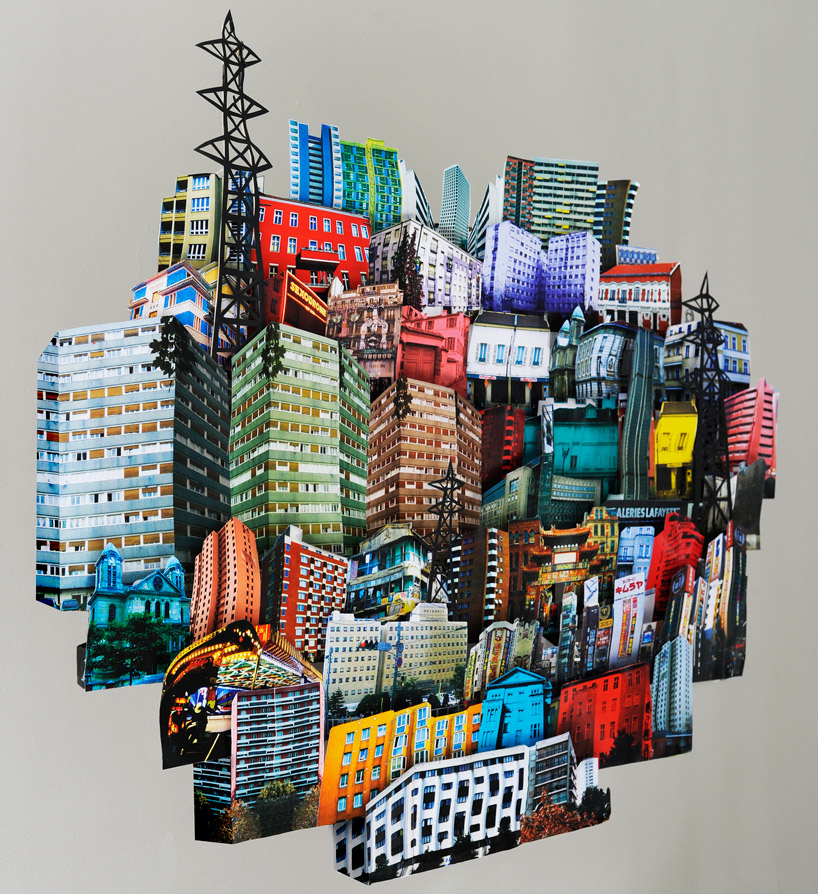
paris-based designer mathilde nivet takes the context of urbanism and the city as the source for her work. she uses a pop-up technique which combines folding, decoupage and montage to represent three-dimensional architecture at a large scale. the facades make up a paper town at different levels to evoke a sense of memory and metropolitan legacy.
 ‘slicetow, module 2’, 2010 image © zoe guilbert
 ‘upside town’, 2006 image © zoe guilbert
 image © zoe guilbert
 ‘dreamcity’, 2009 image © mathidle nivet
 ‘dreamcity’, 2009 image © mathidle nivet
 ‘earth catcher’, 2010 image © beatrice coron
french artist beatrice coron uses tyvek, a non-woven textile to etch her stories. the material has the look and feel similar to paper and is more resistant to tearing. the substance allows her to produce large images with numerous layers of detail which she has chiseled with finesse using a knife and scissors as her tool. the illustrations are invented stories, cities and worlds for the viewer to explore. the compositions include memories, word associations, ideas and observations that unfold in juxtapositions where everything is connected.
 ‘dead city’, 2004 image © beatrice coron
 ‘invisible cities’, 2012 image © beatrice coron
 ‘aviary’, 2010 image © stephanie beck
american stephanie beck carves cities from the urban landscape taken from experiences she has accumulated through her many journeys around the world. thin layers of paper are applied over the miniature models revealing a method similar to oil painting. the lightness and fragility of the pieces are a result of the cut outs done with scissors. the materialization of these volumes echo plans of cities halfway between dream and reality.
 image © stephanie beck
 image © stephanie beck
 aviary detail image © stephanie beck
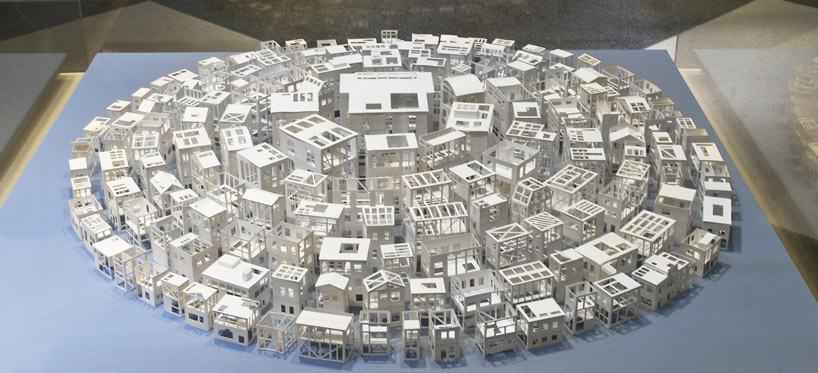 ‘neighborhood arrangement #2: circle’, 2009 image © stephanie beck
 image © stephanie beck
 detail of neighborhood arrangement #2: circle image © stephanie beck
 ‘neighborhood arrangement #2: maze’, 2010 image © stephanie beck
 detail of neighborhood arrangement #2: maze image © stephanie beck
 cosmopolitan new york, 2011 image © ingrid siliakus
dutch designer ingrid siliakus uses a technique called origamic which takes its technique from origami (the art of folding) and kirigami (the art of japanese paper cuts). the models are developed from a single sheet which is carefully creased and pierced to create an architectural volume. the full quality of the archetype is seen with the shadows which are cast between the full and empty spaces.
 (left) chrysler building, 2010 (right) rockfeller, 2010 image © ingrid siliakus
 ‘the short distance between time and shawdow’, 2012 image © peter callesen
danish designer peter callesen explores the transformation of a simple A4 white sheet into figures that expand into the space surrounding them. the negative and empty area left by the cut points out the contrasting three dimensional reality it has created. the fragile elements face a tragic story of always being attached to their origins without the possibility of escaping.
 ‘icecastle’, 2012 image © peter callesen
shop
your own online design shop — no sales commission collected