concrete canvas by peter brewin and will crawford. concrete canvas has won 11 awards including the saatchi and saatchi award ............................

......................... shop .................. competitions .............. education ................ interviews ................... snapshots ................... history .......... contemporary


concrete canvas
peter brewin and will crawford

CCO1 is an multi award winning project that
will revolutionise the work of aid agencies
and troops that help save lives in emergency
situations. with over 35 million refugees
worldwide, concrete canvas - 'the building
in a bag' - will provide quick accommodation,
field offices and medical clinics that give
much bette protection in extreme climatic
conditions, better security against looting
and enable otherwise impossible medical
procedures. unlike current solutions (soft-
skinned tents), which offer inadequate
protection, or are expensive and difficult to
transport, concrete canvas is a rapidly
deployable hardened shelter that requires
only water and air for construction. it can be
deployed by a person without any training in
under 40 minutes and is ready to use within
2 hours. plus, with a design life of over
10 years, (tents only survive for 2 years)
concrete canvas is a solution that saves
effort and costs over the lifetime of medium
to long term operations.


how it works...

delivery - CC01 comes delivered folded in
a sealed plastic sack. the dry weight is 230kg,
an 8 man lift, and light enough to be
transported on a pick-up truck or light aircraft.
the pack contains a cement impregnated
fabric (concrete cloth) bonded to the outer
surface of an inflatable plastic inner.

hydration - the sack is positioned and filled
with water. the volume of the sack controls
the water : cement ratio eliminating water
measurement. the bag is then left for
15 minutes while the cement hydrates, this
is aided by the fibre matrix which wicks
water into the cement. once hydrated, the
sack is cut along its seams it then forms part
of the ground sheet. deployment is done at
dusk to avoid over drying the cement.

inflation - the key to concrete canvas is the
use of inflation to create a surface that is
optimised for compressive loading. this allows
thin walled concrete structures to be formed
which are both robust and lightweight.
the structure is unfolded to form the shelter’s
footprint. a chemical pack is activated which
releases a controlled volume of gas into the
plastic inner and inflates the structure.
it forms a 'nissen-hut' shaped structure with
over 16 m² of floor space and the technology
can be scaled to provide larger structures.

setting - the concrete cloth cures in the
shape of the inflated inner and twelve hours
later the structure is ready to use. doors
and ventilation holes are left with no concrete
cloth bonded to the plastic skin this allows
access points to be easily cut from the inner
once the cement has dried.

once CC01 has fulfilled its primary application
as an emergency shelter, another use found
for the structure. however, CC0 can be easily
demolished using basic tools and the thin
walled structure has a very low mass, so
leaves little material for disposal.


a few words from peter and will on
the design process...

what inspired the idea?

'the compressive strength on an egg.'

'we arrived at the concept in an unusual way:
normally we would approach a design by
first identifying a need and then generating
solutions etc. however in this case we came
up with the solution in response to a concrete
competition 'to find new uses for cement'.
we approached it by thinking of cement purely
in terms of its engineering properties to avoid
being guided by preconceptions. one of these
is excellent compressive performance yet
poor tensile behavior. this led us to consider
compressive ceramic structures of which an
egg shell is an excellent example.

we prototyped initially using plaster as this is
much quicker to work with but is a reasonable
approximation as it is also a cracked ceramic.
we started with rotationally molding plaster in
an inflatable balloon in order to get the egg
shell structure. our plaster eggs had excellent
strength for plaster but no obvious uses.
however, this led us to use inflation as a
means of making compressive forms and also
introduced us to modrock (this is plaster
impregnated cloth used for setting broken
bones). from here we came up with the two
critical components of concrete canvas -
a cement impregnated cloth and inflatable
formwork. development of the cloth in particular
has required a very large number of iterations.
so in our case we started with a raw material
and ended up with a concept before we had
a need.

another critical step was the field research
in uganda, we did this over the summer of our
first year and managed to fund the trip from
a combination of winning the BSI design travel
award and sponsorship. at this stage we had
fairly crude prototypes, but were having great
trouble as students getting access to personnel
from aid agencies in order to assess their
requirements and whether there really was
a need. uganda was incredibly useful as being
on the ground we were able to meet people
and set up meetings with 22 UN agencies and
NGO's operating there. we were also able to
see first hand how camps etc operate which
is vital for designing a product for use in
scenarios outside our day to day experience.'


and challenges...

'among the most difficult challenges we have
faced have been learning, mainly by experience,
how to set up a business and raise the
development funds we require. we have found
that this is very similar to designing in that it is
also about recognising problems and innovating
to solve them.'


what are your hopes for the future
of this project?

'that the shelters will become widespread
as a tool for aid agencies to assist in their
work, the shelters will ultimately find other
uses from the military to the civil sector and
that the concrete cloth will find uses in civil
engineering applications beyond the shelter.'


what type of design do you look up to?

'buckminster fuller, he had amazing ideas and
a combination of understanding the physics
and the human needs.'


what is your daily routine?

'when starting up a company there is very
little routine as there are so many diverse
tasks, we have to be very flexible -
one of the reasons its fun.'


do you have a motto?

'no, but we're considering getting a factory
dog!'

---
peter and will are both engineering graduates
(peter studied at cambridge and will at bristol
and berkeley california) who met a the
royal college of art in london, UK.
since then they have formed 'crawfordbrewin ltd.'
and are currently seeking funding to continue
the development of the CCO1.

http://www.concretecanvas.org.uk

concrete canvas has won 11 awards including
the saatchi and saatchi award for world
changing ideas.
http://www.saatchi.com/innovation


---


-------
monthly designboom newsletter
-------


-------
? comments and contact us ?
-------


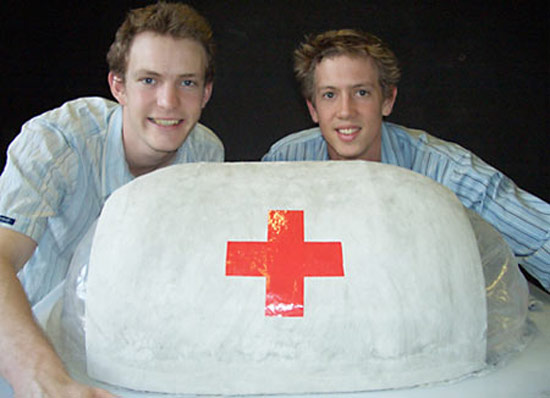
peter brewin and will crawford with a 14 1/8 th scale model of the CCO1 shelter.


14 1/8 th scale model of the CCO1 kit and standing shelter.


14 1/8 th scale of the concrete canvas pack.