festarch - contemporary architecture in cagliari, sardinia .................................................................................................................................................................................
festarch festival of architecture
contemporary architecture in cagliari, sardinia
june 29th - july 1st / september 3, 2007
http://www.festarch.it
on the italian island of sardinia, in the southern city of cagliari,
architects, artists and writers have transformed the industrial
area of an ex tobacco manufacturer into a workshop of cultural
research and urban architecture projects.
‘festarch’ is the first sardinian festival of architecture,
with master lessons, round tables, discussions and exhibitions
focused on architecture theory, planning, urban design,
transportation, ecological restoration, economic development,
resource use, ...
the festival presented four main themes: - converting un-used industrial areas;
- the blending of architecture with its surrounding environment;
- the attention to urban mobility;
- and the communicative power of architecture.
the master lessons were conducted by pritzker prize recipients:
rem koolhas, paulo mendes da rocha and jacques herzog along
with fellow architects kengo kuma, massimiliano fuksas,
philippe rahm; by landscape architect gilles clément; designer
enzo mari; by the writers hans ulrich obrist and laurence weschler
and photographers armin linke and gabriele basilico.
the festival also offered various films of sardinia’s cinematografic
history and a life concert by the musician ludovico enaudi.
urban development
the artistic director of the first edition of festarch was stefano boeri, architect and former editor-in-chief of the italian
‘domus’ architecture magazine and current editor-in-chief of
the italian ‘abitare’ magazine.
‘when an architect re-designs the structure of an un-used
industrial site, he needs to investigate the cultural climate of
the environment and feel the responsibility of giving these
spaces new life and functions, and of course it is important to
find economic resources that will fund the renovation of these
spaces’, boeri says. ‘banks, foundations, manufacturing companies
and tourism companies, which are keen to invest in this sector,
must be supported by a ‘public political guide’.
at the same time, these spaces must open-up to the surrounding
territory and must become promoters and the centre of a network
of other spaces. to prevent failure, one must not expect to do
everything in one move, but one must schedule a gradual process.’
the relationship between architecture and its surroundings
was also the central theme of kengo kuma's talk.
during festarch he presented his latest projects in cagliari.
he states that architecture must disappear within the environment’
and in the master lesson he stressed that ‘borders disappear and
so the environment and landscape merge and become one'.
‘architecture is tradition, and when it is, it is an art discipline.
unfortunately modern architects, yes, the star architects,
plan their works in not more than three months’ says designer enzo mari, ‘and such a short time explains our rococo culture
in which we currently live. most of the time those architects give
a design answer to really banal needs, those of a bank,
a supermarket, or of an automobile industry...
not to mention the need of museums which educate us to
consume art and to buy souvenirs at the museum shops.’
urban planning of the future will be characterized by chaos.
but, according to architect rem koolhaas, chaos can be
productive. social structures are never long-lasting; instead,
they quickly morph into another form. the failure of one form
of planning is recycled as an opportunity for something new.
koolhaas loves motion, both as a personal state and as a
fundamental aspect he looks for in a city. the idea of cities
turning into centers of flexible self organization does not
mean that urban planning has become superfluous.
instead, it tends to occur at a moment’s notice rather than
according to a master plan.
he talked about his vision of a hyper-mobile city of the future -
a city in constant flux that is both spontaneously self-organizing
and pretty much in chaos. koolhaas spends considerable time
traveling through cities around the world; in fact, he estimates
that he is on the road 300 days a year.
at the festarch he talked about his role as a writer, because
before he could build, rem koolhaas wrote.
now that buildings of his design are cropping up everywhere,
he continues to write. ‘in my own mind, I am as much a writer as
an architect’, he says.
massimiliano fuksas believes that italy has the most prestigious
architecture magazines and has the highest number of
architecture students, but unfortunately this is not met by an
equally elevated level of quality in architecture projects.
‘I am against nature. I don’t like nature. I like towns, but I cannot be
radical. I can do radical architecture but I am not radical’, says
fuksas. ‘less aesthetics more ethics’ was the title he chose for the
venice architectural biennale back in 2000. ‘ethics is working with
the relationship to a town, a place a family or whatever.’
his latest work ‘is molas’ in the south of sardinia, is the first
attempt in italy to build a tourist structure, which makes use of
quality architecture for holiday resorts’, he says.
‘the plastic nature of the new museum of nuragic and
contemporary art in cagliari designed by zaha hadid represents
a mark of regeneration of undisputable strength and visibility,
says stefano boeri, ‘within the landscape of the gulf of cagliari,
and with the interweaving of its sinuous built elements
expresses the desire to base the new museum on the interaction
between the exhibits (related to Nuragic and contemporary art)
and the movement of the users-visitors. it is a fertile contamination
between the past and future identity of the area and the island
of sardinia’. zaha hadid was part of the master lesson program
but at the last minute unfortunately was unable to attend.
paulo mendes da rocha considered the profession's highest
honor. he is best known for his sculpture museum in são paulo,
where he is considered the unofficial dean of the city's brutalist
movement. in six decades of work, the brazilian architect has been
creating ‘honest’ buildings - he builds with exceptional economy to
achieve an architecture of profound social engagement, an
architecture that transcends the limits of construction to dazzle
with poetic rigor and imagination. ‘we must transform nature;
fuse science, art and technology into a sublime statement of
human dignity he says’. at the festarch event mendes da rocha
presented his new campus project for the university in cagliari.
---
paulo mendes da rocha
monumentality vs. transformation
I received a specific request to create a dormitory,
a 1000 bed facility for the cagliari university.
I felt obligated to make a reflection on the spacial
characteristics of cagliari and the identity of sardinia in
the universe. I thought I have to consider its primordial
architecture and its ongoing transformation with 'naturalezza'
(in a natural way). I had to consider the city's topographic
specificity, its geomorphology, the original difficulty of human
settlements, that big repository of all the intelligence and
wisdom of architecture.
I committed myself to find a way of natural transformation,
in an even more virtuous manner.
'naturalezza' here is not intended as a landscape.
we architects allude to the phenomenology of the 'naturalezza' :
again, geomorphology, the winds, that the planet in itself is
not stabile, we include the mechanical behavior of materials,
the theories of propagation, the force of gravity...
for example, the people who have build the medieval cathedrals
have applied their knowledge of the gravitational forces;
the stone had to be cut to a desired angle and in an adequate
geometric manner to be placed one upon the other,
the same process is true for stonehenge and so on.
this kind of monumentality has been the proof of our intelligence
and our cognitive capacities through the course of human
evolution and proof of our capacity of transformation.
---
architecture is universal knowledge
I do not see myself as a brazilan architect,
a specific form of brazilian architecture does not exist.
architecture is a form of universal knowledge,
based on the experience of humankind and its history.
---
towards water
here in cagliari I tried to embed two aspects in in my project:
a 'spacial issue' and that of a 'point / counterpoint' position
to america. in america's civilization (and in more or less all
the occidental civilization and independent from the disaster
of colonization...) the development is towards water.
the direction has been from the coasts, the seaside,
towards the inland. different to cagliari, which started from
the inland, from the mountains developing towards the coast.
in cagliari, you see all these monumental buildings,
the ancient stone towers / the marvelous st. pancrazio
with the elefant...
I now synthesize the magnificent inventions that have given
new opportunities to people: as building in stone and all
this complex and difficult constructions in this specific
geo-morphological landscape,developing towards the seaside.
---
satellite images
today there is the possibility for architects and engineers to
work from maps but also by photos taken from satellites.
this does not seem to young architecture students a novel thing,
but when I was 30 or 40 and working as an architect,
there was no such opportunity for me to base my work
on. no arial views of the landscape, the cities, the buildings...
---
canals instead of roads
as you can see from the satellite image of the area
including cagliari airportthat there is already a tiny canal.
I proposed to restore the canal which goes directly to
the central train station. this is a proposal that does
not resolve the problem of pollution, but is intended to
start thinking about an alternative to automobile transport.
if the government wants to avert disaster it must stop
promoting passenger cars and instead consciously
encourage the use of public transport, because cars are
the enemy of our cities. what can be better for a city
located on the seaside than to use water transportation -
a connection from the airport directly to the city center,
to the hotels...
--- rem koolhaas
introduced his experience as writer
architecture vs. writing
one of the things that are deeply enjoyable,
and why this could work within different disciplines,
is that anybody who WRITES knows that before starting,
they decide what to write. they first have to decide the
'genre'. they have a choice, in terms what genres they
would like to write in. in architecture it is not the same.
when you start a project you start always with seriousness,
curiousness, obligation, a moral duty, ...
I don't think 'well, I have to do an office building, now I can
choose to do a frivolous office building, or a beautiful office
building, or a wild office building'.
the kind of routine and the permanent seriousness of
architecture is a very heavy burden and I think involvement
in literature has simply enabled me to assume different
identities. the art is, of course, that anybody with a literate
background can see that and will notice if I write in the
junk space. they will also see that I am a totally different
person, intentionally, than if I write something about singapore.
in architecture this 'genre game' does not exist.
people think that the architect one day is like this and
another day like that and they might not recognize his work
anymore. so they think he has changed. they do not
understand that it is simply an exercise of freedom and
also a kind of randomness in order to be as explicit as possible,
as powerful as possible - to get a message across with
maximum impact.
---
very few architects write these days ...
I think that fewer and fewer architects write these days,
but why? my theory is that there is a sort of triangle gap
between the clients, the critics and the architects.
also now there is such a thing as a ‘star architect’.
both implies that the whole field of architecture today can
be simply reduced to ‘shape-icon-and-landmark’.
this has been a huge liberation for most architects,
it seems they no longer have to deal with any other
issue than shape...
so, there is no architecture speech anymore,
no architecture writing, no architecture program,
no architecture nothing!
today architects make simply ‘shapes’, they ‘sculpt’,
and think everyone will live happily ever-after.
it will be interesting for us to break-through that.
festarch logo
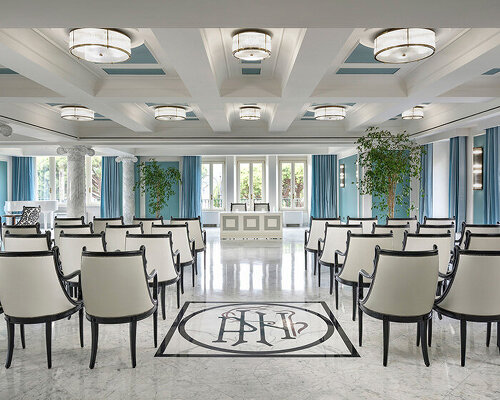
the venue - the disused ‘manifattura di tabacchi’ in cagliari, italy
a sketch of the urban development of the city of cagliari by paulo mendes da rocha.
since ancient times of the punic domination it has been from the inside towards the sea.
the white elements are are mendes da rocha’s architecture project of the campus
the dormitories adjoint the two pears
on the roof there will be a terrace, on the second floor the cafeteria and on the
first floor the dorms with a scenic view.
a sketch of the volume of the dormitory, developing outwards, towards the sea