anirudha rao: kranium effective cycling protection
'kranium' looks at creating a lightweight outdoor sports activity helmet that will change the market through improved safety, recyclability and overall design. it absorbs four times the amount of impact energy when compared to regular polystyrene cycling helmets.
‘kranium’ image © designboom
recent industrial design RCA graduate anirudha rao has developed ‘kranium’, a solution for effective cycling protection, exhibited during london design week 2010 at designersblock.
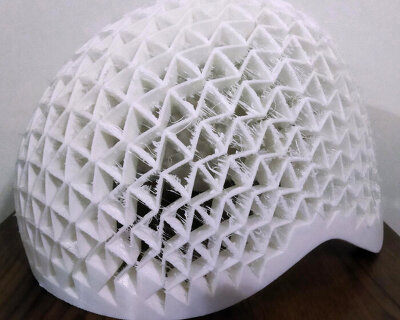
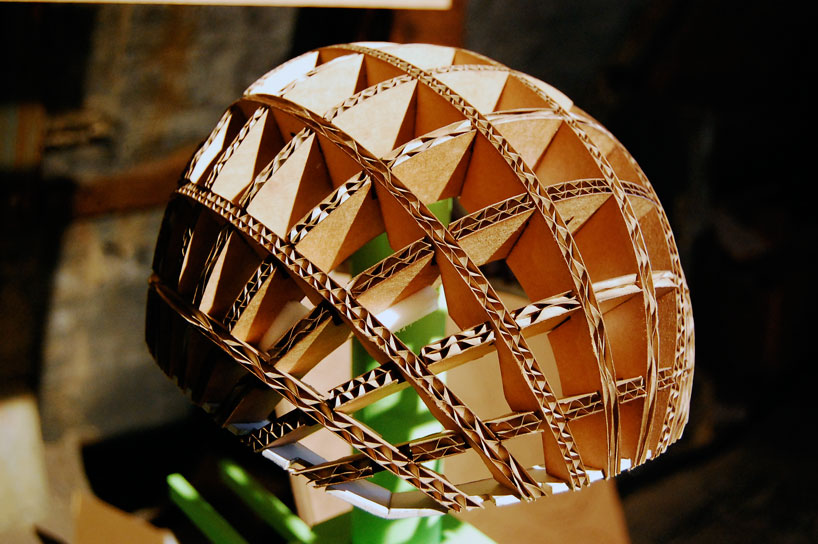
 ‘kranium’ structure image © designboom
through his research, rao found that expanded polystyrene has been used to create bike helmets for the last few decades, and there has been little in terms of safety over the years. on average, helmets protect your head only 16 percent of the time during a crash, giving us the false implication of safety. polystyrene does little to absorb impact energy. instead it distributes it over the head. typically in helmet design, more emphasis is given to styling and aerodynamics. however, while cycling through a busy city an average speed of 12 mph, safety definitely becomes more important than aerodynamics. so, rao asked himself, ‘why is this unsustainable, non-recyclable material, largely focused on aesthetics being pushed into our lives to promote safety?‘
 image © designboom
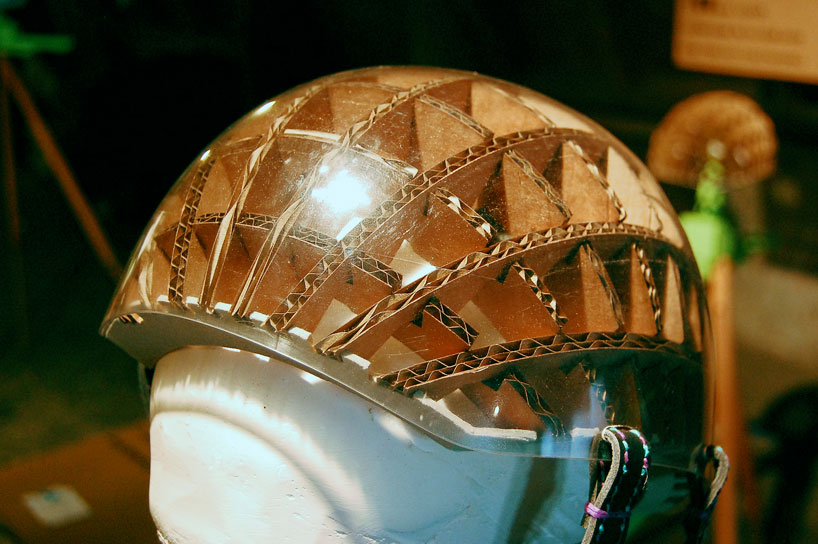
‘kranium’ is his solution. it looks at creating a lightweight outdoor sports activity helmet that will change the market through improved safety, recyclability and overall design – its structure has been developed to absorb impact energy. the ribs have been designed to accommodate movement in some places, however remaining perfectly rigid in other areas. during a crash, the force peak of the impact is absorbed by the ribs tending to flex and de-flex. the remaining amount of energy is then absorbed by the crumpling nature of the corrugated ribs. when tested against british (EN 1078) standards at the imperial college, it was calculated that ‘kranium’ absorbs four times the amount of impact energy when compared to regular cycling helmets. this means that during a crash, lesser amounts of energy go into your head, making it a safer option than those already on the market.

it has also been concluded that ‘kranium’ lasts more than one impact. during the testing phase, the same helmet was tested five consecutive times, still proving to pass the standard. however, polystyrene helmets were rendered useless after a single impact.
 ‘kranium’ with a clear shell image © designboom
another issue that came up during rao’s research was that polystyrene helmets today, never properly fit the user’s head. additional straps and levers are provided to grip the head, but they never tend to provide a perfect fit, hence when a crash occurs, the helmet slides out of its position upon impact and does very little to protect the user’s head. due to the structural nature of ‘kranium’, bespoke custom made helmets can be manufactured by scanning one’s head. through generated coordinates, templates can then be produced and assembled together, making it a completely customizable piece of head protection, where every single element such as shape, fit, color etc., can be tailored to the user. the individual’s head would be scanned and a file would remain in a system, so that upon damaging the helmet, a brand new one could be could be reproduced for a fraction of the price. this encourages one to change the helmet when it needs to be changed without spending an exorbitant amount of money.
 ‘kranium’ structure with clear shell (profile) image © designboom
‘kranium’ is lighter and its custom sizing makes it more comfortable, bringing together form and function in a cost-effective product made from eco-friendly materials. it also has the potential to play a part in the future of bike rentals, which are becoming more eminent in cities world wide. a cheap helmet, which can be dispensed through a vending machine, could be the answer for the future of bike rental safety.
 up close image © designboom
 ‘kranium’ with black shell image © designboom
 ‘kranium’ with black shell (side view) image © designboom
 ‘kranium’ with blue and red shell image © designboom
 ‘kranium’ with blue and red shell (side view) image © designboom
 ‘kranium’ with white shell image © designboom
 up close of front image © designboom
 inside view of the ‘kranium’ helmet image © designboom
 designer anirudha rao portrait © designboom
 ‘kranium’ display at designersblock 2010 image © designboom
 rao showing designboom some material samples image © designboom
 more material experimentation image © designboom
 ‘kranium’ can be custom made to fit each person’s head through a digital scan, and can be easily assembled through a slotting system image © designboom