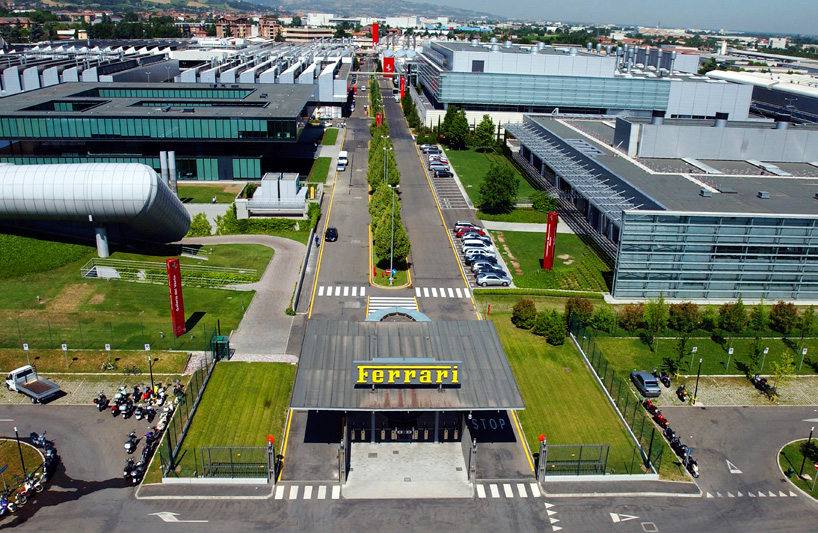
founded in 1929 as a racecar sponsor and manufacturer, ferrari has been producing hand-finished road vehicles since 1947. the ferrari factory was designed by french architect jean nouvel and modernized beginning in 1997 by company president luca di montezemolo. all ferraris in the world continue to be produced exclusively on the maranello campus, where every ferrari is produced custom to order, and all installations are performed by hand. as a result, the company produces approximately 10 to 12 cars a day.
designboom visited the ferrari factories and is excited to bring you a three-part behind-the-scenes look at the vehicles’ production. this article looks at the ‘nuova meccanica’ (‘mechanical workshop’) building, where engine components are produced.
the ‘nuova meccanica’ (‘mechanical workshop’) is the site of construction for the machining and finishing of headshafts, cranks, and other engine parts. designed by marco visconti, the 15,000 square-meter building was opened in 2001 and contains 15 work areas and about 100 different machines. all conditions in the building are carefully regulated, including the temperature and humidity levels during winter and summer respectively, as well as the maximum noise level, which thanks to efficient soundproofing never exceeds 73 decibels.
ferrari vehicles are assembled and completed by hand, but in recent years the company has integrated automation and robotics into certain elements of the production process. at the ‘nuova meccanica’, robots work in conjunction with one another and with human technicians to produce parts, temper cylinder heads (with liquid nitrogen), and complete other machining. once all engine parts are produced and refined, they travel to the nearby engine assembly facility before ultimately moving on to the ‘new assembly line‘ to be installed into a custom vehicle.
 floor map of the ‘nuova meccanica’ (‘mechanical workshop’)
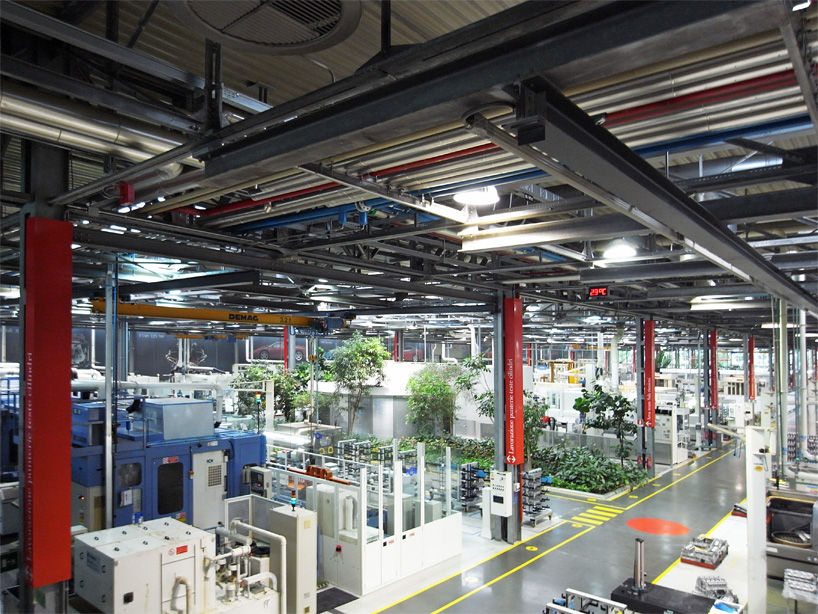 the entrance opens onto a second-floor balcony, offering a view of the factory floorimage © designboom
 automated robots temper cylinder headsimage © designboom
automated robots at the ferrari factoryvideo © designboom
 greenspaces both indoors and out temper the metal and machinery of theplant, as part of the ‘formula uomo’ initiative for employee health andcontentmentimage courtesy ferrari
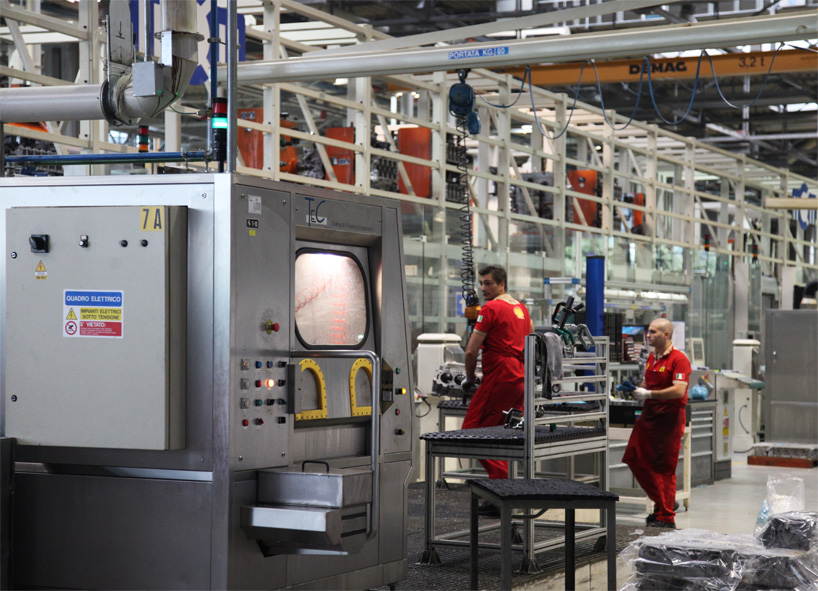 a sanitation station runs (front left) while technicians work in the distanceimage © designboom
 image © designboom
 image © designboom
 testing of componentsimage © designboom
 stacked cylinder headsimage © designboom
 gardens surround the building, and trees along the floor’s center offset the technology and high industry of the factoryimage © designboom
 engine production machines work behind closed wallsimage © designboom
 cylinder headsimage © designboom
 a finished engineimage © designboom
 ‘166 inter vignale’ (1948) in the show area of of the workshopimage © designboom
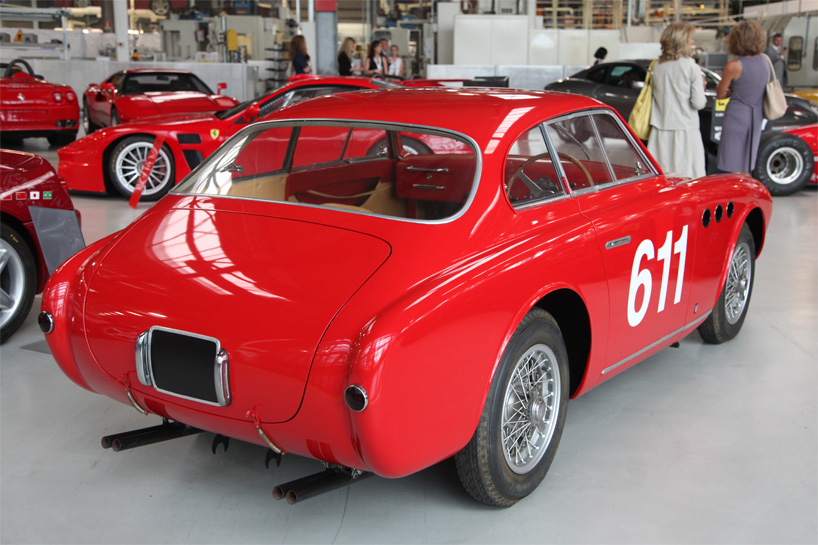 ‘166 inter vignale’ (1948)image © designboom
 technology like the trigeneration plant evaporative cooler circuit, pictured above in another building on the ferrari campus, are among the ecologically sustainable initiativesferrari has undertaken in recent years – this machine simultaneously produces power, heat, and cooling, reducing carbon emissions by about 40%image courtesy ferrari
 view leaving the buildingimage © designboom
coming next: designboom’s feature on the ferrari design process.did you miss our first feature? read about the ‘new assembly line‘ facilities here!
AUTOMOTIVE CURIOSITY (295)
 Oct 19, 2023
 Sep 08, 2023
 Sep 06, 2023
 Sep 05, 2023
FACTORY VISITS (28)
 Nov 03, 2023
 Feb 23, 2021
 Nov 25, 2019
 Nov 10, 2018
 Jul 09, 2018
FERRARI (68)
 Mar 15, 2024
 Oct 10, 2023
 Aug 22, 2023
 Jun 30, 2023
 May 30, 2023
PRODUCT LIBRARY
 Apr 17, 2024
 Apr 15, 2024
 Apr 15, 2024
 Apr 12, 2024