first image
'mine kafon' by massoud hassani
image © massoud hassani
afghan product designer massoud hassani grew up in a war-torn kabul, on the edge of the desert. as a child, he and his friends used the constant
wind and relatively flat terrain to race homemade wind-powered toys across the rocky terrain. after the military occupation however, soldiers left
thousands of landmines hidden just under the topsoil, posing a deadly threat to the innocent inhabitants of the area. now, many years later,
massoud revisits the still-present mine situation that has by now claimed the lives of many citizens. using his experiences as a kid, he reinterprets his
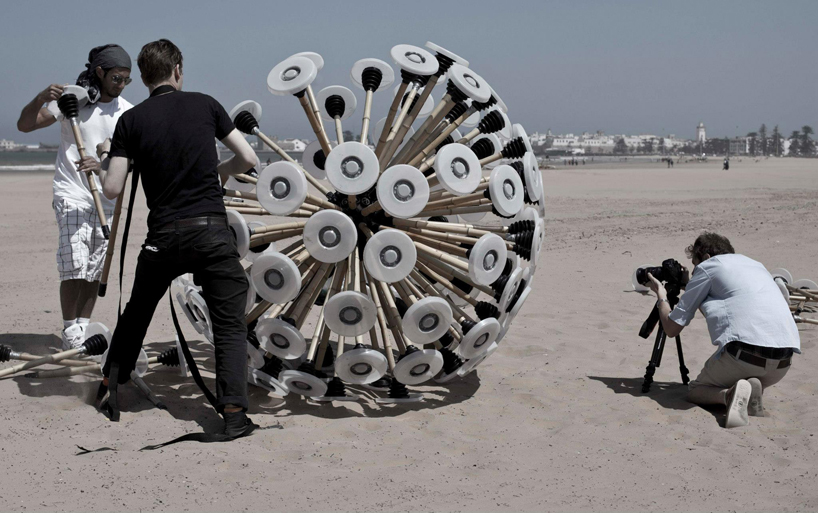
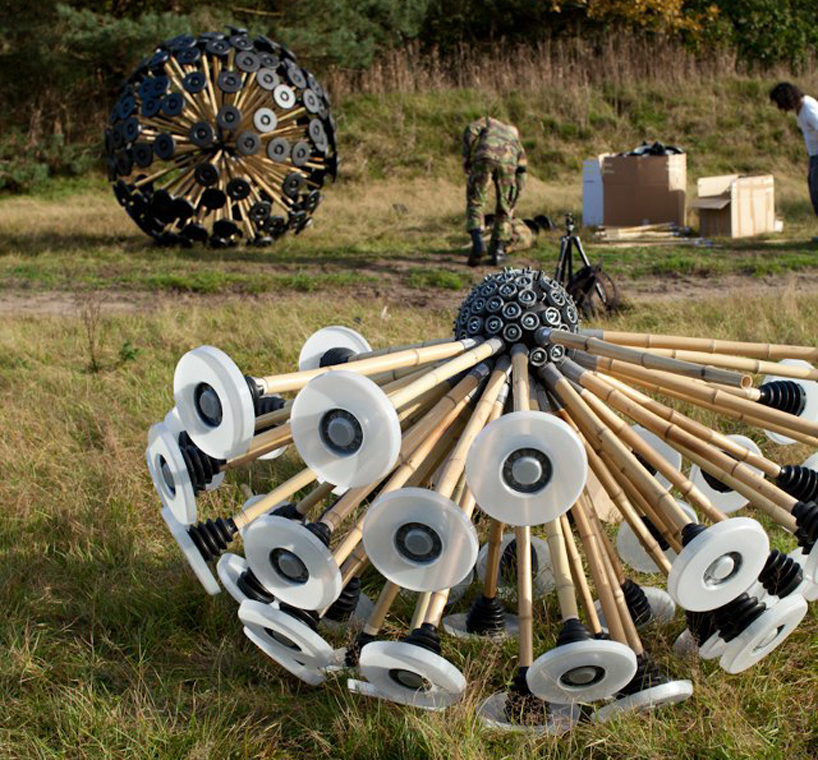
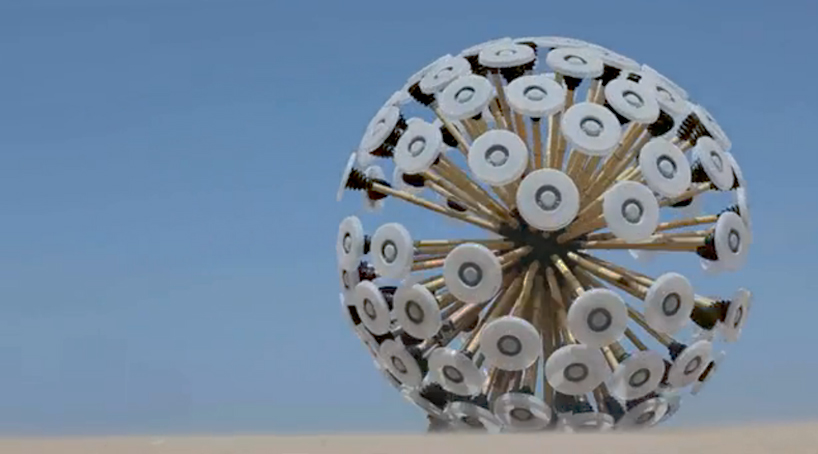
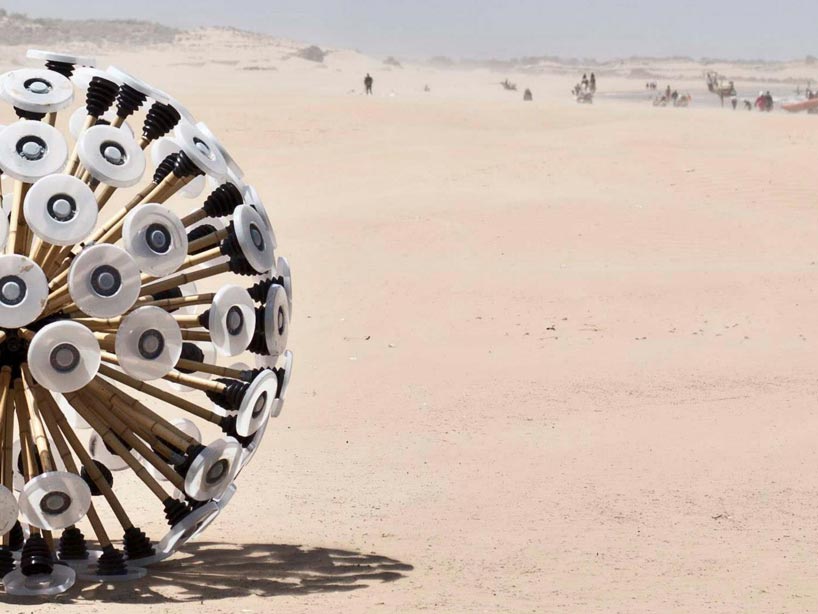
old toys into full scale working wind machines that cost 40 euros. like a sphere made of long bamboo plungers with plastic caps, the 'mine kafon' can
be rolled across the landscape without human assistance and with its many legs and adequate weight detonates forgotten landmines. as each limb is
modular and cheaply reproduced and replaced, the construct can be used time and time again at a low cost. an embedded GPS chip will transmit the
locations of cleared areas, creating a map of safe zones and saving countless lives in war-devastated regions as it combs over the ground disarming
dangerous explosives.
the project is currently seeking funding via kickstarter, with the campaign ending on january 17th, 2013;
and will become part of the MoMA collection and exhibited at the museum in march.
introductory video
video © ardent film trust

setting-up one of the detonators
image © massoud hassani

de-miner assembly
image © massoud hassani

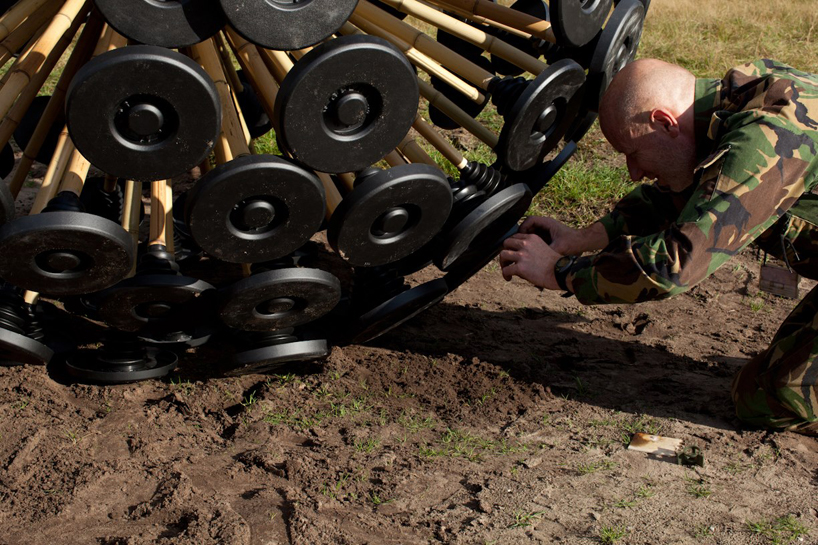
the numerous legs and plates provide support in any direction
image © massoud hassani

view form the core
image © ardent film trust

after having detonated a mine, a leg is blown off
image © ardent film trust

mine detonation
image © massoud hassani

first working prototype
image © massoud hassani

assembly: bamboo legs screw into the round core
image © ardent film trust

prototype
image © massoud hassani

miniature model
image © massoud hassani

model/toy renditions
image © massoud hassani

concept render
image © massoud hassani
Worst design ever for clearing mines.
Wind power? Really? considering you want to simulate the weight of a human for triggering the mines, you need at least 100 pounds, and where are you going to find strong enough winds to blow and move 100 pounds.
Also, each cap/pedal is a foot across, which means it can only clear a 1 foot wide strip of land at any one pass….very slow progress.
let’s not even get into how random that path is depend on the wind. and how you can assure that every swath of the mine field is checked…
Got to say its better than seeing another bicycle light on Kickstarter looking for backers…
Product design at its best! It isn’t the fancy chair and accessories that will solve the world’s problems, it’s ideas like this!
@Mzungu
Do you realize that the wind of the Afghanistan desert it has more then enough power to drive an object like that even if he has a weight of 120 pounds? And yeah, the path is very random (considering that I don’t know if the desert wild hasn’t a pattern of dominant winds) but that’s why you will have to use several. Not the final solutions, that’s for sure, but way better then octopus shaped chair or skull full of diamonds in what comes to resolving the problems of the world.
Definitely not anyone who has any real experience with landmines. Good to see you actually watched the video before leaving your comment.
@Mzungu
So I guess the evolution of this brilliant piece ‘could’ be towards the cylinder, increasing the footprint and its potential for clearance. Perhaps anchoring the piece so the wind drives it on an arc/radius. It is a brilliant solution that is ‘dovetailed’ beautifully to its context
Dear Mzungu, if you had watched the video you would have learned that the intention of this design, is to provide the local people a cheap(er) way to survey the danger in their immediate surroundings.
can you imagine being born and raised in a place like that? all you know, is what other people tell you, and those things probably resultet in loss of limbs or life..
with this tool that they created, it raises the awareness of the danger, and possibly could turn to clearing of these fields.
i wonder from what point of view you are standing at..
I made the comment from the point of how effectiveness of this design. If this is merely an exercise to raise awareness, then the time and money can be better spend elsewhere.
The designer may be thinking of designing for the open desert where these things rolls in the wind, but in reality mines are strategically placed, place where people travel, or lived. and most people live near wood lands near streams, rivers, and fields. Places where there are bushes and tress and things that block these thing from working.
With each ball can only cover a swath of land 1 feet across, you’ll need 5,280 of these just for 1 square mile, is that really going to be a cheap solution for the locals?
With all the possible gaps of coverage that this device creates, do you really want to create that false sense of security for the locals?
You can not technically call this a mine detecting/sweeping device since you can not be sure the area in which this device has been used is clear of mines. I can not see how you can make 100% sure that the path/area the device has covered is free of mines. There is no guarantee this will find all (if any) mines.
How can you use this device to clear a certain area? How do you control the movements of the device in that area (to send it where YOU want it to go)? Other problems could be the availability of wind, existence of obstacles, uphill and downhill terrains….
This will probably travel in a path imposed by wind (=random) and will not clear the area/path you want it too.
This is a good project for an engineering student but as it stands it will not solve the problem it is made for. I personally would not dare step in an area where this device has supposedly cleared of mines. In the mine clearing business 99% is not good enough, it has to be 100%
All the best to the designer and I hope they can develop this further in order to make it workable.
Mzungu is correct in saying that this device would not be the most effective approach. See this simulation and analysis of the efficiency of the Kafons. http://www.statisticsblog.com/2013/01/simulation-of-landmine-clearing-with-massoud-hassanis-mine-kafon/