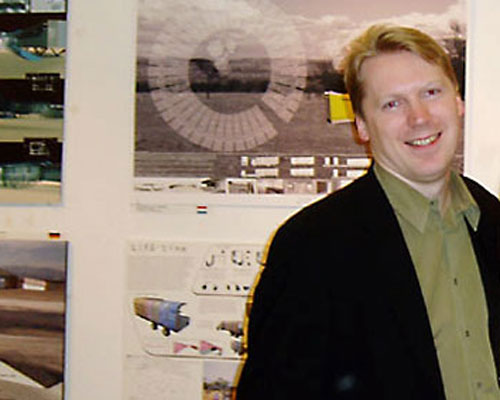
cameron sinclair is co-founder of architecture for humanity, a charitable organization which promotes architecture and design solutions to humanitarian crises .................
cameron sinclair
was born 1973, in london, uk.
sinclair was trained as an architect at the university of
westminster and at the bartlett school of architecture
in london.
during his studies, he developed an interest in social,
cultural and humanitarian design. his postgraduate thesis
focused on providing shelter to new york's homeless
population through sustainable, transitional housing.
after completing his studies, he moved to new york
where he has worked as a designer and project architect.
from 1996 to 2002, sinclair has worked on projects in
more than 20 countries including england, mexico, russia,
south africa and the united states.
this work included on the GUM department store in moscow;
the restoration of the brancusi sculptural complex and
30-year rejuvenation plan for the town of tirgu jiu, romania;
a health center for UNITE (union of needletrades, industrial and
textile employees); the award-winning school of the international
center of photography in manhattan and he was a key
member in the disaster recovery team for lehman brothers
after terrorist attacks destroyed their offices in the
world trade center on september 11, 2001.
he is a regular guest critic and lecturer at schools and
colleges in the united states and abroad.
he has spoken at a number of conferences including
the fortune brainstorm conference, the UIA world congress
on architecture, the international design conference in
aspen and the art center design conference in pasadena,
california. he has contributed to a number of exhibitions
dealing with social justice and design.
cameron sinclair
is co-founder and executive director
of architecture for humanity,
a six year old charitable organization which promotes
architecture and design solutions to humanitarian crises
and provides design services to communities in need. http://www.architectureforhumanity.org
-----------------------------------------------------------------------------
designboom interviewed cameron sinclair on january 12, 2006.
----------------------------------------------------
--- what is the best moment of the day?
usually get up early in the morning to have an hour
to myself and have a coffee and catch up on news
and email. however I wouldn’t pinpoint a specific time,
this sort of work involves hours and hours of struggle
interrupted by moments of sheer joy.
what kind of music do you listen to at the moment?
I’ve been listening to afro reggae (after seeing favela rising),
the north mississippi allstars and a bunch of mash up artists
from boston and san francisco.
do you listen to the radio?
mainly online or through podcasts.
KCRW in los angeles has the best architecture podcast
called design and architecture.
what books do you have on your bedside table?
I’ve spent the couple of years on the road so I usually have
a couple in my carry-on luggage no room for monographs.
we just finished compiling a book on the history or humanitarian
design called ‘design like you give a damn’:
architectural responses to humanitarian crises.
so I’ve been reading a lot of non-fiction, especially about
urban issues in post-disaster situations.
most recently I have read
‘shadow cities: a billion squatters, a new urban world’
by robert neuwirth and
‘disasters and development’ by fred cuny.
do you read design magazines?
often though usually online. I have found that a lot of print
media can get formulaic and the same names appear over
and over. in the online world younger designers get to
have a platform to show their work. core 77, designboom
or archinect are good online resources
where do you get news from? newspapers?
again online.
I usually read the same story from different sources
the usual suspects like BBC and CNN but also blogs like
worldchanging.com and treehugger.com .
there is so much bias in the media at the moment you need
to read the same story from a couple of places to get
a sense of what is really going on.
do you notice how women are dressing?
do you have any preferences?
naturally. I was in denmark last year and really impressed
by the way they dress. it seemed to be well cut and
sophisticated but casual at the same time.
however I have to admit I’m more of a sucker for how
a woman thinks rather than the way she dresses.
are there any clothes you would avoid wearing?
living in montana where it can get to be 26c and then traveling
to areas in africa or india where it can be 45C you don’t
really get a choice.
do you have any pets?
no but on almost every project a stray shows up
the last one was named after me as it would sit around
the job site and get in the way.
when you were a child, did you want to be an architect?
no I actually wanted to be a war photographer or get into
politics. in my late teens I became fascinated the effects
bad architecture has on society and how we can create
better public spaces.
why did you start 'architecture for humanity'?
ever since I was interested in design almost every designer
and architect I spoke with want to get involved in responding
to humanitarian issues. as a profession our role is to improve
the built environment but we seem to serve the needs of the
very few. well thought out and innovative design should not
be tied directly to cost and we have an amazing opportunity
to improve the the built environment for everyone.
we began architecture for humanity thinking that there were
a number of designers who thought alike and did not have a
platform to do this work. we began as a response to the
housing needs of returning refugees in post-conflict kosovo
from which a number of housing prototypes were built.
in the years to follow we were stunned to find out that
thousands of designers around the world who join us in
participating in design competitions, local projects or responding
to natural disasters.
can you describe an evolution of the organization,
from first projects to the present day?
it has been a long road.
initially we sought to advocate good design, then as we
grew we instigated a number of projects, like the mobile
HIV/AIDS clinic project, and most recently we are implementing
project in the field. every one of these projects are a pilot to
show the world that is architecture can not only be cost
effective but innovative at the same time.
organizationally we are still just a handful off fulltime people
recently we grew from two to three.
however we have thousands of locally based volunteers
working in cities around the world.
our strongest local chapters have grown in boston,
london, new york and minneapolis.
where do you work?
in a plane, in a hotel, on the floor of a strangers home
wherever I can find wireless access.
you say - architecture and design can improve lives -
do you discuss this with other designers / architects?
all the time. I’m sure I sound like a broken record but I really
feel that good, innovative and thoughtful design can make a
world of difference. architects can play two roles in society
either create buildings that affect a community for the better
or for the worse. given the choice I think as an industry
we strive to improve life whether it be a single family or an
entire village. sadly the design media tends to focus it’s
attention on the dozen or so ‘stararchitects’ and in doing so
strengthening the general publics view that design is only
for the whims of the rich. as a result most recently I’ve spent
most of my time speaking to non-architects such as business
and political leaders who are the real decision-makers,
K-12 schools and other forms of media such as radio
or television.
how do you encourage the design profession to respond
to the 98% of the world that usually do not benefit from
the architectural and design services ?
by showing that it can be done.
the average cost of one of our community buildings is between
$5,000 - $15,000. I am not asking for designers to give up
designing for corporate entities, governments or wealthy clients.
if anything I want them to continue to do that but by donating
1% of their time to help those who could benefit from their
expertise and wisdom we can make a world of difference.
how does this process work in terms of identifying a
need and agreeing on a viable design solution?
it is done locally. while many of the issues we tackle are global,
specific needs can only be addressed with the community you
are serving. we partner with a number of local groups and
usually have an on-site designer that works and lives alongside
communities where we are building.
you learn a lot more in day to day conversation than any presentation
meeting can offer. most of the time we are asked to help and
we never go into a town or village and impose a design solution
it is borne out of the partnership between designer and community.
how do you fund the 'architecture for humanity' projects?
we rely on a vast range of donors from small companies,
individuals and even school children selling hot chocolate
(they were one of our largest fundraisers in 2005).
additionally I donate all my speaking honorariums and any
money given from prizes. designers give their time on a pro-bono
basis and we provide a stipend for living costs and hard costs
(filing fees, material costs and travel).
what project has given you the most satisfaction?
without a doubt it has to be siyathemba.
not only is it about tackling the systemic issue of HIV/AIDS but it is
about womens empowerment, encouraging locally based initiatives
and integrating local skills and technology.
the field will be a FIFA regulation pitch and, as it is less than 3
hours from durban, we are hoping that it will available as a training
camp for a national team before the 2010 world cup.
are there any designers / architects from the past
you appreciate a lot?
hundreds.
from visionaries and dreamers like buckminster fuller and
peter cook to pragmatic realists such as fred cuny as well as
non western architects such as geoffrey bawa and hassan fathy.
what current designers / architects do you appreciate?
most of the ones I really respect by never make the covers
of magazines. designers like sergio palleroni, sandra d’Urzo,
diebedo francis kere, nathaniel corum and steve kinsler
as well as relief workers like chuck setchell (USAID)
and rick hill (CHF). I would also like to note groups like the
aga khan development network and ITDG for pursuing
innovative ideas both architecturally and environmentally.
any advice for the young?
people will call you stubborn until they truly understand your
intentions, then they call you visionary.
you should take disappointment and lack of support as a
challenge it will make your success that much more rewarding.
what are you afraid of regarding the future?
I truly believe the creative world will become the future leaders.
despite the global boom in population and serious issues that
will need to be addressed by architects I am excited by the
challenges and opportunities the future will bring.
in the spring of 2006 metropolis books and thames and hudson will be
co-publishing ‘design like you give a damn : architectural responses to
humanitarian crises’, co-authored by cameron sinclair and kate stohr
grenada : responding to hurricane emily, 2005.
these white units, known as ‘global village shelters, are designed by
daniel and mia ferrara of ferrera design and are made from recycled
corrugated cardboard impregnated to be fire retardant and laminated
for water resistance.
siyathemba youth football pitch, winning entry by swee hong ng, 2005.
the field will be a FIFA regulation pitch and, as it is less than 3
hours from durban, hopefully it will be available as a training
camp for the national team before the 2010 world cup.
the first prototype of the tsunami safe(r) house has been completed in
september 2005 in balapitiya in sri lanka.
TDI - tsunami design initiative is a student initiative at harvard design school
that was set up in response to the rebuilding efforts in the south asian coast
after the tsunami in december 2004.in march 2005,
TDI won the tsunami challenge competition.
architecture for humanity have provided funding.
design competition : mobile HIV/AIDS health clinic for africa, 2002-2006
finalists - KHRAS architects, virum, denmark
design competition : transitional housing for returning refugees: kosovo
1999-2000. among the finalists basak + mark altan schrimer