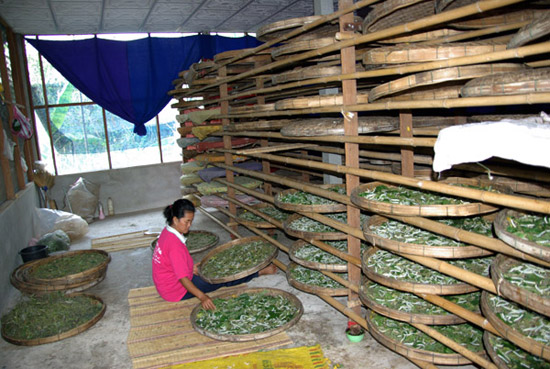
silkworms are really not worms at all. silk worms are the larvae of ‘bombyx mori’ moths and silkworms are actually domesticated insects. native to china, the silkworm does not longer exist in the wild, after so many centuries of inbreeding the silkworm is incapable of flight, mates quickly after emerging from its crysalis, and dies a day or so after laying its eggs.
designboom illustrates the several stages of sericulture, which begins with hatching silkworm eggs …
image © designboom
at the beginning every few days, the worms need to be moved to a clean tray with fresh food. members of the farmer’s household must spend a growing amount of time to their bamboo trays, also because silkworms produce quite a lot of excrement and cleaning the trays is not a job for the weak-stomached. they continue feeding and moving the silkworms, dividing the colonies when the silkworms are too large or hungry for the numbers in that tray. by the fourth week, the largest of the silkworms will be more than 5 cm. long, fat, and hungry enough that they need to be fed every day.
an easy test confirms their readiness to cocooning. the farmer picks them up and looks between their rear pair of legs, from the underside. if there is a gray mass there, the caterpillar isn’t quite ready, but if it’s milky and translucent, the silkworm has pooped its last and is definitely ready. the worms suddenly stop eating and raise their heads – another sign that they are ready for the all-important job of spinning cocoons.
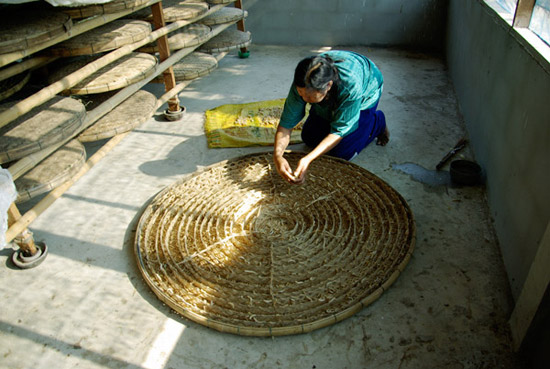 image © designboom
the ‘bombyx mori’ worms are now inserted in a specially woven circular bamboo scaffolding, which will make the cocoons more uniform in shape and easier to collect.
each silkworm now doubles itself up on its back, and by contracting secretes, from an opening under its mouth, a steady stream of liquid silk, coated with sericin, which hardens on exposure to air. they’re starting to lay out the support strands for their cocoons, although they may not yet be serious about cocooning.
at that stage they are removed from their feeding trays.
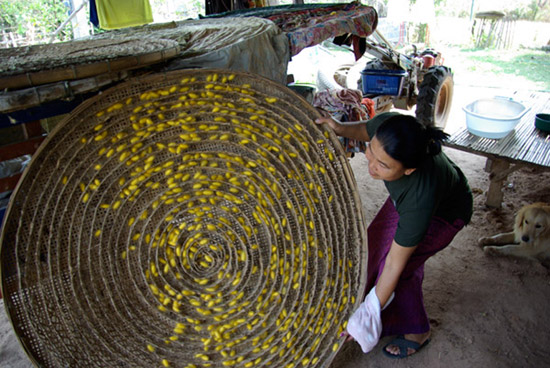 image © designboom
some of the larger caterpillars are climbing the walls of the tray (they’ve done this before, to shed their skins, but this time their heads are pointing toward the lid) and the busy silkworms are guided by figure of eight movements of their heads, to dispose the liquid silk in layers, forming the cocoon. after some 36 hours, the worms are sealed within a yellow cocoon, embarked on the process of metamorphosing into a moth.
silk (9)
 Jan 25, 2012
 Mar 27, 2011
 Dec 02, 2010
 Mar 14, 2008 Mar 14, 2008
 Sep 17, 2026
 Sep 15, 2026
 Sep 14, 2026