tensegrity and geodesic domes. a tensegrity dome structure is a form in which the tensile and compressive members do not touch each other ..........

......................... shop .................. competitions .............. education ................ interviews ................... snapshots ................... history .......... contemporary


tensegrity and geodesic domes


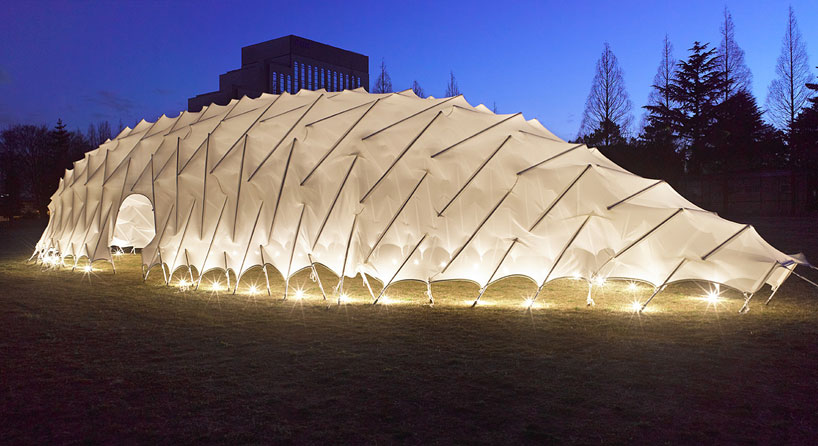
a tensegrity dome structure
is a complex form in which the tensile and compressive members
do not touch each other.
it was buckminster fuller's claim that structures based on
tensegrity technology could be used to build domes which
could provide environmental control for entire cities.

---
a geodesic dome structure
is a type of structure shaped like a piece of a sphere or a ball.
this structure is comprised of a complex network of triangles
that form a roughly spherical surface.
the more complex the network of triangles, the more closely the
dome approximates the shape of a true sphere.
the weight of these structures is distributed evenly throughout
the series of triangles in the structure. they enclose the most
amount of space with the least amount of material.
since they have less area to lose heat from, they're also very
energy-efficient.
buckminster fuller invented the geodesic dome in the late 1940s
to demonstrate some ideas about housing and energetic-synergetic
geometry' which he had developed during WWII.
this invention built on his two decade old quest to improve the
housing of humanity. it represents a brilliant demonstration of his
synergetics principles; and in the right circumstances it could
solve some of the pressing housing problems of today
(this housing crisis fuller predicted back in 1927).

---
shelter systems' patented geotensict™ structures
use both tensegrity and geodesic design principles.
the advantages of geotensictm structures are high strength-to-weight
ratio and simplicity that that is gained when tensegrity and
geodesic construction are combined.
shelter systems structures are tensegrity structures because
the poles are not attached to each other except by the tension
of the covering (ie, the poles would not stand without the covering).
they are geodesic structures because the poles follow the
shortest line on a sphere. geotensictm structures make possible
the greatest strength to weight possible in a self supporting shelter.

---
shelter systems
bob gillis, owner of shelter systems and inventor of the grip clip
tarp and tent fastener, has a long history of design in the tent
industry, licensing tents to the north face, sierra designs,
mountain hardware, marmot, and others.
almost all of the backpacking tents using flexed poles that
you see on the market are covered by bob gillis' patents.
he has been granted 18 U.S. patents, from structural concepts to
the molded clips used in the construction of shelter systems' dome,
yurt, tent and greenhouse structures.
shelter systems has consulted on many shelter and structure
design projects: everest base camp, emergency relief shelter,
folding shelter designed for the army, F22 tent.
http://www.shelter-systems.com

---

make your own tensegrity model
http://www.shelter-systems.com/tensegrity-model-making.html


---

how to draft a geodesic dome
by spencer hunter
http://www.uni.edu/darrow/new/geodesic/drawings/draft.html


---

what kind of applications for this technology would be suitable?
an abstract on technology for designing tensegrity domes and spheres
by robert burkhardt

superstructures for embedded substructures allowing the
substructures to escape terrestrial confines where this is
useful (e.g. in congested or dangerous areas, urban areas,
flood plains or irregular, delicate or rugged terrains).
-
economic large-scale protection of storage, archaeological,
agricultural, construction or other sites.
-
refugee or hiking shelters.
-
frames over cities for environmental control, energy transformation
and food production.
-
large-scale electrical or electromagnetic shielding.
-
exclusion or containment of flying animals or other objects.
-
spherical superstructures for space stations.
-
earthquake-resistant applications.
these structures are extremely resilient and testing would very likely
show they could withstand large structural shocks like earthquakes.
thus, they would likely be desirable in areas where earthquakes are
a problem. a pneumatic structure (fuller has characterized tensegrities
as pneumatic structures) performed very well during recent earthquakes
in japan.
-
low-environmental-impact shells for musical performances.
-
indoor/outdoor pavilions for trade shows etc.
-
supports to hold sunscreen protection for vulnerable amphibians.
-
watersheds to keep rain water from percolating through contaminated
soils into groundwater, perhaps temporarily during in-situ remediation.
-
frames for hanging plants or other objects to dry.
-
pergola, trellis, or topiary framework.
-
micro-meteorite protection, sun-shielding for martian colonies.


---
more about tensegrity solutions
http://www.channel1.com/users/bobwb/prospect/prospect.htm

---


-------
monthly designboom newsletter
-------


-------
? comments and contact us ?
-------


a portable yurt dome next to a real mongolian yurt.
they are quite similar to the mongolian yurts.
both have a domed roof section over top of walls and
the covering sections are shingled over each other.


domes have been to everest base camp many
times over the years.


dome with extra strong translucent skylight windows
instead of the clear vinyl windows


'yurt domes come complete with stakes, guy lines,
vent tubes, spare parts and instruction manuals that
detail floors, site selection, anchoring, cooling,
winterizing, and stove installation...


how to divide the yurt dome into rooms -
the double-layer type where an outer and an inner
layer of tendons are inter-connected


portable greenhouses


shelter system's domes were used in a star trek episode


the first oval intention by robert gillis, later to be made by
the north face. this structure started the geodesic backpacking
tent revolution


lineup of earlier shelter systems tents


origami model