|
origin of the the wire coat hanger .......................................................................................................................................................................................
|
|||
|
|
|||
......................... shop .................. competitions .............. education ................ interviews ................... snapshots ................... history .......... contemporary origin of the the wire coat hanger |
|||
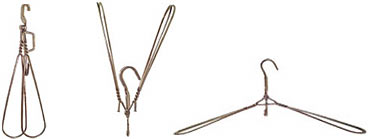
the invention of the wire coat hanger is attributed to albert j parkhouse in 1903. albert worked for a company in jackson named timberlake & sons. john b. timberlake had managed to collect several dozen enterprising inventor-type employees such as albert, who made wire novelties, lampshades, and other ubiquitous devices for their customer clients. --- in response to co-workers complaints of too few coat hooks, and in a burst of inventive inspiration, albert j parkhouse bent a piece of wire into two ovals with the ends twisted together to form a hook. then he grabbed some wire and twisted it around so that it fit inside the shoulders of his coat. he bent another wire to curl in the center, allowed him to hang the coat practically anywhere he wanted. he continued to refine the idea over the next few weeks and soon, all the other employees started using copies provided by albert. --- parkhouse patented his invention, but it is not known if he profited from it. timberlake's lawyer, charles l. patterson applied for the patent on january 25, 1904, and U.S. patent # 822,981 was granted and assigned to john b. timberlake. (patterson put his own name on the line that asked for 'name of inventor.') a second patent, 877,726, was granted to timberlake's son in 1907, for a more elaborate hanger which he termed a 'shirt drier.' --- between 1900 and 1906, over 189 different patents were granted on different versions of 'garment-hangers' worldwide. steel wire has been used to shape the hanging garments, sometimes combined with wood, fabric, or sheet metal, for better or for worse, the functions changing with the requirements of every era's clothing styles. let's here examine some of the beautiful shapes and forms. --- victorian women's skirts and bustles received great care by hanger inventors and manufacturers, with adjustable hangers often using spring systems to hold the waistbands and allow the skirts to retain pleats and folds. these hangers often took the shape of flying birds and are referred to as eagle wing hangers. --- moving further into the twentieth century, wire manufacturers were producing hundreds of styles of hangers meant to shape and contour. spring coiled wire gave dimension to some, while extra hooks allowed belts and other accoutrements to hang from others. travel hangers collapsed, folded, and telescoped with ease. not to be outdone, tailors and clothing merchants advertised their businesses on specialty hangers. --- see the related article re-use of wire coat hangers more info on albert j parkhouse http://www.vcnet.com/garym/hanger/hanger.html --- thanks to the museum of useful things , cambridge, massachusetts / usa, for collaboration on this article ![]() http://www.themut.com --------------------------------------------------------------------------------------------- --- --- ------- monthly designboom newsletter ------- ------- ? comments and contact us ? ------- |
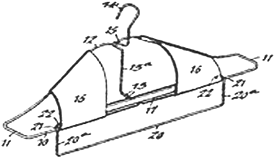
![]() wire coat hanger by albert j parkhouse, 1903 --- other patented wire coat hangers ![]() ![]() ![]() --- historic wire coat hangers, inventors unknown ![]() ![]() ![]() ![]() ![]() ![]() ![]() ![]() ![]() ![]() --- with hook end protection ![]() ![]() |
||