
forget 3D printing – MIT’s 4D printed self-assembling objects are the future
as the technologies in 3D printing progress over time, new scientific breakthroughs leading to the discoveries of organs printed from regenerative cells and bio-engineered body parts will become a thing of the past. seeing the potential in self-assembling forms, MIT researcher skylar tibbits and team from minneapolis-based stratasys have worked together to develop a method of 4D printing programmable entities that self-actuate on their own – much the way a strand of DNA zips itself together. the new rapid-protoyping technique entails multi-material prints with the added capability of embedding transformative information from one shape to another.
instead of printing out a complete object, the 4D method creates a long string of multiple materials – which then fold and convert into various shapes when placed in water, activating the morphing process. engineered with different properties at the particle level within the 3D geometry – software allows for simulated self-assemblies, optimizing design constraints and joint folding. it is the idea that this technology can be implemented not only into small-scale projects, but used in the future construction of architectural projects such as skyscrapers, buildings or even housing on the moon.
4D printing: cube self-folding strandvideo courtesy skylar tibbits
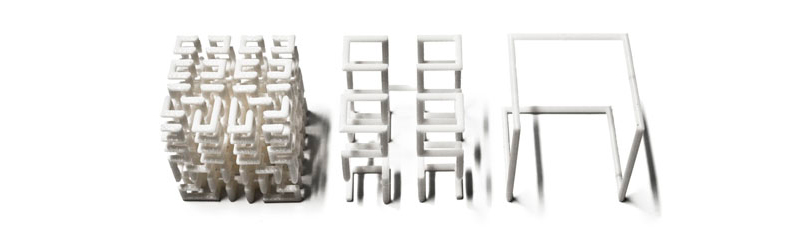
4D printed cubes
4D printing: MIT self-folding strandvideo courtesy skylar tibbits
self-folding sheets: hyperbolic paraboloidvideo courtesy skylar tibbits
3D PRINTING (745)
 Apr 10, 2024
 Apr 02, 2024
 Mar 13, 2024
 Mar 12, 2024
STRATASYS (4)


PRODUCT LIBRARY
 Mar 21, 2024
 Mar 13, 2024
 Feb 24, 2024
 Feb 07, 2024