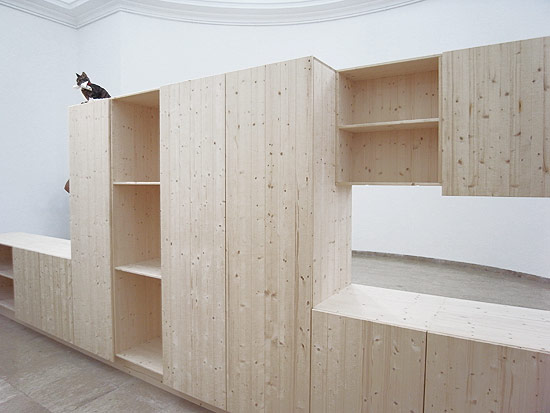
cabinets made from pine run throughout the pavilion image © designboom
for more than a year, liam gillick has been travelling, researching and developing his project for the german pavilion in a continuous dialogue with curator nicolaus schafhausen. making use of computer modeling of the existing german pavilion, the final questions for gillick regarding his contribution circle around models of social behaviour and the problem of how to create new forms of address within loaded ideological sites. the main components for gillick’s work were determined during the final days of installation. the first step of the process was the fabrication of an edition in the form of a model of arnold bode’s 1957 proposal for the new german pavilion.
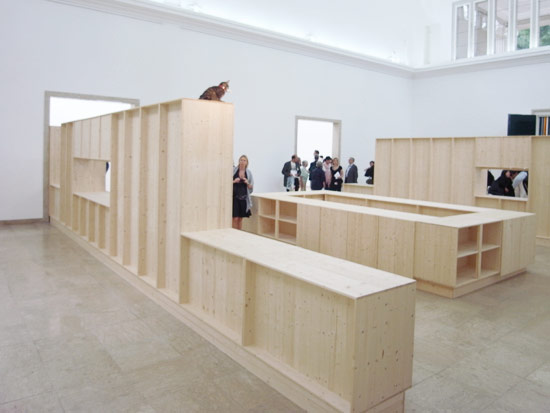 the ‘kitchen’ stands in the main room image © designboom
the pavilion has not been changed or masked. the interior and exterior of the building is left in basic form so that it can be seen and examined. recently painted white as general maintenance to the building, gillick has left the walls this way to create a starck backdrop to his installation. every room of the building is left open. no part of the pavilion has been closed off or used for storage.
here, gillick has transfered his daily working environment – his kitchen used as an improvised studio – translating it over to the german pavilion. he has installed a kitchen-like structure which has been constructed from simple pine wood. it lacks appliances, but the ‘kitchen’ exists as a diagram of aspiration, function and an echo of applied modernism that resonates in opposition to the corrupted grandeur of the pavilion.
after re-visiting the replica of margarete schütte-lihotzky’s frankfurt kitchen at the museum of applied art in vienna, a place which has long been an important marker of applied modernism within gillick’s practice, he looked for a solution as to who should occupy his venice kitchen. leading up to the biennale, gillick sat for months in his kitchen with his son’s cat, considering the question ‘who speaks? to whom and with what authority?’ while the cat tried to disrupt his work. as the final touch, gillick and his studio team in berlin, created an animatronic cat as the kitchen’s occupant that sits on top of one of the cabinets. the cat fights against the echo of the building and tells us a circular story that never ends. the cat is in the kitchen, the children are in the kitchen:
‘I don’t like it,’ the boy will say. ‘I don’t like it,’ the girl will say. ‘I don’t like you,’ the cat will think.
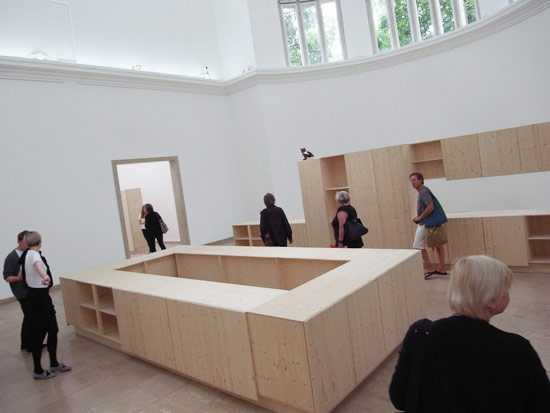 the large island which sits in the middle of the ‘kitchen’ image © designboom
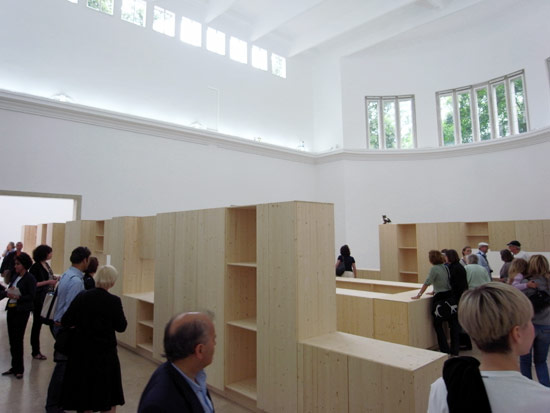 image © designboom
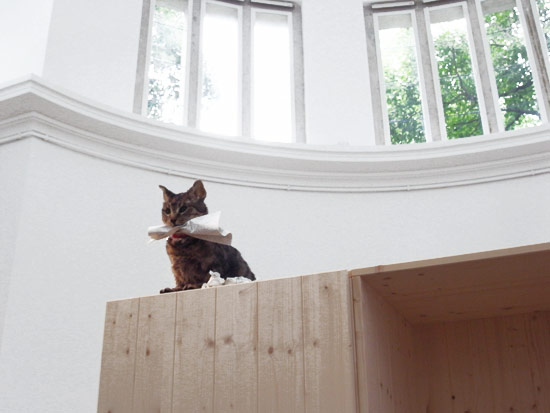 the ‘kitchen cat’ image © designboom
 the ‘kitchen cat’ sits above one of the cabinets in the kitchen image © designboom
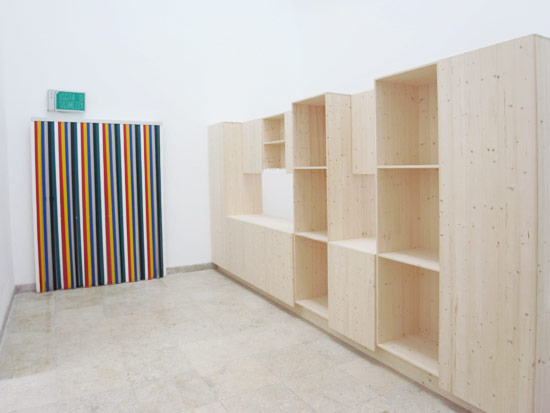 colors of red, yellow, green, blue, black and white mask the openings to the pavilion’s exteriorimage © designboom
strips of plastic hang like blinds, much like those used to keep flies out of a room. they mark the entrance and two emergency exits of the pavilion. the only signs of color within the neutral space.
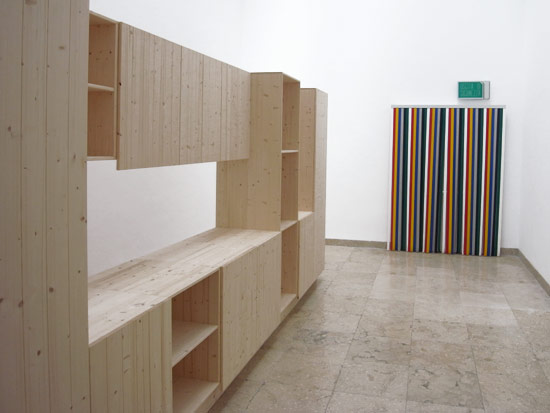 image © designboom
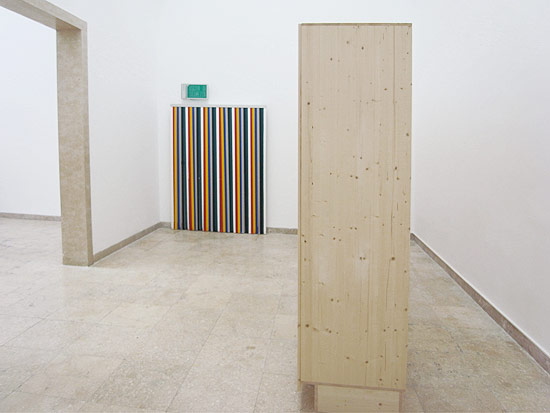 image © designboom
 image © designboom
 the pine cabinets puncture the doorways of the pavilion that lead into the side rooms image © designboom
 the pine cabinets seem quite expansive leading visitors into the other rooms of the pavilion image © designboom
 image © designboom
 the arrangement of the cabinets dividing the interior space image © designboom
 cabinets standing in the middle of the room, usually an unlikely place in a home image © designboom
 image © designboom
 the backs of the cabinets which would normally stand against the wall, are exposed image © designboom
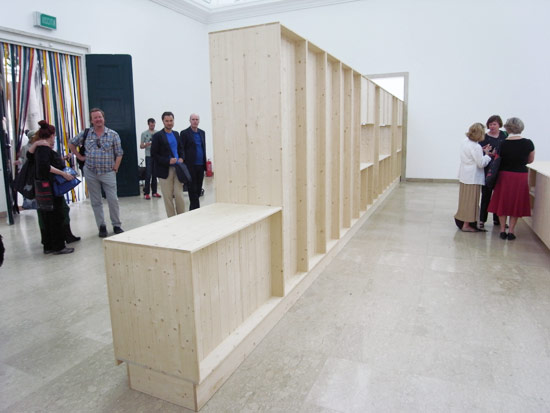 image © designboom
 image © designboom
 image © designboom
 artist liam gillick portrait © designboom
liam gillick was born in aylesbury, england 1964. he divides his time between london and new york city. the work of the british artist had it’s starting point in germany. by deciding to present gillick at the venice art biennale at the german pavilion, curators have opted to promote an image of germany as being a cultural location in international art, as well as a centre for critical debate on contemporary art, architecture and forms of national representation.
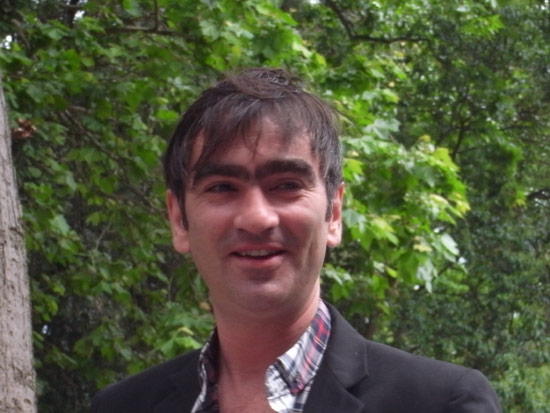 curator of the german pavilion, nicolaus schafhausen portrait © designboom
VENICE ART BIENNALE 09 (41)
 Sep 02, 2009
 Jul 22, 2009
 Jul 20, 2009
 Jul 14, 2009
 Jul 09, 2009
PRODUCT LIBRARY
 Apr 19, 2024
 Apr 17, 2024
 Apr 09, 2024
 Mar 27, 2024