
new research at MIT has demonstrated a way of using plant waste to generate solar electricity
a team led by MIT researcher andreas mershin, continuing an 8-year research project of shuguang zhang, has developed a viable means by which agricultural waste– like grass clippings and leaves– can be used to create solar panels. within a few years, the technology could be used so that people in remote and developing regions can generate their own electricity with few materials and at low cost.
the technology is based on the way trees in nature naturally organize themselves into densely packed forests. the solar array itself comprises a ‘forest’ of nanowires, interspersed with titanium dioxide ‘sponges.’ this system is then coated with ‘photosystem I’, a solution that contain photosynthetic material (extracted via chemical processes from waste plant material like grass clippings) alongside stabilized peptides. by coating the ‘nanoforest’ array with the photosynthetic extract, the wires can harvest the energy produced, carrying it away to power sources. the titanium dioxide (adn zinc oxide) in the system absorb UV light to protect the mixtures.
head researcher andreas mershin discusses the technology
at present, mershin’s solar panels have an efficiency of only about 0.1%, enough to power only about a single LED light. an efficiency of 1 to 2% would be commercially viable and can be expected within a short timeframe, given recent research into biophotovoltaics. within a few years, mershin hopes to produce a cheap bag that comes prefilled with the necessary additives (alongside ‘one sheet of carton instructions, with no words’) that users can fill with their agricultural waste, mix together, and then paint onto a sheet of ordinary glass to create a solar cell.
the research is documented in the paper, ‘self-assembled photosystem-I biophotovoltaics on nanostructured TiO2 and ZnO‘, just published in the open-access journal ‘scientific reports’. you can also read more at MIT.
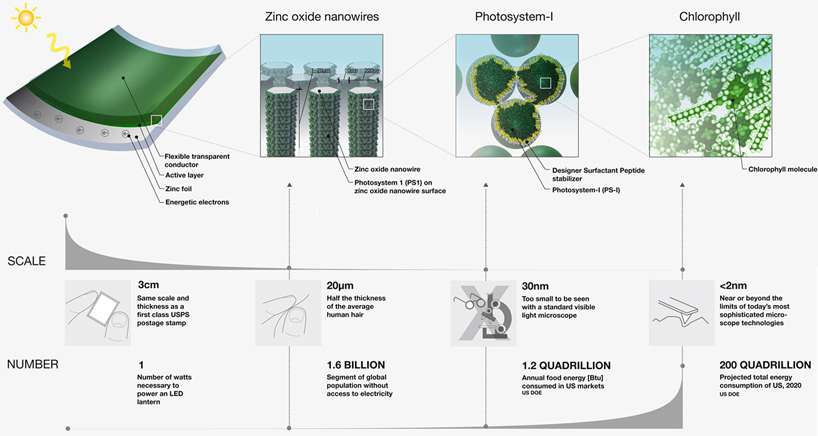 concept schematic of the bio-powered solar technology (click the image for full-size version) image © sloan kulper, 2008
via extremetech
SOLAR POWER (369)
 Feb 20, 2024
 Feb 17, 2024
 Jan 27, 2024
 Jan 17, 2024
PRODUCT LIBRARY
 Mar 21, 2024
 Mar 13, 2024
 Feb 24, 2024
 Feb 07, 2024