— the following is an example of a lesson from the upcoming paper course:
karacho’s karakami – woodblock-printed paper http://www.karacho.co.jp
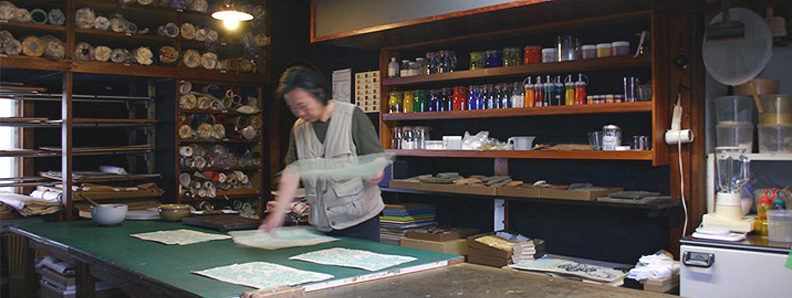
established in kyoto in 1624, karacho is japan’s only ‘karakami’ maker (woodblock-printed paper). still in operation today, the karacho workshop has been directed by members of the senda family for 12 generations, preserving a japanese tradition. the sendas are the custodians of 650 hand-carved wooden blocks, made over the centuries and they still use them to produce the karakami paper for which karacho is world famous. some blocks are more than 200 years old – the oldest (with a checkered pattern of chrysanthemums), dates back to 1792. when the residential quarter of the karacho studio burned down in the 1864 hamaguri gomon incident, the woodblocks were placed in a wash-tub of water in a storehouse with earthen walls. to protect the blocks from fire, craftsmen kept pouring water on them. such a close encounter with destruction has ensured that the surviving woodblocks are treated as a treasure.the senda family still produces karakami for temples and other traditional places in japan. additionally they produce on demand for architects (kengo kuma is among them). while western-style housing increasingly is favored by many japanese, there is also a growing number of people who want to decorate parts of their homes with traditional karakami patterns.
karakami patterns the technique has remained virtually unchanged for more than 400 years: karakami is produced by pressing pigment onto paper using patterned wooden blocks. the patterns show the strong artistic influence of the ‘rimpa’ school of painting, as the studio was used by artist honami koetsu (1558-1637), one of the founders of the school. the meditative designs combine subtle colors with a pattern of freedom and life force. nature provides the spirit of invention and discovery that inspires the ornaments of all the patterns. with the rise of popular culture in the edo period (1603-1868), the karacho woodblock prints became a major artform and its technique was fine tuned to produce hand-made prints used to decorate sliding doors, walls and single-leaf screens. karakami woodblock prints also had an important influence on 18th-century european wallpapers textile patterns and patterns on book covers.
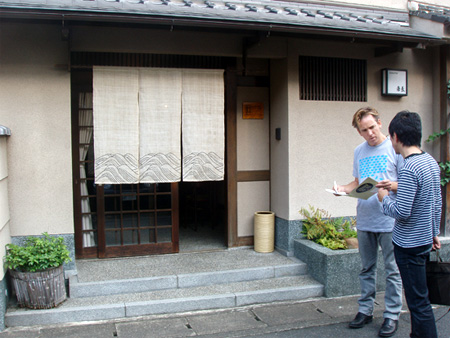 massimo mini (designboom) visiting karacho. – meeting up with koh kado in front of the entrance of the karacho shop in shugakuin, kyoto, japan.
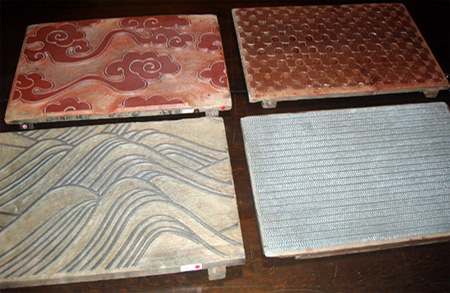 woodblocks
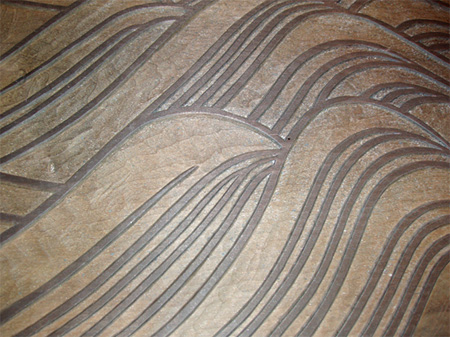 detail of wave pattern on woodblock
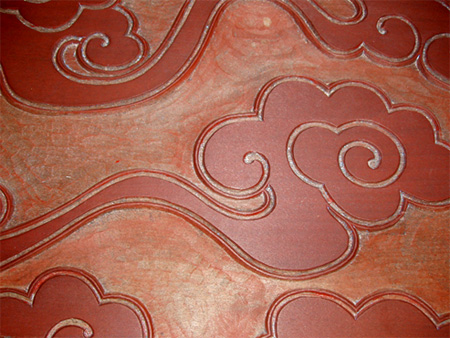 detail of clouds pattern on woodblock
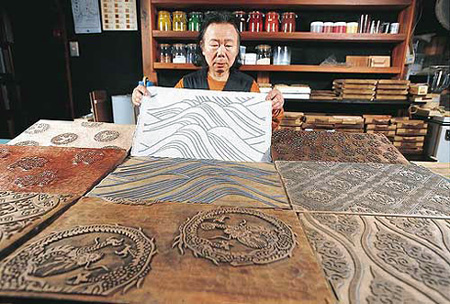 kenkichi senda, the master craftsman and eleventh-generation head of karacho studio, is showing a sheet of paper with big wave patterns called ‘korin onami’.
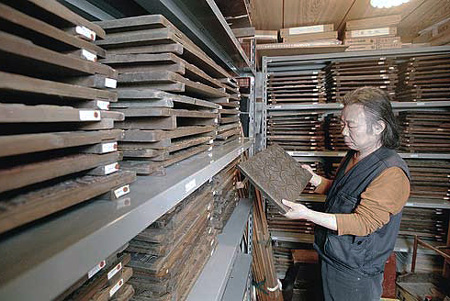 the blocks are sorted according to the number required to print one ‘fusama’
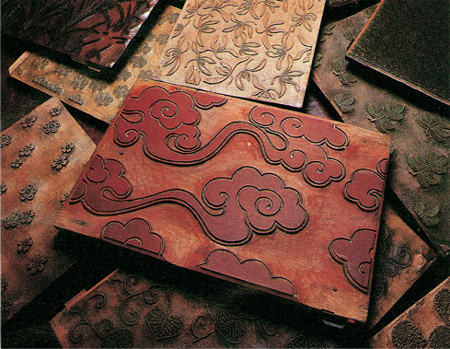 the original woodblocks were carved by craftsmen almost 400 years ago. most of the blocks are made of easy-to-carve ‘honoki’ wood, which has a fine, soft grain and rarely warps or cracks.
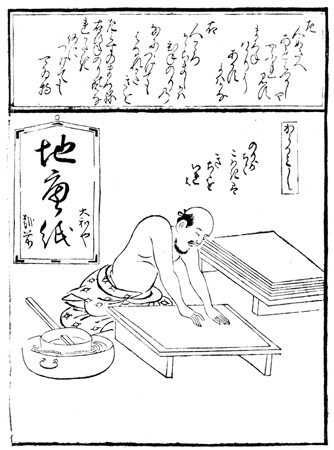 karakami expert wakoku shoshoku etsukushi (1685)
fusama doors once, the space under the roof of a japanese house was partitioned with screens into several spaces. these movable screens were eventually fixed into the wood frame and became sliding ‘fusama’ doors. fusuma doors are used as movable walls, so when people host large gatherings in the house the panels can be removed to make one large space. originally several sheets of paper, in sets of 5, 10, or 12, were required to cover a fusama door, at the end of taisho period (1912 – 1926), techniques were successfully developed to make large single sheets that were ‘fusama’ size. the nobility were first to use karakami paper on fusama doors their preference was for patterns based on their family crests and which reflected their court ranking and status. the majority of the patterns are combinations of flowers and plants such as chrysanthemum, bamboo, maple, and pine with geometric designs of diamonds, squares, tortoise-shell motifs, circles, crisscrossing lines and wave patterns. other popular motives include cranes and clouds. the senda family also repair sliding doors at historical sites such as ‘katsura rikyu’.
tea ceremony karakami paper was used for the interior of tearooms. many leading ceremony schools designed their own patterns. their taste lead more towards patterns of plants than abstract motifs. karacho’s stock of woodblocks include a large number with tea-related patterns. among the most famous are patterns favored by the ‘ura’ and ‘omoke senke’ schools of tea ceremony.
what you don’t see in this illustrated article: gu-hiki or the process of preparing the pigments: the use of colors is limited as most of the karakami patterns do not print well with too many color overlays. the limit is usually three colors, including the original color of the paper. the basic colors are vermillion, blue, yellow, black and gofun white, – made from ground mother-of-perl. the pigments are mixed with mica dust and an adhesive to create a paint. natural pigments are used as much as possible. they are the most compatible with washi handmade paper. natural colors help to create subtle nuances of shadow and light, when the karakami paper is exposed to candle light and sunlight.
the mica dust and gofun have also more pratical applications as they help to make the paper fire-resistant and are able to cut down the humidity in a room by absorbing excess moisture in the air.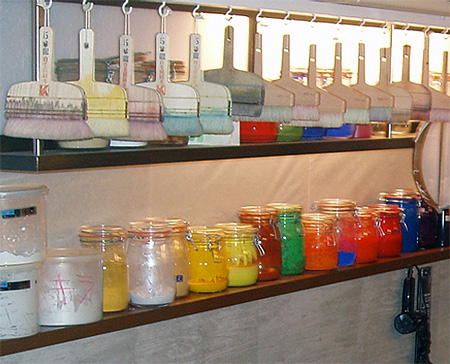 the process of karakami involves: carved woodblocks, washi handmade japanese paper, paints, sieves, brush…
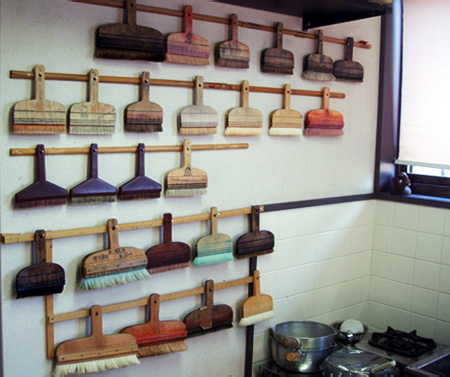
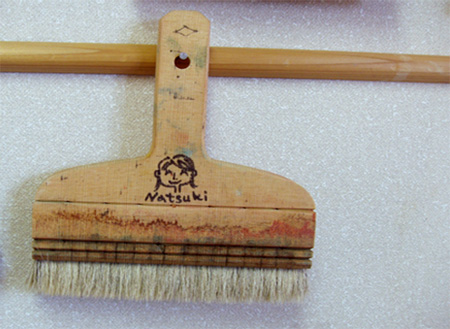 every artisan has their own brush
 for long ‘fusama’ sheets karacho staff member koh kado is measuring the size of the pattern
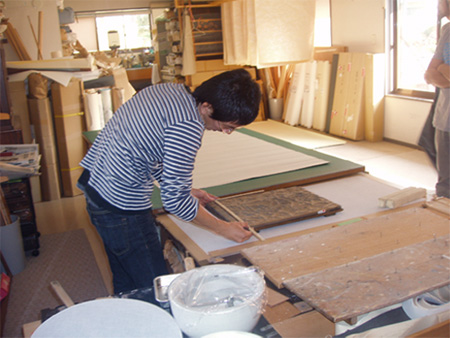 for long ‘fusama’ sheets karacho staff member koh kado is measuring the size of the pattern
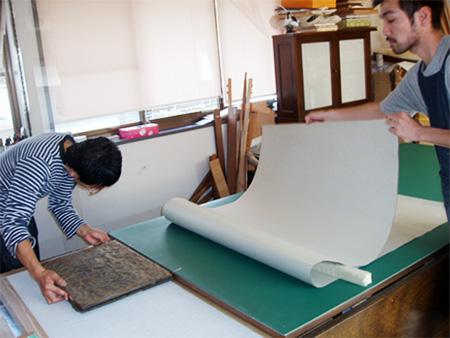 his colleague helps him for the precise placement of the woodblock
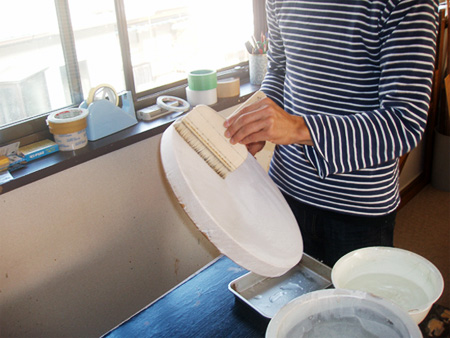 the paint is brushed onto a fine mesh sieve covered with gauze …
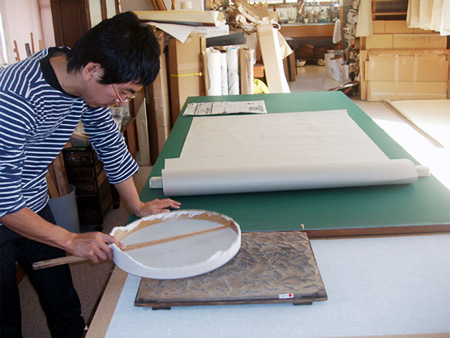 … and applied on the woodblock pattern.
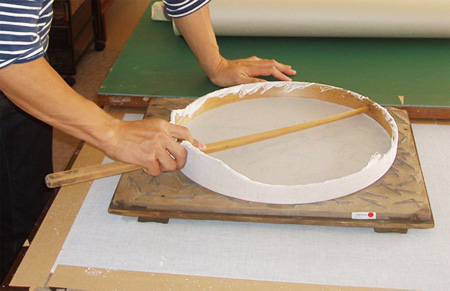 the sieve should be kept perfectly parallel to the pattern, in order not to apply too much color in certain parts and not enough in others.
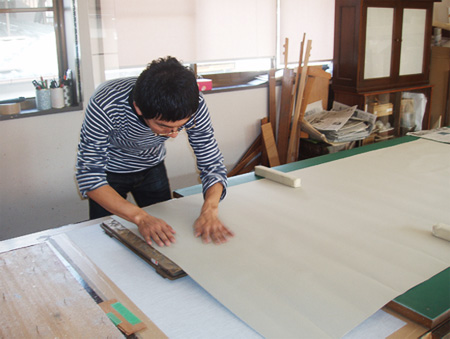 the first upper part is printed.
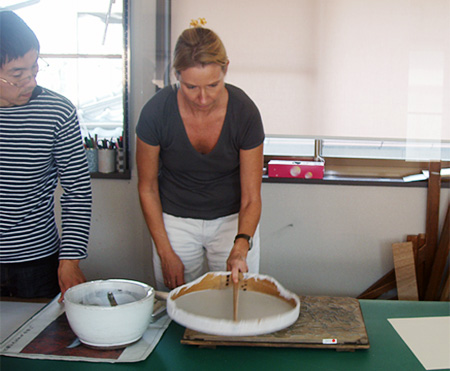 during our visit to the karacho wokshop, we were able to explore our manual skills. we tried our ability on a small sheet of paper. as first step birgit (designboom) gently presses the paint-coated sieve onto the carved woodblock.
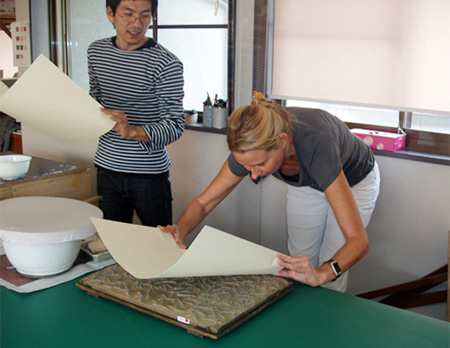 the right corner of a sheet is carefully aligned with the right corner of the block.
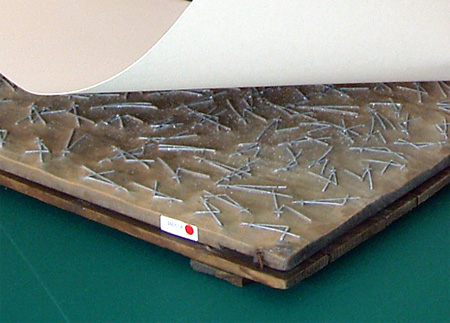 just a little paint on the block pattern is what’s needed
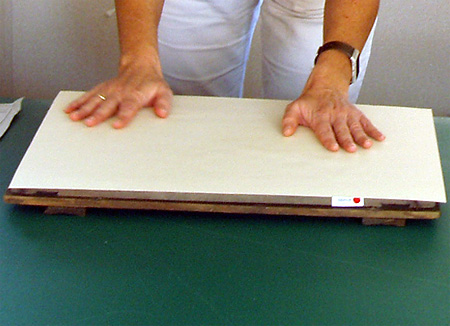 the paper is then pressed down with a gentle sweep of the hands (for a few seconds only) and then carefully peeled away.
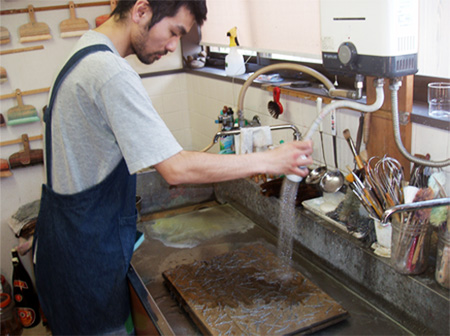 cleaning of the woodblock
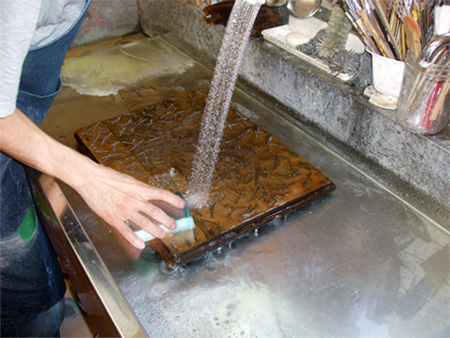 first with a sponge
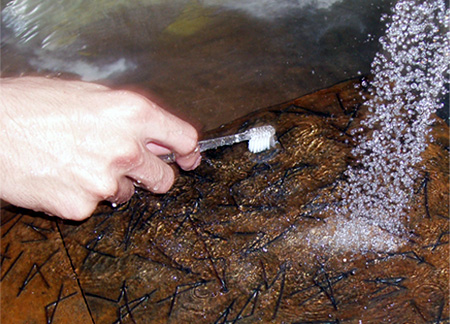 then a toothbrush
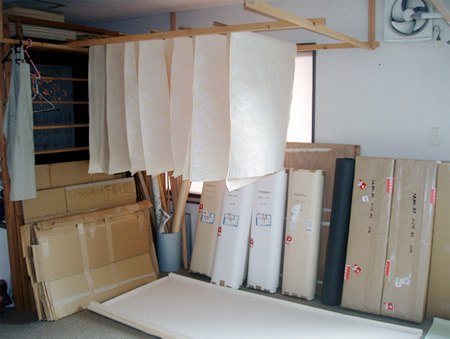
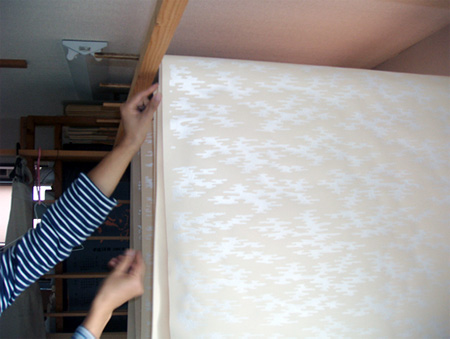 printed sheets of paper are hung to dry
the katsura imperial villa (katsura rikyu) in its present form was completed in 1645. the country villa and its surrounding gardens of the imperial princely family,hachioji no miya, is located near the katsura river in the outskirts of kyoto, japan. the building is carefully preserved as a national monument because it represents the purest form of japanese native architecture. architects throughout the world have long admired the main building, which has a zigzagging floor plan, for its clean lines, its display of natural materials, and its integration of interior and exterior space. the thatched straight, not curved roofs, the shoji (the square-patterned sliding screens with karacho karakami woodblock-handprinted paper windows) and straw matted rooms are the principal features. this building did indeed influence the entire tradition of japanese domestic and hotel architecture. the building owes much of its charm to the fact that the site is uneven, the delicate restraint and rusticity of traditional landscaping with stone pathways. galleries overlook the garden. the inmates would sit on the veranda and contemplate, converse, …
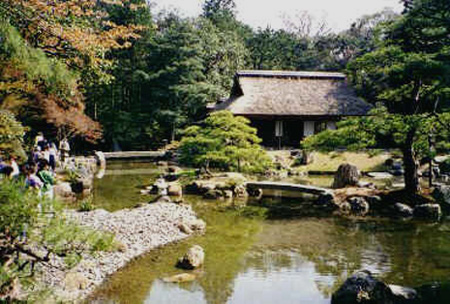 katsura rikyu country villa
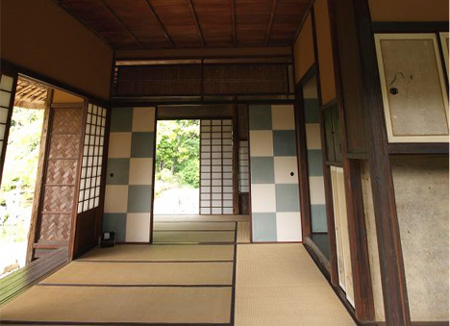 a view inside
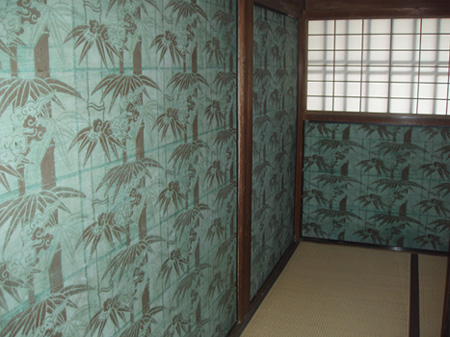 early karacho karakami woodblock printing is beautifully represented here.
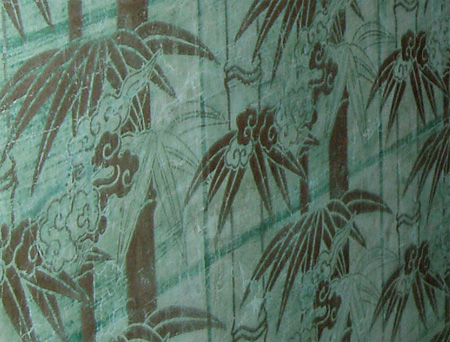 detail
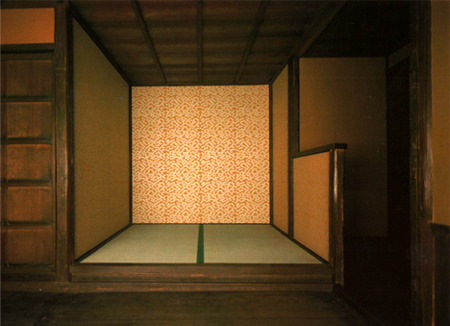 earth-color-based karacho karakami on shouji, partitions that can divide the interior of a building into separate rooms.
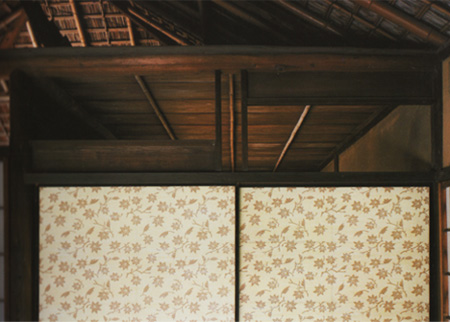 karacho karakami woodblock-handprinted paper.
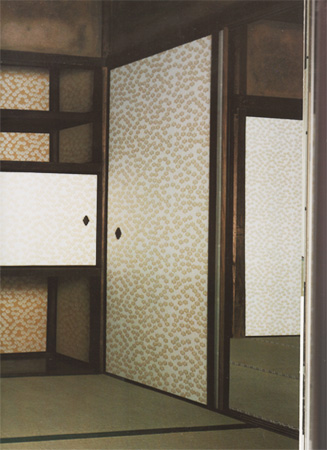 karacho karakami woodblock-handprinted paper.
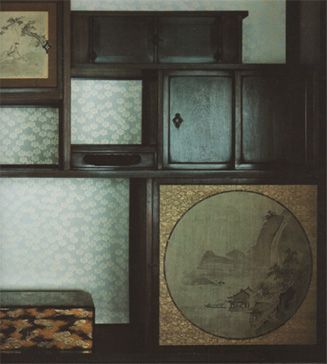 karacho karakami woodblock-handprinted paper.
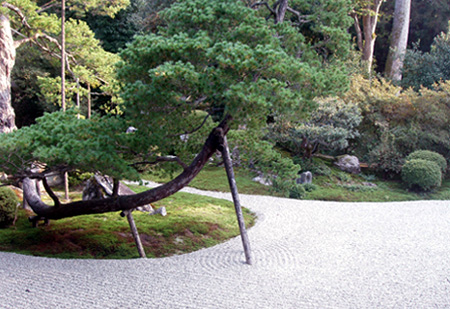
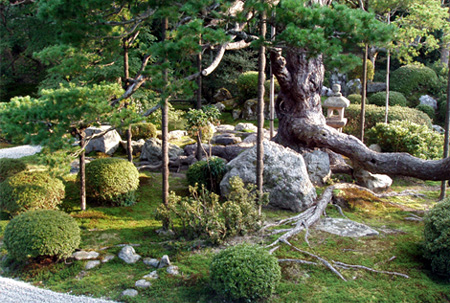 views of the garden.
temples and shrines favored large patterns in keeping with the larger spaces they had to decorate compared to the average home. the patterns include cloud motifs, flowers and bamboo. karacho has roughly one hundred woodblocks of motifs associated with specific temples and shrines and which are still used on occasion.
—

« BACK TO THE DESIGN-AEROBICS HOMEPAGE
DESIGN AEROBICS 2012 (22)
 May 17, 2012
 Nov 11, 2011
 Nov 11, 2011
 Nov 11, 2011 Oct 31, 2011
PRODUCT LIBRARY
 Apr 17, 2024
 Apr 15, 2024
 Apr 15, 2024
 Apr 12, 2024