giffin' termeer: drip-dry

'drip-dry' dishes
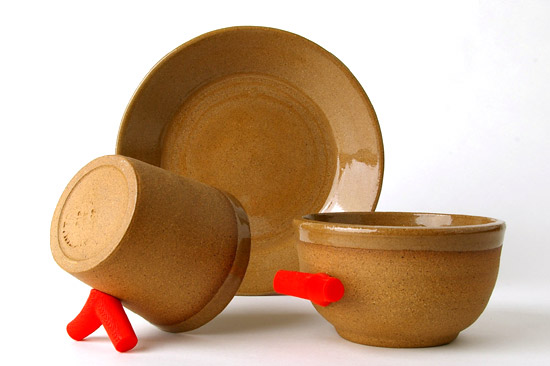
'drip-dry' dishes by american design studio giffin' termeer (jess giffin and jim termeer),
is born from this idea of wanting to escape the systems of racks, dishwashers, extended place settings
and the intricate household rules of drying dishes. they thought about how dishes spend
most of their time waiting to be used in the cupboard or waiting to be washed.
at home they don't use a drying rack, just a towel in which they wash one or two things
and set them out to drip dry. what if this was all they did - sitting out to dry?
what would the dishes look like then?
they chose to design three basic pieces, whose designs change our relationship to dishes,
through one simple alteration. 'drip-dry' makes dishes more efficient in terms of their purpose.
giffin' termeer decided to 'tip' the plate, bowl and tumbler of the 'drip-dry' series,
and make them self-sufficient, while at the same time animating them in a new way.
now, with small tipping forms, the tableware becomes more figurative and contemplative.
there is no longer a need for cupboards or dish racks. in the development of the series,
they looked at naturalistic elements such as a crab stock handles found in 18th century
european teapots drawn from a long tradition of asian ceramics. rounded crab stock forms,
sprigs, what easily shed water, became the way in which to perch the dishes in the right
orientation to literally 'drip-dry' after cleaning.

'drip-dry' dishes with small plastic sprigs used to tip the dishes so that water can easily run off them
the first set of 'drip-dry' dishes were designed for the designboom NY mart, 2007 and
were also exhibited in the designboom handled with care exhibition the same year.
the patterns for this set were designed in CAD and printed with a 3D printer.
the final stoneware dishes were produced entirely using a RAM press, glazed in off-white
with a production run of 25 of each piece. the support sprigs were made from the same
material as the body. while they liked the uniformity of a single material, the 'tink' sound
of ceramic hitting the counter top was unsettling when the dishes were set down.
the second chance for a re-design came about with a set they designed for the 'pressing matter'
exhibition for the cheongu craft biennale in cheongu, korea last year. since the dishes are
designed as if a dishwasher wasn't invented, the materials didn't have to be dishwasher-safe.
because of this, along with the advances in adhesives, they decided that a plastic sprig would give
a softer landing for the dishes.

the set consists of a tumbler, plate and bowl
for this new set of 'drip-dry' dishes, giffen' termeer worked with ceramicist meg biddle,
who hand threw the body of each piece. the throwing technique was chosen over RAM
or slip casting because it is more efficient for the 10 sets they were producing with no tooling required.
biddle needed only a 2D profile to use as a guide. the springs were individually modeled
for each body and produced using an FDM (fused deposition modeling) rapid prototyping 3D printer.
the 3D printer became a production method that matched the one-by-one process of wheel throwing.
giffin' termeer asked biddle to leave her finger marks on the thrown bodies, and as a final detail,
they left the unfinished wood-grain-esque surface textures that are inherent in 3D printing on the sprigs,
resulting in a fingerprint meets fingerprint aesthetic.


'up close' - you can see the 'fingerprint' texture of the sprig

process of making the 'drip-dry' dishes:

process making

process making
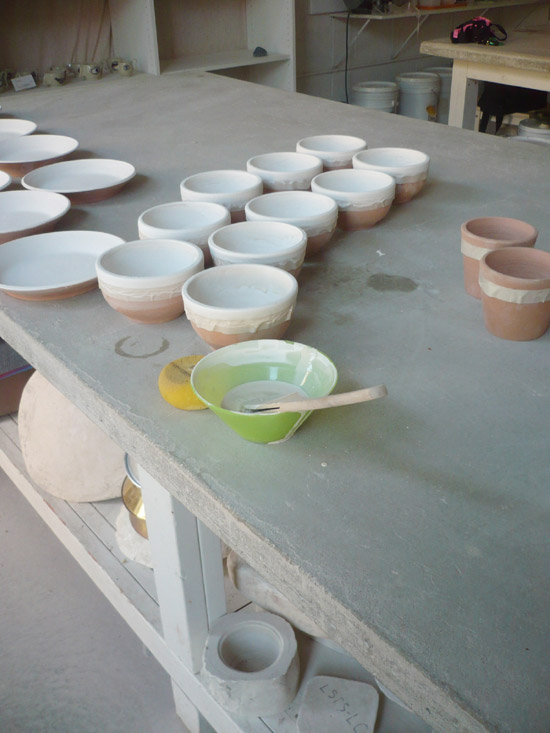
fitting sprigs


fitting sprigs attached to the dishes

'drip-dry' models

'drip-dry' model

preliminary models

designing the mark
I'd hate to be the first one to set the tone, but:
• Where are all the drips meant to go, surely not onto a counter top?
• Doesn't leaving a wet object intact with a wet surface for any period of time encourage mold/bacteria growth? Surely creating multiple wet areas, would do the same.
• What happens when the waterless dishwasher is perfected, the use of running water for washing dishes will become obsolete?
• Dishwashers, aren't going away, nor dishracks.
Why allocate a purpose built device for each piece of crockery when a dish rack is able to apply this principle universally without the need for individual superfluous augmentation.
I can only muse that this is a waste of Meg Biddle's beautiful organic work adulterated by a synthetic material. This really follows the "chindogu" or useless invention principle.
• Where are all the drips meant to go, surely not onto a counter top?
• Doesn't leaving a wet object intact with a wet surface for any period of time encourage mold/bacteria growth? Surely creating multiple wet areas, would do the same.
• What happens when the waterless dishwasher is perfected, the use of running water for washing dishes will become obsolete?
• Dishwashers, aren't going away, nor dishracks.
Why allocate a purpose built device for each piece of crockery when a dish rack is able to apply this principle universally without the need for individual superfluous augmentation.
I can only muse that this is a waste of Meg Biddle's beautiful organic work adulterated by a synthetic material. This really follows the "chindogu" or useless invention principle.
cmon guys 03.08.10
re: cmon guys
I can understand your technical points of concern, but...
The project seems to explore more the idea getting away from conventional methods of drying dishes, new concepts or ways to envision this kind of everyday action. I think it's quite poetic and sculptural. A more whimsical approach. The dish ware, though mundane, becomes something on display, emphasizing the handmade qualities of the product while still 'doing something' when in its tipped form. Sure, ideally things should be purposeful and less superfluous, but once in a while these types of pieces make us think differently about how to look at an object and its potential functions.
I can understand your technical points of concern, but...
The project seems to explore more the idea getting away from conventional methods of drying dishes, new concepts or ways to envision this kind of everyday action. I think it's quite poetic and sculptural. A more whimsical approach. The dish ware, though mundane, becomes something on display, emphasizing the handmade qualities of the product while still 'doing something' when in its tipped form. Sure, ideally things should be purposeful and less superfluous, but once in a while these types of pieces make us think differently about how to look at an object and its potential functions.
Bev H. 03.08.10
I like that the dishes drying become more of a display scene, than if in a rack - but perhaps the way to do this is drying rack that holds / displays dishes in a new interesting way?
name/signature 03.08.10
umm this is lame. dont dis on dishracks! they are much better because you can stack things vertically in one place, and save space on teh counter. and how would you store these dishes once they are dry? the objects are a bit of an eye sore in my own opinion and seem kind of junky. a better way to go about with this idea would be to make a tiny bit of the lip on the dish wave up a little higher then the rest of the lip rim. it would be easier to clean, easier to make and you would still be able stack/store the dishes in a cabinet.
Ariel E 03.09.10
Non stackable dishes??? The dish rack is perfect for air-drying dishes. Do it all the time d;-)
Jetwax 03.09.10
Bev H.
This is a case of not being able to appreciate the beauty in things for what they are. I'd hardly call these earthenware pieces mundane. This support device actually impedes our experience with the tradition of washing/drying up (possibly done between two people), and the random sculptures than can be achieved by stacking dishes according to a chaos theory approach. The placement of these vessels is governed by a single outcome, limiting potential functions (stacking for instance).
Why try to fix something when it aint broke?
This is a case of not being able to appreciate the beauty in things for what they are. I'd hardly call these earthenware pieces mundane. This support device actually impedes our experience with the tradition of washing/drying up (possibly done between two people), and the random sculptures than can be achieved by stacking dishes according to a chaos theory approach. The placement of these vessels is governed by a single outcome, limiting potential functions (stacking for instance).
Why try to fix something when it aint broke?
cmon guys 03.09.10
just wipe them with a teatowel - job done?
juleso 03.09.10
beautiful, witty, fun! thanks for sharing the process
emily 03.13.10
crapola
not impressed 03.13.10
Why try to reinvent the wheel? You'll need to dry the bottoms at some point so why not dry a little more with a dishcloth with a conventional plate etc. Also, it reduces the stacking side of it...when drainers seem to be getting smaller....houses etc, this just doesn't make any sense! Yes, we need to think creatively but also practically.
Eugene 03.14.10
very similar to the mug done by some korean designer.
http://www.designnothing.com/sub_02.html
kuchacha 03.15.10
i like it, is fun, love the colors, and like the first idea of the wooden sticks. Nice!!! beso!
nola 03.15.10
kastiel: uganda glass cabinet
READER'S SUBMISSION
taking form from old world voyage boxes, this glass cabinet maintains the shape and sense of personal storage with modern objec...
arhimetrics: rosa shop
READER'S SUBMISSION
a boutique shop is transformed from a small and dark space into a timeless and intimate fantasy.
RENAULT 4 ever behind-the-scenes
DESIGNBOOM COMPETITIONS
thousands of you entered from across the world; now take an exclusive video look
'horsey' by eungi kim
DESIGNBOOM COMPETITIONS
'horsey' by eungi kim from korea is one of the shortlisted design entries from m
SELFPROMO - january 17 - march 17
DESIGN - AEROBICS
how to present yourself in a creative world. different approaches to make sure your work is brought to the attention of the people that 'matter'...
POP UP - january 17 - march 17
DESIGN - AEROBICS
don’t blink or you’ll miss it! in this course we’ll look at temporary structures, from living quarters and exhibition stands to container stores...
keep up to date with recent articles and upcoming events.
to receive both newsletters please check 2 boxes.
© copyrights 2000 - 2012 designboom, all rights reserved. all material published remains the exclusive copyright of designboom.
no contents, including text, photographs, videos, etc. may be reproduced in whole or in part without the written consent of designboom. in addition,
no material or contents may be reproduced on the world wide web by techniques of mirroring, framing, posting, etc. without the written consent of designboom.
no contents, including text, photographs, videos, etc. may be reproduced in whole or in part without the written consent of designboom. in addition,
no material or contents may be reproduced on the world wide web by techniques of mirroring, framing, posting, etc. without the written consent of designboom.

submit a project
publish a project
email
RSS
facebook
twitter