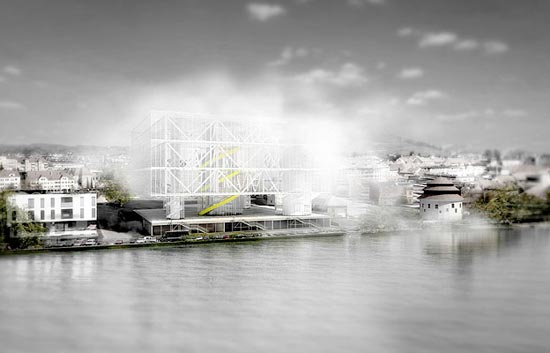
‘water from the sun’ by nicolas dorval – bory, raphael betillon and guillaume freyermuth all images courtesy nicolas dorval – bory
french architects nicolas dorval – bory, raphael betillon and guillaume freyermuth have created ‘water from the sun’, a proposal for the architectural design competition for the maribor museum, slovenia.
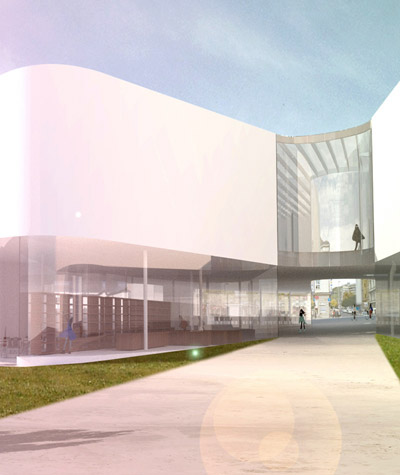
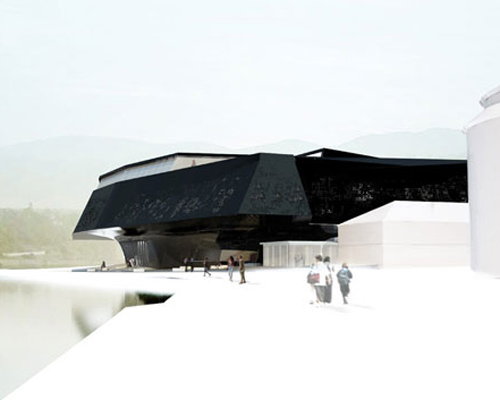
the project chose to clear a large floor space, an open landscape more than a built density, linking the drava to koroska street. the museum will no longer be an obstacle to this route, but rather an urban catalyzer: risen off the natural ground that then becomes a cultural plaza, most of the program crystallizes in an abstract volume and a floating landmark.
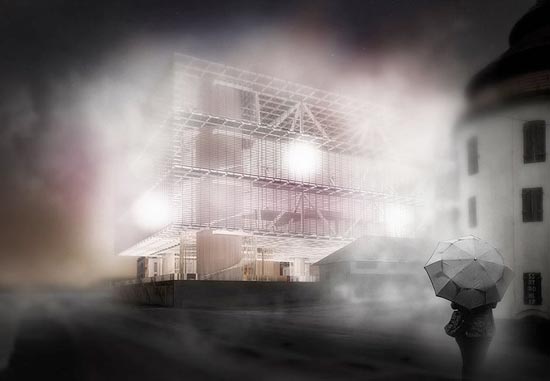
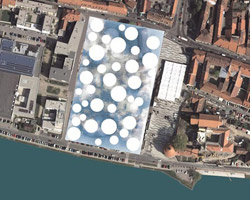
the tower of sodne stolp is one of the key landmarks of the city. in plan, the museum and park site extends this strong element by creating a structuring constellation of circles with various scales, both in the architecture of the museum and in the landscaping of the park.
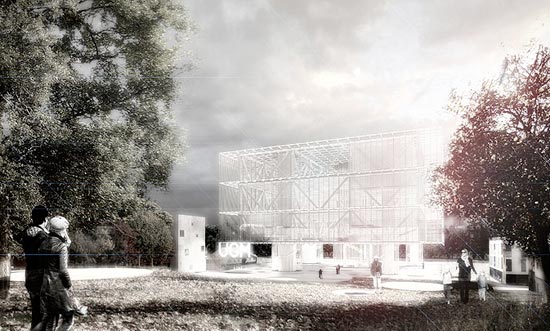 entrance to the site through a park, north side
the main volume is a sort of rubik’s cube, 54×54x27m structurally independent box, three-dimensionally triangulated, whose edges are divided into 3 modules (27 boxes: 18×18x9m). thought of like an accumulation of 27 brian o’doherty’s white cubes, it provides the necessary space for museum activities, uncluttered and bright, opened and accessible. glazed on all four sides (as protected by a climatic double skin), the volume is over-insulated on the underside by a visible multilayer aluminum foil, and protected on the roof by shading/photovoltaic panels.
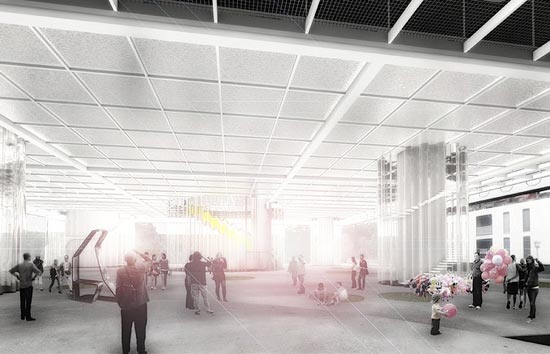
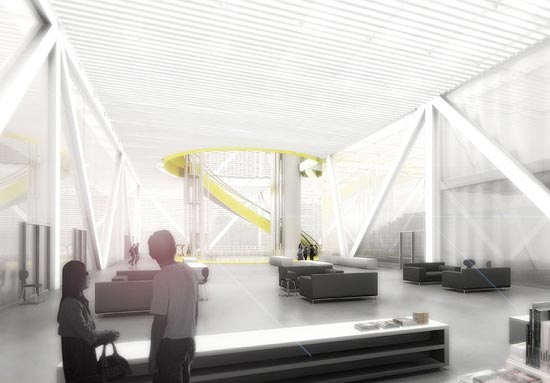 main nave ‘city’s living room’ viewed from the bookstore
circulations – 5 large vertical tubes – are positioned independently but in order to serve the most logically possible the different areas of the museum. these transparent tubes (corrugated glass, offering greater resistance) allow the connection between the basement and exhibition spaces, between the plaza and the library, between offices and storage, between delivery ramps and the catering area. the two east tubes are reserved for museum staff and bulky items, while the two west ones are used by visitors. the large central tube serves as the main circulation, a landmark, a meeting place shaped like a journey. in its nucleus, each of the 5 tubes features a structural core, wrapping the elevators, that supports the main volume.
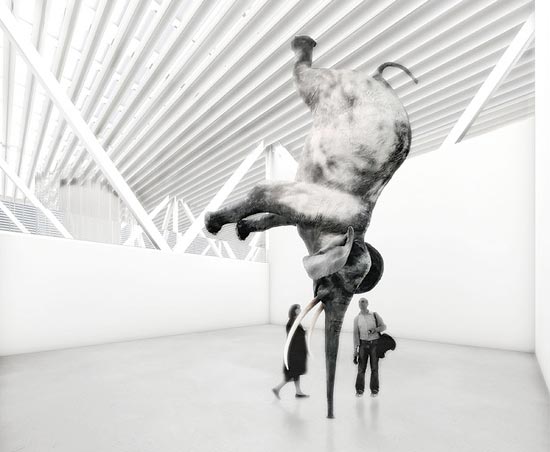 high ceiling periodical exhibition room. work of art : daniel firman ‘würsa (à 18 000 km de la terre)’.
exhibition areas are spread over the last two levels in a large open space. the permanent exhibition space, gathering artworks requiring special storage conditions, is located on the 2nd level, sheltered from light and temperature variations. the architecture center, also located on the 2nd level, allows a coherent organization with the permanent exhibits. temporary exhibitions are settled on the top floor to take maximum advantage of natural light, appropriately shaded on the roof. in two square modules (18×18m, 324m2) the floor is offset by + /-4m in height in order to promptly identify a ceiling height of 12m, to accommodate works of greater size in each of two levels of exposure.
both montes charges laid in the tubes is used to deliver works to those floors. widely open to the outside exhibition areas can expand on 3000m2 of outdoor terraces.
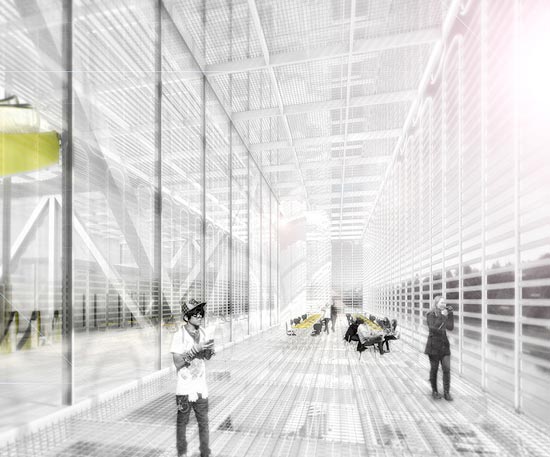 south terrace (catering area), main nave level.
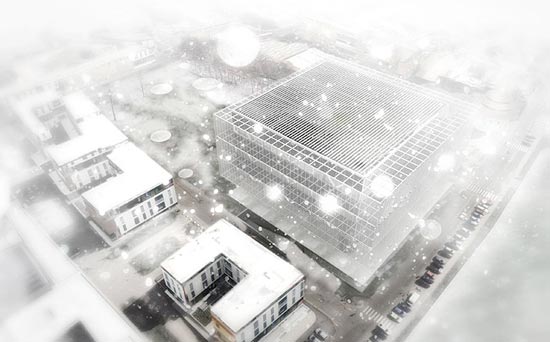 view of the site from above, during winter
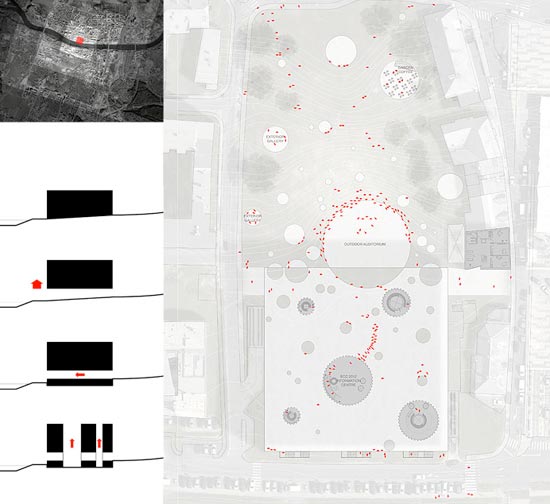 site plan of the project at street level: a large public park connects with the museum plaza. conceptual section diagram: continuity from the street to the river and vertical communications.
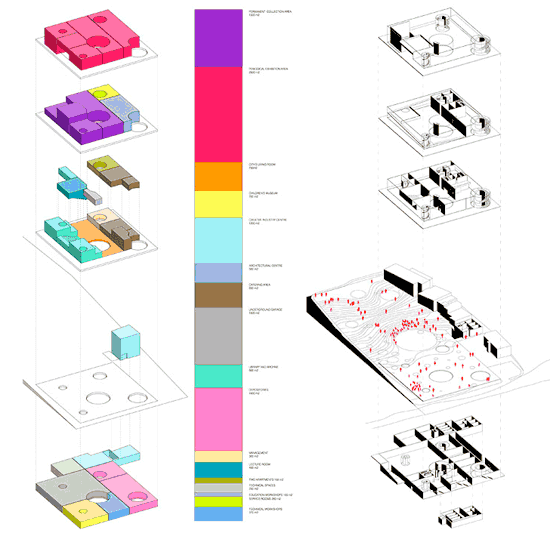 programmatic diagram -1 : storage, parking 0 : public plaza +1 : general public program +2 : permanent exhibition +3 : periodical exhibition
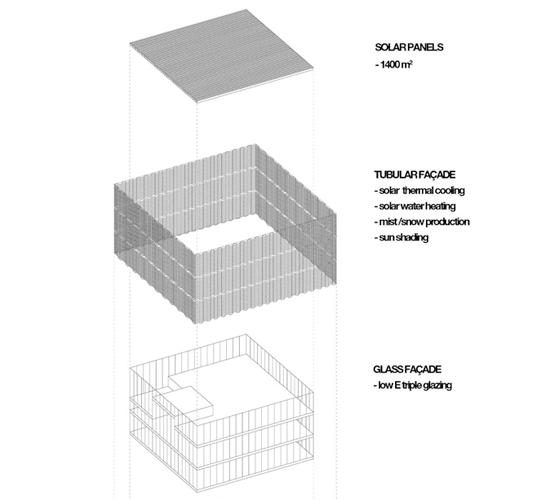
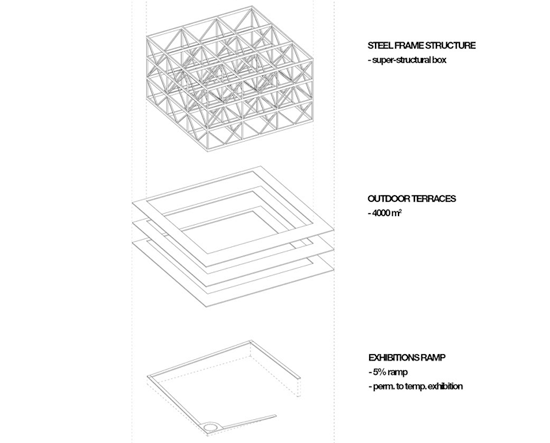
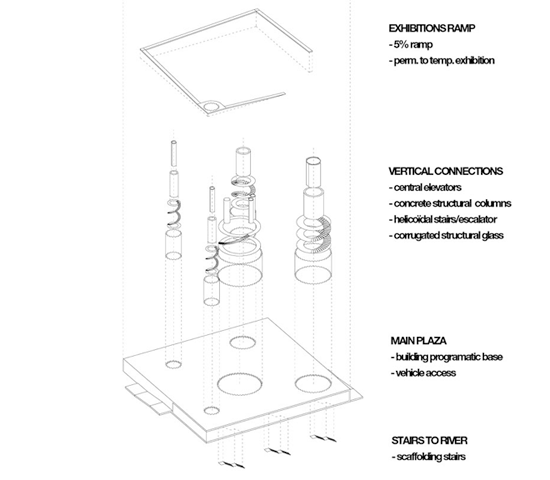
isometric view featuring the architectural components of the building
the main volume is an independent structural box, featuring most of the program. vertical connections as well as structural pilars are handled by 5 large glass tubes.
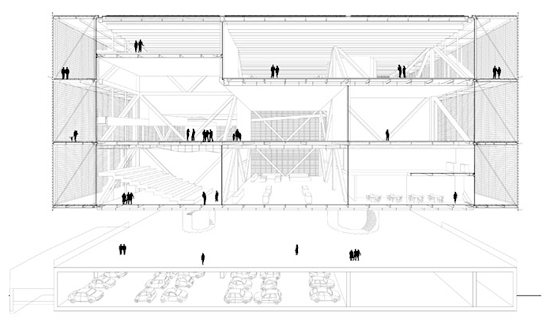 section view
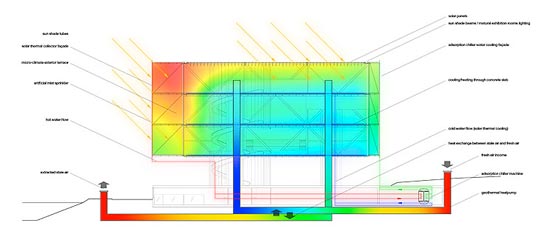 general climatic functionning, mixing air and water temperature conditionning techniques : heat pump + solar thermal cooling/heating
to ensure the climatic balance of the museum, the project uses various sources of renewable energy and thermal vectors.
first, the ventilation of the museum is made through a geothermal heat pump, heating / cooling incoming outside air through an underground canal (+ / – 16 º C) and heat exchange with the extracted stale air. in summer, part of the stale air is evacuated through the roof, by natural convection, reducing air pumping energy consumption and creating in some areas natural air flows. vertical air ducts are located in the five glass tubes.
cooling of the museum is provided by an innovative system of solar cooling. the vacuum tubes of the south facade heat the water to a temperature of 80 º C, which is then sent to an adsorption machine (adsorbent: silica gel). through a vaporization/condensation heat exchange process, cold flow is produced in a separated water circuit. necessary to the proper functioning of the system, a third water circuit, called coolant (not freezing), is used in this principle and runs through the north facade of the building. thus, the quantity of cold produced is proportional to the amount of sunshine, making the use of this system particularly relevant. on the other hand, its very low power consumption is counterbalanced by the photovoltaic electric production on the roof.
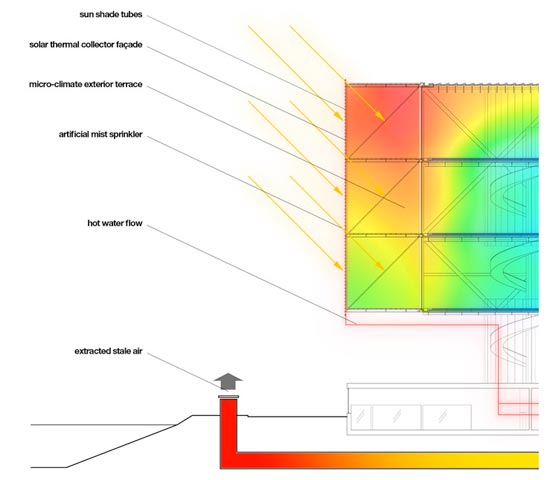 south part, featuring solar thermal collectors, stale air way out…
in winter, the vacuum heating collector tubes can be used to directly preheat the building.
the water system of heating/cooling then runs directly into the thick concrete slabs, ensuring an ideal inertial diffusion for a museum, where sudden changes of temperature are avoided.
finally, a occasional misting system is included in the technical tubular façade through hundreds of high pressure nozes, enabling the creation of an artificial cloud from the filtered water from the drava. this option, used to refresh both the envelope of the museum and its surroundings (bank, park) can be programmed and operated as an event to create unusual situations around the museum that becomes itself dynamic, like a floating cloud, a separated active meteorology in the landscape of maribor.
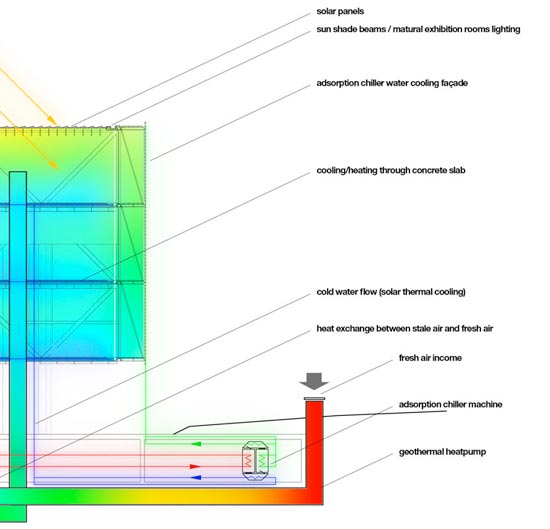 north part, featuring fresh air entrance, solar thermal cooling machine…
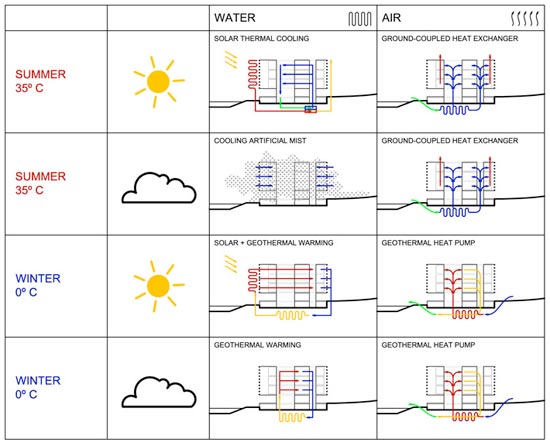 indoor temperature control : air + water flows in various climatic situations
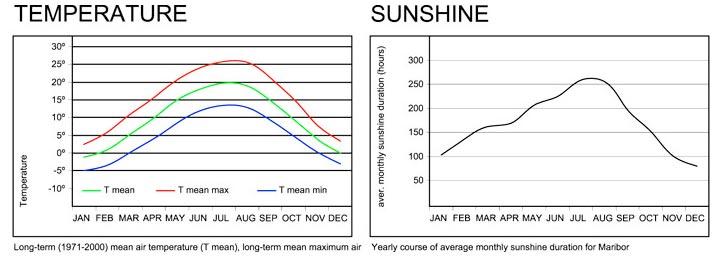 maribor climate: outside temperature increases with sunshine duration, making very efficient use of solar thermal cooling.
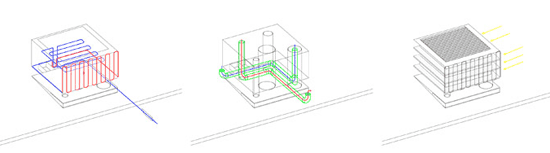 climatic control through 4 elements : – water : heating/cooling through ground and sun energies, refreshing through mist – air : heating/cooling through ground geothermal energy – sun : heating façade, provinding shaded light, providing photovoltaic energy
MARIBOR MUSEUM (4)
 Apr 22, 2010
 Apr 01, 2010
 Mar 31, 2010
NICOLAS DORVAL-BORY (13)
 Nov 13, 2020
 May 07, 2013
 Jun 30, 2012
 Jun 16, 2012
 Jun 10, 2012
PRODUCT LIBRARY
 Apr 02, 2024
 Mar 31, 2024
 Mar 21, 2024
 Mar 20, 2024