desitecture: vertical city, venezuela

vertical city, venezula by desitecture
all images courtesy desitecture
'vertical city' by british architecture collective desitecture is a proposal situated on 23 de enero
caracas, venezuela - which was originally designed to become a mass housing block for residents
to live and work in.
on january 23rd, 1958, when the dictator president jimenez was ousted following a military coup,
masses of homeless and lower class citizens flooded into the tower and it has since become known
as 23 de enero.
to cope with the threat of eviction, the residents became more organised and networks of exchange
and communication formed within the towers which became self contained micro communities.

rooftop gardens
as the area on which the tower is constructed is that of slums, this gives value to previously
worthless land. the stakeholders now have the option of either relocating altogether,
though this would break up the established sense of community, or to move out of the slums
and into the emerging micro economic community of the tower while deriving an income from
their share in the land development.
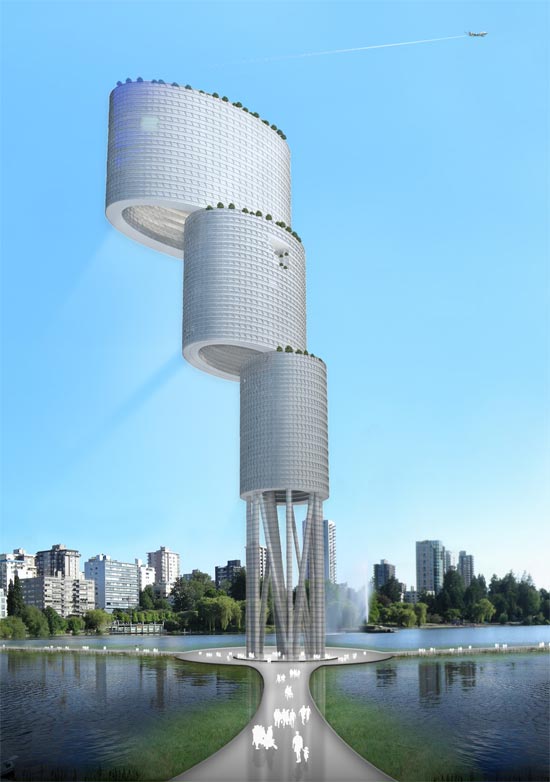
the 180-storey tower appears to be a twisting cantilever, but is in fact a simple structure
with only the top cup containing a cantilevered element.
the main support is the vertical and diagonal structural frame containing circulation
and services. this system runs through all three cups and within the first forty five storeys,
supports the palette shaped overlapping gardens and city farms.
beneath the tower are four levels of vehicular access and parking that covers an expansive area.
it incorporates the piled structural legs and the diagonal main composite core, acting as a
stabilizing counterweight to the tower. the inner structure of the cups is a diagonal grid into
which the wheat sheaf pattern of woven individual units are embedded.

the three cup structure
the three cups are meant to define distinct user groups and activities while remaining connected.
they could contain: retail, hotel, apartments; or social housing, local administration and offices etc.
the tower encompasses elements of work, leisure, home and a sense of
place. access to and from
the tower takes many forms such as
cable car, helicopter, water taxi car or metro.
bars, cafes and restaurants will flourish in such a climate, taking their cue from the many roof top
spaces. the hope is that the tower will become a destination in its own right with 24hr zones of activity.

the diagonal structural frame
the external skin elements of the tower are made of a lightweight composite.
precast units contain a hollow structure which has embedded micro turbines.
this transforms the skin into a wind energy, generating surface, providing power to
augment photovoltaic panel solar collection. within the inner skin, the effect is enhanced
as natural convection assists the production of energy.

interior


night view

photos of the present site of 23 de enero
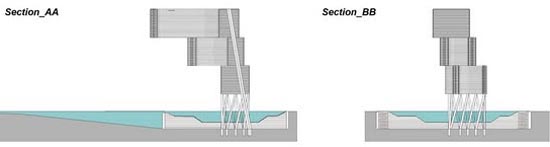
section view
And by the way, night(mare) images look like post-apocalyptic landscapes of Terminator 1 or Matrix...
the amount of work that went into this poor idea and project could have been spent trying to understand and attempt to propose something worth spending time on!
what a waste of energy, resources and time...
Architecture isn't art - there should be at least a minimum of thoughtful and supportive tasks for the human beeings.
I have to stress there was very detailed analysis and research into the nature of the site and its inhabitants!
A whole ground up masterplanning exercise into the site took place that dealt with building the required socioeconomic stability for the tower to be built. These basically consider the current impact of the Bolivarianism missions, but also propose elements such as urban farming and better access to services for the barrios, as well as retaining the heritage of the original tower blocks designed by Raul Villanueva. Put simply by gentrifying the barrios from the ground up it can transform the area into valuable real estate.
The tower is luxurious only in the few images shown within the website! Rest assured there are a range of different residential environments. The design of the tower is also less about its luxurious look, and is more about the eco-friendly ideals that underpin and motivate it. We've incorporated many of these ideas into the project. I'd agree with most comments that it may look unsuitable for its context, but this is perhaps because the website is only able to present around 20% of the actual project.
Structurally it may look like a reconfigured leaning tower of pisa with a deathwish but actually we have worked very closely with top structural engineers at every stage of the project, and they'maintain the design is structurally safe and secure.
So I hope that may help clarify the project, in the end I hope it provokes debate and critical thought - but we're very happy to be featured and welcome any questions!
Thanks!
http://desitecture.blogspot.com/
with only the top cup containing a cantilevered element."
Sorry, but words alone do not negate the effect of gravity, not to mention lateral wind loads experienced adjacent to a body of water AND a mountain... Wait, didn't Venezuela just have an earthquake? Sigh...
Also a cantilever on top is more difficult than one near the bottom as it can't use the mass of the building above it to counter it's moment. And there are TWO stacked cantilevers!
IF this structure were even possible in economic terms, "simple" would not be the adjective used. May I propose more appropriate ways to describe it:
Exceptionally Deep (lets say 2X the height of the tower itself)
Monolithic
Complicated
Heroic
Naive
Impossible
Pointless
You should have researched about previous projects to erradicate slums in Caracas (there are hundreds....since 1939), and not parachute with this monster project unreal and unbuildable in a third world country like ours.
You may have had fun designing it, but is a waste of time (probably your time would be better used in other skills rather than "design")
Please try to relocate your building on your city, probably you will be forced to move away.
crass, vulgar, puerile, elitist.
Even if it was buildable, this merely creates a prison in the sky. People have a connection with the earth and this greatly negates this basic instinct.
Getting in and out of this thing, the mind just boggles..... maybe via helicopter?
Thanks for posting the project and also giving comments on this thread.
Can we know a bit about the context on which this project was produced? is it and independent research?, an academic exercise, a commission?, is this meant to be exhibited somewhere?
Beyond any issues on feasibility, it is a peculiar approach on the subject. I (being a Venezuelan architect as well) feel this kind of ideas can only encourage discussions and thinking, so all this panicked and heart-attacked comments are nothing but useless. We definitely suffer from a lack of production and an excess of nonconstructive criticism.
But still, what is the aim here? why was the project's structure so carefully calculated as you say?
Another thing, why is it landing on that large pond? where is that? that cannot be 23 de enero...
The project stems is an independent research, with the aim of generating debate and discussion around the best way of dealing with informal communities. Around six UK based architects and designers got together over a short period to work on the project - it'll never be built of course, but its real purpose is to generate thought and discussion.
Unfortunately there were two stages prior to the skyscraper, that aren't present within this article. The initial stage was familiarisation with the site, learning about Caracas and 23 de Enero. This is a 200 page document of analysis which naturally the website may not wish to upload! (But I'll do my best to upload this somehow for all those that are interested!) Then from there a masterplan was devised, informed by the research, that would provide the economic means to accommodate such a high end appartment. You can argue that the end product is a statement, incredibly utopian and surreal, But beneath that it serves a greater purpose to illuminate the barrios, and possible approaches to improving informal settlements.
The structure has been carefully managed, because we wanted to push the boundaries slightly, and see what is theoretically possible. The structural engineers proposed numerous refinements and new emergent structural methods that mean the concept expressed here in is possible. However I'm not best qualified to discuss the structure as my own role within the project was more regarding the reseach and masterplan stages.
The large pond visual, as you correctly mention is not 23 de Enero. Its a visual we made to show the building in other contexts, because finding the right image and angle for us to paste the tower into proved problematic. But also the website opted to use that image as the main visual!
To summarise we motivated ourselves, with no other intention than to explore a complex and important world site, with the aim to suggest a new possible way of easing the barrios and informal growth. And also spark a debate perhaps on architectures role within societal reform. There are no plans to build this thing! Nor to move or negatively impact upon the lifes of the residents. We simply asked a question, and synthesised an answer.
Its a huge project, and only a small amount is visible here. But as I may have mentioned for those interested we will do our best to find an alternative means to express more detail!
Thank you for your very reasonable comment, I hope that may explain things a little better, but we also welcome any questions and constructive criticism!
Thanks!
Please use you unemployment time in much usefull ways...gardening perhaps
Sin duda que este vistoso proyecto de ambiciones irresponsables, no representa ni en el mas mínimo rincón conceptual, las necesidades urgentes que una ciudad como caracas, desesperadamente, ruega que sean satisfechas.
El sentido común es el menos común de los sentidos.
I guess you are getting hit pretty hard about this. Perhaps you don't know why. So, I offer my opinion. I think the big issue here is that you don't seem to be very particular about the things you state, and the words you use. You are eager to justify a bold design, but don't seem to have the backup to do so.
For instance I doubt "6 Architects" worked on this. Are they really Architects with licenses? Or are they eager students? I know it's easy to get a UK licenses, but with this type of naivete and inexperience? That worries me, if it's true.
You say that you have "200 pages of research". Good for you, but so what? What was the end result? How has the effort in this research actually helped you? If this was the focus of the project, then why make a building at all? Why not publish a book and infographics instead? To put this out in the world is both an insult to architects/engineers, and possibly an insult to the work you put into the research.
You say that the structure is based on "new emergent structural methods". What are they? Anyone with a basic knowledge of structures should look at "Section AA" and know that there is a problem. No material known to man could make this happen. A lake bed is too soft, even if the building were made to be stiff enough to resist collapsing, the whole thing would just tip over into the lake. This is not to say that you have a responsibility to solve this thing finitely. But if this is a conceptual project, with a theoretical structure, what was learned? How will this design ever influence the development of future structures? What's the point if it doesn't?
And finally, perhaps the types of rendering used are part of the problem. You seem to have made an effort to make them "realistic"...but this is a conceptual project. Do the images convey a feeling of "hey what about this crazy idea", or "this building could be real". I think the latter, and that's a problem. It's confusing your intent. The graphics Architects produce are as important (and some would say "more") than the ideas themselves. What good is it to have a great idea if you can't communicate it to anyone?
Anyway, I'm glad to see you engaging the criticism. There is a lot to be learned here, and I hope that this doesn't discourage you from doing more work.
Firstly I think most of your points are valid, and I'm definetly very pleased you've taken the time to consider the project and write very accurate and intelligent remarks. I'll do my best to respond as best that I can!
6 designers/architects worked part time, in our spare time after work, overlapping on the project for a short period of maybe 4 - 6 weeks. Two fully qualfied architects and 3 supporting interior/graphic designers and 1 researcher. I don't quite know how the project made it to being listed online! And as such there is a huge amount of issues we needed to resolve. For us its been a side project, its not perfect, but its purpose is to generate debate and stimulate thought.
As for being hit quite hard, no not so much. Everyones entitled to an opinion and most opinions expressed herein are very valuable to us. It's a conceptual project with a controversial outcome and debatable design and structure. If anything I'm glad its sparked debate, and the criticism we've received has certainly been very helpful.
The research document gave us a clearer picture of the site, its history, its inhabitants, its reasons for being, and the greater perspective on the political shift in Venezuela with Chavez wishing (either honestly or manipulatively) to invest more in the lower classes. This was mostly applied to the masterplan that proposed improving the condition of the surrounding existing 23 de Enero tower blocks through structural amendments and reconfiguring spatial layouts of each apartment, gentrifiying the barrios through providing economic means for self betterment, and also proposing some areas for urban farming. We looked into previous attempts at clearing the barrios, and why they failed. The politics of Bolivarianism, the history of the site, and cultural aspects of general influenced the masterplan and elements of the tower. I'm reticent to write more about it here when the work not shown communicates it better, but I hope that makes sense.
I think your very correct with the graphical communication side. I think your absolutely right regarding the rendering. But as I said before unfortunately all the diagram and infographics haven't been uploaded to the site. If we had a chance to re-configure the article I'm sure it would read far better.
The same can be said regarding your comments on the structure. We'll do our best in the mean time to find a way relay the information via alternative means. I cant answer the question directly myself because I was only involved with the preliminery stage. And I dont wish to masquerade as a structural engineer!
Finally to be absolutely honest, from my personal viewpoint, the comments are far from discouraging. I'm glad to have the chance to defend the project, and most intelligent criticism has been good, we're not so arrogant as to completely ignore or dismiss the criticism - we appreciate the time and energy invested in reviewing the project (as much as shown in the article) and all feedback will be considered if we have the time to refine the project.
(The assumptions about us as authors of the project being unemployed, or having too much leisure time, are really far from the truth! So we don't take them very seriously I'm afraid. I wouldn't object to spending more time gardening however, but only once the incessant tide of negativity begins to slow here. On that note I have a lot of work to get back to!)
Any more questions please let us know!
Bold concept, tho. Try Dubai next time.
Las mismas torres de 23 de enero son otro ejemplo de fallidos inentos de horizontalizar la ciudad, una cuidad con monumentales problemas sociales y de infraestructura
metous studio: barrio de los paracaidistas
preserving the character of mexico city - specifically its propensity for change, the mosaic nature of its urban character, and the traditional barrio - this tower is a frame-work for a new vertical city.
atelier du pont: tres honore restau
a space filled with elements of fantasy and make believe. it is a world of fairly tales and new experiences. a wonderland for y...
the camerette collection by florens
design time breil award ceremony
curved visions digital art competit
GRAPHIC DESIGN - may 17 - july 17
SHOPPING - may 17 - july 17
keep up to date with recent articles and upcoming events.
to receive both newsletters please check 2 boxes.
no contents, including text, photographs, videos, etc. may be reproduced in whole or in part without the written consent of designboom. in addition,
no material or contents may be reproduced on the world wide web by techniques of mirroring, framing, posting, etc. without the written consent of designboom.

submit a project
publish a project
email
RSS
facebook
twitter