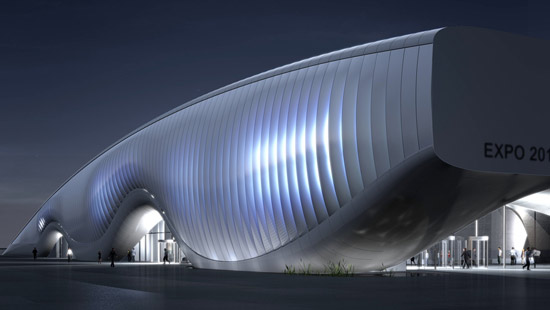
thematic pavilion expo 2012 yeosu, south korea by soma all images courtesy soma
austrian firm soma has recently finished the work on the construction plans of the thematic pavilion for the expo 2012 yeosu in korea. their winning design proposal was announced in 2009 and now has successfully been adapted to fit the building budget and exhibition concept. the kinetic media facade was developed according bionic principles to underline the expo’s agenda. soma’s project will be presented as a part of the austrian exhibition for the venice architecture biennale 2010 – curated by eric owen moss.
construction of the pavilion is due to begin next month.

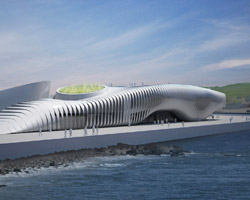
as a major and permanent facility the thematic pavilion embodies the expo’s theme ‘the living ocean and coast’ in manifold ways. the ocean is experienced in two ways, as an endless surface and in an immersed perspective as depth. the plain duality of the ocean motivates the building’s spatial and organisational concept. continuous surfaces twist from vertical to horizontal orientation and define all significant interior spaces. the vertical cones induce the visitor to immerse into the thematic exhibition. they evolve into horizontal levels that cover the foyer and become a flexible stage for the best practice area. continuous transitions between contrasting experiences also form the outer appearance of the pavilion. towards the sea the conglomeration of solid vertical cones define a new meandering coast line, a soft edge that is in constant negotiation between water and land. opposite side the pavilion develops out of the ground into an artificial roof landscape with gardens and scenic paths. the topographic lines of the roof turn into lamellas of the kinetic media facade that faces the expo’s entrance and the ‘digital gallery’.
the building will be erected in a former industrial harbour along a new promenade. bridges will connect the pavilion to the expo site. after the expo and the aspired improvement of water quality the promenade will be transformed into an ‘urban beach’ offering leisure activities to the public.

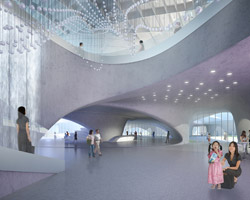
the main entrance is situated on ocean plaza, which is partly covered by the pavilion to achieve a shaded outdoor waiting area. the space boundaries of the open foyer are defined by the twisting surfaces of the cones. the interstitial spaces between them frame the view onto the ocean and create niches for the visitors to take a pause from the exhibition. the sequence of pre-show, main show and post show is spatially modulated: lingering through the first two small cones with a ceiling height of 8 meters people arrive at the main show, a 20 meter high space of 1000square meters. after the show people arrive again at the lower and more intimate post-show that leads to the café and aswimming island in the open water, where they can relax and experience the movement of the ocean. visitors with a deeper interest can take the escalator to the second level, where the best practice area, an open, flexible day-lit space is located. here institutions will present their research in fields like renewable energies or marine technology. from the foyer or the best practice area visitors can take stairs or lifts up to the roof top garden. the roof-landscape functions as a third exhibition area, which invites people to relax and enjoy a 360-degree view over the expo site. roof gardens will be covered with plants of the local coast. to leave the pavilion people stroll down a meandering ramp with panoramic views onto the surrounding ocean and the islands.

service functions, like offices, technical and storage areas are located underneath the landscape part of the building. after the period of the expo the building will house public and educational facilities.

as a counter part to the virtual multi-media shows of the thematic exhibition, the kinetic facade like the overall architecture of the pavilion evoke sensuous experiences through analogue means. beside their function to control light conditions in the foyer and the best practice area the moving the lamellas will create animated patterns on the façade. the choreography will span from subtle local movements to overall waves effecting the whole length of the building. after sunset the analogue visual effect of the moving lamellas is intensified by linear led bars, which are located at the inner side of the front edge of the lamella. in opened position the led can light the neighboring lamella depending on the opening angle. the bionic principle of the lamellas produce a consistent effect: geometry, material, movement and light are seamlessly interrelated. the longer the single lamella – the wider the opening angle – the bigger the area which is lit.

the foyer and the best practice area are naturally ventilated. therefore the interstitial spaces between the cones were orientated towards the prevailing wind direction to create air nozzles. in the large vertical exhibitions, air will be infused through the floor, to reduce the amount of conditioned volume. during daytime the kinetic lamellas are used to control solar input. they will be operated by energy gained through solar panels on the roof. the building’sperformance was analysed by detailed simulations to reduce energy consumption and increase efficiency.

the different appearances of the building – open towards the expo site and compact towards the sea- is also routed in the constraints of the site. facing the open sea the reinforced concrete cones prevent the pavilion from damage through typhoons and high waves. the roof and the kinetic facade will have a steel sub-structure. the kinetic facade will be produced out of GFRP and uses the material characteristics and flexibility for its mode of operation.
 model of the thematic pavilion expo 2012 yeosu
 model of the thematic pavilion expo 2012 yeosu
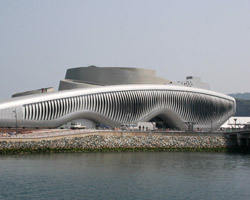
 the pavilion is wrapped around a cylindrical form
start of construction: 2010 (completion 2012) client: the organizing committee for expo yeosu 2012 architect: soma local partner: DMP, seoul consultants: structural engineer: brandstätter zt gmbh, salzburg kinetic facade: knippers helbig, stuttgart climate design: transsolar, stuttgart münchen new york climate design (competition): jan cremers, stuttgart light design: podpod, vienna team soma: stefan rutzinger, kristina schinegger, martin oberascher, günther weber, lukas galehr, christoph treberspurg, alice mayer, victorie senesova, karin dobbler, kathrin dörfler, raimund krenmüller
SOMA (6)
 May 11, 2012
 Jan 21, 2012
 Apr 10, 2011
 Dec 06, 2010
 Oct 30, 2009
VENICE ARCHITECTURE BIENNALE 2010 (68)
 Mar 20, 2013
 Nov 22, 2010
 Oct 02, 2010
 Oct 01, 2010
 Sep 28, 2010
PRODUCT LIBRARY
 Apr 02, 2024
 Mar 31, 2024
 Mar 21, 2024
 Mar 20, 2024