harvest green project-02 image courtesy romses architects
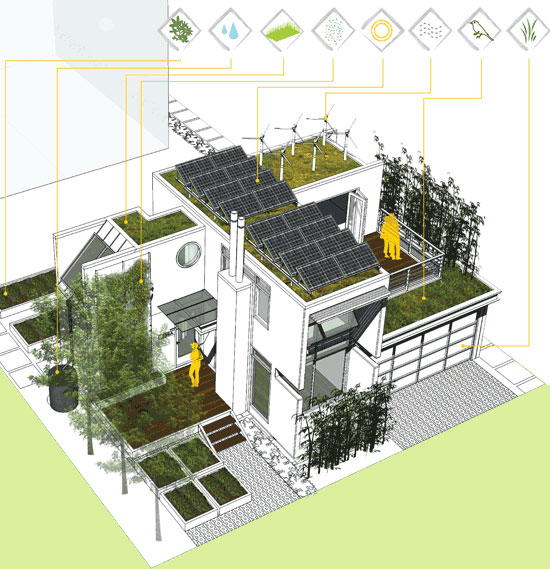
romses architects has designed ‘harvest green project -02’ as a part of vancouver ‘the 2030 challenge’. harvest green project is rooted in a concept that challenges the status quo of how energy and food is produced, delivered and sustained in our city, neighbourhoods, and individual single-family homes. taking cues from the citys eco-density charter, and in particular, it’s new laneway housing initiatives, the harvest green project proposes to overlay a new ‘green energy and food web’ across the numerous residential neighborhoods and laneways within the city as these communities address future increased densification. the city’s laneways will be transformed into green energy and food conduits, or ‘green streets’, where energy and food is ‘harvested’ via proposed micro laneway live-work homes.
an array of mobile nomadic prefab laneway homes (‘modpods’) are proposed to provide needed adaptable affordable housing for the city, but equally important, will act as incremental nodes of sustainable energy and urban farming infrastructure for it and the immediate home, as well as the city at large. the laneway homes will act as an armature for the harvesting of renewable energy sources such as solar, and wind, with excess energy sold back to energy companies to feed into the rest of the city’s energy system. the concept of ‘harvesting’ is also explored more literally, in the project, where the laneways and modpods will act as a venue for the harvesting of rainwater and urban farming food. private and communal rainwater cisterns will provide irrigation for edible green roofs, community and private edible gardens, fruit bearing vegetation, and vertical gardens that will inhabit the facades, laneway, and yards and spaces between buildings. the goal is for homeowners to re-think the obsession with the suburban lawn, in favor of creating ‘edible-estates’.
to help sustain the city’s energy needs, generate energy surpluses, and reach the goals of ‘the 2030 challenge’, the government and energy companies could provide home owners with incentives to ‘over-design’ the energy harvesting technologies of their modpod’s. this could also help generate income for the home owner that, with the help of creative financing packages from financial institutions, could help to amortize the costs of the green technologies proposed.
 harvest green project-02 image courtesy romses architects
 harvest green project-02 image courtesy romses architects
 green street (laneways) image courtesy romses architectsinspired by the vibrant traditional mixed-use ‘hutong’ laneway housing throughout china, the harvest green project seeks to transform vancouver’s hidden laneways into synergistic ‘green streets’. a new space where environmental, social, urban design, and community aspirations intersect while respecting and enhancing the existing single family fabric of the surrounding neighborhood. a proposed 10m zone of the rear of the owners single family land parcel will be designated as a flex zone where they can live, work, or even rent this land to the adjacent community or city for such environmental programming elements such as: shared car co-op parking, community gardens, communal energy harvesting, communal rainwater cistern, pocket parks etc. as individual lot parcels develop laneway housing, the standard 6m paved laneway would slowly be remediated to a permeable 4m paved surface with rain gardens, bio-swales and lay-by’s for cars passing in opposite directions.
 harvest green project-02 image courtesy romses architects
 harvest green project-02 image courtesy romses architects
 green prefab ‘modpods’image courtesy romses architects
an explicitly green prefab micro-module is proposed that can be stacked, mirrored, rotated vertically, and sited in multiple configurations and sizes to create a dynamic, and varied built-form experience along the green street laneways. they are prefabricated modules and scaled to fit on a standard flat bed truck to promote adaptability, ease of construction, minimize construction waste, and to sit nimbly on the site on point footings to minimize site and ecological disturbance. in addition to providing a much needed compact affordable supply of rental accommodation, these live-work ‘modpods’ will allow ‘clean’ environmentally friendly program uses such as home office, bed and breakfast, artist studio, or such communal uses as neighborhood recycling depot, urban produce food store, or small-scale daycare.
PREFABRICATED HOMES AND BUILDINGS (199)
 Nov 02, 2023
 Oct 06, 2023
 Oct 04, 2023
 Sep 19, 2023
 Sep 13, 2023
URBAN FARMING (84)
 Oct 05, 2023
 Aug 18, 2023
 Mar 12, 2023
 Dec 22, 2022
 Dec 14, 2022
VANCOUVER 2030 (5)
 May 18, 2009
 May 12, 2009
 May 08, 2009
 May 06, 2009
PRODUCT LIBRARY
 Apr 02, 2024
 Mar 31, 2024
 Mar 21, 2024
 Mar 20, 2024