visiondivision: 'umbrella' children's hospital project, rwanda

hospital in rwanda - phase 1 by visiondivision
all images courtesy visiondivision
visiondivision architects have sent us in images of their latest project which was
part of the 'design for children' competition to design a hospital in rwanda.
insufficient water is one of the most severe problems in rural africa, bearing this
in mind the architects thought of using a from similar to an upside down umbrella
for dew/rainwater collecting, where they went to the the sahara desert to experiment
with the concept.
the new hospital prototype is simple consisting of an upscaled upside down umbrella
which serves as a roof to an already built rural hospital. the umbrella roof is gathering
rainwater or dew depending on the location to supply the hospital with clean water.
the big umbrella also serves as a light roof giving shadow to the hospital.
phase I - the structure is made out of light felt and steel. in the middle of the umbrella
shaped tent there is a water container gathering the clean water from the roof.
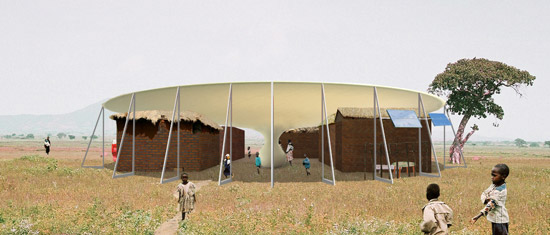
phase II
at first the hospital is built as a small village with local materials under the umbrella,
the water container becomes the midpoint of the hospital. the hospital gets energy
supply from solar panels.
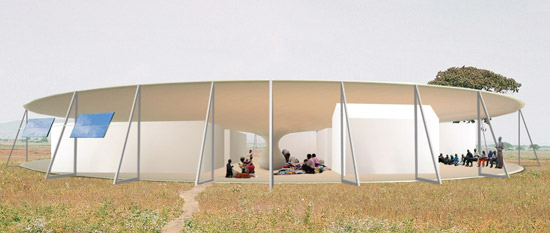
phase III
when the hospital grows the umbrella can easily grow by adding an outer layer of felt
and moving the pillars outwards from the centre point. the different houses expands
by mirroring themselves outwards. as the structure grows the water supply surface gets
bigger at the same time.
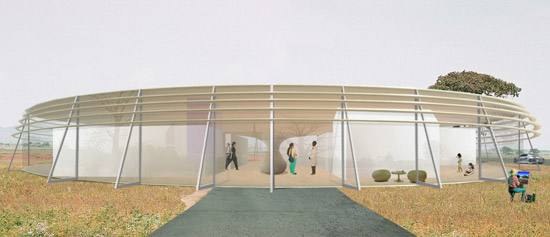
phase IV
as time goes by, modern materials can be added to improve the village without
interfering with the design. our hope is that the structure becomes a roof for constant
developing.
phase V
as a final stage a facade with sun protection can be added, making the building into
a modern hospital. It is our hope and belief that the regions in need for this hospital
will develop into strong economies one day. this building is prepared to stand in better
times as well.
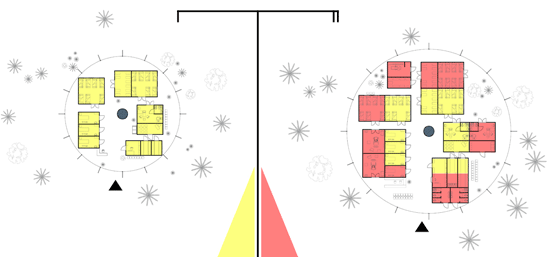
plans of hospital

experimentation in the sahara desert
cheers
It is also important that a project like this has in house maitenance, that is to say that someone on the ground can repair, upgrade and innovate upon the original concept.
Simply, mine is an arguement for education to accompany this currently idealistic project.
Much more extensive
Sorry too get argumentative with you, but you need to look at the NEEDS of the people and understand that the MUT project is about 20 times larger, hence, the more complicated YET BUILDABLE design - they use woven bamboo, and because they have all those cisterns they needed to make the 'complicated' (looking) form - anyone in the world can weave bamboo with little training.. And everything in Mut's project is locally sourced, including the mud to make the buildings.. the image of the one above is simply more blob architecture without thinking about the people in need.
Blob-architecture?
The canopy is all function if you ask me, and it is a quite strange argument that their project is bigger, so what, it is all proportional?
I also find it strange that you say the bamboo is a "local" product, the competition was a prototype hospital, it should be erected on different places around east Africa, with different natural resources.
I have lived in Kenya for 15 years and I have never seen bamboo there, and I have traveled vastly.
The whole thing about teaching them to build in mud and so forth, is to patronize the african people, they have built houses for thousands of years for crying out loud! Before Europe had settlements.
In this proposal I see great things with small means, a canopy and a masterplan, and everything else is made locally, thus more flexible on the site; (wood, clay, concrete, bricks depending).
I think african architecture needs more projects like this.
And regarding mud architecture - I guess your experience is as lacking: http://www.eartharchitecture.org/
I'm guessing you really haven't lived in Kenya, or you'd know how difficult it is in the locations these guys are designing for to produce what you say are (wood, clay, concrete???!! and brick) And no-one said anything about "teaching" the african people how to build with mud.. I just said that the materials can be locally sourced.. Bamboo is the most versatile building product on the planet and actually regenerates lost molecules from the ozone layer.
The project above looks like something my 10 year old girl could design in sketchup. I see no solutions in this project.. other than that they tried.. and I commend them for that, but there's really not much there other than that they related their project to an image of an upturned umbrella.
Do you work at this studio or something?
visiondivision: the patient gardener
ten japanese cherry trees will grow into a two story study retreat at the politecnico di milano in italy.
visiondivision: chop stick
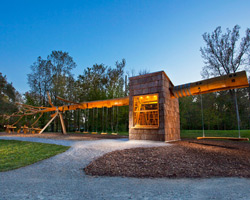
a concession stand conceived for the indianapolis museum of art in which the raw material selected for the structure is a 100-foot yellow poplar tree which lies horizontally.
visiondivision: paper cut parlor
the main feature of the redesigned space is its ceiling. replacing the usual 60 x 60cm tile plates found in hospital and most public spaces in sweden, visiondivision has developed a custom disk of form pressed trans...
4of7 architecture: pediatric clinic, east afr
the idea behind the modular configuration is to define a spatial solution which would be able to grow and adapt according to the changing need; or according to varied conditions in different locations.
we are not from kalamazoo: children's hospita
the materials of the project are the most commonly used around east africa ; pallet of sun dried earth bricks, corrugated steel mono pitch roofs and wooden frame windows
temporary pavilion made of lego
the 'abondantus gigantus' space was formed entirely from lego bricks and intended as a meeting point and stage for performances...
gymnastics furniture by MEJD studio
the home furniture series has been developed to mirror the shapes of well known gymnastic equipment.
RENAULT 4 ever behind-the-scenes
'horsey' by eungi kim
SELFPROMO - january 17 - march 17
POP UP - january 17 - march 17
keep up to date with recent articles and upcoming events.
to receive both newsletters please check 2 boxes.
no contents, including text, photographs, videos, etc. may be reproduced in whole or in part without the written consent of designboom. in addition,
no material or contents may be reproduced on the world wide web by techniques of mirroring, framing, posting, etc. without the written consent of designboom.

submit a project
publish a project
email
RSS
facebook
twitter