
designboom has dedicated a large amount of time to learn more about clay – one of the earliest natural buildingmaterials in history of men. our intent is to promote earth also as a building material of the future. it represents an excellent alternative to cement whose manufacture releases considerable quantities of CO2. individual housing units and small apartment buildings can easily be built from earth in every part of the world. however, concrete remains an essential material for high-rise construction. the research effort should be therefore two-pronged: tailoring earth to the needs of modern construction and making concrete ‘greener’.
in this first article of a series, which we will publish in the upcoming weeks, we’ll examine a few ancient building techniques.
the musgum, an ethnic group in far north province in cameroon, created their homes from compressed sun-dried mud. the tall conical dwellings, in the shape of a shell (artillery), featured geometric raised patterns.
musgum clay houses in cameroon
what strikes at first sight is their almost organic simplicity, a second reading reveals the functions behind the forms.the walls of the houses are thicker at the base than at the summit, which increases the stability of the building. detail
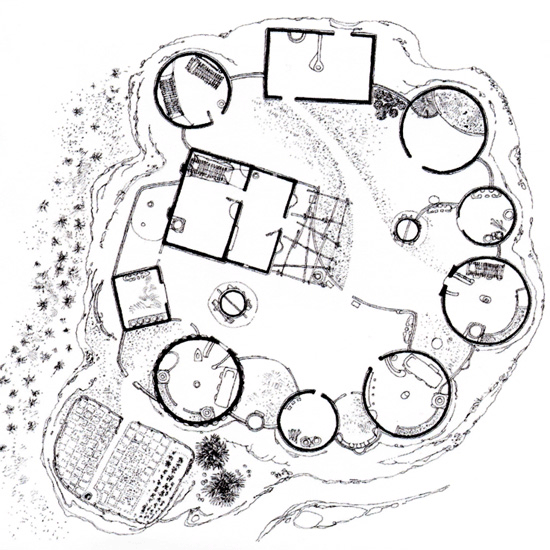 a characteristic settlement form is the compound, a cluster of units linked by walls
the domed huts of the musgum people are built in shaped mud, a variant of cob. cob building is the most widely used technique in the world, since no tools are needed – hands, earth and water are enough.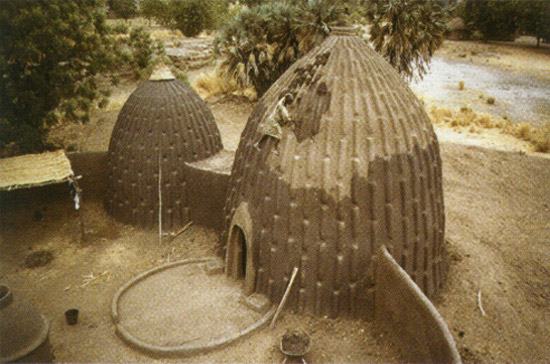
the name of these houses (‘cases obos’) comes from their similarity with the profile of shells. it is very close to the catenary arch, the ideal mathematical form to bear a maximum weight with minimal material. this profile also reduces the pressure effect of the impact of water drops on the walls. furthermore, the extraordinary height (up to 9 meters) of these houses provides a comfort climate during hot days. the top of the house is pierced with a circular opening, allowing the air to circulate, resulting in the sensation of freshness. today, these buildings have become somewhat obsolete, with only a few groups still practicing this ‘cases obos’ type of construction.
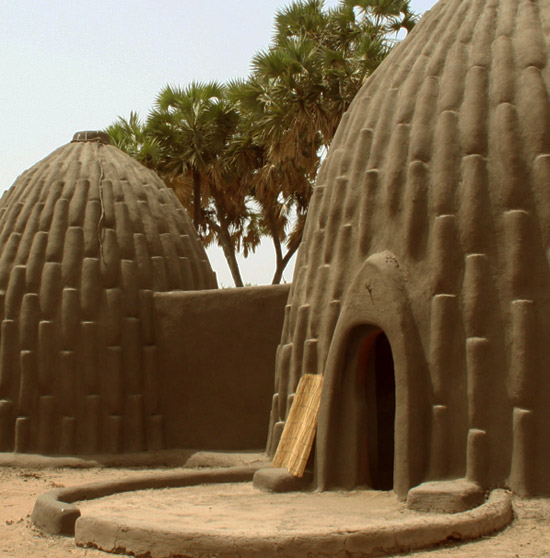 it is customary to lay the mud spirally in lifts of approximately half a metre, allowing each lift to dry before adding the next.
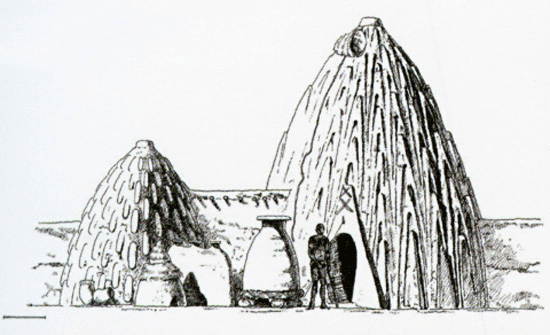 drawing of a musgum dwelling
 cross section of a musgum dwelling
 … in the shape of a shell
curves and grooves are the language of natural forms. the musgum house follows the profile of shells – the arc of a chain. bows and vaults obtained in this way can be very slim and allow the use of a minimum of material for maximum rigidity. the arc adopting the inverted profile (figure below) will only work in compression and does not produces parasitic twisting or bending moments.
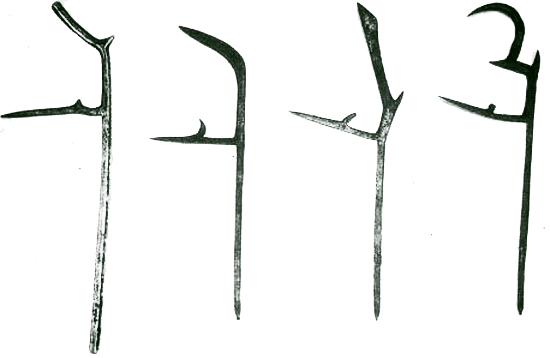 musgum throwing knives
 maintenance of a musgum
the decorative surface allows for further refinement and individualization. the veins are also contributing to the drainage of rain. the musgum houses require regular maintenance of the coating and the veins allow people to climb atop the building.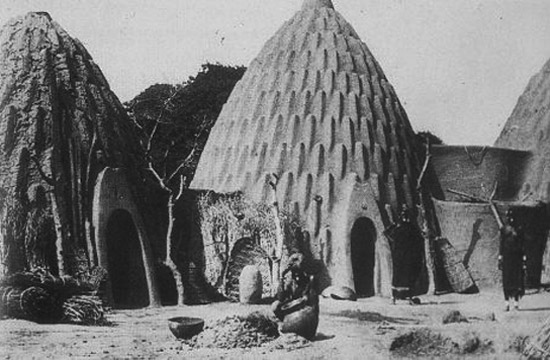 historic images
 historic images
the construction technique of musgum clay houses is currently also mentioned in the exhibition ‘ma terre premiere pour construire demain’. it explores how and why we should build with earth. on show at the cité des science et de l’industrie, paris until june 10th, 2010.
EARTH ARCHITECTURE (56)
 Mar 17, 2024
 Jan 16, 2024
 Jan 09, 2024
 Aug 26, 2023
 Aug 15, 2023
PRODUCT LIBRARY
 Apr 02, 2024
 Mar 31, 2024
 Mar 21, 2024
 Mar 20, 2024