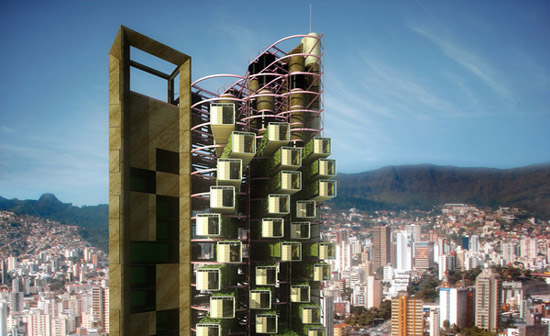

‘portability housing’ skyscraper
brazilian architect felipe campolina has developed ‘portable housing’, a skyscraper
design that is composed of hundred of mobile units. currently, the need to inhabit the
planet sustainably is an increasing concern for the future. thus, the concept of portable
housing was created with a construction system that deals with both, environmental and
social issues. these individual living units start from a modular system scaled from
the standard OSB plate (oriented strand board) of 1,22m x 2,44m.
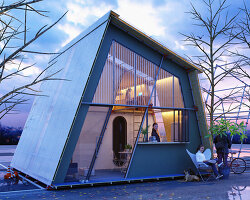
the mobile units are composed of a steel frame structure, vertical walls and floor in
OSB with thermo-acoustic insulation, windows in tempered glass, green roof and walls,
and is equipped with a water recycling system.
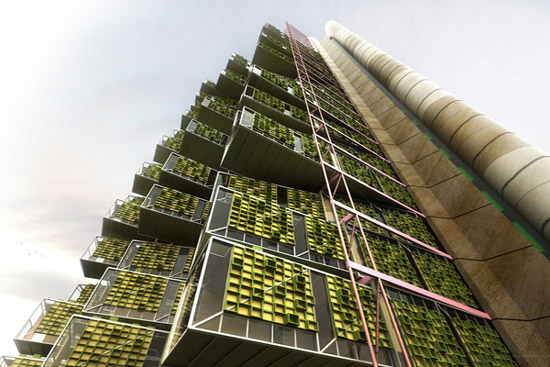
‘portability housing’ skyscraper detail
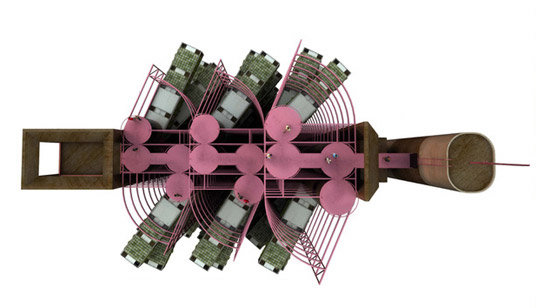
aerial view of ‘portability housing’ skyscraper
the tower in which the mobile units are housed is an empty metallic structure consisting
of rails. every floor of the tower can receive up to six independent units, each of which can
transfer in and out without interfering with its neighbours. on the left side of skyscraper,
a house lift is installed to transport the housing units from the ground floor to its destined
floor level. on the other side, there is an elevator and fire escape to be used by the residents.
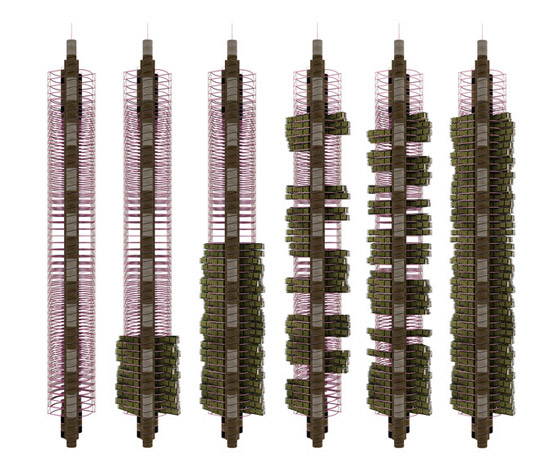
the compact structural shape of the tower makes it an ideal building for very dense urban
centers where space is limited. however, the modular nature of the building allows it to
expand both horizontally and vertically and, thus, can be adjusted according to the skyline
of the city.
this proposed design was part of the 2010 skyscraper competition organized by evolo magazine.
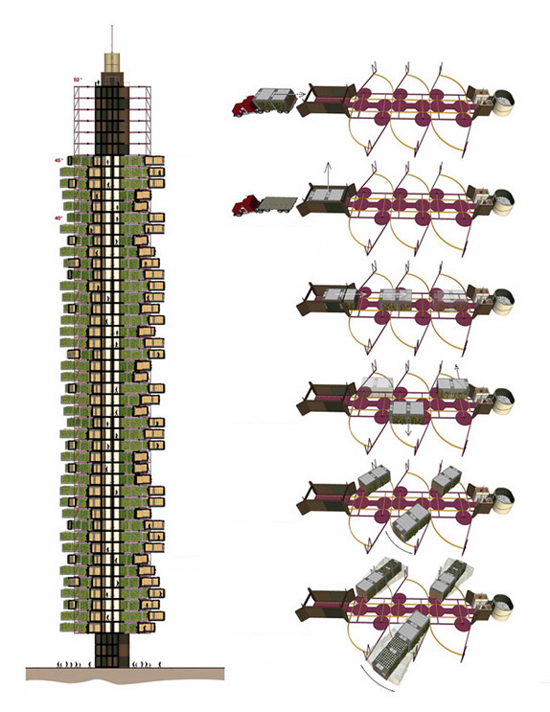
diagram showcasing the various steps in which the mobile units are moved in and out of the metallic tower frame:
1. delivery (load the house lift)
2. house lift (up to the destined level)
3. center rail (slide to your box)
4. side rail (slide to center pivot)
5. arc rail (lock on the center pivot)
6. telescope (enjoy the view)
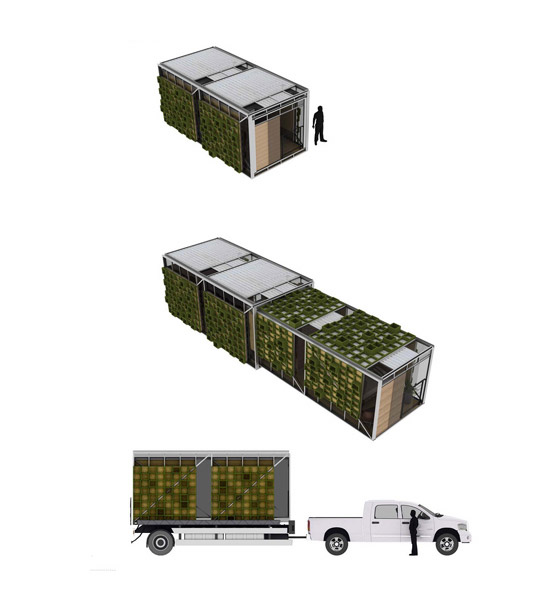
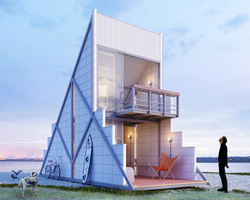
the mobile units in various modes, from top to bottom:
1. compact mode (area = 17m2)
2. telescope mode (area = 32 m2)
3. transport mode
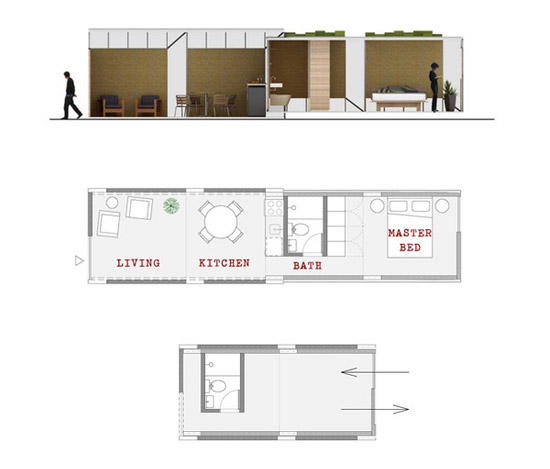
interior sectional view and site plan of mobile unit
2010 skyscraper competition (13)
 Mar 18, 2010
 Mar 18, 2010
 Mar 17, 2010
 Mar 16, 2010
 Mar 12, 2010
felipe campolina (3)
PRODUCT LIBRARY
 Apr 27, 2024
 Apr 02, 2024
 Mar 31, 2024
 Mar 21, 2024