quirky and sculptural retail facades: a global tour
from tokyo to toronto, brands are embracing sculptural exteriors, oversized surreal forms, and material experimentation.
When Retail Puts on a Surreal New Face
In an age when storefronts compete for attention in both the physical and digital realms, some brands are taking retail facades to fantastical new heights. From Tokyo to Toronto, brands are embracing sculptural exteriors, oversized surreal forms, and material experimentation to turn their storefronts into immersive visual landmarks. Imagine a luxury boutique shaped as a giant ship docked on a city street, or a jewelry storefront bursting open as a life-sized elephant strides out. These are real examples of conceptually quirky, surreal, and sculptural facades around the world. Far from mere branding gimmicks, these facades invite passersby into a story or even a dreamscape before they ever step inside. designboom explores several recent standout projects and the playful design nature behind them, from giant objects-as-buildings to material wizardry and nature-inspired fantasies.
The ‘SITE’ Legacy and the Roots of Retail Irony
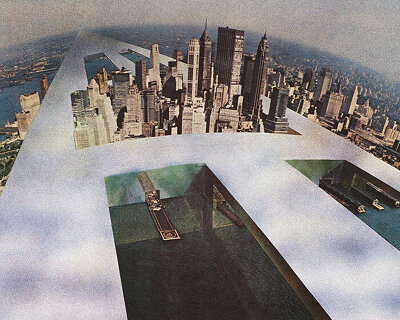
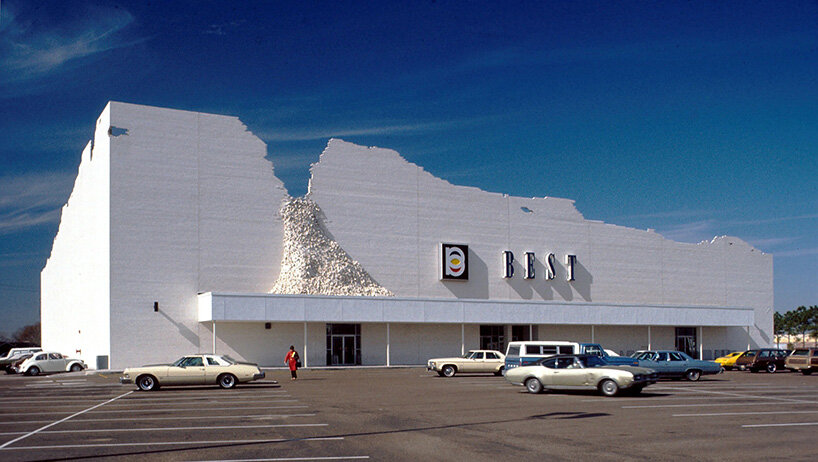
A precedent for these experiments can be traced back to the early 1970s, when James Wines and his New York-based architecture studio SITE designed a series of conceptually charged facades for the now-defunct BEST Products company. These included a crumbling brick wall, a forest piercing through the showroom, and a facade that opened like a mechanical drawer. While most of them have since been lost, their influence is undeniable. Wines’ ironic, often cheeky approach to the commercial box paved the way for contemporary facades that defy expectations.
SITE treated each facade as ‘a subject matter for art,’ turning the dull masonry boxes into ironic sculptures and visual commentary. Their designs for BEST stores became legendary in retail design and foreshadowed today’s push for experiential retail. They proved facades could be cheeky, conversation-starting, and participatory, essentially Instagrammable long before Instagram.
These iconic facades did not survive the ravages of time and commerce. When BEST Products liquidated in the 1990s, most of Wines’s masterpieces were either demolished or defaced by new owners. The famous peeling brick wall was partially stripped off by a pawn shop tenant, the forest and notch facades were removed or remodeled, and one Tilt showroom was completely razed to make way for a generic strip mall.
Yet the spirit of those experiments lives on. Today, in an era of ‘experience economy’ buzzwords and competition from e-commerce, designers and brands are doubling down on facades that grab attention and spark wonder, effectively picking up where SITE left off. Contemporary retail facades around the globe are embracing quirky, playful, and subversive designs to draw in sightseers and shoppers alike. Below, we explore a selection of recent projects that exemplify this trend, from Asia to Europe to the Americas.
Luxury Brands Use Architecture to Shape Urban Identity
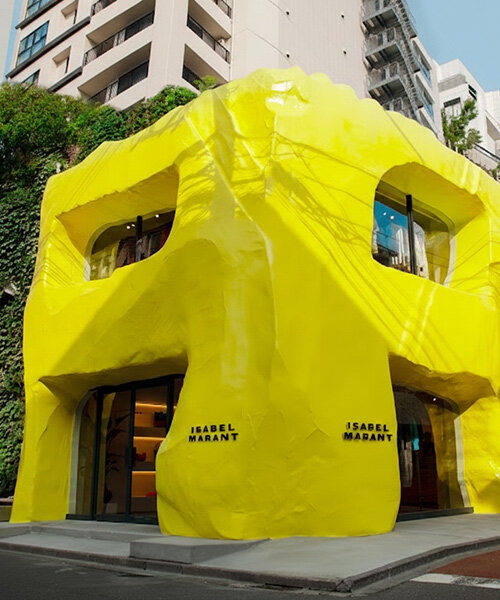
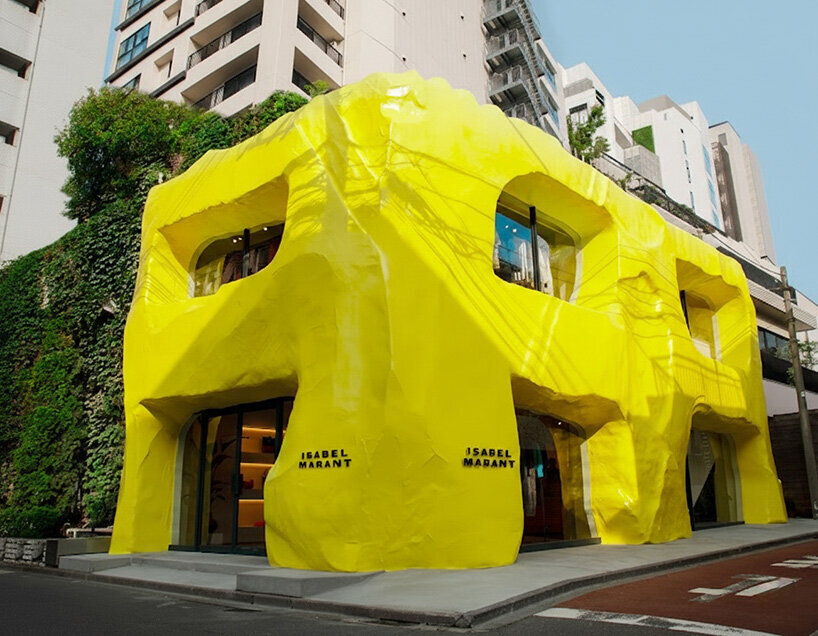
In Tokyo’s Aoyama district, Isabel Marant’s flagship distills the spirit of spatial play into a vivid yellow house. Designed with artist Yutaka Sone, the two-story building takes on an almost cartoonish presence. Its obsidian-inspired forms and lava-like detailing result in a surreal, sculptural object signaling from the street with its unapologetically bright palette and expressive plasticity.
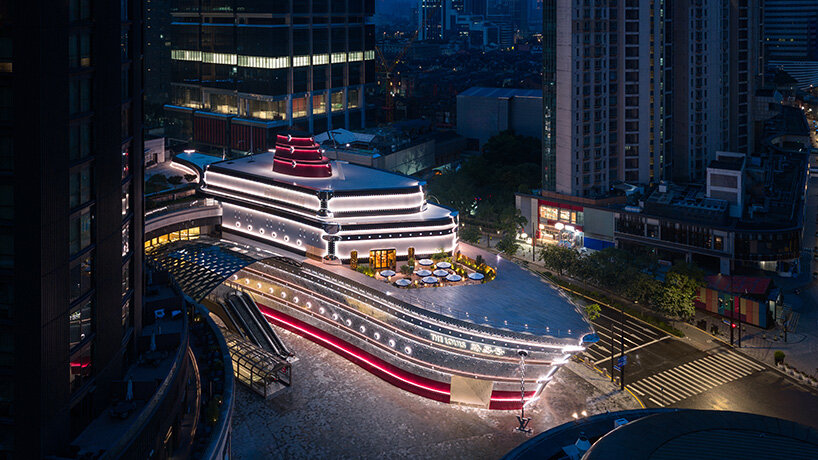
OMA’s Louis Vuitton flagship in Shanghai is designed to resemble a sailing vessel, the building curves upward like a ship’s prow, clad in metallic skin perforated with monogram motifs. Inside, stacked trunk-like forms evoke the travel legacy of the brand, while from the outside, the structure reads as both kinetic and monumental.
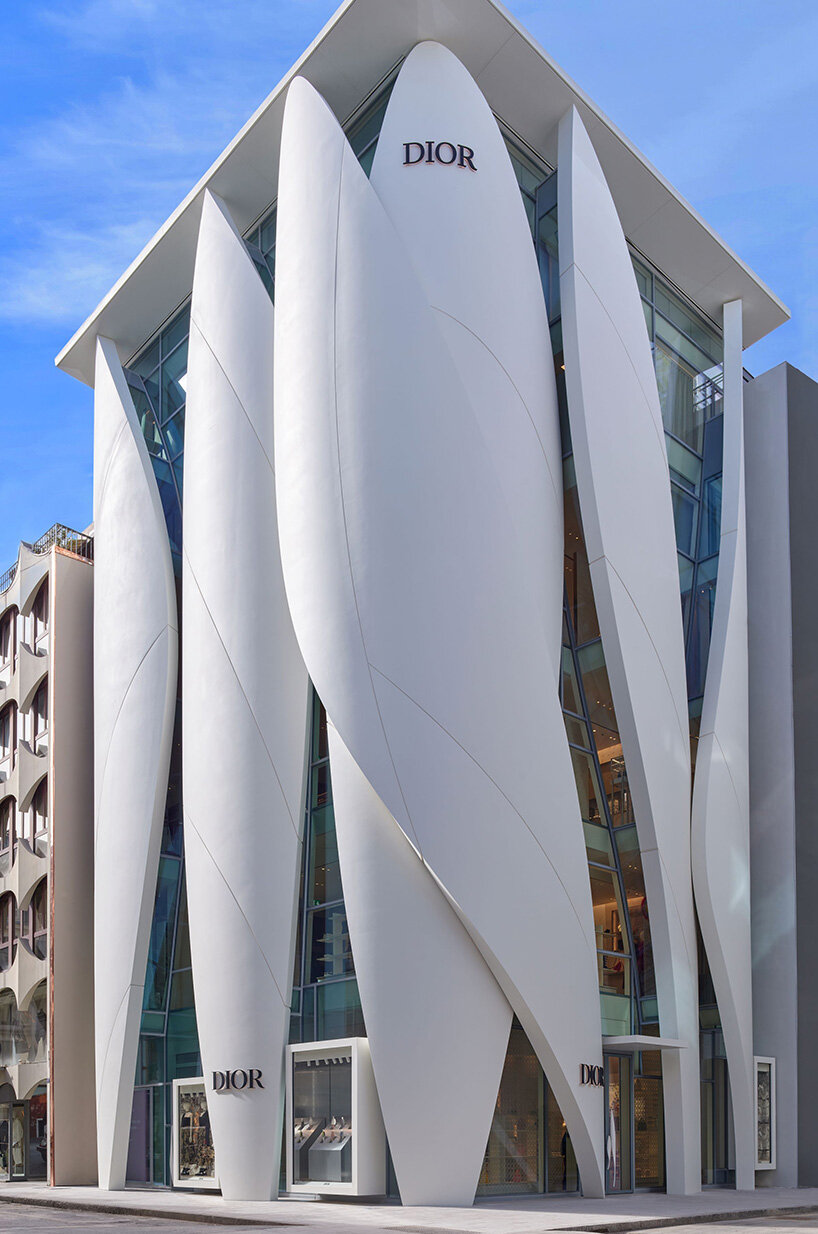
A quieter but equally sculptural approach defines Christian de Portzamparc’s Dior flagship in Geneva. The facade is composed of towering petal-like shells in glass fiber-reinforced concrete, a nod to Dior’s floral and couture heritage. Rising to over 20 meters, these interlocking forms overlap and taper, casting subtle shadows and creating rhythmic patterns of solid and void. Lit from within at night, the flagship turns into an urban lantern, evoking both architectural grace and sartorial drama.
Material Alchemy: Surface as Signature
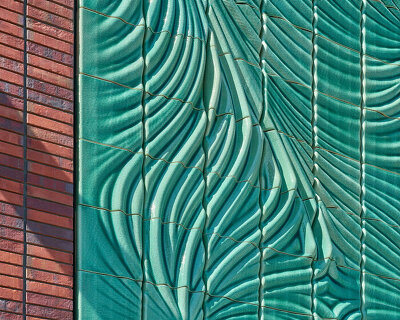
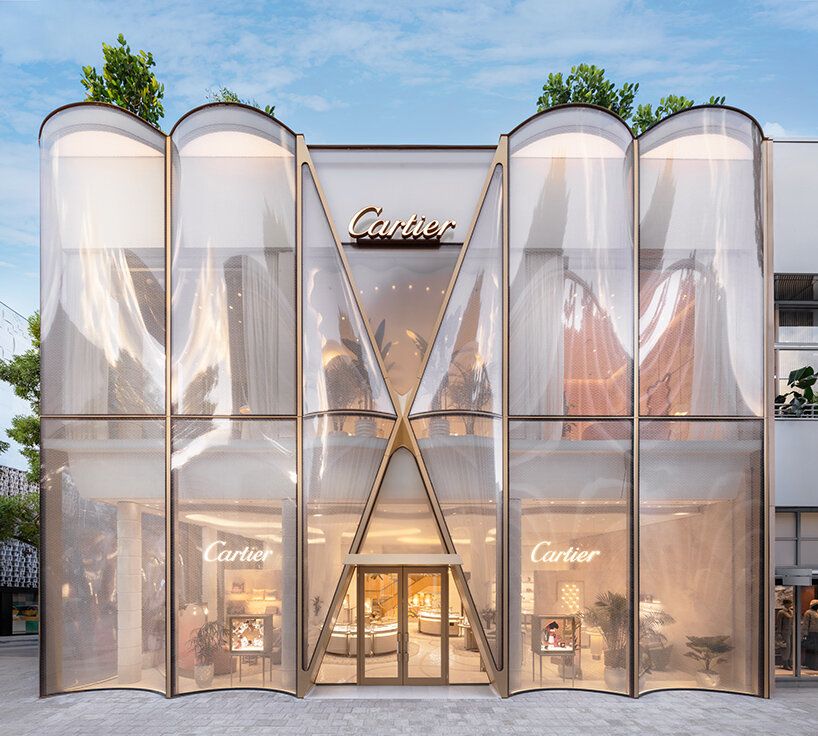
Material performance becomes the main actor in Cartier’s flagship in the Miami Design District. Diller Scofidio + Renfro encases the boutique in undulating fluted glass, its curved bays etched with a Cartier brooch motif from 1909. The rippling, iridescent facade shimmers by day and glows from within by night. I
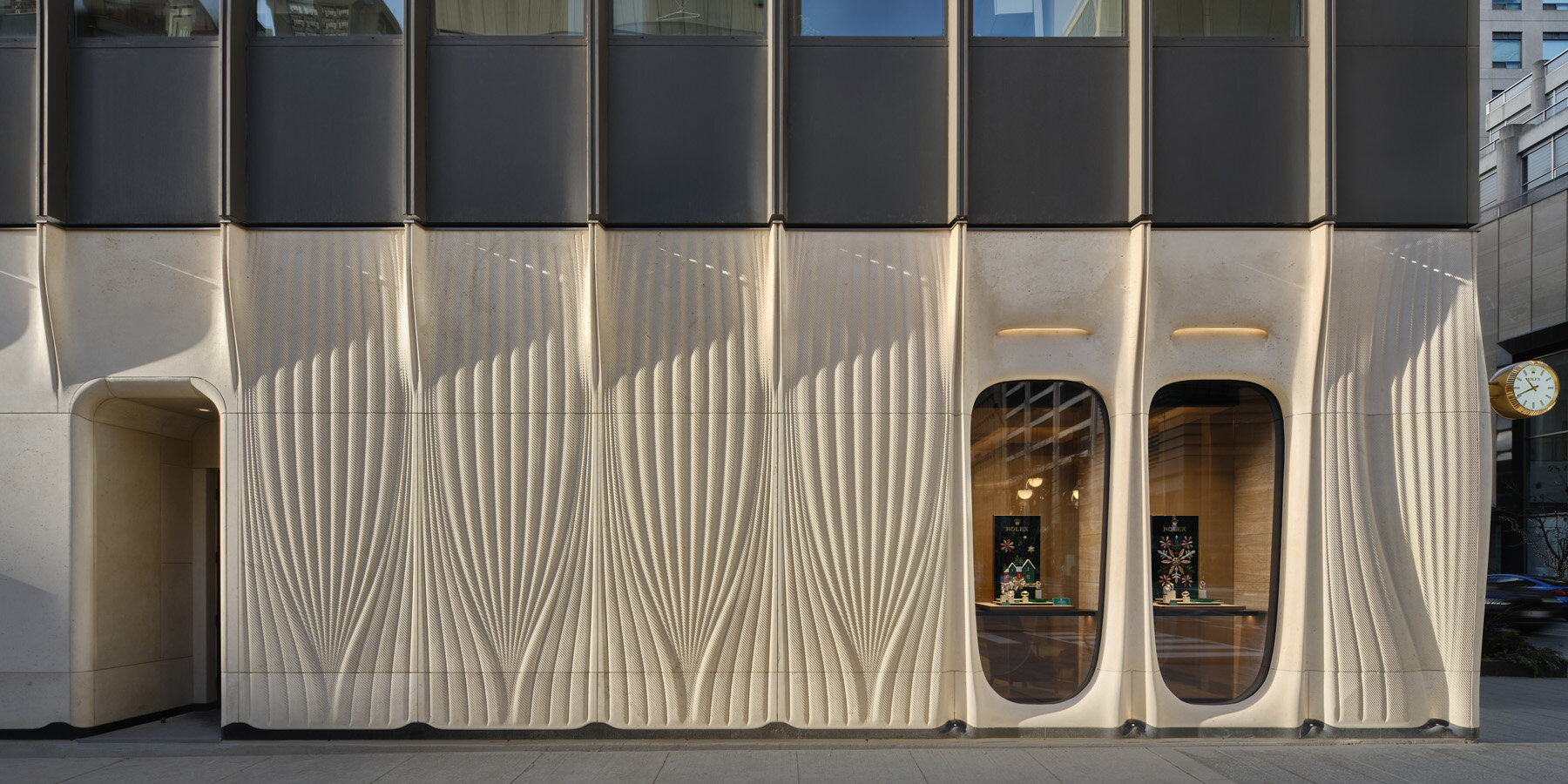
In Toronto, Partisans apply digital craft to their design for the Rolex Boutique. Carved from parametric limestone, the shell moves in soft ripples and arches. Inspired by the mechanics of Rolex watches, its fluid geometry suggests motion within stillness. On one side, a guilloché-like pattern has been CNC-etched into the stone, a reference to classic watch dials.
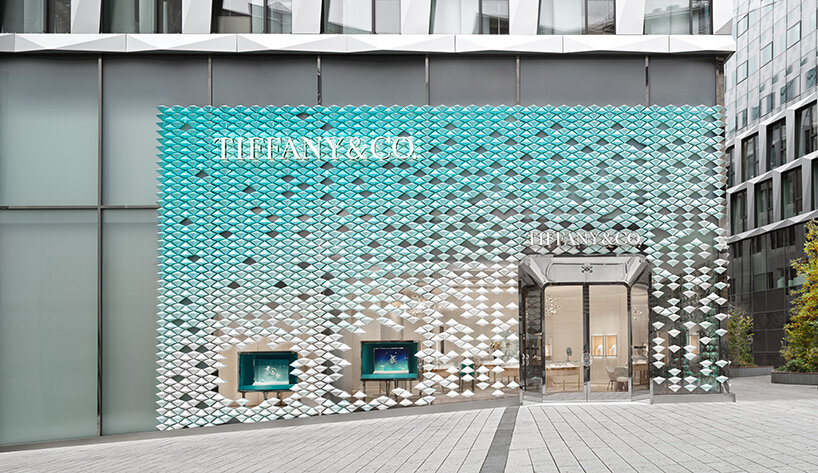
Material experimentation continues in MVRDV’s Tiffany flagship in Shanghai, where the brand’s jewelry heritage is magnified into a facade of thousands of handcrafted glass diamonds. These gem-like modules are suspended over a transparent structure, transforming the storefront into a crystalline veil. During the day, the facade glistens in natural light; by night, it glows in Tiffany blue.
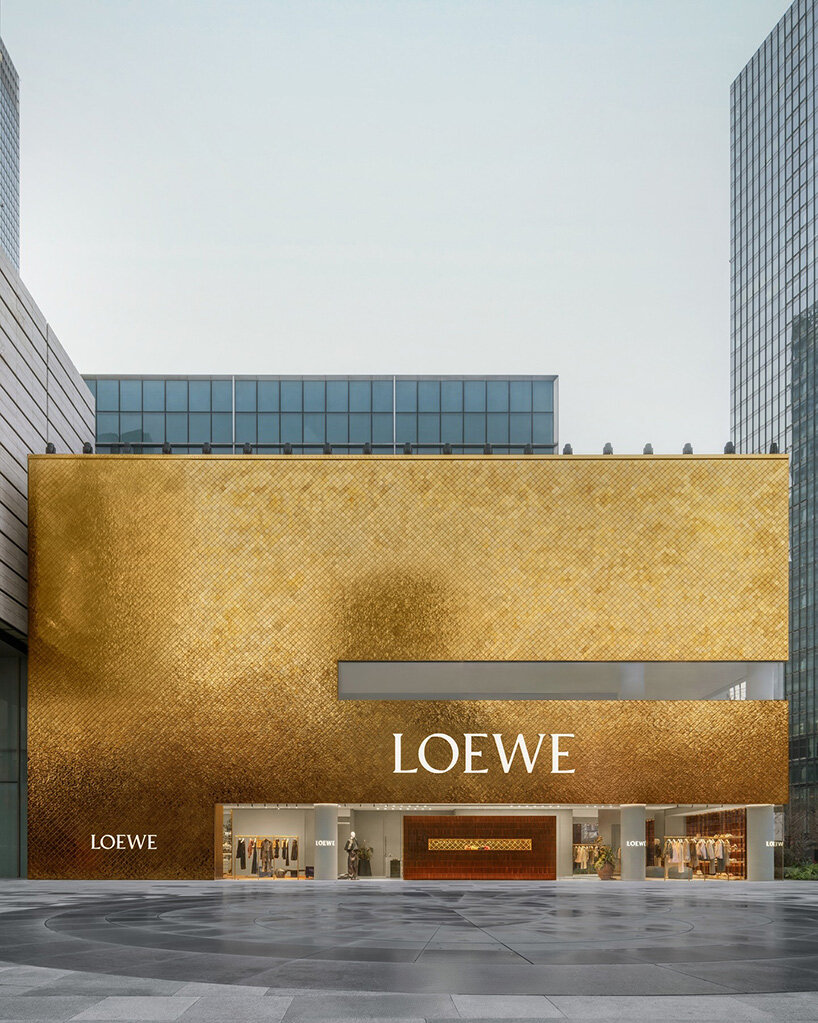
Loewe’s Casa in Shanghai takes a similar approach to tactile spectacle, this time using over 35,000 golden ceramic tiles crafted by Studio Cumella. The ceramic cladding undulates across the facade, creating depth and shimmer through hand-glazed surface variation. Referencing both Spanish craft and the gilded roofs of nearby temples, the store is wrapped in a skin that is at once contemporary and steeped in regional dialogue.
Studio RAP’s Ceramic House in Amsterdam also harnesses digital craft, combining 3D printed bricks and tiles into a flowing, textile-inspired facade. Waves of clay rise and fall across the building, echoing stitch patterns and baroque ornamentation. While it nods to historic Dutch craftsmanship, the execution is entirely futuristic, making it a standout on the city’s luxury shopping corridor.
Figurative Facades and Playful Spectacle
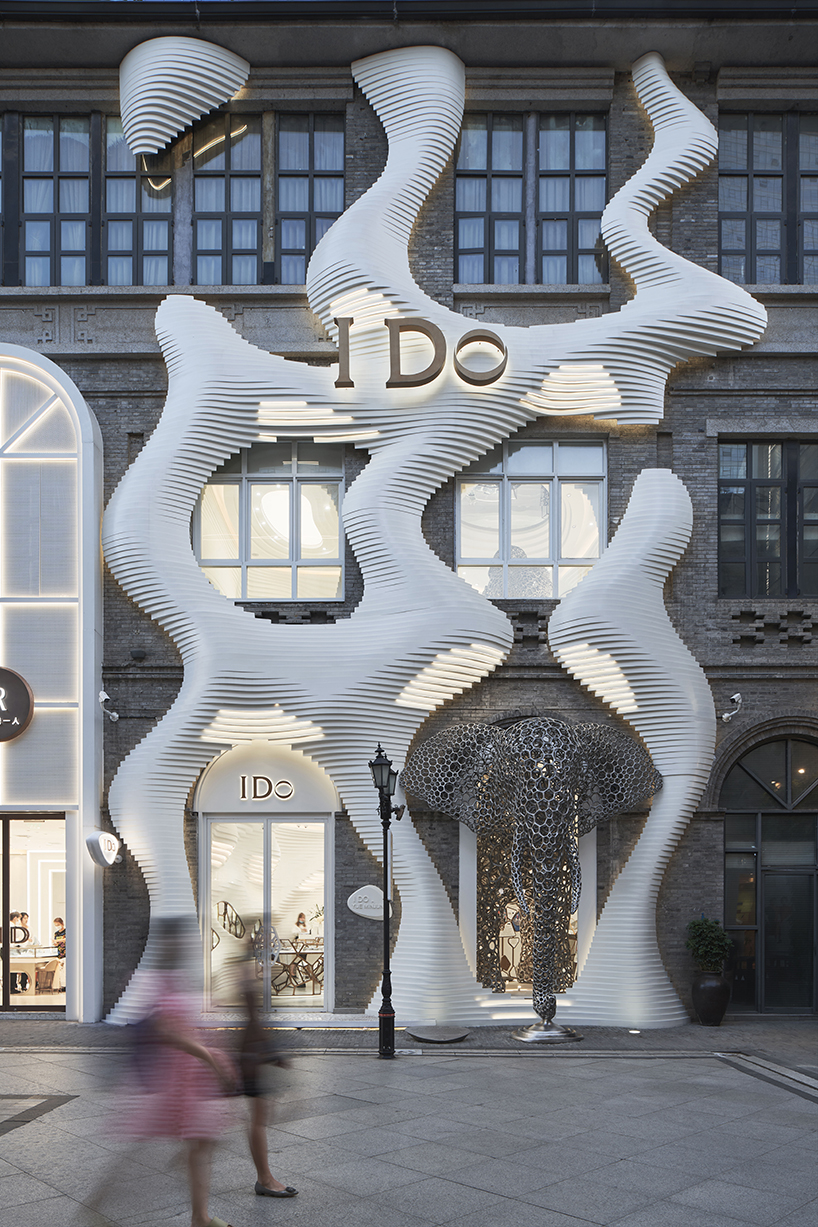
Literal figuration enters the scene in Wuhan, where AntiStatics Architecture designed a jewelry store featuring a life-sized elephant sculpture that bursts through the facade. Constructed with 3D printed steel latticework, the elephant carries one of artist Yue Minjun’s grinning figures on its back. The surrealism continues inside, with the cave-like, crystalline aesthetic.
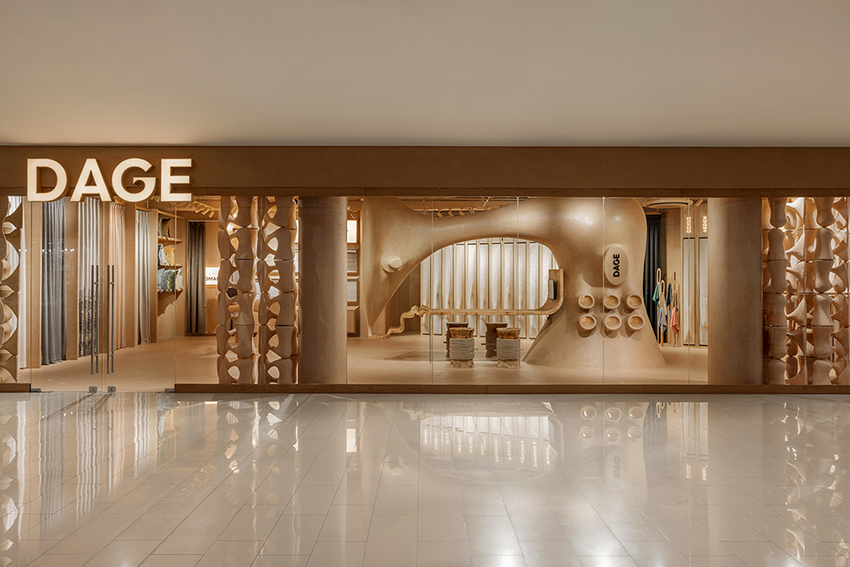
Playful literalism also defines the Dage Curtain Store by Molos, where a giant sculpture of a vintage sewing machine becomes window display. Set against an otherwise minimalist backdrop, the oversized object hints at the dedication of the brand to fabric and tailoring while creating a dramatic visual hook from the street.
Nature, Fantasy, and Urban Storytelling
Other recent examples lean into natural symbolism and immersive materiality. In Seoul, the flagship for beauty brand Skin1004, designed by LMTLS, appears as a rocky outcrop transplanted from Madagascar. The rich textures and earthy palette of the facade are a direct expression of the brand’s use of natural ingredients. UNStudio’s Huawei flagship in Shanghai interprets flower petals into a layered white facade. Biophilic and sleek, it evolves in scale and rotation as it ascends the building, creating a sense of blooming in the urban fabric.
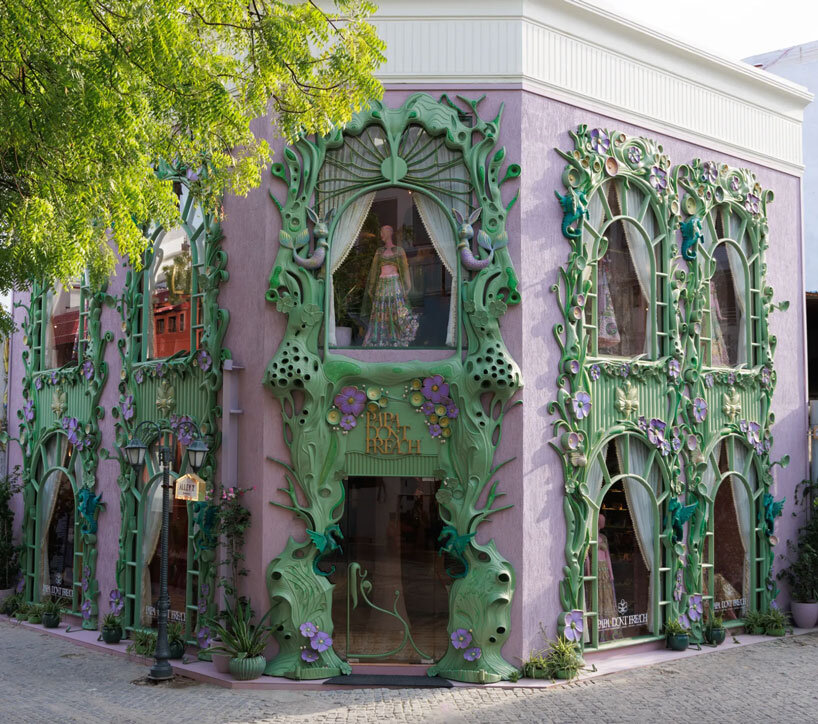
A fairytale aesthetic defines the new Papa Don’t Preach boutique in Delhi. Sculptural wooden flowers, pastel-hued carvings, and marine creatures wrap the building in a whimsical skin. Designed by DesignHex, the facade recalls childhood fantasies and couture drama, creating a storefront that functions like a dream sequence. From elephants to obsidian to ceramic couture, these recent facades aim to make architecture expressive, immersive, and delightfully bizarre.
Ceramic House by Studio RAP in Amsterdam | video © Oculus Film
shop
your own online design shop — no sales commission collected