designboom has received this project from our DIY submissions feature, where we welcome our readers to submit their own work for publication. see more project submissions from our readers here.

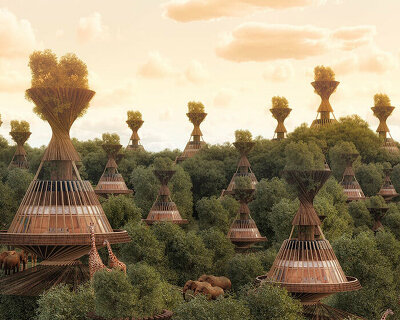
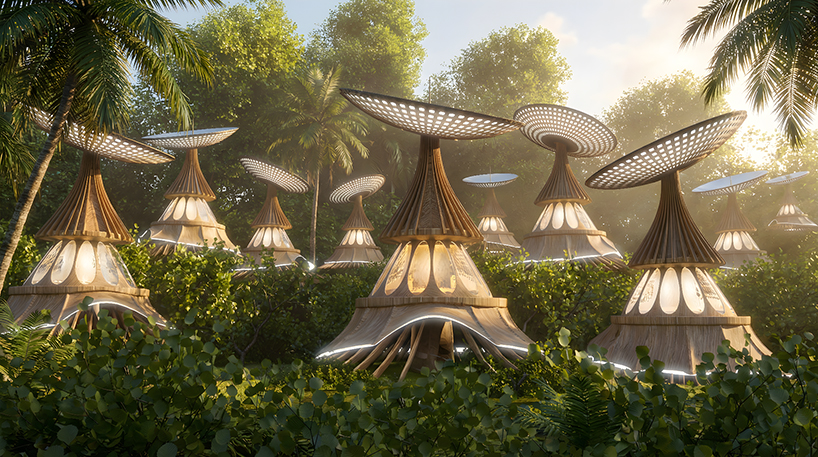
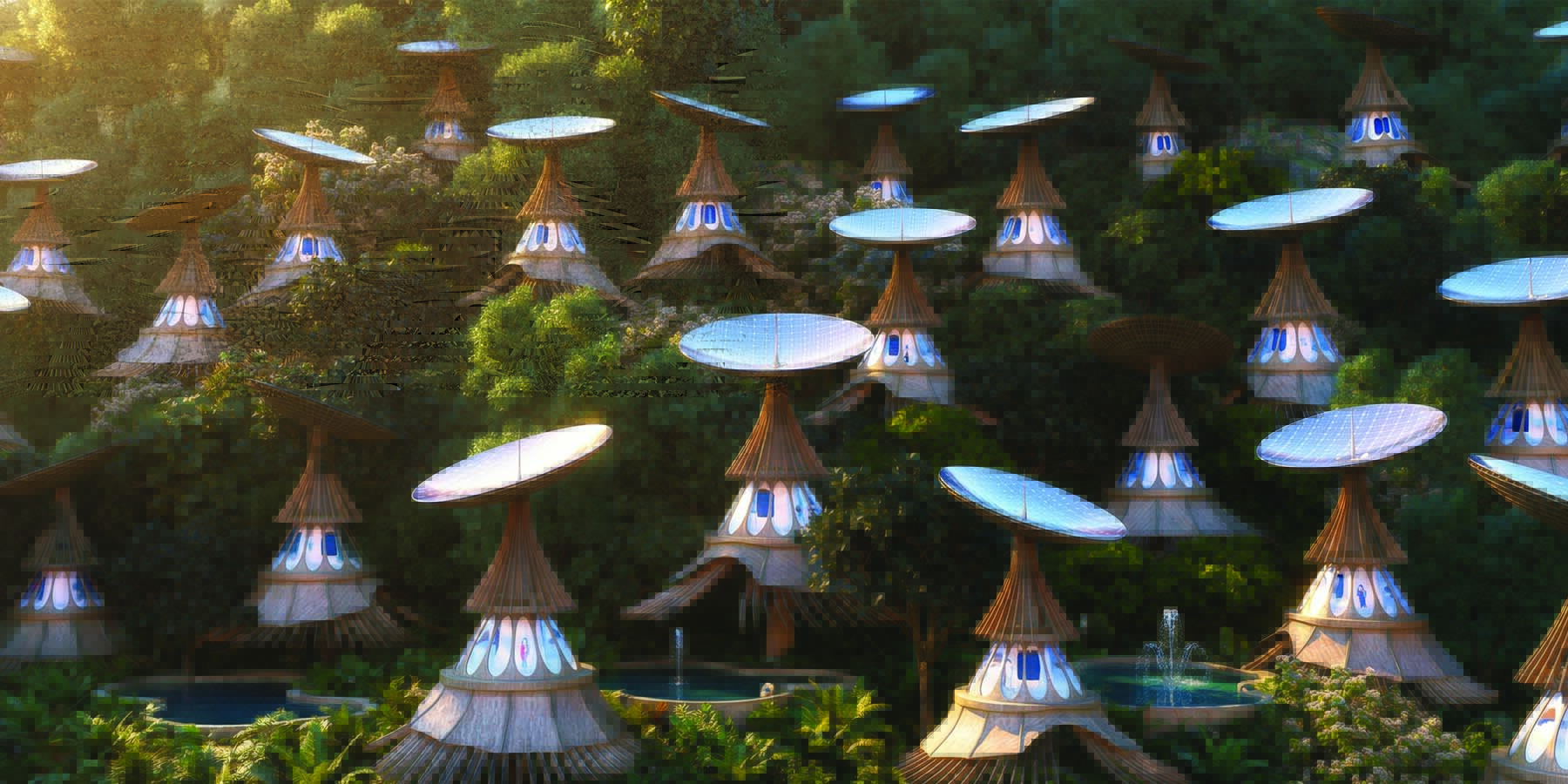
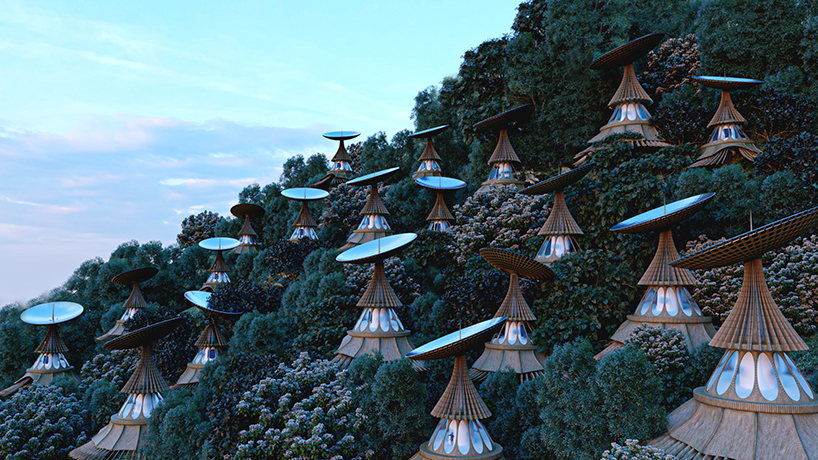
crafted with bamboo and geopolymer concrete, each living module is crowned by a dual-axis concave parabolic mirror that tracks the sun in real time.
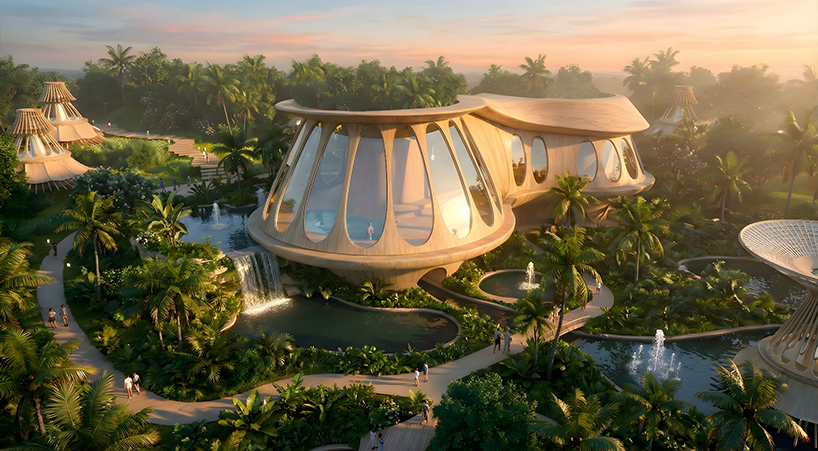
Developed by MASK Architects, the Dual-Axis Concave Mirror Living System proposes an architectural model in which buildings function as integrated energy, water, and environmental infrastructure. Rather than treating architecture and utilities as separate systems, the project positions the building itself as a responsive interface that produces resources while shaping inhabitable space. The design centers on a dual-axis concave parabolic mirror mounted at the crown of each module, which tracks the sun in real time to concentrate solar energy while simultaneously supporting shading, ventilation, and microclimate regulation for the spaces below.
Known as the Fiji Solar Crown, the system introduces a solar-integrated living architecture that incorporates a kinetic concave mirror into the primary structural and spatial framework. Developed in collaboration with TesserianTech, responsible for engineering and kinetic mirror technology, the project addresses Fiji’s challenges related to energy instability, reliance on imported diesel, freshwater scarcity, saltwater intrusion, and increasing climate pressures. The system is designed to operate independently from centralized grids, allowing architectural units to generate electricity and harvest water directly on site.
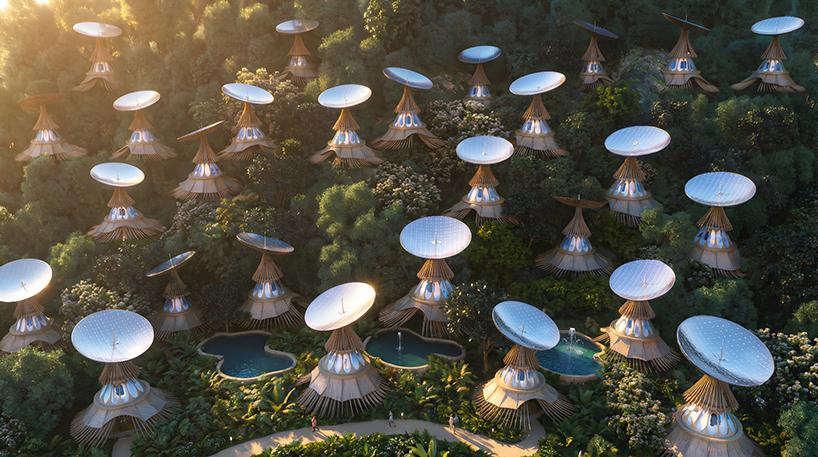
The architectural language draws from the traditional Fijian bure, reinterpreting its elevated structure, passive ventilation principles, and symbolic roof apex through contemporary materials and technology. The concave solar crown functions as an environmental engine, concentrating sunlight for electricity generation, redirecting heat to support passive cooling, powering nighttime illumination, and collecting rainwater that is stored within the structural core for potable and non-potable use.
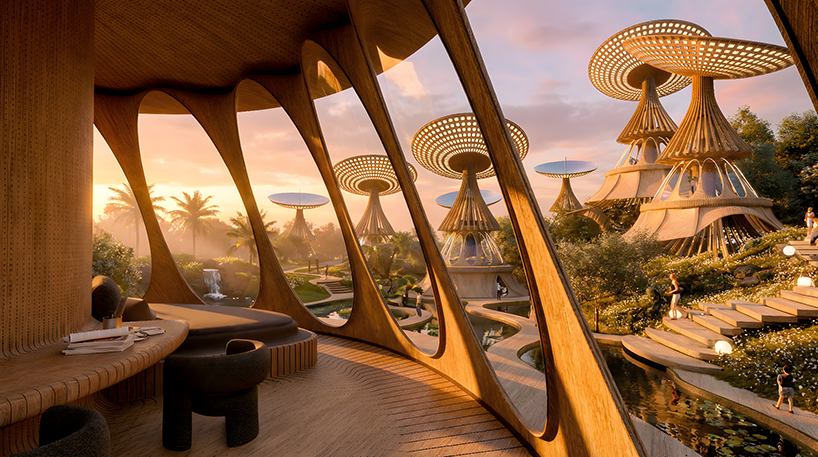
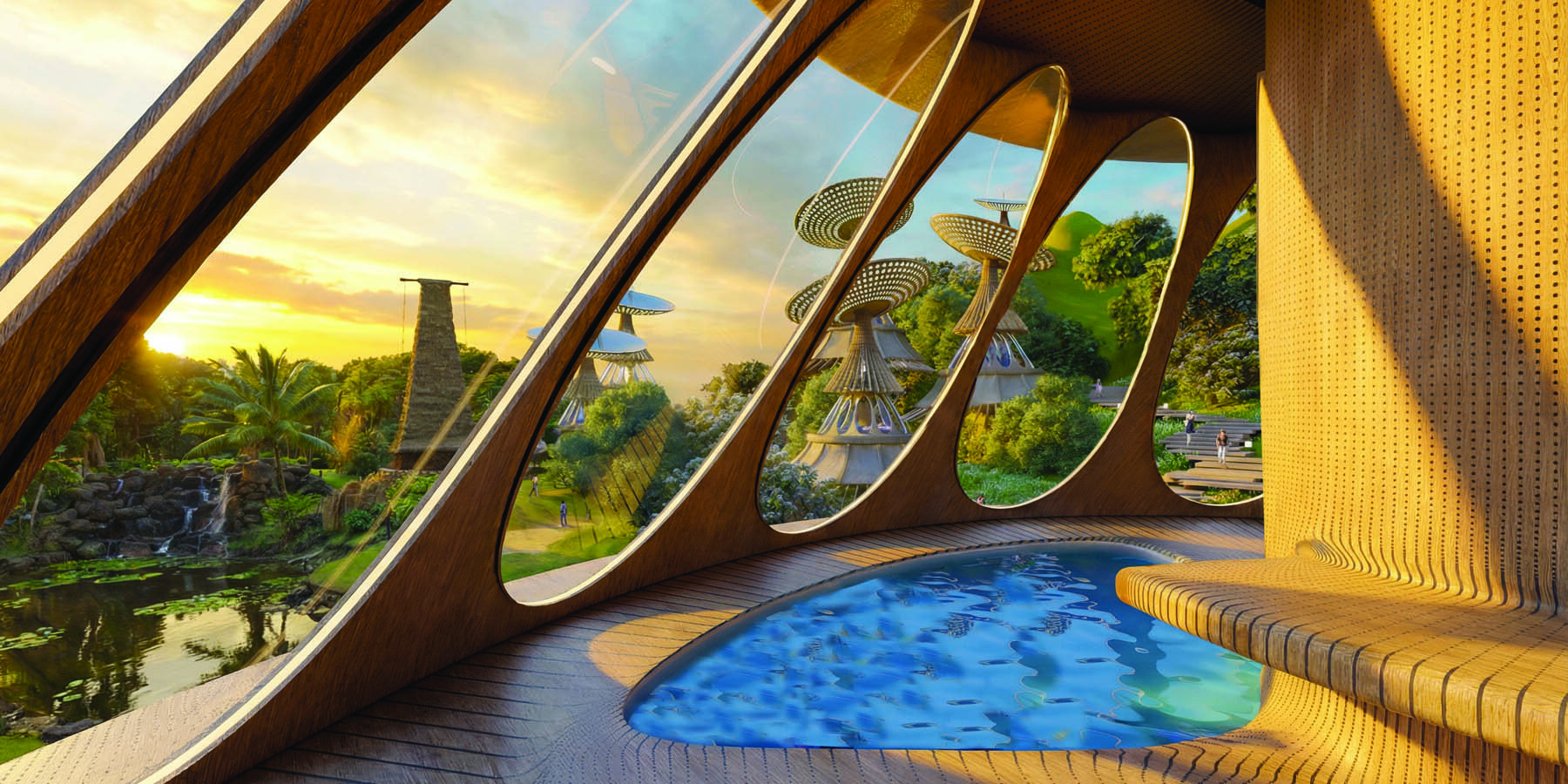
Beneath the crown, the spatial organization unfolds vertically. The ground level forms a shaded, naturally ventilated living platform, while the main inhabitable floor integrates panoramic views with the service core. An upper observation level frames the sky and surrounding landscape, reinforcing the vertical relationship between living space and environmental systems.
The design team at MASK Architects considers the system as a family of three modular scales, each defined by its concave solar crown. The 3-meter-diameter module functions as a compact energy and water generator suited to rural infrastructure, agricultural use, and small off-grid shelters. The 5-meter module supports community-oriented programs such as outdoor classrooms, gathering spaces, and small tourism facilities. The 7-meter module is conceived as a fully inhabitable multi-level residence or accommodation unit, capable of operating on elevated or floating foundations in response to rising sea levels. These modules can function independently or be clustered to form larger communities, micro-grids, or territorial networks.

Energy generation is a central performance parameter. Under Fiji’s solar conditions, the 3-meter mirror produces approximately 12 kWh per day, the 5-meter mirror around 30 kWh per day, and the 7-meter crown approximately 58 kWh per day. When deployed in clusters, groups of ten units can generate between 120 and 580 kWh per day, supporting off-grid residential areas, agricultural operations, educational facilities, and tourism infrastructure without reliance on diesel fuel. Rainwater collection integrated into the crown and core provides localized water independence for drinking, irrigation, and greywater systems.
Material selection reinforces both environmental and cultural considerations. The system employs laminated bamboo, locally sourced Fijian hardwoods, bamboo-fiber composites, and geopolymer concrete, combined with ground-based or floating foundations depending on site conditions. Mechanical systems, photovoltaic receivers, the dual-axis tracking mechanism, and the central energy transfer axis, an insulated structural column, are integrated directly into the architectural anatomy. At night, the underside of the mirror functions as an ambient lighting element powered entirely by the energy generated during the day.
As deployment increases, the Fiji Solar Crown transitions from a single architectural prototype into a scalable territorial system. Smaller units support individual households and farms, mid-scale modules reinforce community infrastructure, and larger crowns anchor high-performance micro-grids, floating settlements, and elevated villages. Across all scales, the system reduces dependence on fossil fuels, stabilizes water supply, moderates microclimates, and establishes a consistent architectural identity rooted in local spatial traditions. The project demonstrates an approach in which architecture operates as an active environmental system, integrating spatial design, structural performance, and resource production into a unified framework suited to climate-vulnerable regions.


project info:
name: World’s First Dual-Axis Concave Mirror Living System Redefining Energy and Water Independence in Fiji
architect: MASK Architects | @maskarchitects
design team: Oznur Pinar Cer, Danilo Petta
location: Fiji
designboom has received this project from our DIY submissions feature, where we welcome our readers to submit their own work for publication. see more project submissions from our readers here.
your own online design shop — no sales commission collected