‘I don’t agree with the idea of utopia,’ Sir Peter Cook once told me. Coming from the co-founder of Archigram, the 1960s avant-garde collective that practically defined the architectural imaginary, these words took me by surprise. But Cook, ever the pragmatist among dreamers, clarified: ‘It’s usual to say there is the utopian world, and then there is the real world. But I don’t think there is a dividing line.’
This sentiment reminded me of an Oscar Wilde observation: ‘A map of the world that does not include Utopia is not worth even glancing at, for it leaves out the one country at which Humanity is always landing. And when Humanity lands there, it looks out, and, seeing a better country, sets sail. Progress is the realisation of Utopias.’
What Wilde understood, and what Cook was also suggesting, is that utopia is not a place that exists somewhere beyond reality. It is a way of thinking about the present. A tool for dismantling what already exists to make room for what might be. As Frederic R. White described in his introduction to Famous Utopias, progress is born from humanity’s ‘eternal dissatisfaction with things as they are and the eternal desire to make them better.’
That impulse, part critique, part radical imagination, lies at the heart of utopian thought. It was also the most important takeaway from my conversation with Cook. Utopia may be dismissed as unreachable, but the willingness to imagine what lies beyond accepted limits can become a powerful guiding force. Pursued with enough conviction, those ideas can, eventually, reshape reality. In many ways, this is also the story of designboom.
When designboom was founded in 1999, it was a bet on the early, utopian ideal of the Internet.
The world’s first online magazine was launched under the premise of a horizontal distribution of culture, connecting creatives across borders at a time when visibility was a guarded privilege. Long before social media or global digital networks became commonplace, designboom offered a platform where architects, artists, and designers from around the world could share ideas with unprecedented openness.
For years it helped shape the digital cultural landscape as we know it today. A place where knowledge, experimentation, and visionary thinking were freely accessible to anyone with an internet connection. A place where a moonshot idea from an unknown student carried the same weight as a masterwork from Milan. Optimistic in spirit and deeply human in its approach, designboom cultivated a global creative community that extended far beyond the traditional circles of professional recognition.
Twenty-seven years later, that landscape looks very different.
The media ecosystem that designboom helped pioneer has become saturated with platforms competing for attention. Content travels instantly, often detached from its source. Social media rewards speed and virality over reflection. Algorithms feed on polarization, and Artificial Intelligence generates a relentless tide of content that often blurs the line between genuine creativity and mere noise.
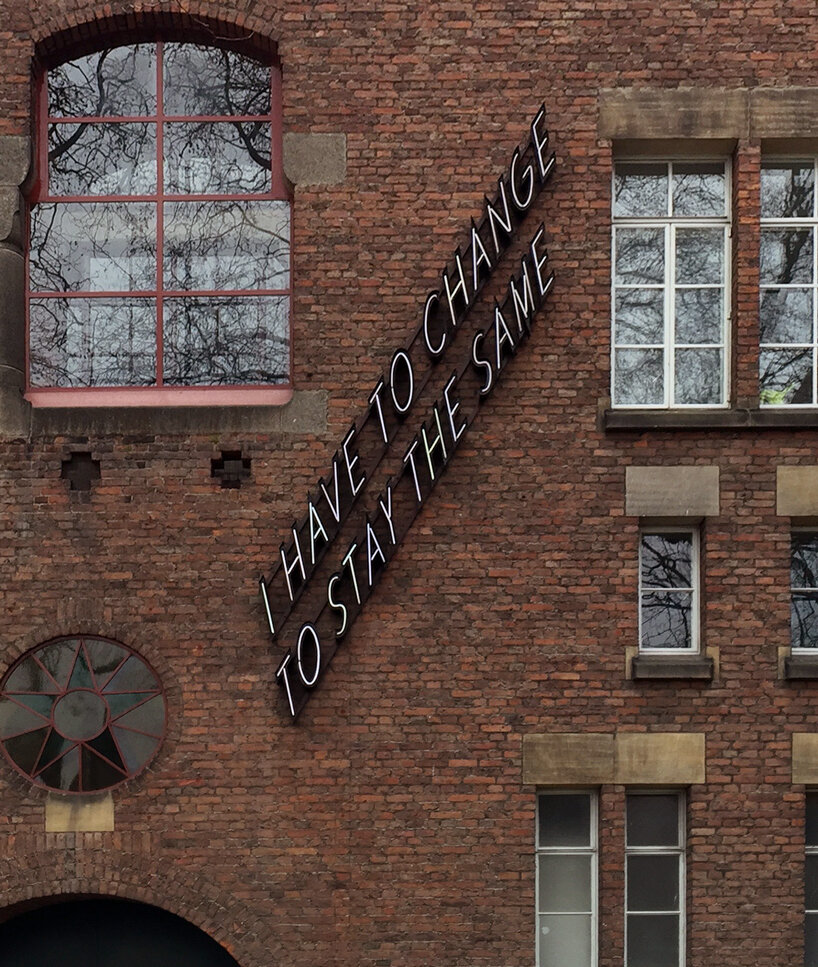
‘I have to change to stay the same’ neon sign on the WdKA facade in Rotterdam
During my years in Rotterdam, a neon sign outside my school read: ‘I have to change to stay the same.’ This quote by Willem de Kooning has stayed with me ever since, and today becomes the driving force to reinvent our approach. In order for the mission on which designboom was built to remain vital, we must evolve.
As we recalibrate, designboom returns to the place where it has always felt most at home: the intersection of imagination and progress. We believe creativity remains one of the most powerful forces for change, and that design, when guided by curiosity, experimentation and care, has the capacity to shape the world in tangible ways. It is these positive narratives we want to highlight now more than ever, guided by themes and questions on design’s inherent utopian nature and the alternatives we can build together to outshine the darkness.
For this first chapter of our new journey, Utopia, Then and Now, we ask:
What if Utopia was never a destination, but a method?
After all, the word itself stems from the Greek ou topos, meaning ‘no place’. So instead, we are examining Utopia’s role in the past, present and future, as a way of envisioning a better way of being: with ourselves, with each other, and with the non-human entities that share our planet. We are looking for an ideal reality that is within reach: an eutopia, or rather, a Utopia, Applied.
In the true spirit of designboom, this journey is not a monologue, it is a collective endeavor. I invite you to join us in this next chapter. Reach out, contribute your projects, thoughts and ideas, and help us shape a future worth believing in.
 Mar 14, 2026
 Mar 12, 2026
 Mar 11, 2026
 Mar 10, 2026