
rachel youn reanimates discarded wellness devices as restless machines of care
the artist’s kinetic installations explore the strange afterlives of objects designed to heal, soothe, and improve the body.
rachel youn on the strange lives of machines of care
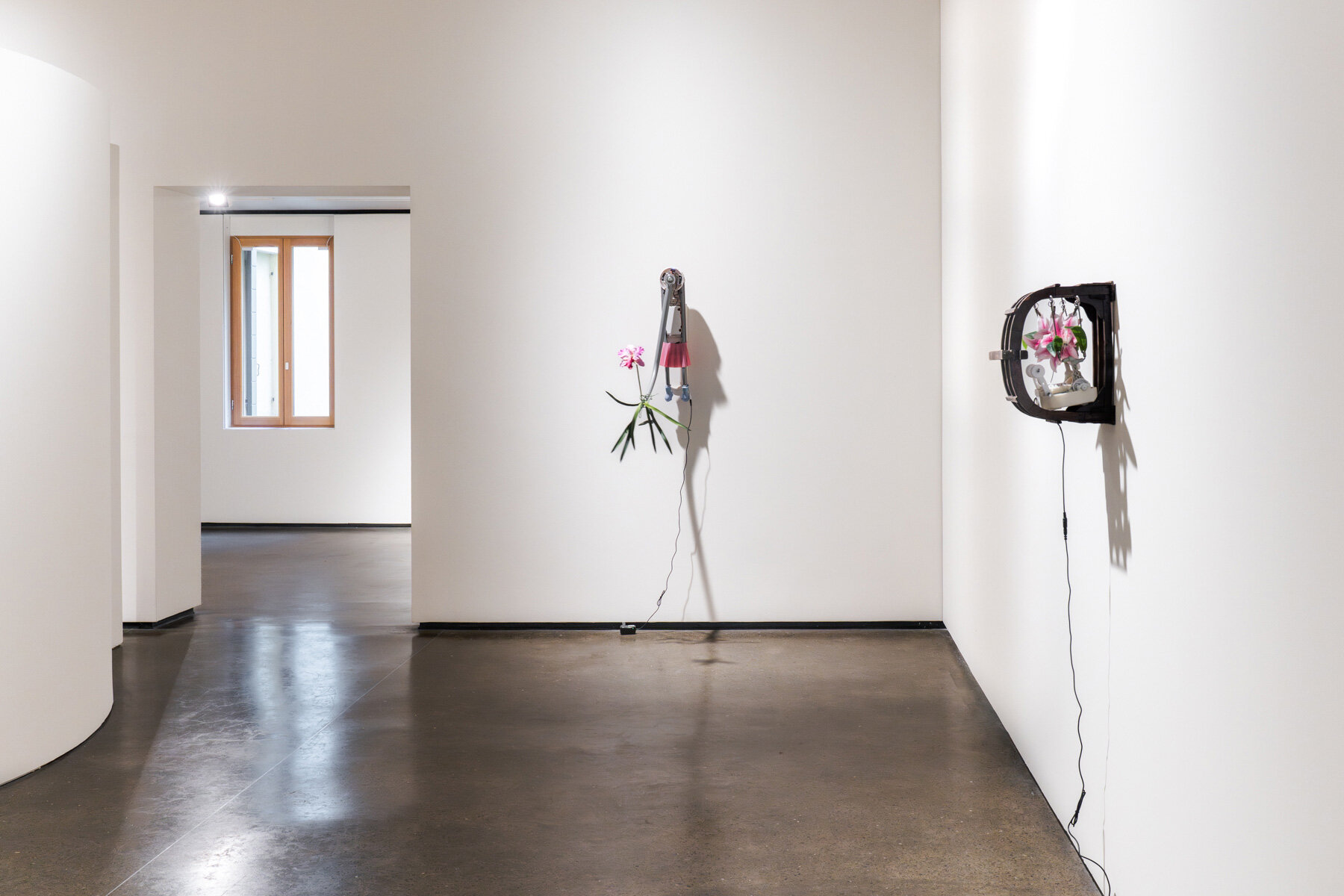
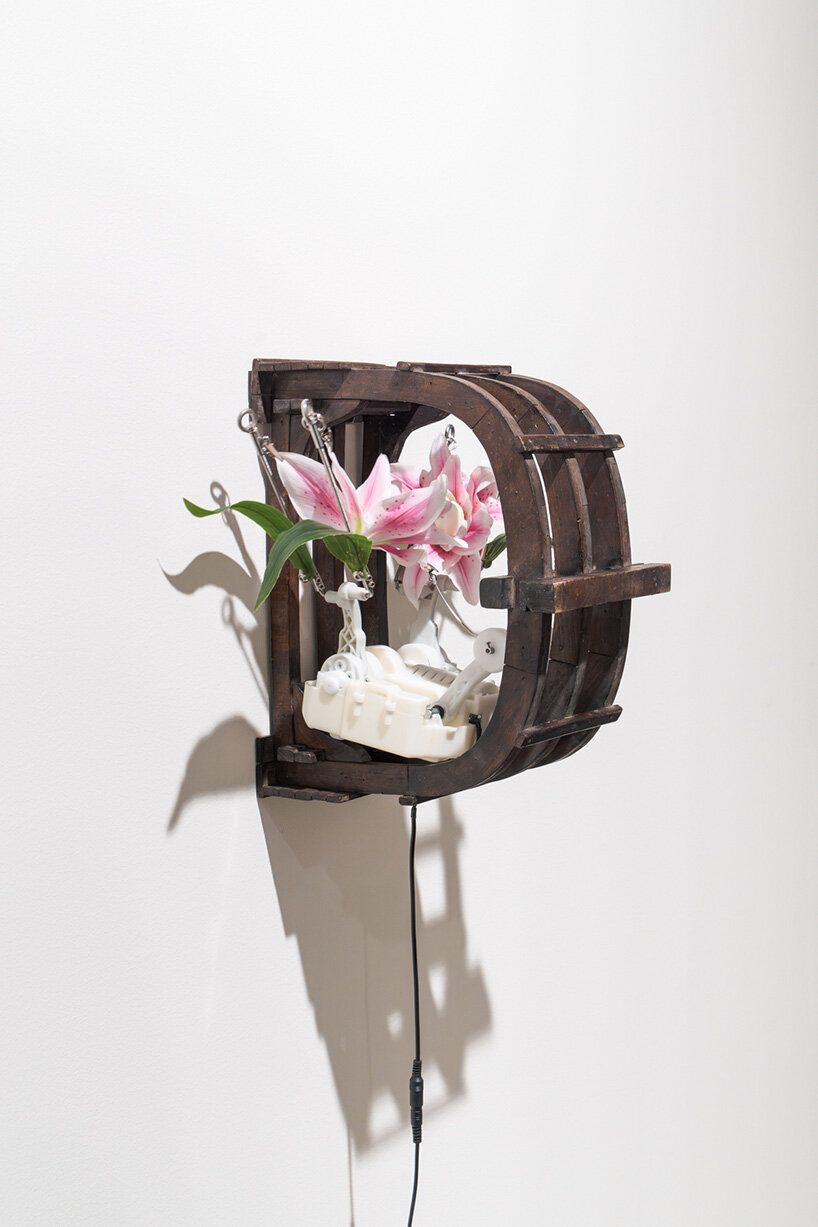
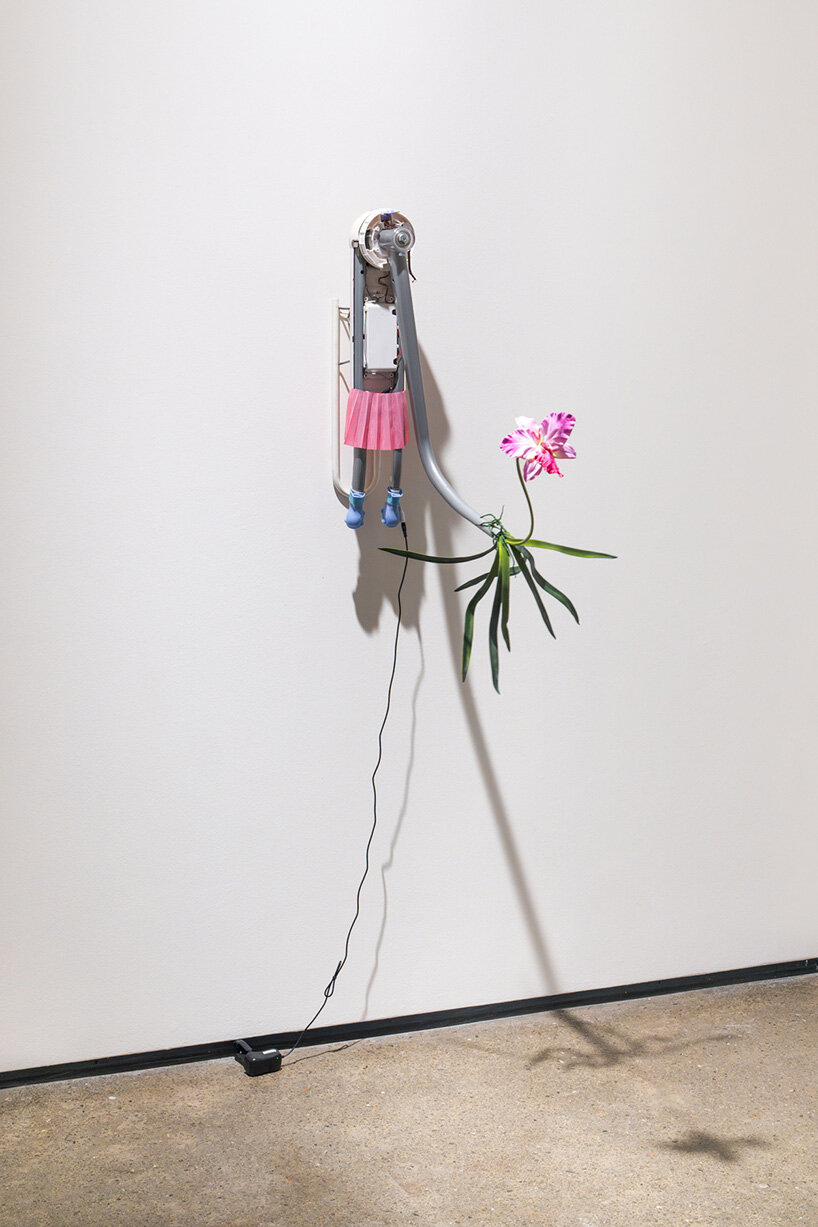
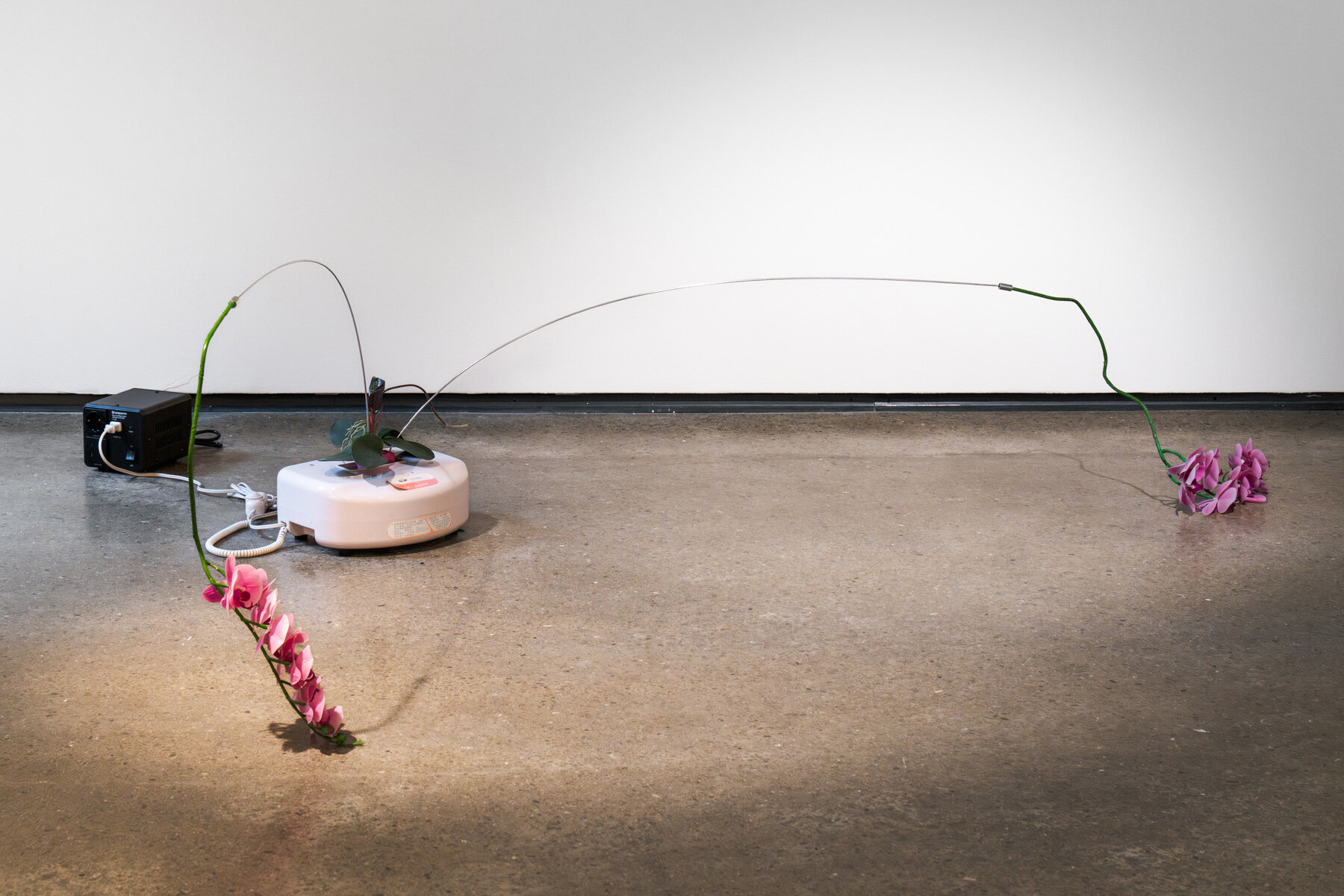
In Rachel Youn’s exhibition, Unruly Vessel, on view at Scuola Piccola Zattere in Venice, sculptures never seem to rest. Electric massagers knead endlessly, exercise machines row toward nowhere, and artificial plants tremble, writhe, and sway under the force of repurposed motors. Across her kinetic installations, objects designed to soothe, rehabilitate, or improve the body become caught in perpetual cycles of motion. Her artworks draw attention to the uneasy relationship between self-care and self-discipline, revealing how repetitive acts of improvement can become exercises in endurance.
The presentation brings these concerns into dialogue with the lagoon city’s own histories of confinement, labor, religion, and exclusion. Developed during Youn’s residency at the institution, the show combines newly commissioned works with recent sculptures built from discarded wellness devices and synthetic plants, that together form what might be described as a congregation of restless bodies, shaped by machines that continue to perform long after their original purpose has faded.
For the artist, however, these devices are never simply materials. ‘I love the term collaborators,’ she tells designboom, ‘because I’ve found these machines to have their own lives and personalities that I’m extending into new movements and forms.’

devices that imitate touch shape unruly vessel
That relationship began nearly a decade ago. Looking for ways to introduce movement into her practice, the artist purchased a secondhand foot massager and dismantled it in her studio. Curious about the mechanics hidden beneath its plastic shell, she began collecting more discarded wellness products, gradually becoming fascinated by the peculiar ways they imitate human touch.
‘I realized I was drawn to them specifically for how they imitated human-like movements,’ she explains. ‘Thumbs pressing into sore limbs, hands squeezing and palpating shoulders.’ Baby swings became equally important, with their gears, motors, and wires recreating the soothing rhythm of a parent’s embrace, translating intimacy into a mechanical action. ‘At the time, I was already interested in the concept of artifice,’ Youn says, ‘and the uncanny nature of these movements and the labor and intimate touch that they imitated felt like a natural step in my work.’
The same ambiguity surfaces throughout Unruly Vessel, where machines designed to comfort the body perform their gestures long after comfort has disappeared. The exhibition traces unexpected connections between contemporary wellness culture and older systems designed to regulate the body. While researching in Venice, Rachel Youn became increasingly interested in how rehabilitation, self-improvement, religious discipline, and punishment often share common histories and gestures. She traces this interest back to her upbringing in a Christian immigrant household, where ‘morality and self-worth were conflated with achievement and hard work, and suffering and sacrifice were seen as a natural part of people’s sinful nature.’

the rituals of self-improvement
The artist has long been preoccupied with what she describes as ‘the breaking point or fine line between pain and pleasure.’ In both historical research and personal experience, she discovered recurring overlaps between practices intended to heal and those intended to discipline. ‘The original form of the modern treadmill, called the treadwheel, was effectively a form of torture intended to reform prisoners by teaching them the habits of industry,’ she notes. Elsewhere, cold plunges and saunas echo forms of hydrotherapy once used in psychiatric institutions.
‘There are many things we do to ourselves in the name of self-improvement that are arguably painful and resemble punishment,’ the artist points out. ‘The difference, of course, is consent and willingness.’ What interests her most is the human capacity to embrace discomfort when it arrives wrapped in the language of productivity, health, or personal growth. ‘I am drawn to the idea that we can convince ourselves that something is good or productive, even if it causes physical and emotional pain,’ Youn reflects.
This inquiry materializes in sculptures that appear trapped within endless loops. Motors activate the same gestures repeatedly, producing movements that hover between soothing ritual and exhausting compulsion. ‘The work is really an existential inquiry for myself,’ Youn explains. ‘How does repetition go from comfort to pain?’ A massage may initially feel restorative, she suggests, but prolonged indefinitely, it becomes unbearable. The same dynamic applies to daily routines, employment, and relationships. ‘How much do my daily habits ground me until they disturb me? How does the consistency of clocking into the same job every day go from pleasurably consistent to completely demoralizing? On a larger relational level, how can the comfort and reliability of a partner or family member become boring or grating?’ she adds.

endless cycles of motion
For viewers, these repetitive motions often produce a hypnotic effect. Rachel Youn sees something different. ‘To me, I see an endless cyclical motion bordering on torturous that will only end once the machine fails and ultimately dies,’ she shares. Artificial plants play a crucial role in amplifying that ambiguity. Throughout her installations, synthetic flowers and palm fronds can read as bodies, ornamental objects, failed imitations of nature, or even unwilling participants in the mechanical systems that animate them. Asked what these plants represent, Youn responds. ‘All of the above.’
She describes fake plants as uncanny substitutes for human figures. ‘Stems and branches feel like limbs, flower petals and stamens feel like genitalia.’ Their movements provoke reactions ranging from attraction to discomfort. ‘They don’t have eyes or faces the way animals do, but there is something distinctly anthropomorphic about them,’ the artist highlights.
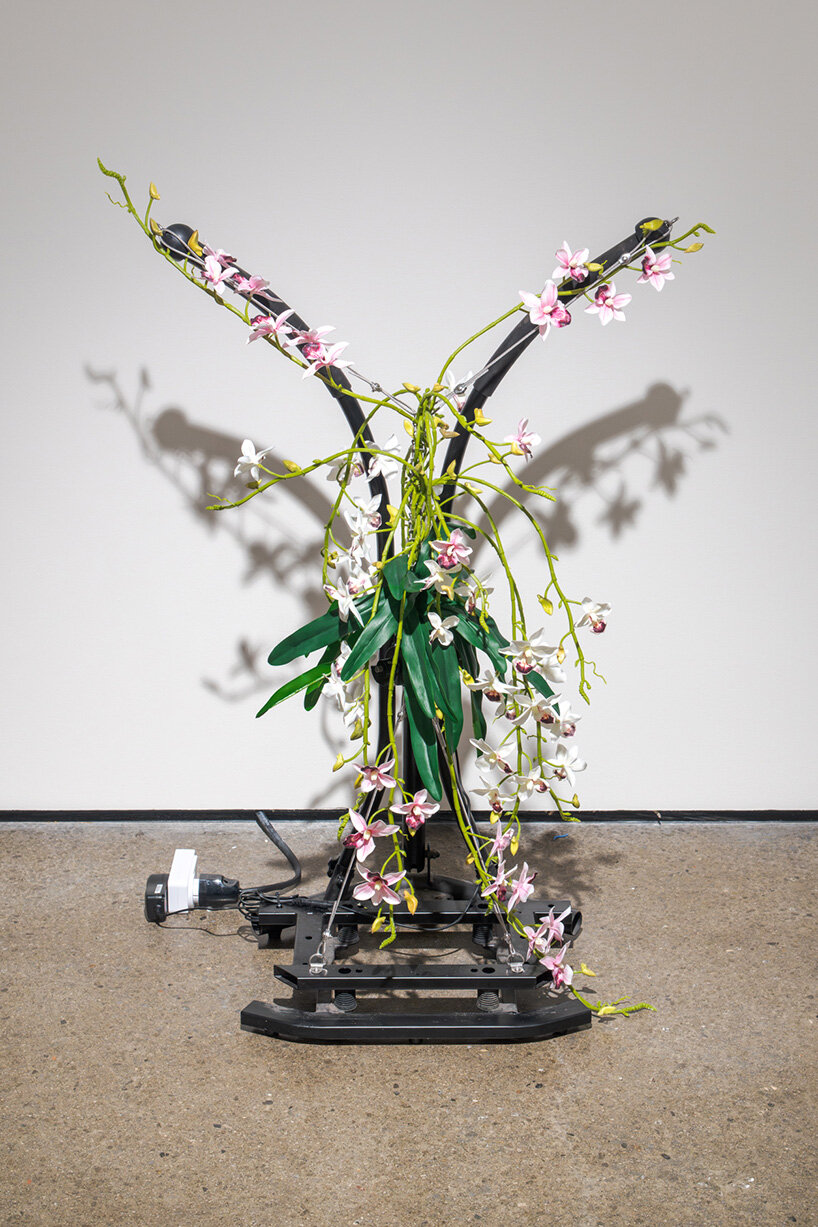
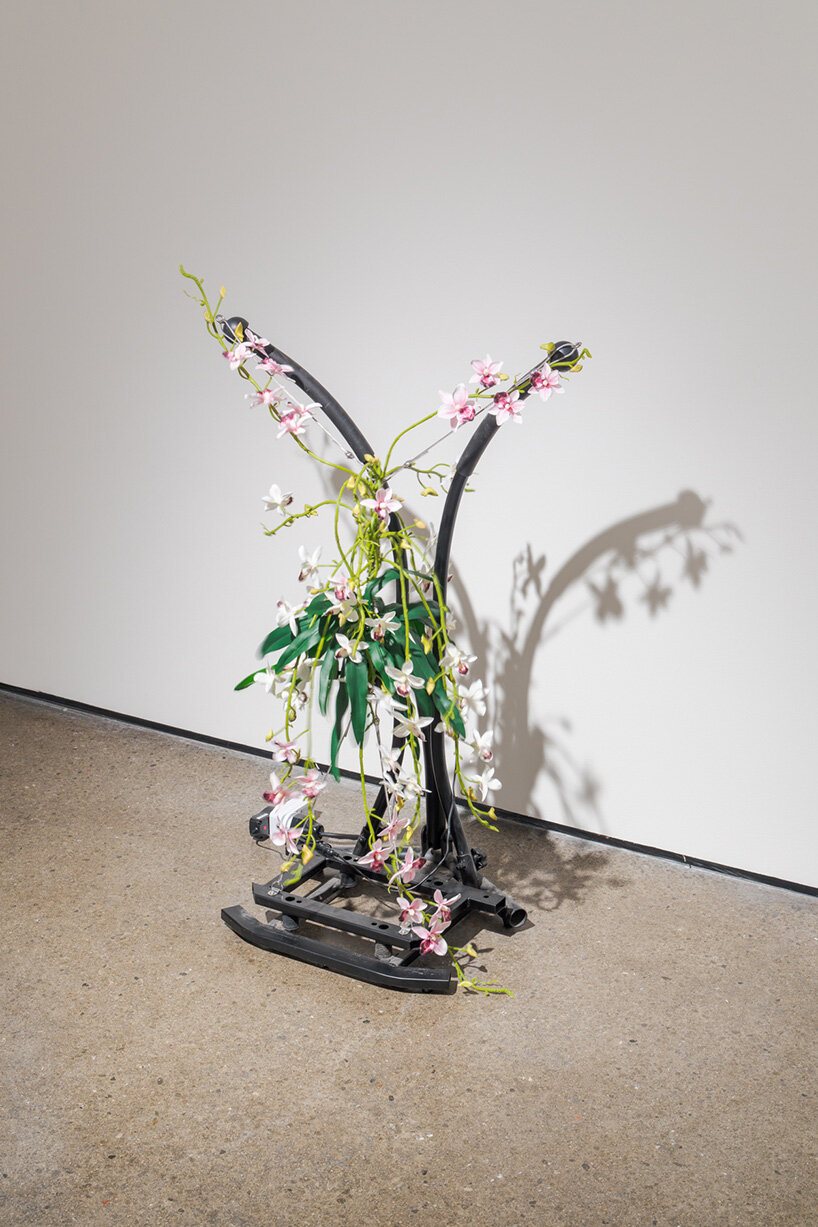
What fascinates her most is that these objects are designed to remain permanently unchanged. Artificial plants require no maintenance and preserve nature in an idealized state of perpetual bloom. By introducing movement, Youn disrupts that illusion. ‘By making them writhe or shake or spin, they draw attention to themselves whilst also slowly self-destructing.’

rowing towards nothing
Venice provided a particularly fertile setting for these investigations. During her residency, Rachel Youn spent time researching the island of San Servolo, home to a museum housed within a former psychiatric institution. There she encountered the history of the Pubblica Fusta, a mastless vessel anchored near Piazza San Marco that functioned first as a floating prison and later as a site for confining people deemed socially undesirable.
‘It was there that I learned about the Pubblica Fusta,’ she recalls, describing how convicts, people experiencing mental illness, and individuals suffering from disease became linked through systems of exclusion and public stigma.
This research directly informed Congregation, one of the central installations of the exhibition. Exercise machines propel large palm fronds mounted on wooden benches, transforming them into mechanical oars. The work references both the Pubblica Fusta and Christian rituals such as Palm Sunday. ‘I wanted to create the feeling of madly rowing towards nothing as a congregation,’ Youn explains, ‘an expression of frustration towards the ruling political and religious institutions.’
Underlying many of these works is a deep empathy for the objects. The machines Youn collects were originally sold as tools for self-care, health, and transformation. By the time they arrive in her studio, however, those aspirations have often faded. ‘There is a prevailing sense of failure with the objects and machines I use,’ she shares with designboom. ‘The massagers and exercise machines are both aspirational for self-care and self-improvement, yet shortcut human interaction and intimacy.’
Whether they were heavily used or left untouched, the devices carry traces of unrealized hopes. ‘They have been purchased with that aspiration, but ultimately resold or donated after falling into disuse,’ the artist tells us. For Youn, they embody ‘a narrative of desire and shortcoming.’

a narrative of desire and shortcoming
Humor offers another way into these complex emotional territories. Although her sculptures often address exhaustion, obsolescence, and disappointment, they remain undeniably absurd. ‘I see humor as a form of relation,’ Rachel Youn emphasizes. Art may not solve structural problems, but it can create moments of shared recognition. ‘It’s amazing when the work allows for a common ground of understanding, even if the feelings are fatigue and hopelessness.’
While she believes her work has become less overtly comedic over time, absurdity remains essential. ‘I hope it allows myself and others to step back and see how absurd everything is.’ Reflecting on a recently read memoir by Youngmi Mayer, she adds, ‘I very much resonate with the title: I’m laughing because I’m crying.’
Looking ahead, Youn’s ambitions continue to expand in scale. Recent works such as Congregation and CLEANSE (I’ll do it myself) have deepened her interest in immersive environments that surround viewers physically and emotionally. ‘I want to create installations that envelop the viewer,’ she remarks.
Her attention has also turned toward monocarpic plants such as agave, which flower only once before dying. The phenomenon fascinates her because it condenses beauty, reproduction, and mortality into a single dramatic gesture. Agaves produce what she describes as a ‘stunning death bloom,’ after which the plant expires. ‘I find this singular reproductive act to be profoundly tragic,’ she observes.
It is easy to imagine such a subject entering Youn’s growing ecosystem of machines, artificial bodies, and failed promises. Like the discarded wellness devices she rescues from obscurity, these plants embody a paradox that defines her practice: the ways care, desire, growth, and decline remain inseparable.


project info:
name: Unruly Vessel
artist: Rachel Youn | @rachelyoun
venue: Scuola Piccola Zattere | @scuolapiccolazattere
location: Venice, Italy
dates: on view through November 22nd, 2026
shop
your own online design shop — no sales commission collected