
nienke hoogvliet: exploring alternative ways of production
Imagine an advertisement for household textiles: ‘towels, sheets, napkins, tablecloths—quality so exceptional it will last a lifetime.’ The price of this set? About the same as your house. As absurd as that sounds today, it was a reality in the 1800s. Craft and quality were highly valued. Labor was relatively inexpensive, while materials were costly and difficult to replace. As a result, reuse and repair were not just sensible practices—they were economic necessities.
Although we can hardly imagine materials being this expensive today, these prices may have been closer to their true cost than what we have become used to paying. Before the Industrial Revolution, creating raw materials was extremely labor-intensive. Take linen: flax first had to be grown, then processed through retting, scutching, and hackling before it could even be spun. After spinning, the yarn still needed to be woven into cloth. In the eighteenth century, a kilogram of linen could embody more than a hundred hours of human labor. Today, modern machinery can produce the same amount with less than half an hour of direct human work.
While it may seem logical that less labor leads to lower prices, the environmental costs of production are often overlooked. Growing textile crops frequently requires synthetic fertilizers, pesticides, insecticides, large amounts of freshwater, and fossil fuels to power machinery.
These inputs enable mass production and lower consumer prices, but the true costs are shifted elsewhere. Soils become depleted, biodiversity declines, water resources come under increasing pressure, and agricultural workers may suffer health problems due to exposure to hazardous chemicals. What appears inexpensive at the checkout often carries significant environmental and social costs that remain largely invisible. It is a system that cannot last. We need alternatives: materials that do not overexploit the earth, but are created in harmony with ecosystems and the people who depend on them.

nienke working on her ‘SEA ME’ carpet | all images courtesy of Studio Nienke Hoogvliet
breaking the cycle of responsibility
The question of who is responsible for creating these alternatives remains open for debate, making progress slow and the discussion difficult. Industries often argue that innovation is constrained by market readiness. From their perspective, consumers are hesitant to adopt unfamiliar materials, especially when these come with higher prices or different aesthetic and functional qualities. This perceived lack of demand is used to justify maintaining production systems optimized for cost efficiency and scale rather than material innovation.
Consumers, meanwhile, tend to place responsibility on industry. They expect manufacturers and brands to lead the transition, arguing that large companies have both the resources and the influence to develop and normalize more sustainable alternatives. When progress feels slow, it is often interpreted as a lack of commitment or innovation from industry players.
Governments add another layer of complexity. While increasingly aware of environmental pressures, they must also balance ecological goals with economic stability, employment, and international competitiveness. As a result, they often hesitate to impose strict regulations, fearing such measures could disadvantage domestic industries or slow economic growth. This creates a self-reinforcing cycle of mutual deflection: each stakeholder group sees the others as primarily responsible for change while simultaneously feeling constrained by their expectations or limitations.

seaweed on the coast of Oosterschelde National Park | image by Hannah Braeken
why designers sit at the beginning of change
Breaking this cycle is one of the key challenges, and the role of the designer is central to this process. Although designers may not control the system, they occupy a unique position within it. They operate at the very beginning of the production chain, where fundamental decisions about materials, forms, and production methods are made. Every design decision—whether large or small—can influence a product’s environmental impact and lifespan.
Take the small bow found on many pieces of women’s underwear. While seemingly insignificant, removing it can make recycling the garment far more efficient by eliminating the need to separate different materials. This example illustrates how even the smallest design choices can have consequences far beyond aesthetics. When designers consciously seek to minimize environmental impact, choose more sustainable materials, or extend the lifespan of products, these decisions ultimately shape what reaches the market. This places an urgent responsibility on the designer.

collecting seaweed | image by Hannah Braeken
finding value in what we throw away
We, as a research-driven material practice, strongly feel this responsibility. That is why we have spent years developing material innovations that may offer part of the solution. In the early years of our practice, we focused primarily on materials with a lower environmental impact. It was a logical first step to investigate existing waste streams and overlooked resources as sources of innovation.
Waste requires significantly less energy and fewer resources to transform into something new than virgin materials. Unlike primary production—which often involves extraction, refining, and energy-intensive processing—waste streams have already undergone much of this initial transformation. As a result, they represent a form of ‘pre-processed’ material that can be reactivated with comparatively little input.
Take discarded fish skins, for example. Every year, thousands of tons are treated as waste and incinerated, despite their potential to be transformed into beautiful leather through a tanning process that requires no harmful chemicals.
At first, we tanned fish skins by hand, drawing on traditional craft techniques. Later, we collaborated with industry to bring our RE-SEA ME stools to market.

the REA-SEA ME stool
changing perceptions through craft
Another example is used toilet paper, a material recovered during wastewater treatment by Dutch water authorities. Once sanitized, these recovered cellulose fibres can be used in a wide range of paper applications.
Yet despite its technical potential, finding a market for the material proved challenging. As a raw material, it is abstract, difficult to relate to, and easy to dismiss. In the Waterschatten project, we transformed these fibres by hand into a collection of lamps, bowls, and a table, imagining the living room of the future—one in which even ‘disgusting’ materials such as used toilet paper are accepted.
Through design and craftsmanship, the material was removed from its original context and given a new narrative. What had once been perceived as waste became something beautiful, desirable, and worthy of attention. Remarkably, the project did not generate negative reactions. Instead, visitors responded with curiosity and appreciation. This demonstrated that the challenge was not the material itself, but the way it was perceived.
Craft and design acted as catalysts for change, making an unfamiliar material tangible, relatable, and ultimately acceptable. In doing so, they revealed how design can bridge the gap between technical innovation and societal acceptance.
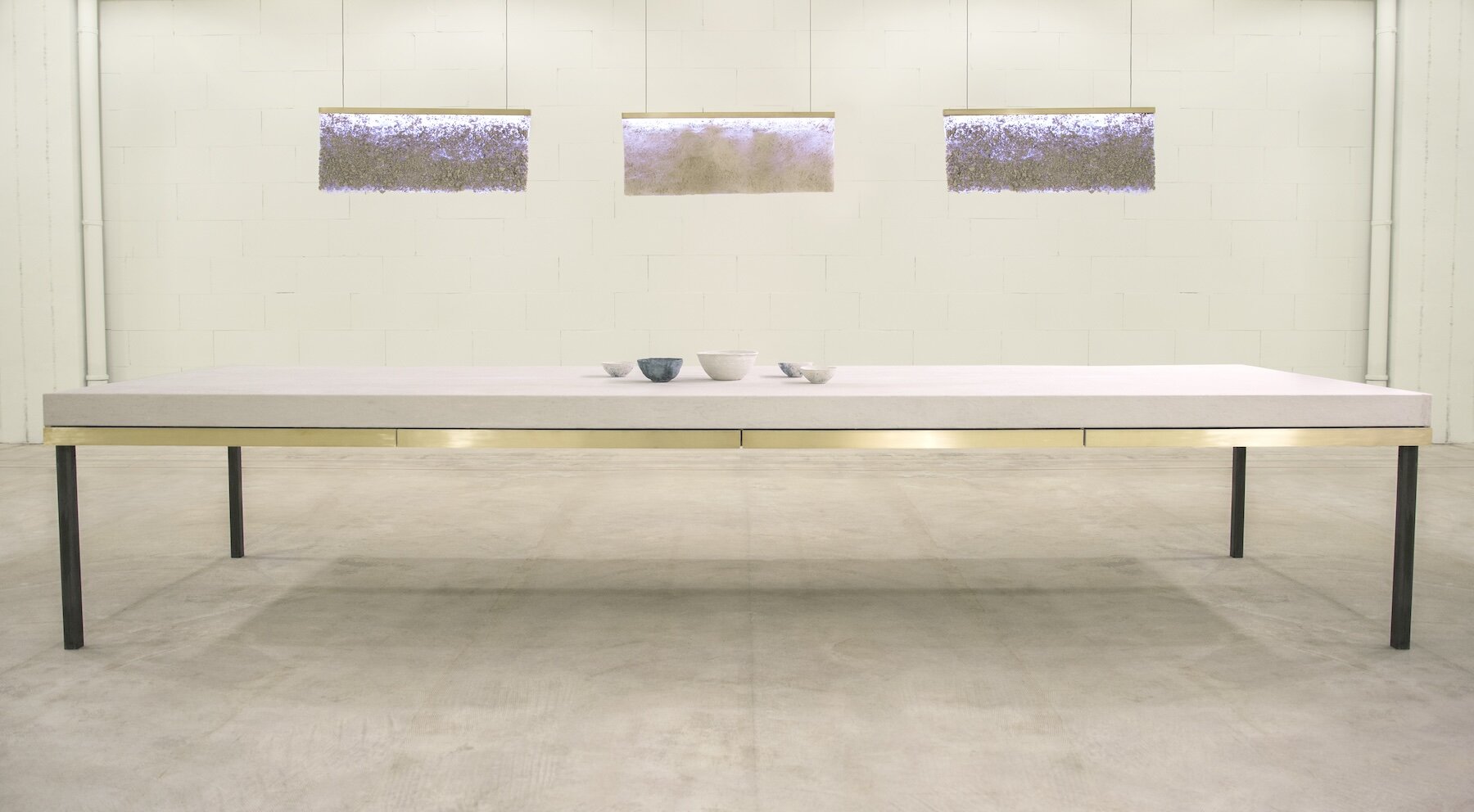
Waterschatten project | image by Femke Poort
from waste streams to living ecosystems
These examples show that reuse and upcycling are not only environmentally beneficial, but also represent a fundamental shift in how we define value in materials. They challenge the assumption that newness equals progress and instead reveal the potential of what already exists.
By reactivating waste streams as design resources, we can reduce environmental impact while simultaneously rethinking cultural perceptions of which materials are considered valuable, acceptable, or even beautiful. While waste streams offered immediate opportunities to rethink existing materials, our research gradually expanded toward natural systems that actively regenerate rather than deplete. This shift led us to explore materials that are inherently produced in balance with their environment.
Growing up near the Dutch coast, we became fascinated with one particularly promising raw material: seaweed. It became our most extensive research project, eventually leading to the founding of Zeefier, a company focused on producing industrial textile dyes made entirely from seaweed.
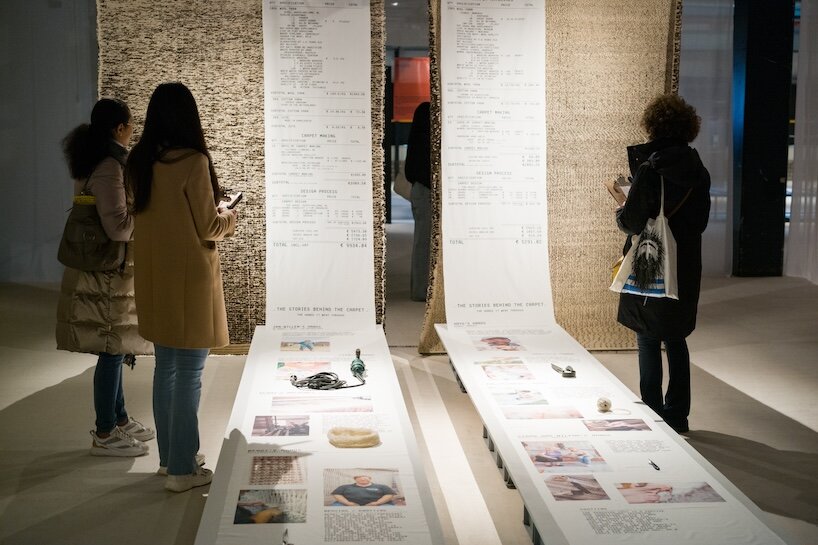
the Value // Values exhibition by Studio Nienke Hoogvliet and Tim Jongerius | image by Boudewijn Bollmann
Seaweed as material experiment
Seaweed is a remarkable raw material. It requires no freshwater or soil and does not compete for agricultural land. It grows rapidly—in some cases up to 20 centimeters per day—and absorbs excess nutrients that would otherwise contribute to ocean overfertilization. In addition, it produces oxygen, supports marine biodiversity, and creates habitats for countless forms of sea life.
We initially researched how seaweed could be transformed into textiles, but increasingly focused on its potential as a textile dye. Textile dyes are one of the industry’s hidden polluters: around twenty percent of global water pollution is linked to textile dyeing. While growing awareness has emerged around the environmental impact of textile fibres, far fewer people realize that the color of their clothes has an equally significant footprint.
When we first began researching seaweed, we collected local species by hand and used traditional natural dye recipes as the foundation for our experiments. When we discovered the remarkable range of colours, together with strong light- and wash-fastness, we realized this craft-based research had the potential to become something much larger. Years—and much more research—later, Zeefier is doing exactly that. Once again, craft proved to be the catalyst for change.
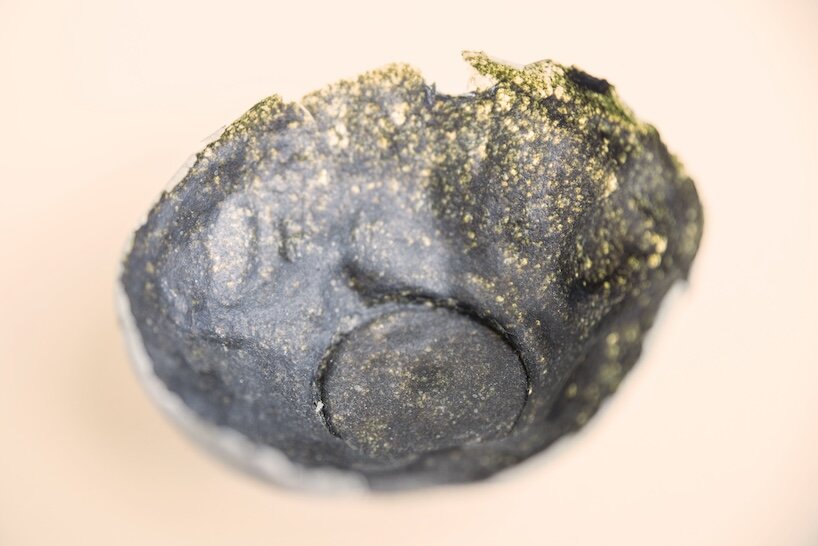
plastic sources from seaweed | image by Hannah Braeken
when transparency creates value
More than 4,500 people participated in the research. The result was striking: after engaging with the stories behind the carpets, the value participants assigned to them increased by more than 60 percent. The research demonstrated that value is not determined by material alone. Knowledge, transparency, craftsmanship, and human connection all play a significant role in how we perceive and appreciate the things we own.
Over the years, our perspective has evolved significantly. What began as a search for lower-impact materials gradually developed into a broader investigation of the systems that shape production and consumption. We initially believed that working with waste streams could create meaningful change. While waste remains a valuable resource, we came to understand that reducing harm alone is not enough. The challenge is not only to use fewer resources, but to create systems that actively regenerate ecosystems and communities.
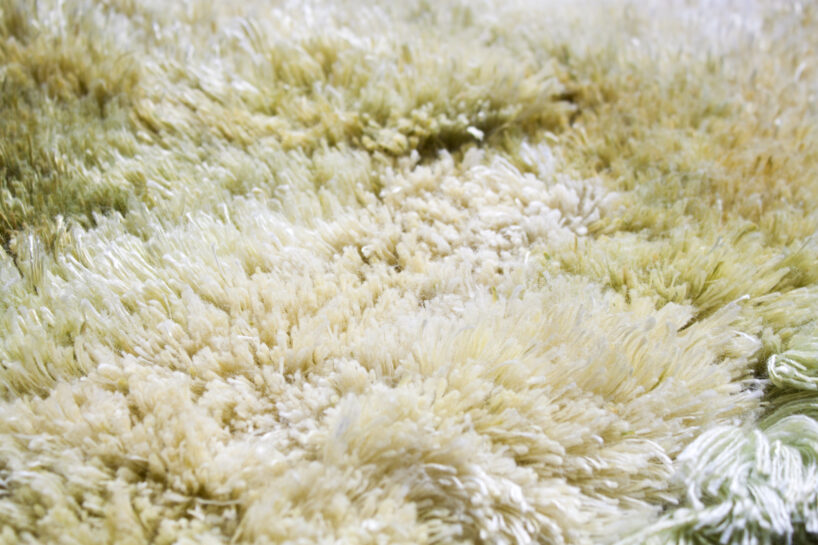
detail of the RE-SEA ME carpet
making products worth keeping
Bio-based materials, such as our seaweed-based dyes, can play an important role in this transition. However, we have learned that replacing one material with another will not, by itself, solve the underlying problem. Even the most sustainable material has limits when consumption continues to grow. This insight led us to reflect more broadly on what makes products meaningful in the first place.
While returning to the high prices of the nineteenth century is neither realistic nor desirable, the value products held at the time remains an important source of inspiration. People repaired, maintained, and cherished their possessions because they represented a significant investment of materials, labour, and skill. Today, the challenge is not to make products artificially expensive, but to make them truly valuable again. Re-establishing this sense of value requires not only new materials, but also new ways of making—and relating—to products.
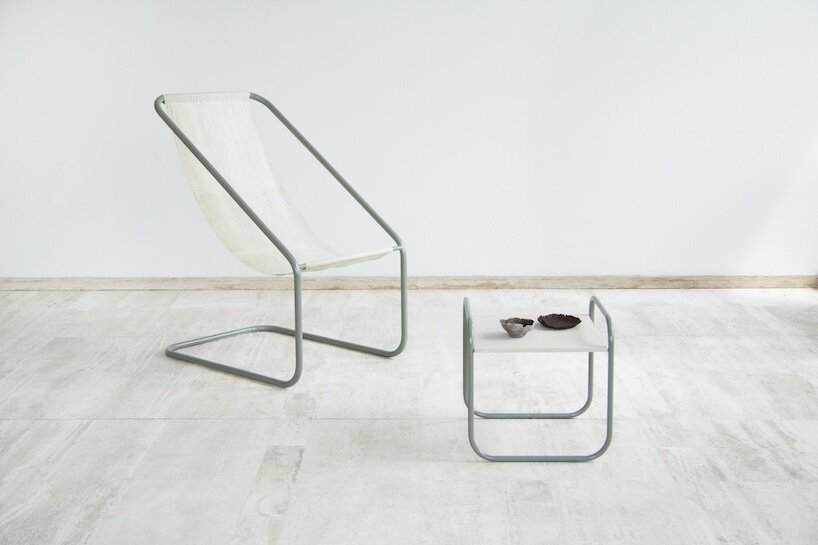
SEA ME collection | image by Femke Poort
craft as a bridge between innovation and care
Craft offers a meaningful way to restore value to products and reconsider the relationship between people and the objects they use. The labour, skill, and care invested by the maker create qualities that are difficult to replicate through machines or digital technologies. The aesthetics that emerge from variation, imperfection, and the visible presence of the maker encourage stronger emotional connections and longer product lifespans.
Traditional crafts, often developed in close connection with local materials and ecosystems, offer valuable knowledge for contemporary practice. At the same time, craft can help visualize emerging innovations, making new materials and production methods more tangible and relatable. In this way, craft acts as a bridge between material innovation and human experience, reconnecting making, meaning, and value.
What began as a search for better materials ultimately became a search for better relationships: between makers and materials, people and products, craft and industry, production and ecology, and consumption and value.
We learned that meaningful change does not emerge from a single material, technology, or innovation, but from reconnecting these relationships and rethinking what we choose to value.

Nienke Hoogvliet
Describing herself as an ‘artivist’ – a portmanteau of ‘artist’ and ‘activist’ – Nienke Hoogvliet (1989, The Hague) uses design to inspire harmony between humans, society and the natural environment. Growing up on the Dutch coast gave her a love of the ocean from an early age but it was plastic waste on the beach that instilled her deep sense of responsibility. This has informed a holistic approach which considers every stage of a project’s lifecycle as well as its environmental and social impact. She founded Studio Nienke Hoogvliet in 2013.
project info:
designer: Nienke Hoogvliet | @studio_nienkehoogvliet
photographers: Femke Poort, Hannah Braeken, Boudewijn Bollmann
This article is part of designboom’s Crafting the Future chapter, exploring what it means to be a maker in today’s world and the future of craftsmanship. Discover more related stories here.
biomaterials (60)
 Aug 17, 2026
 Jul 28, 2026
 Jul 26, 2026
 Jul 20, 2026
 Jul 13, 2026
CRAFTING THE FUTURE (57)
Jul 13, 2026 Jul 11, 2026
 Jul 10, 2026
 Jul 10, 2026
 Jul 09, 2026
guest essays (7)
 Sep 05, 2026
 Aug 10, 2026
 Aug 01, 2026 Jul 10, 2026
 Jul 07, 2026
materials (240)
 Sep 16, 2026
 Sep 02, 2026
 Aug 28, 2026
 Aug 25, 2026
 Aug 21, 2026
 Sep 15, 2026
 Sep 14, 2026
 Sep 03, 2026