
HOW THESE COLORFUL ELECTRONIC TATTOOS MONITOR YOUR HEALTH
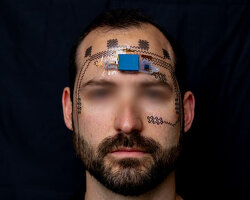
Forget bulky adhesive patches and clinical-looking wearables. Engineers at Pennsylvania State University have developed a conductive ink that can be painted directly onto the skin, creating colorful electronic tattoos capable of monitoring heart, muscle, and brain activity. Applied like face paint and customizable with food coloring, the temporary electrodes conform closely to the body’s surface, offering a more comfortable and accurate alternative to conventional wearable sensors. The technology is detailed in a new study published in Proceedings of the National Academy of Sciences (PNAS).
The water-based conductive ink dries in less than ten minutes, forming a flexible electrode that closely follows the skin’s natural texture. Unlike traditional metal electrodes (which can detach during movement) or hydrogel-based alternatives that gradually dry out and lose performance, the painted sensors maintain intimate contact with the skin. This direct application reduces the tiny air gaps that typically interfere with signal quality, allowing the system to capture electrocardiogram (ECG), electroencephalogram (EEG), and electromyogram (EMG) signals with improved precision, even on hairy or sweaty skin.

the paint-on electrode forms a colorful sensor connected to a silver textile | images by Wanqing Zhang
COLORFUL BODY ART REPLACES CLINICAL-LOOKING WEARABLES
Beyond their technical performance, the electrodes are designed to be visually expressive rather than purely functional. Researchers compare the conductive ink to face paint: once pigmented, it can be brushed onto the body in virtually any color or graphic, from abstract patterns to cartoon characters. Instead of resembling medical devices, the sensors become customizable body art, opening possibilities for more approachable healthcare wearables—particularly for children or patients who may find conventional monitoring equipment intimidating.
To bridge the soft painted electrodes with rigid electronic hardware, the team integrated a porous silver textile that acts as a flexible connector. The wet ink penetrates the fabric before hardening, creating a durable bond that stretches to more than 150 percent of its original length without breaking. A compact reusable electronics module clips onto this textile interface and wirelessly transmits biometric data via Bluetooth, while the breathable structure allows sweat and body hair to pass through, improving comfort during prolonged wear.

conductive ink transforms a playful red character into a functional health-monitoring electrode
PAINTED ELECTRODES CONTROL PROSTHETICS AND WASH AWAY AFTER USE
Laboratory testing demonstrated the system’s versatility across multiple applications. Participants successfully recorded ECG signals throughout twelve hours of everyday activities as well as during exercise, with the painted electrodes remaining securely attached and maintaining signal quality. In another demonstration, muscle signals collected from a volunteer’s forearm were used to control a robotic prosthetic hand without physical contact, highlighting the technology’s potential for assistive devices and human-machine interaction.
Looking ahead, the researchers envision a reusable monitoring system in which the electronic module is retained while the painted electrodes can simply be washed away and reapplied whenever needed. A single bottle of conductive ink could produce multiple applications over several days, reducing waste compared to disposable adhesive patches. The team is also exploring future versions capable of detecting biochemical markers such as cortisol or glucose, while investigating applications beyond healthcare, including conformable sensors for monitoring plant health and other irregular surfaces.

the washable e-tattoo adheres directly to the skin while transmitting biometric signals
project info:
name: paint-on conductive ink electrodes
research team: Pennsylvania State University
lead researchers: Larry Cheng and Wanqing Zhang
location: Pennsylvania, USA
images: Wanqing Zhang | courtesy of Pennsylvania State University
body art (94)
 Jul 31, 2026
 Jul 24, 2023
 May 23, 2023
 May 22, 2023
tattoo art and design (40)


wearable technology (336)
 Sep 04, 2026
 Aug 05, 2026
 Jul 31, 2026
 Jul 30, 2026
 Sep 08, 2026
 Sep 01, 2026