
INNER CHILD at Artipelag asks why designers lean towards play
Why are so many designers making playful objects now? That is the question at the heart of INNER CHILD: Playing with Design, an exhibition opening at Artipelag in Stockholm this October. Bringing together 100 designers and artists, curators Lidewij Edelkoort and Philip Fimmano argue that the rise of animal-like furniture, tactile materials, handmade objects and childlike forms reflects something larger than an aesthetic trend. They see it as evidence of a changing attitude toward creativity. Bringing together 100 designers and artists, the exhibition grew out of a pattern Edelkoort and Fimmano kept encountering in their work as forecasters and curators. Designers from different parts of the globe, often working independently of one another, were beginning to make work that shared a similar, tactile, handmade and emotionally driven spirit, often infused with a sense of play.
The title, INNER CHILD, might suggest an exhibition about nostalgia or childhood memories. The curators, however, are after something else. For them, the ‘inner child’ is a way of approaching creativity, one driven by curiosity, intuition and the freedom to make mistakes. Across eight thematic chapters, furniture, textiles, sculpture and craft are arranged like pages of a storybook, exploring how imagination and making by hand re-emerge as creative tools at a moment shaped by political uncertainty, environmental anxiety and rapidly evolving technologies. ‘We are living in a very difficult time frame with lots of panic and chaos and anger and fear,’ Edelkoort tells designboom. ‘The overwhelming mood of society is pretty pessimistic, and therefore to revisit your inner child can help you find some solace… maybe restore your faith in humanity and in yourself.’
That connection between imagination and the present moment became a recurring theme throughout our conversation. Neither curator spoke about play as escapism. Instead, they described it as a response to a changing world and to a changing design culture. For Fimmano, one of the biggest revelations while developing INNER CHILD wasn’t the playful appearance of the work, but the mindset behind it. ‘It’s really a new mentality,’ he says. ‘They’re part of a movement, even though they’re working each individually.’

Sascha Grewe’s letter stools (read more here)
A new mentality in contemporary design
Looking across the hundred participating designers and artists, the curators began to notice recurring patterns. Despite working independently and across different continents, many had arrived at similar ways of making: embracing smaller-scale production, handcraft, experimentation and a more personal relationship with materials.
That observation shaped the exhibition as much as the objects themselves, leading the curatorial duo to group the works featured in INNER CHILD looking for recurring attitudes. Across the exhibition, designers work with leftover cardboard, wood offcuts, textiles, wool and paper. Many embrace handmaking and experimentation, while others create animal-like furniture, characters and playful forms, together suggesting that contemporary design is becoming more and more interested in creating meaningful relationships with materials, with making, and with the people who use them.
What surprised Philip Fimmano was that this shift wasn’t confined to one country or one generation. ‘You can find it in Asia, in Africa, in South America, in Europe,’ he observes. ‘It’s not a phenomenon that is happening just in one place.’ The trend designer describes a generation of practitioners who have consciously moved away from some of the ambitions that defined design over the last two decades. ‘These are designers without egos,’ Fimmano tells us. These creatives have reorganized their practices around family life, smaller-scale production and the simple act of making. ‘They’ve realized that they cannot change the entire world’s problems, but on a small scale, in your practice, in your village, in your community, you can actually have an impact,’ he adds.
This idea also changes the way the exhibition frames optimism. It doesn’t present hope as something achieved through grand technological breakthroughs or ambitious social agendas, but as something that comes out of modest gestures, such as making something from a piece of cardboard, reusing leftover materials, spending time with craft, or creating objects that invite curiosity and affection. As Lidewij Edelkoort puts it, many of the works begin ‘from scratch, literally from scratch,’ a piece of paper, waste material, an old piece of fur or leftover wood. ‘It’s very humble,’ she shares with designboom. ‘It has no pretension.’

Kindergarten Black chair series for Yellow Nose Studio | image by Daniel Faro
What AI can’t replace
Trend forecaster Lidewij Edelkoort sees that shift as a response to the last two decades. She describes an accumulation of crises, economic instability, conflict, environmental anxiety and political uncertainty, that have fundamentally changed how people think about creativity. ‘It’s a correction,’ she explains. ‘Since this century started, it has been disaster upon disaster upon disaster—economic, human, planet, political. We are reaching such a critical mass of unlivable trauma that there needs to be at one point a certain answer.’ For her, that answer is not another technology or design movement, but a return to imagination, play, empathy and making, qualities that are harder to measure. She describes the exhibition as ‘a form of activism in aesthetics,’ suggesting that choosing to create slower, more emotional and more tactile objects can itself become a cultural position.
Technology inevitably enters that conversation, though neither curator frames the exhibition as anti-digital. Instead, they see many of the participating designers searching for a different balance. Fimmano points out that most of them belong to a generation that grew up alongside computers and digital tools. Using technology is second nature to them; what has changed is the growing desire to reconnect with forms of creativity that cannot be automated.
‘It’s almost a form of activism against having their lives taken over by robots and AI,’ he proposes. ‘It’s a way of reminding people that there are other conversations, there’s other arguments than the only topic in design’
That distinction feels important, as the upcoming exhibition does not reject technology so much as question what risks being lost when efficiency becomes the dominant measure of creativity. Throughout INNER CHILD, mistakes are left visible, handmade processes are celebrated and experimentation is valued. The works suggest that imagination is not only about producing something new, but mainly about remaining open to uncertainty. Fimmano believes this is especially significant for a younger generation that has grown up under constant pressure to perform. He speaks about children being encouraged to excel, curate perfect lives and avoid failure, while many of the designers in INNER CHILD are embracing the opposite. ‘There’s beauty in trial and error,’ the curator highlights. ‘It’s not superficial. It’s really a deeper connection to what they’re doing, to what we’re doing on this planet.’

Square Stools by Yinka Ilori
children become collaborators
Those ideas become tangible across the eight chapters that compose the exhibition. Edelkoort and Fimmano describe works that range from Front’s oversized hibernating bear for Vitra to Miroko Machiko’s expressive animal rugs, Max Lamb’s cardboard furniture painted by his son, and the story of Punch, the orphaned monkey that famously formed an attachment to an IKEA stuffed toy and went viral. Individually, the projects may differ widely in scale and material but they all point to a growing fascination with objects that feel less functional than emotional, inviting affection, storytelling and even companionship.
Animals appear throughout the exhibition, but not simply as decorative motifs. Furniture curls up to sleep, textiles become creatures and familiar objects take on personalities of their own. Colorful blocks recall childhood construction games, while soft forms invite visitors to touch and embrace. The exhibition explores the emotional relationships people develop with objects throughout their lives.
That interest in emotional attachment extends beyond the works themselves and into the scenography of the exhibition. Instead of asking Dutch designers Kiki van Eijk and Joost van Bleiswijk to develop the installation on their own, Edelkoort and Fimmano invited their children, Ko and Puk, to become collaborators. Their ideas shaped parts of the exhibition design, introducing perspectives that the adults deliberately chose not to overrule. ‘For curators, that’s not so easy,’ Fimmano admits. ‘But if you listen to children more, you realize that their way is usually a much more clear and honest way’
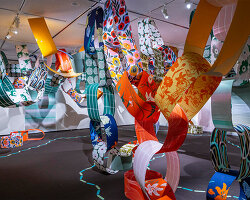
Edelkoort recalls one moment in particular, when Puk proposed transforming part of the exhibition into a planetarium, completely changing how a papier-mâché installation would be experienced. For the curators, these contributions became more than charming anecdotes, helping one of the exhibition’s central ideas to become more evident: that children approach the world with a freedom adults often lose, seeing unexpected possibilities where others see familiar forms.

Square Stools by Yinka Ilori
finding optimism through making
Throughout our conversation, the curators Lidewij Edelkoort and Philip Fimmano rarely referred to play as entertainment, but they kept returning to it as a way of working rooted in the freedom to make mistakes. If INNER CHILD argues for anything, it is that these qualities are more valuable now than ever, in a world driven by speed and certainty. The exhibition’s optimism, then, is not naïve but emerges through the act of making.
Perhaps the strongest testament to that idea came not when the curators described the works on display, but when they reflected on the months spent developing the exhibition. Immersing themselves in these projects, they admit, also changed the way they experienced an increasingly turbulent year.
‘It has helped us to keep that at bay,’ Edelkoort says. ‘It’s almost like armor—happy armor. We don’t suffer as much because we are protected by this storytelling.’
Fimmano pauses before adding just three words:
‘It’s a fuel.’
Edelkoort smiles.
‘It is an optimism engine.’

Cubes by Vincent Godeau

Cubes by Vincent Godeau

A4Adesign’s Riccio cardboard sculptures | image by Vera Cannone

Max Lamb, BOX Stool (2023) | image by Angus Mill

Gustaf Westman, Puzzle Shelf (2025) (read more here)

curators Lidewij Edelkoort and Philip Fimmano | image by Thirza Schaap
project info:
name: INNER CHILD: Playing with Design
curators: Lidewij Edelkoort | @lidewijedelkoort and Philip Fimmano | @philipfimmano
location: Artipelag | @artipelag, Stockholm, Sweden
dates: October 10th, 2026 – April 11th, 2027
This interview is part of designboom’s PLAY chapter, exploring what would happen if form didn’t follow function, but pleasure. Discover more stories that celebrate joy, imagination and playfulness here.
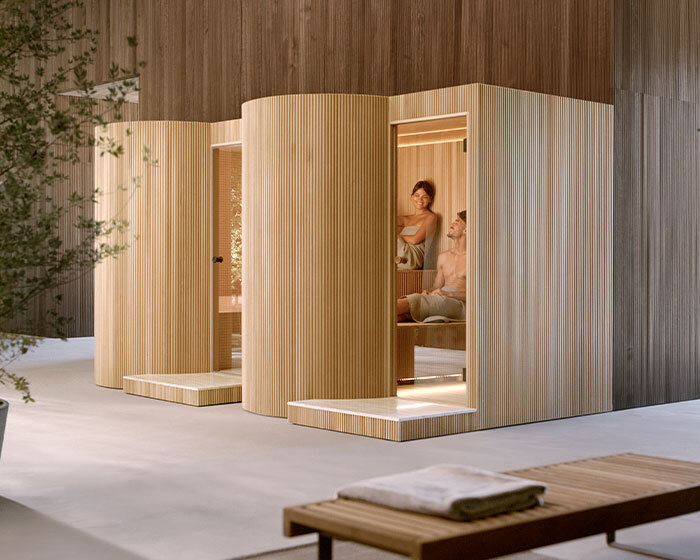
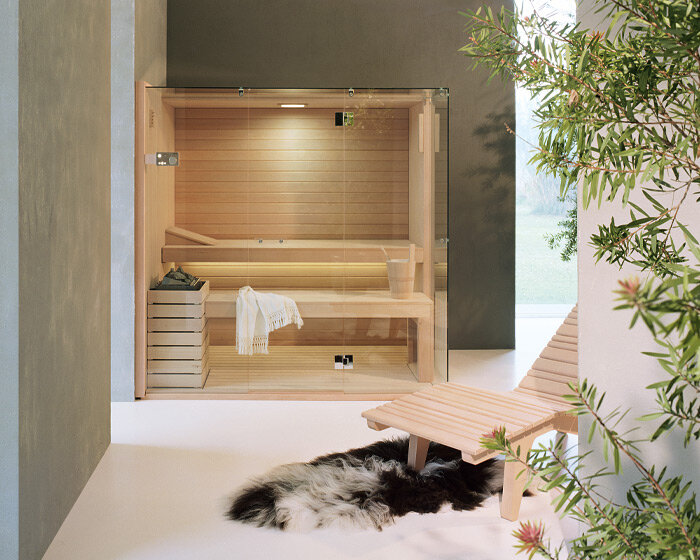
happening now! effe and patricia urquiola design baluar, a sauna and hammam collection translating medieval bastion geometries into wellness architecture.
design interviews (158)
 Sep 15, 2026
 Sep 11, 2026
 Sep 04, 2026
 Sep 03, 2026
exhibitions (271)
 Sep 20, 2026
 Sep 16, 2026
 Sep 13, 2026
 Sep 11, 2026
 Sep 08, 2026
PLAY (45)
 Aug 10, 2026
 Aug 10, 2026
 Aug 09, 2026
 Aug 08, 2026
 Aug 08, 2026
playgrounds (21)
 Aug 06, 2026
 Aug 02, 2026
 Jul 23, 2026
 Jul 18, 2026
 Sep 17, 2026
 Sep 15, 2026
 Sep 14, 2026