
wrapped in a photovoltaic skin, this student-designed EV creates more energy than it uses
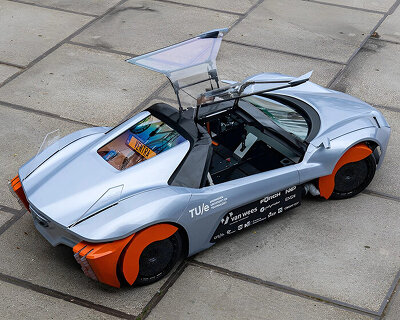
a skin of 1,781 photovoltaic cells turns deep orange 17's exterior into an active energy-harvesting surface.
clemson students ask what a parked car can do
Passenger cars spend most of their time sitting somewhere. Clemson University’s Deep Orange 17 starts with that simple observation and asks what all those stationary hours could contribute to an electric vehicle. Developed by graduate Automotive Engineering students in collaboration with BMW of North America, the fully functional prototype, named Luminetta, covers its exterior with 1,781 photovoltaic cells. They collect energy while the car moves and keep working once it comes to a stop, turning time in the sun into part of the vehicle’s charging cycle.
BMW challenged the Deep Orange team to develop an electric vehicle capable of generating more energy than it consumes over a typical 24-hour urban commuting cycle. The students widened the usual efficiency equation to include the long stretches between drives. In a modeled scenario based on a twelve-mile commute, the solar system generated enough surplus energy for an average 31 additional miles of range. The idea depends heavily on where the car spends its time, which makes the parking space almost as relevant as the road.

1,781 solar cells become part of the body
Solar power sits at the center of Luminetta’s propulsion strategy. Working with the team at Fraunhofer Institute for Solar Energy Systems ISE, the Clemson students integrated photovoltaic cells directly across the exterior surfaces, using the available skin of the car as an energy-harvesting area. The system is designed to continue producing electricity when sections fall into shade, an important detail for a vehicle moving between trees and buildings or sitting beside them for hours.
The two-door coupe keeps a recognizable road-car profile instead of adopting the extremely flat proportions associated with many solar racers. Its shape draws on the aerodynamics of the boxfish, whose compact body combines low drag with useful internal volume, while the broader visual language picks up cues from BMW’s design history. That tension gives Luminetta some personality. Its solar surface reads as part of an actual car, rather than a photovoltaic experiment with wheels attached.

cutting weight to 550 kilograms
Deep Orange 17 becomes more convincing once the numbers move beyond the solar skin. Luminetta weighs just 550 kilograms, or 1,212 pounds, roughly a quarter of the weight of many similarly sized production vehicles. That low mass reduces how much energy the car needs in the first place, allowing the relatively small amount of power gathered from sunlight to have a much larger effect on its range.
The chassis uses structural steel around passenger safety zones, while aluminum cuts weight through other sections. Carbon-fiber structural members connect through 3D-printed metal joints, giving the students another place to strip away unnecessary mass. Regenerative braking feeds energy back into the system, while intelligent torque distribution works with drivetrain controls to reduce losses as the car moves. Inside, a custom interface displays live vehicle data and energy information to the driver.

parking becomes part of the drivetrain
The energy-positive figure comes from simulations, so the 31-mile surplus reads as a modeled use case rather than a blanket promise for every driver. Commute length and sunlight exposure both change the equation, as do weather and where the vehicle is parked. A car sitting beneath a garage roof has a very different energy balance from one spending eight hours outside in direct sun. Deep Orange 17 is useful because it makes those conditions part of the design conversation in the first place.
Luminetta will remain at Clemson’s CU-ICAR campus in Greenville, South Carolina, where it can continue serving as a research platform, with a public appearance planned for CES 2027 in Las Vegas. Its most interesting idea may be simpler than the energy-positive label suggests. Electric-car development often revolves around how much power can be stored and how quickly it can be replenished. Deep Orange 17 looks at all the hours between trips and finds another source sitting in plain sight: the car itself, parked in the sun.


project info:
name: Deep Orange 17 / Luminetta
developed by: Clemson University Deep Orange, Department of Automotive Engineering
industry partner: BMW of North America
solar development: Fraunhofer Institute for Solar Energy Systems ISE
location: CU-ICAR, Greenville, South Carolina, USA
status: fully functional research prototype
shop
your own online design shop — no sales commission collected