turning Silence, Emptiness and Absence Into Art
We may be used to thinking of art as something that asks us to look. Still, some of the most influential experiments in postwar art began by questioning this basic expectation, asking what could happen if an artist withheld the very elements that make an artwork visible or audible. These works leave space for something less obvious to come through, whether that is the changing light of a room, the sounds of an audience, the physical character of architecture or just the awareness of one’s own body occupying a particular place at a particular time.
From Robert Rauschenberg and John Cage in the early 1950s to Yves Klein, Doug Wheeler, Mark Rothko and Alvin Lucier, there is a recurring interest in what becomes perceptible when the artwork begins to recede. Seen together, their work suggests an alternative history of spectacle in which attention is not captured through abundance, but redirected through absence.
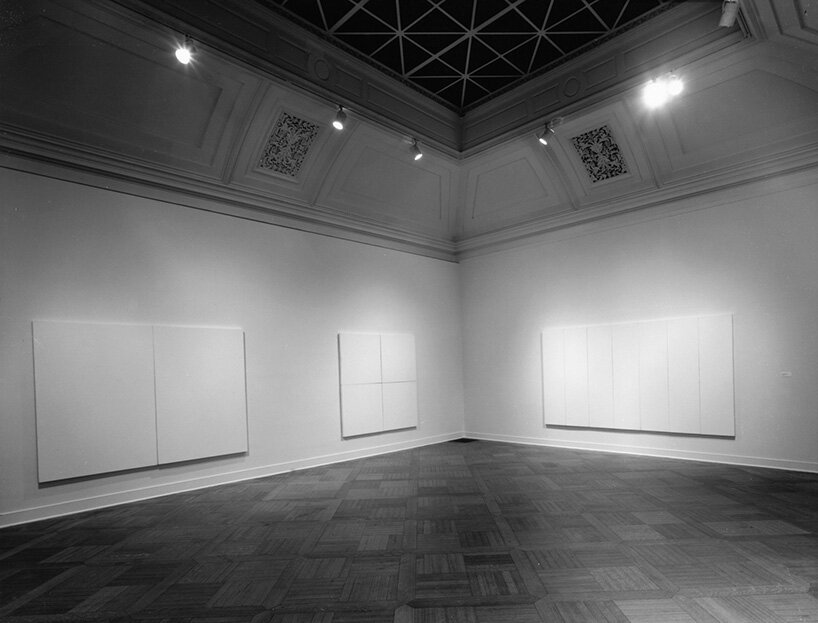
Installation view of the White Painting [three panel] (1951) and White Painting [one panel] (1951) in the Robert Rauschenberg: The Early 1950s exhibition at the Corcoran Gallery of Art , Washington, D.C., United States, 1991. | image Unattributed Photograph Collection. Robert Rauschenberg Foundation Archives, New York
the less there is to see, the more there is to notice
Rauschenberg’s White Paintings, first made in 1951, are perhaps the clearest place to begin because they look like an almost complete withdrawal from painting. Across a series of one, two, three, four and seven white panels, Rauschenberg removed imagery, composition and the visible gestures of the artist, leaving surfaces that appear at first to offer very little information. Yet the paintings were conceived precisely to register the information around them. Light, shadows and the movement of people across the room alter what appears on their surfaces. Rauschenberg later described the works as ‘clocks’, suggesting that they could register changes in their environment in much the same way that a clock registers the passing of time.
John Cage, who was closely connected to Rauschenberg and his experiments, recognised the possibility immediately. He described the white surfaces as ‘airports for the lights, shadows, and particles’, a description that shifts the emphasis away from what has been painted and towards everything that the painting allows us to notice. The absence of an image does not therefore leave the viewer with nothing. It changes the hierarchy of what deserves attention. A shadow that would normally be incidental becomes part of the work; the movement of another visitor becomes visible on the surface; daylight becomes something to observe. In Cage’s 4′33″, first performed by David Tudor in 1952, the performer remains silent for the duration of the composition, leaving the audience to hear whatever sounds happen to occur in the surrounding environment. The work changes with every performance because its material is not a fixed musical score but the unpredictable acoustic conditions of the place in which it takes place. A cough, a footstep, a chair moving or sounds coming from outside the room become the most prominent thing to hear.
Both Cage and Rauschenberg were interested in what happened when the artist stopped determining exactly what the audience should encounter, allowing the surrounding world to enter the work. Yves Klein’s Le Vide, presented at Galerie Iris Clert in Paris in 1958, took this logic out of the canvas and into the gallery. Klein emptied the exhibition space and painted it white, removing the paintings and objects that visitors had arrived expecting to see. Through a deliberately theatrical gesture, the opening was carefully staged to heighten the impact of entering a gallery where the expected artworks had disappeared. What remained was the architecture of the room, the white surfaces, the people standing inside it and, perhaps most importantly, the expectation that something should be there. The absence of the artwork exposed the usual role of the gallery, turning the space itself into the experience.
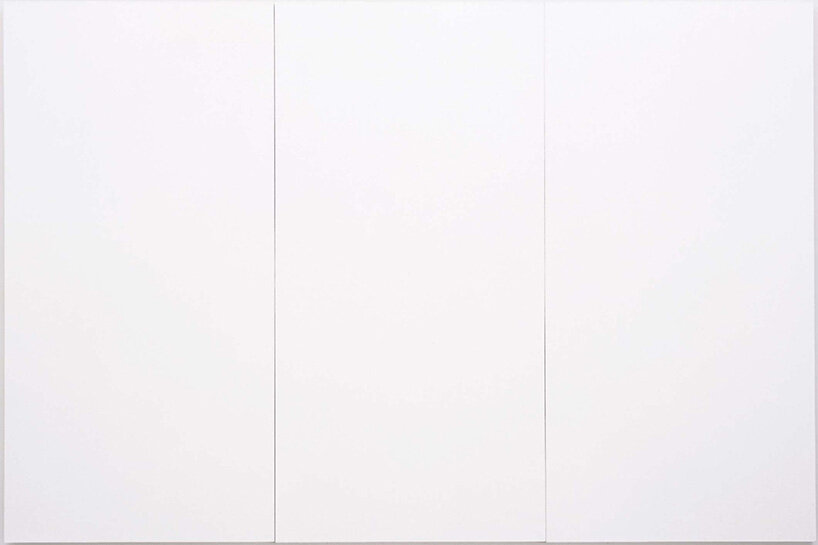
White Painting, 1951, House paint on canvas 72 x 108 in. (182.9 x 274.3 cm) overall San Francisco Museum of Modern Art Purchase through a gift of Phyllis C. Wattis
from looking at an artwork to experiencing a space
By the time artists began working directly with architectural environments, the question had shifted from what could be removed from an artwork to what could happen when the environment became the medium. Doug Wheeler’s PSAD Synthetic Desert III, presented at the Solomon R. Guggenheim Museum in 2017, transformed the gallery through controlled surfaces and lighting, using acoustic absorption to reduce the sounds and reflections that normally help us perceive the dimensions of a room.
In an environment where familiar acoustic cues have been suppressed, the visitor becomes more conscious of small sounds and movements, while the boundaries of the space become harder to read. The room stops behaving like a neutral background and begins to determine what the visitor can perceive. Wheeler’s work is therefore less about presenting an image of a desert than about constructing some of the perceptual conditions associated with its vastness and stillness.
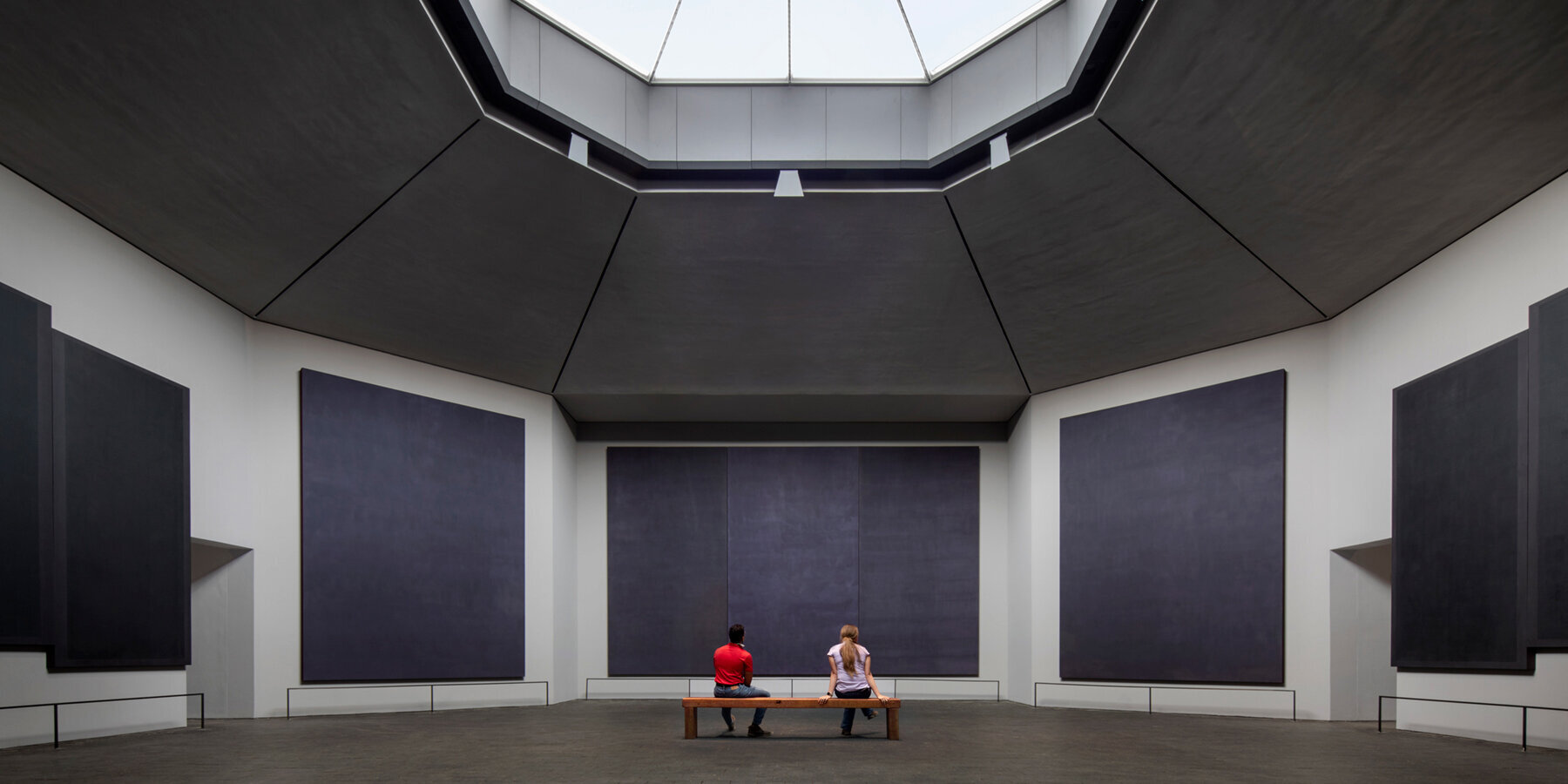
The Rothko Chapel in Houston approaches the same territory through a very different atmosphere. Opened in 1971, the chapel contains fourteen monumental paintings by Mark Rothko within an environment designed for contemplation, with subdued natural light and very little visual distraction beyond the paintings. The space rejects the rapid succession of visual stimuli that defines much of the museum experience. Its scale, darkness, and stillness allow visitors to focus on a small number of visual elements for longer, while time becomes part of the experience.
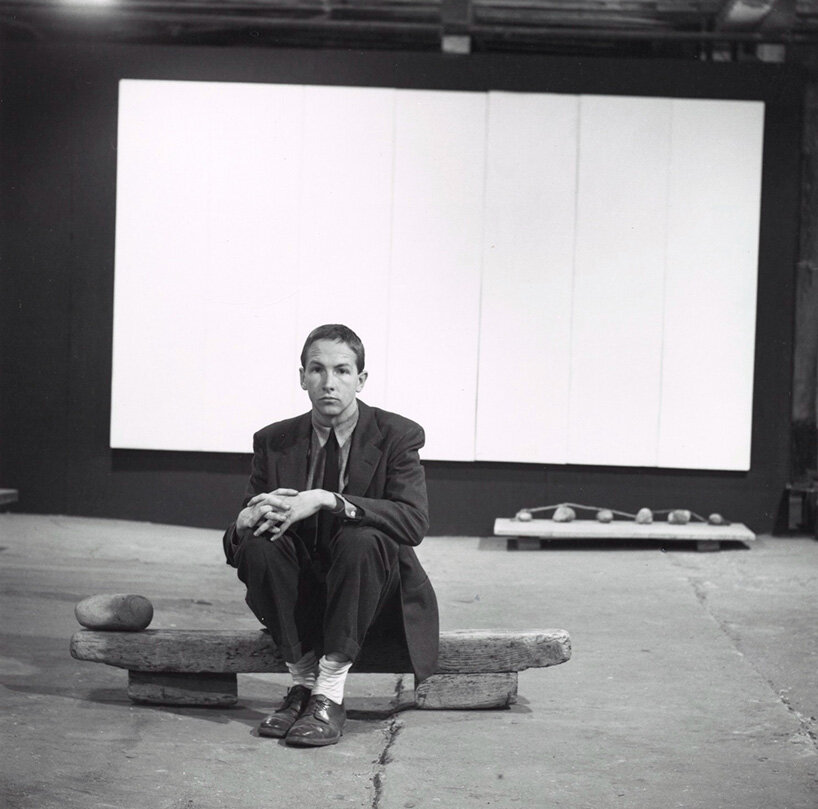
Stable Gallery Robert Rauschenberg with White Painting [seven panel” (1951) and two untitled Elemental Sculptures (both 1953) at the Rauschenberg: Paintings and Sculpture exhibition, Stable Gallery , New York, NY, United States, Fall 1953 | image by Allan Grant / Life Magazine Photograph Collection. Robert Rauschenberg Foundation Archives, New York
when the artwork gives the room a voice
Alvin Lucier’s I Am Sitting in a Room, first performed in 1969, offers a culmination of this trajectory because it allows the environment to take over the artwork completely. Lucier begins by recording himself reading a text and then plays that recording back into the same room, recording it again and repeating the process. With each generation, the words become less intelligible while the resonant frequencies of the room become increasingly pronounced, until the characteristics of the architecture dominate what we hear. The work begins with the artist’s voice and ends with the room’s voice, although of course the latter is produced through the interaction between the two. What Lucier reveals are frequencies that were present in the space all along but normally remain unnoticed because they are masked by speech and other sounds. By repeatedly removing the intelligibility of the original recording, he makes the physical character of the room increasingly audible.
Lucier completes a process that had already begun with the White Paintings. The artwork gradually stops being the thing that demands attention and becomes a mechanism for directing attention elsewhere. Rauschenberg makes the surrounding light and movement visible; Cage allows the sounds of the environment into the composition; Klein turns the gallery itself into the subject; Wheeler constructs a space in which perception becomes the primary material; and Lucier allows architecture to determine the sound of the work. The point is not that all of these artists were trying to make art quieter, emptier or more minimal. What they share is an interest in what happens when the artist relinquishes some control over what the audience is supposed to experience.
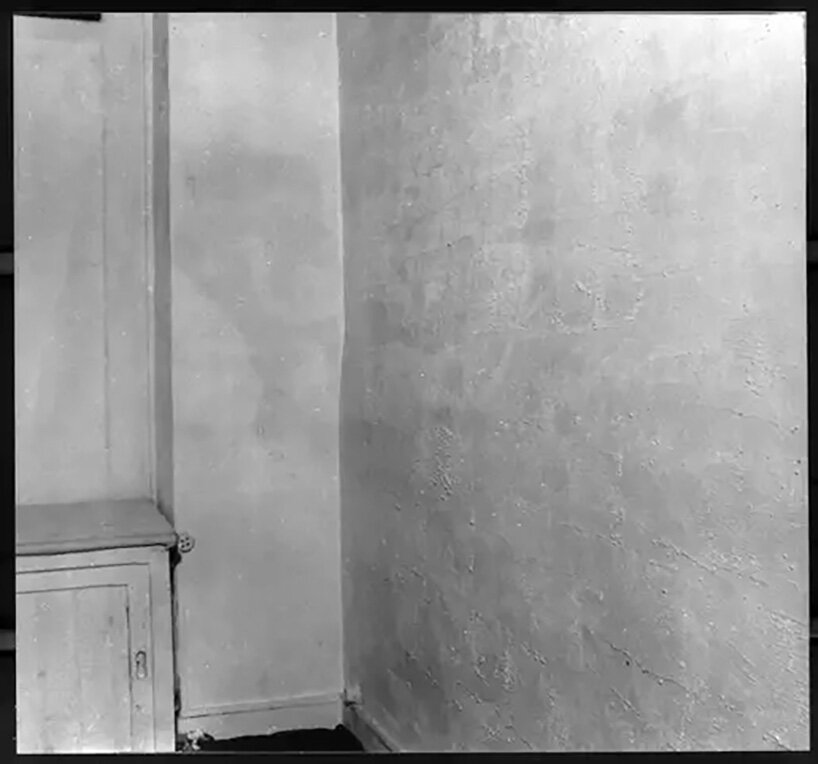
Yves Klein, Interior view of the exhibition Le Vide (The Void), held at Galerie Iris Clert, Paris April–May 1958 © Yves Klein, AADAGP, Paris 2009
an alternative to the culture of constant stimulation
That question feels particularly relevant at a moment when attention has become one of the main things that contemporary visual culture is designed to compete for. Screens, social media, immersive installations and elaborate exhibition environments rely on movement, scale, novelty and constant sensory stimuli to keep people engaged. Against this landscape, the white canvas, the silent performance or the empty room can seem almost strange in its refusal to provide an immediate spectacle.
Yet these works are not really about doing less. They are about making different things available to perception. When the image disappears, we may notice the light falling across the wall; when the music stops, the room begins to sound different; when the gallery is emptied, its architecture and the behaviour of its visitors become visible; when sound is absorbed, the body becomes more present within the space.
This is what makes the idea of anti-spectacle useful, even if it is not a formal category in art history. These works do not reject attention. They change the way attention is produced. Rather than asking the viewer to keep moving towards the next image, object or effect, they make the surrounding conditions of the experience difficult to ignore.
The result is a different kind of spectacle, one that does not necessarily belong to the artwork at all. It belongs to the shadow moving across its surface, the sound of a room, the changing quality of light, the architecture beneath our feet and the awareness that we have been standing in the same place long enough for things we normally overlook to become perceptible. In an age in which almost every empty space is quickly filled, the decision to leave something out can become a surprisingly powerful way of making us pay attention.
John Cage, Public domain, via Wikimedia Commons
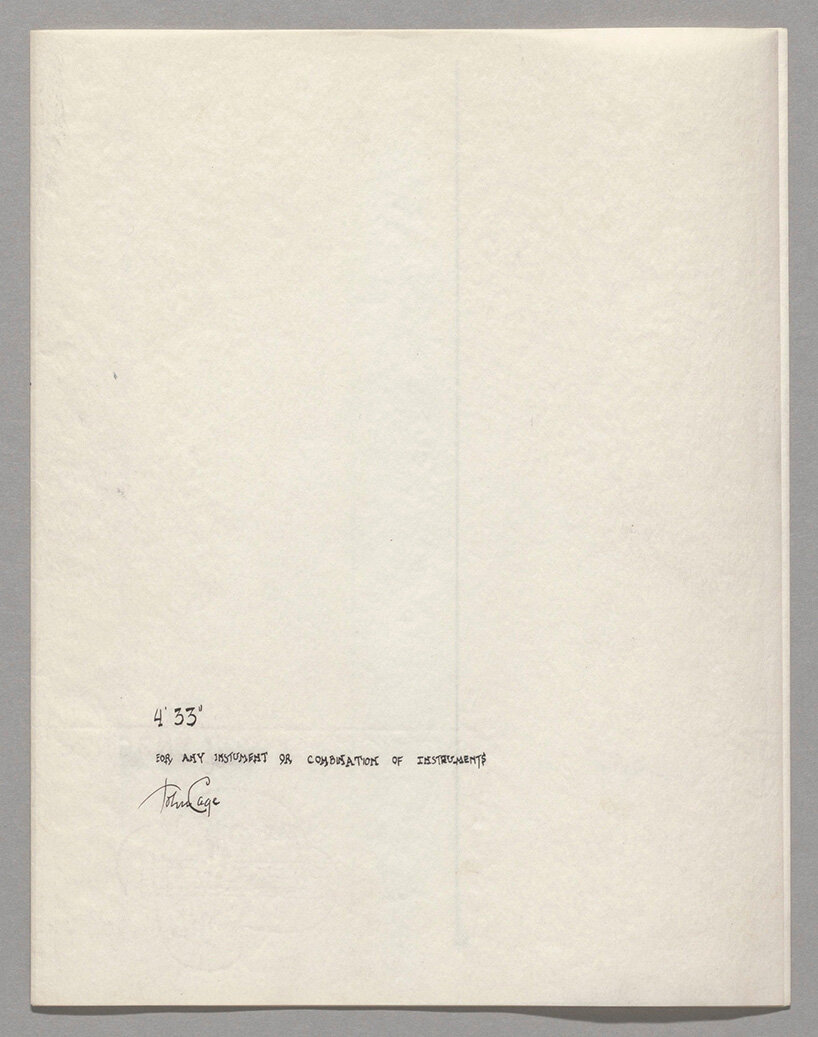
John Cage. 4′33″ (In Proportional Notation). 1952/53. Ink on paper, each page: 11 × 8 1/2″ (27.9 × 21.6 cm). The Museum of Modern Art, New York. Acquired through the generosity of Henry Kravis in honor of Marie-Josée Kravis, 2012. © 2013 John Cage Trust
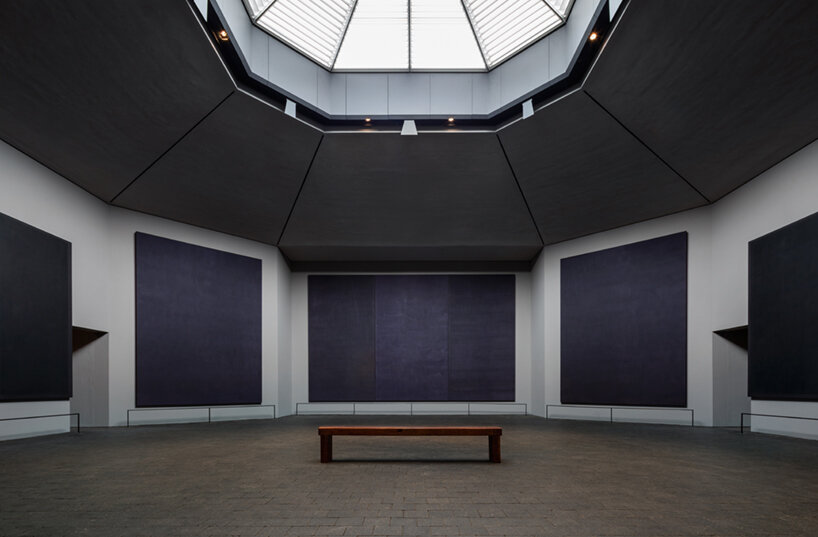
image by Elizabeth Felicella
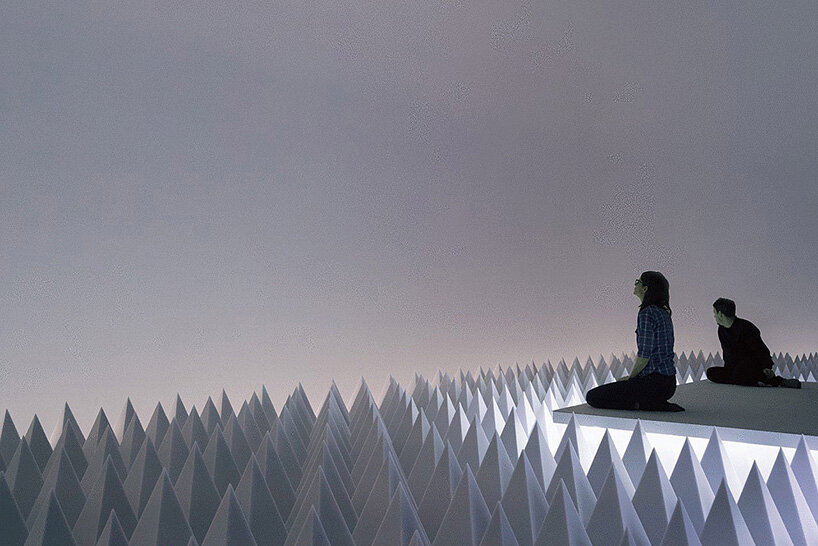
Doug Wheeler, PSAD Synthetic Desert III, 1971 (realized 2017). Reinforced fiberglass, wood, plaster, white plaster paint, anechoic absorbers, sound equipment, and Gro-Lux and white UV neon light, Room: 19 feet x 56 feet 6 inches x 26 feet 6 inches (5.8 x 17.2 x 8.1 m), Solomon R. Guggenheim Museum, New York, Panza Collection, Gift, 1991. © Doug Wheeler
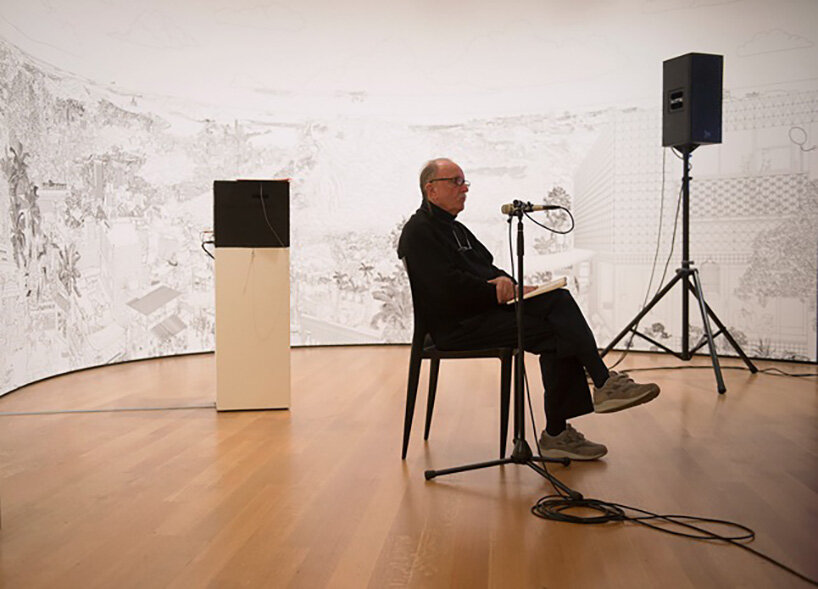
Alvin Lucier recording I Am Sitting in a Room at The Museum of Modern Art, New York, on Saturday, December 20, 2014. Assisted by James Fei | image by Amanda Lucier. © 2015 Amanda Lucier
This article is part of designboom’s SPECTATOR AND SPECTACLE chapter, asking how wonder gets built, presented in partnership with SolidNature, and how it might return some mystery to a world that has measured most of it away. Discover more stories that turn onlookers into participants, alter perception and disrupt the everyday here.
happening now! effe and patricia urquiola design baluar, a sauna and hammam collection translating medieval bastion geometries into wellness architecture.
interactive installation (674)
 Sep 24, 2026
 Sep 23, 2026
 Sep 19, 2026
 Sep 18, 2026
 Sep 15, 2026
museums and galleries (910)
 Sep 24, 2026
 Sep 23, 2026
 Sep 18, 2026
 Sep 17, 2026
SPECTATOR AND SPECTACLE (17)
 Sep 22, 2026
 Sep 22, 2026
 Sep 21, 2026
 Sep 21, 2026
 Sep 14, 2026
 Sep 08, 2026
_Original_Cover.webp)