art is called to perform
World of WearableArt begins with an object, but the competition is structured around everything that happens after that object reaches a body. In Wellington, finalist garments enter an arena where distance and movement become design constraints, while stage lighting changes what remains visible from a seat.
The 2026 edition, titled GLO!, brings 108 finalist works by 134 designers from 18 countries to the TSB Arena. Its strongest critical question sits inside that format: what happens to an artwork when it has to perform for an audience?
The event began on a much smaller scale. Suzie Moncrieff staged the first WOW show at Nelson’s William Higgins Gallery in 1987, asking designers to ‘take art off the wall and adorn the body.’ Around 200 people attended. Today the Wellington production reaches more than 60,000 people across its season. As the audience expanded, the viewing conditions changed with it. A garment that once moved through a gallery-scale setting now has to be legible across an arena.
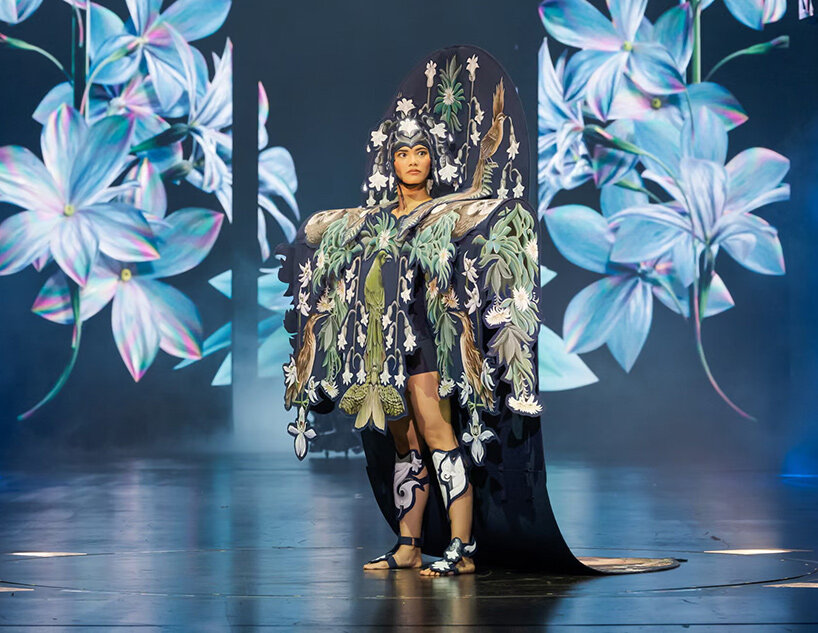
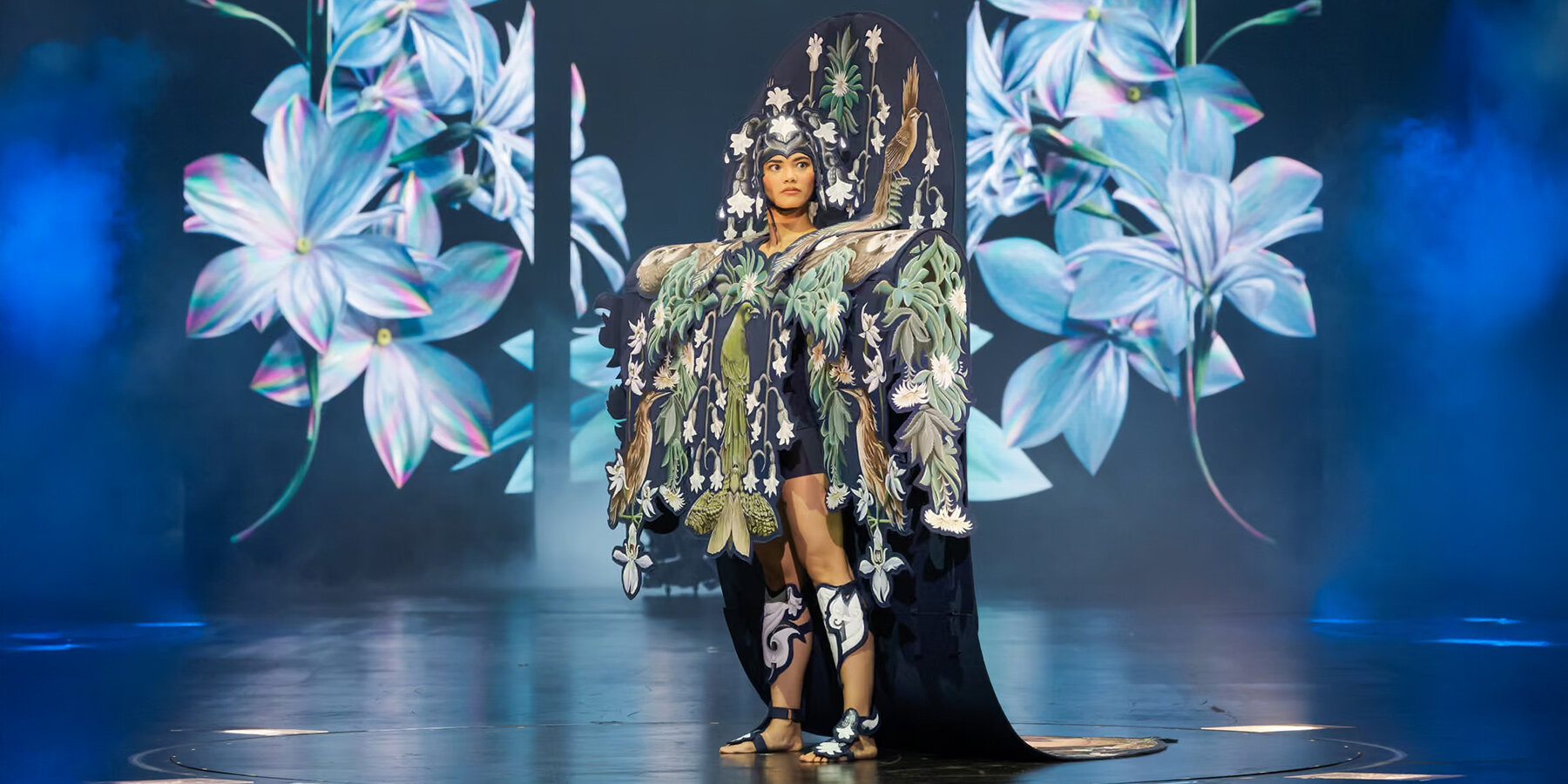
Sacred Nightfall, Kayla Christensen | image © Stephen A’Court
designed for the back row
WOW makes that requirement explicit. Its judging criteria state that a garment should ‘look as good up close, as it does from a distance,’ with construction strong enough to handle choreography. Judges later see the finalists again under full show lighting, with music and the full cast in place. The process treats visibility as part of the design brief. Surface detail still counts, but so does silhouette. Movement can alter the object, and distance decides which gestures survive.
The 2026 works often make that pressure easy to see. Joe Blanck’s Lophii swallows the wearer inside the profile of a deep-sea anglerfish, its illuminated lure projecting beyond the body. Cecilio Castrillo’s Artemis stretches outward through a pale, winged structure that reads almost diagrammatically against the dark stage.
Kayla Christensen’s Sacred Nightfall, winner of the 2026 Supreme WOW Award, works through a different kind of scale: an intricately stitched tapestry becomes a figure once wrapped around the performer. The body turns each of these objects from a construction into an image that can travel across the room.
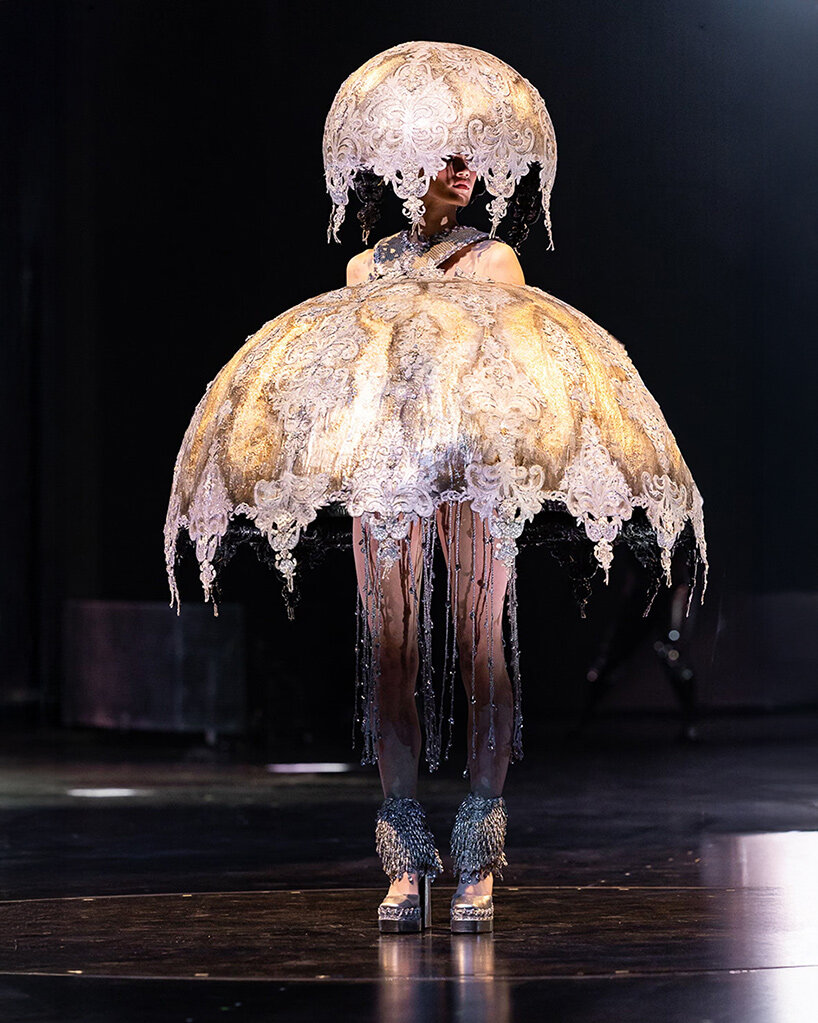
Platinum, Lisa Newsome | image © Andi Crown
approaching the condition of theatre
Modernist art critic and art historian Michael Fried supplied one of the twentieth century’s most famous warnings about art becoming dependent on its viewer and surroundings. In his 1967 essay Art and Objecthood, he wrote: ‘Art degenerates as it approaches the condition of theatre.‘ Fried was arguing against an art whose meaning depended on duration and the beholder’s physical encounter.
WOW takes almost the opposite position. Here, dependence on the stage is built into the competition. The garment is expected to change once somebody steps inside it.
Performance theorist Erika Fischer-Lichte offers another way to understand that shift. She argued: ‘a performance comes into being through the bodily co-presence of actors and spectators.‘ A wearable artwork complicates the relation further because the object sits directly on the performer, the body gives it scale and motion, and the audience supplies another condition through which it is seen. At WOW, the garment bridges sculpture and event, with its full form emerging through use.
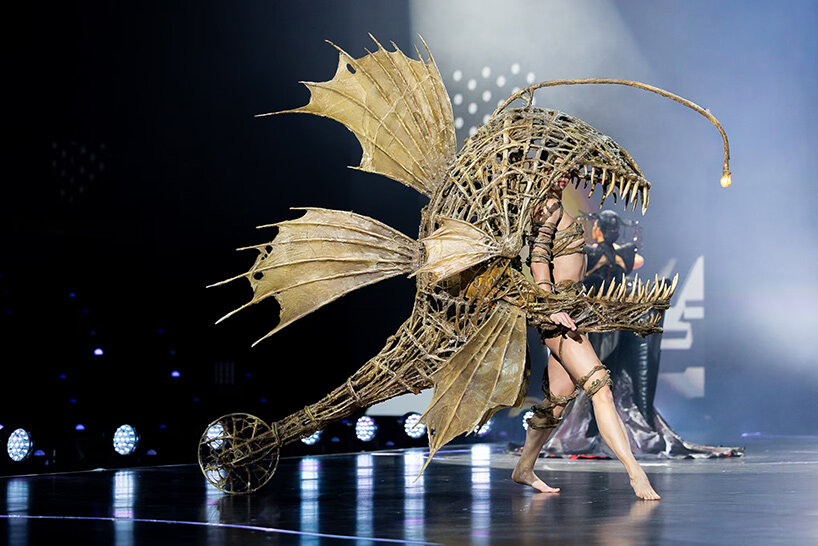
Lophii, Joe Blanck | image © Andi Crown
what survives the photograph
There is another audience waiting beyond the arena. Caroline Evans, writing about fashion after the rise of digital media, observes that ‘we now consume fashion as image as much as we experience it as material object.‘ The photographs coming out of Wellington demonstrate this idea. Viewed as a still image, music disappears and choreography becomes a frozen pose. Movement has to be suggested by the position of a limb or the sweep of a material caught mid-motion.
The same garment therefore has to work through two very different kinds of viewing. Onstage, its appearance changes from one second to the next as the performer moves through light and space. In photographs, all of that is compressed into a single image that reaches far more viewers than the live production itself. Large silhouettes and forms that can be understood almost immediately tend to survive that transition especially well. And so, the qualities that make these works readable from the back of an arena also make them easy to carry onto a screen.
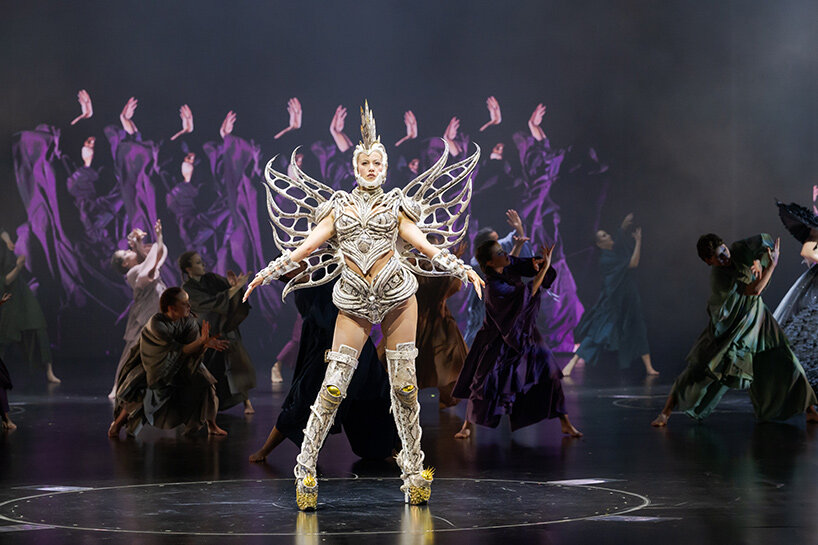
Artemis, Cecilio Castrillo | image © Stephen A’Court
the audience enters the design
Spectatorship is an active process during which viewers select and interpret what they see, connecting it to their own experience. WOW gives them unusually direct material to work with. The designs often begin with recognizable forms, then enlarge or distort them until recognition itself becomes part of the encounter.
Shing Hei’s My Ugly Duckling places the bird around the body, while Rachel Poole and John Fitzgerald’s Ripe for the Pecking turns fruit into exaggerated wearable volume. These references arrive quickly from across the room.
The useful critical question around WOW concerns the pressure that spectatorship places on form. Its garments are built to reach someone sitting far from the stage and a camera positioned closer to it, then continue onward as still images. That sequence favors scale and instant legibility, while movement supplies another layer once the wearer enters. It also explains why the body remains so central. Once art leaves the wall here, the viewer enters the design brief with it.
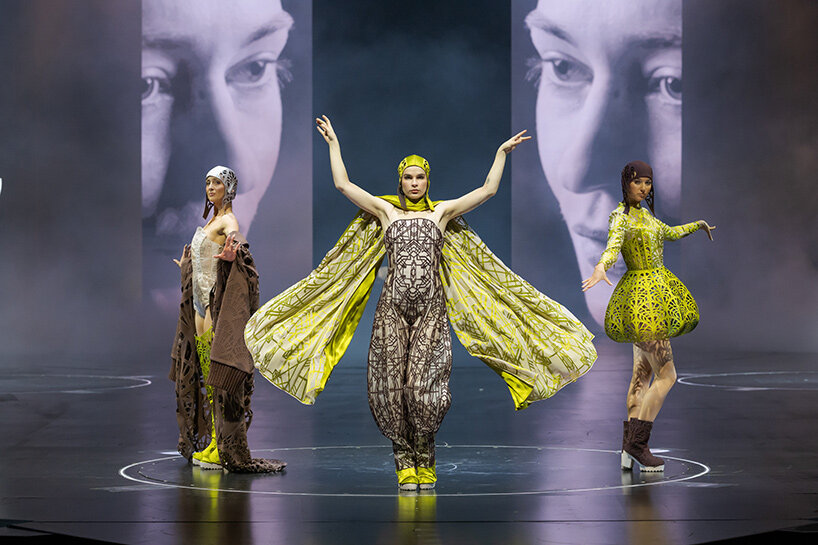
Aviatrix, Hanna Smith | image © Stephen A’Court
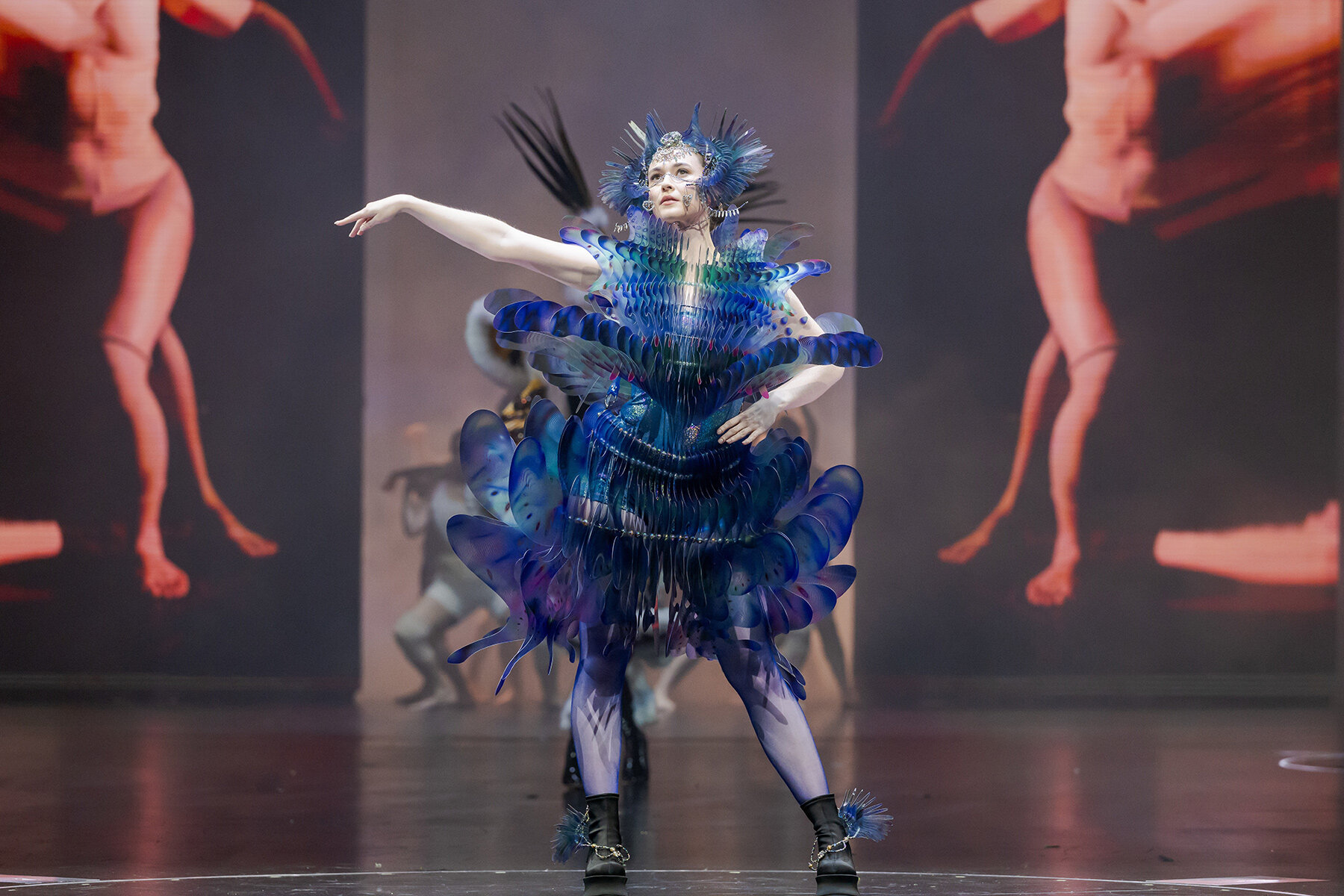
Love’s Gravity, Hanqi Xu, Honglei Zhou and Luo Jingxian | image © Stephen A’Court
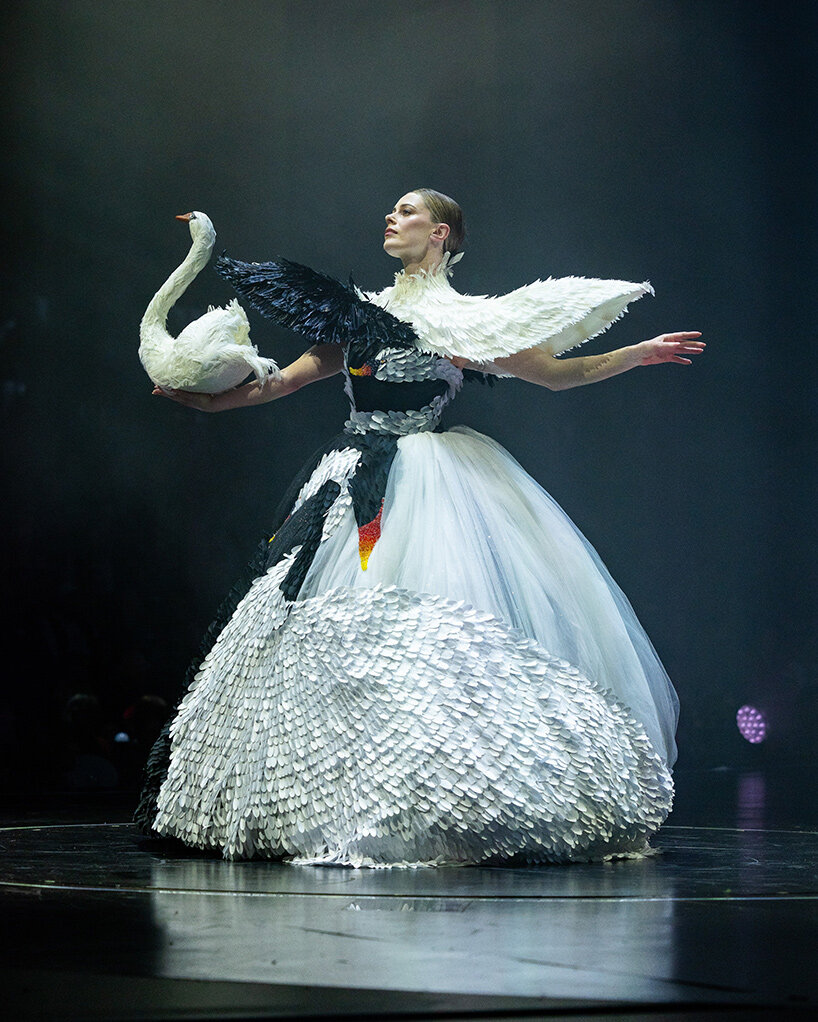
My Ugly Duckling, Shing Hei | image © Andi Crown
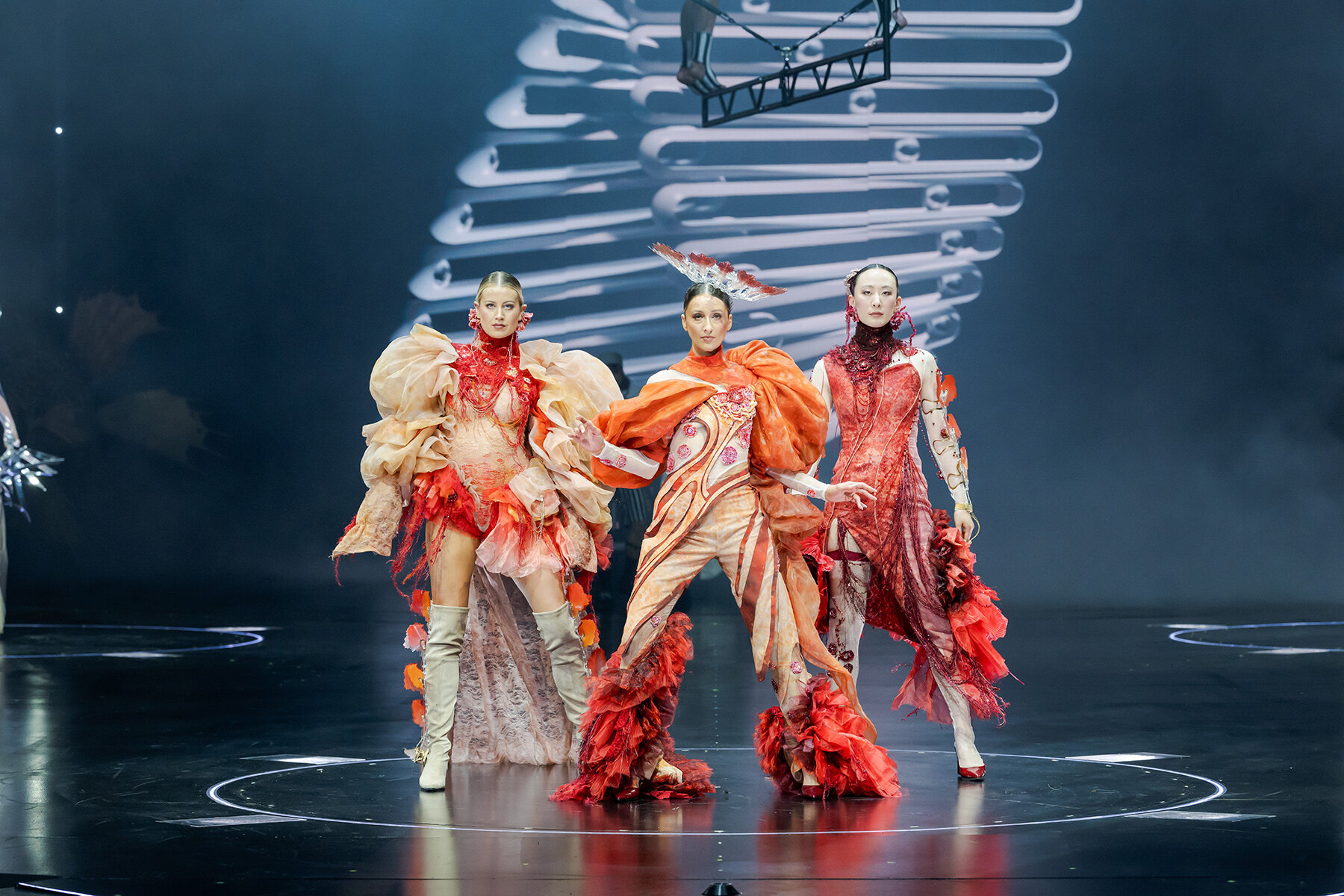
Hen, Zhiqian Li | image © Stephen A’Court

happening now! effe and patricia urquiola design baluar, a sauna and hammam collection translating medieval bastion geometries into wellness architecture.
fashion design phenomena (330)
 Sep 15, 2026
 Sep 05, 2026
 Aug 10, 2026
 Aug 07, 2026
 Aug 04, 2026
SPECTATOR AND SPECTACLE (14)
 Sep 22, 2026
 Sep 21, 2026
 Sep 20, 2026
 Sep 19, 2026
 Sep 19, 2026
 Sep 22, 2026
 Sep 17, 2026
 Sep 15, 2026