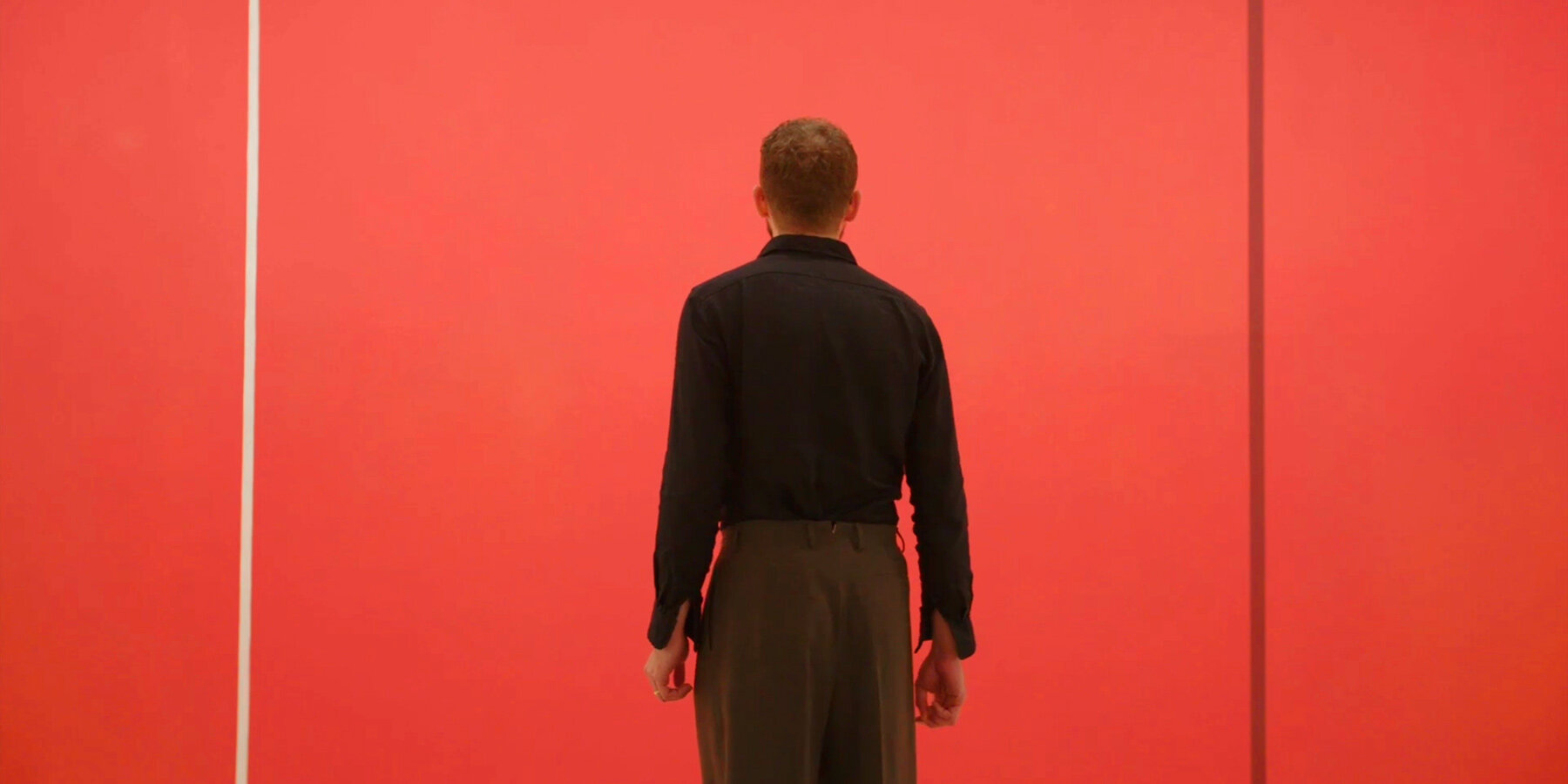
when an artwork becomes too large for the eye
There is a familiar way of looking at art. Most of us tend to stand back, face the work, and take in the whole image. We can see it happen at any museum. There have been, however, some fascinating experiments across twentieth-century art and exhibition design which begin by making that position fail.
Mark Rothko enlarged fields of color until they could exceed the viewer’s central field of vision. Herbert Bayer mapped images above and around the eye. The Eameses arrayed thousands of photographs across seven screens at once, and Lina Bo Bardi pulled paintings away from the wall altogether. Across very different media, the same question still stands: what does art become when there is more to see than one viewpoint can contain?
Peripheral vision marks the edge of attention. We perceive color and movement beyond our line of sight, but detail begins to fall away. An artwork that extends into and beyond this territory behaves in a way that’s unique. Its edges become harder to hold at once, or other images enter behind it. Looking becomes physical, and involves distance, turning, and movement through space. The artwork can remain completely still while the viewer becomes active.
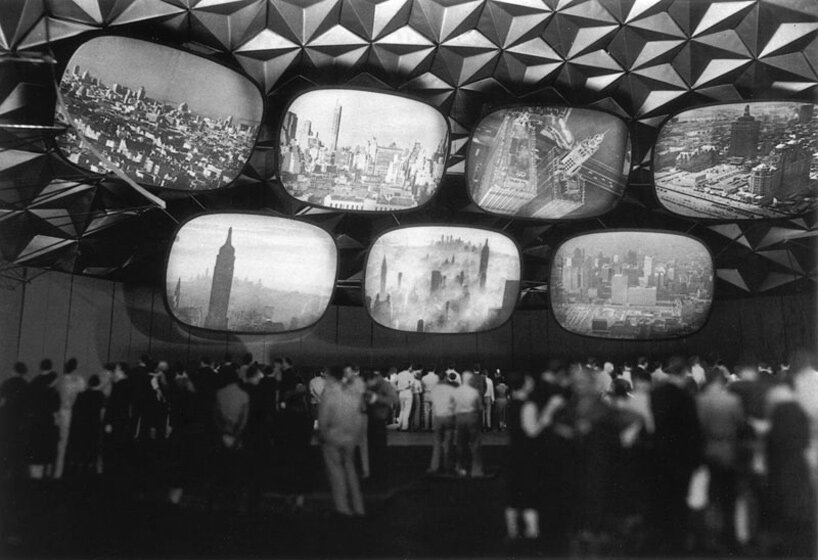
Charles and Ray Eames, Glimpses of the U.S.A., 1959 | image © Eames Office
rothko makes scale intimate
Mark Rothko understood scale through proximity. His large canvases were never intended simply as monumental pictures to admire from across a gallery. Writing in 1949, he explained that he painted large because he wanted the experience to remain ‘very intimate and human.’ A small picture could be surveyed from outside, he argued, while a larger one places the viewer within the experience. ‘However you paint the larger picture, you are in it,‘ he wrote.
The idea becomes physical once we stand close to one of the large dark red canvases of the Seagram Murals, for instance. A wash of color extends far beyond our field of vision and we become immersed in a new, atmospheric world of total red. Rothko even specified that his largest pictures should be encountered at close range. The scale works through a strange inversion: the painting grows enormous so the distance between object and viewer can shrink.
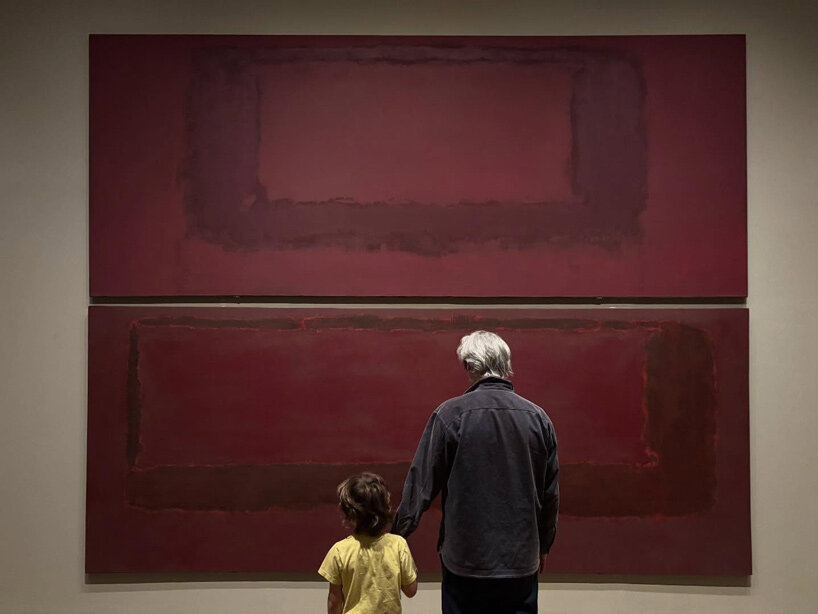
Mark Rothko, The Seagram Murals (1958–1959), Tate Modern | image via @haebean
barnett newman asks the viewer to come closer
Barnett Newman’s Vir Heroicus Sublimis, painted in 1950–51, stretches nearly eighteen feet across. Five narrow vertical bands, which Newman called ‘zips,’ interrupt an expanse of red. From across the room, the painting resolves fairly easily into a rectangle with a compositional structure. Newman wanted another encounter. He hoped viewers would approach the canvas closely enough for the red field to take over their vision.
At that distance, the painting becomes hard to see all at once. One zip appears clearly while another sits farther out toward the edge of vision. The perimeter of the canvas loses some of its authority. MoMA describes the effect as an ‘engulfing environment,’ though the canvas itself stays resolutely flat against the wall.
The spatial experience comes from the viewer standing too close for conventional looking to work. Newman compared the encounter to meeting another person, something understood physically before it can be surveyed from a safe distance.
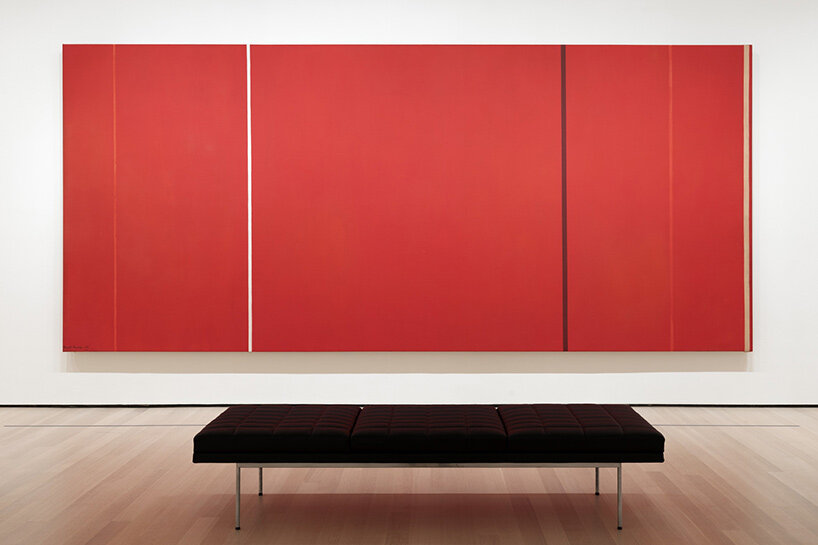
Barnett Newman, Vir Heroicus Sublimis, 1950-51, installation view of the exhibition ‘Collection 1940s–1970s’, October 21st, 2019 — January 1st, 2023 | image by Robert Gerhardt, courtesy MoMA
herbert bayer draws the field of vision
Earlier in the 20th century, Herbert Bayer turned this problem into a diagram. His Diagram of the Field of Vision, first developed for the 1930 Deutscher Werkbund exhibition in Paris and reworked in 1935, places an eye at the center of an expanding field of images. Pictures occupy positions overhead and below the conventional eye line. The viewer faces several directions at once. Bayer described the arrangement as an ‘inclusive picture’ of possible viewpoints, with exhibition material extending beyond the frontal wall.
The drawing is almost funny in its bluntness. Exhibition design becomes a geometry problem built around a human head. Instead of assuming that vision travels straight ahead toward a wall, Bayer works with everything the eye can potentially register around it. The diagram also exposes something museums tend to conceal: every display already contains an idea of where the viewer should stand. Bayer just drew that relationship out in full.
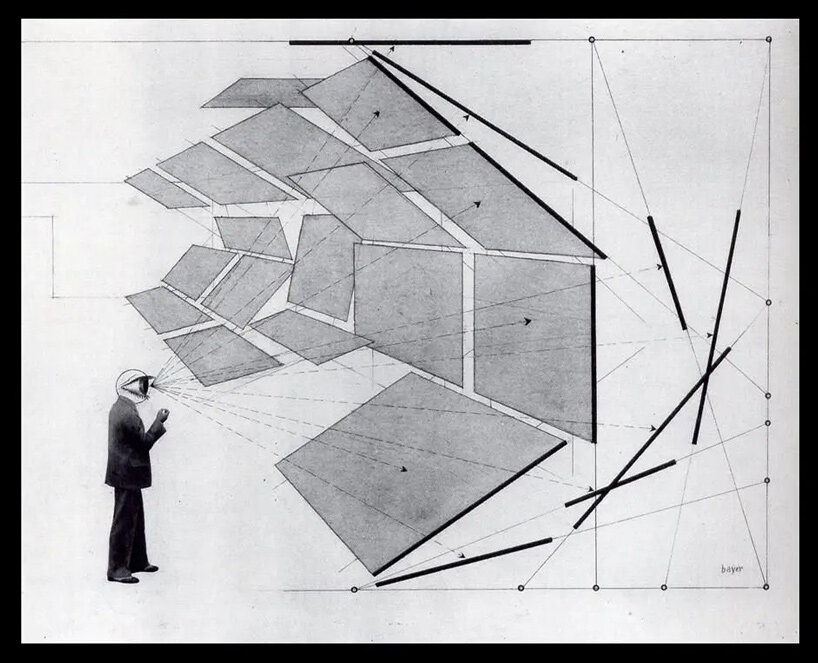
Herbert Bayer, Extended Field of Vision (1930)
the eameses give the eye too much
For Glimpses of the U.S.A., produced for the 1959 American National Exhibition in Moscow, Charles and Ray Eames projected 2,200 still and moving images across seven screens, each measuring twenty by thirty feet. Photographs of homes, highways, supermarkets, newspapers, and other fragments of postwar American culture appeared in rapid combinations across the enormous array.
Nobody in the audience could inspect all seven screens simultaneously. Looking meant choosing, even when the choice lasted only a second. One image sat at the center of attention while another registered somewhere beside it. Charles Eames later explained that the multiple projection system was meant to engage the viewer’s senses through reinforcement across images.
The installation turns visual excess into an organizational tool. Where Rothko stretches one image beyond comfortable viewing distance, the Eameses multiply images until attention itself becomes the scarce resource.
Charles and Ray Eames, Glimpses of the U.S.A., 1959 | video © Eames Office
lina bo bardi removes the wall
At the Museu de Arte de São Paulo, Lina Bo Bardi’s glass easels lift paintings onto transparent panes set into heavy concrete bases. The works stand throughout the open gallery instead of forming a procession along its perimeter. MASP describes the arrangement as a ‘forest’ of artworks, with visitors free to move among paintings that appear suspended in space.
The effect comes from overlap. Look at one painting and another may appear beyond its edge. Walk sideways and the composition of the room changes. Turn around and the back of a canvas enters view, complete with its label and support. A work that would usually claim an isolated patch of wall now shares the field of vision with other paintings and other people. Bo Bardi leaves each artwork intact while removing the architectural device that normally tells us how to approach it.
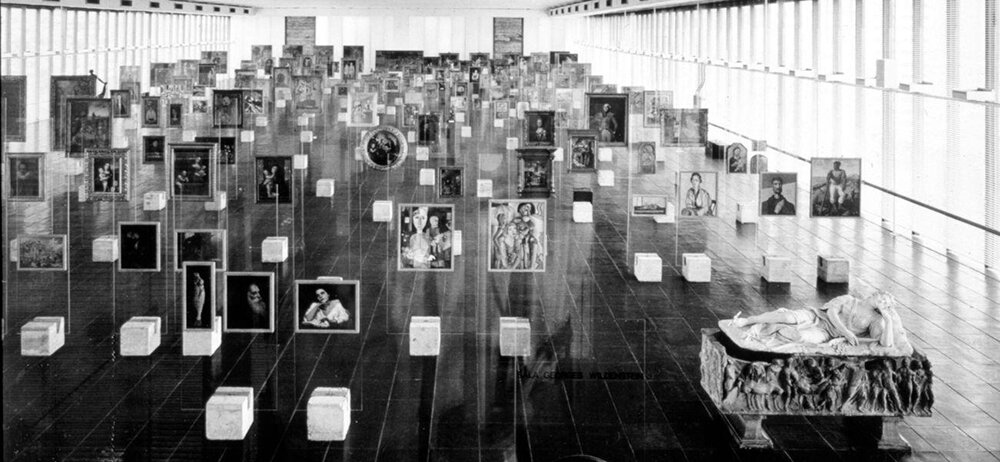
Museu de Arte de São Paulo, Lina Bo Bardi, Brazil | image courtesy La Biennale di Venezia
the viewer becomes part of the display system
Taken together, these works make the viewer unusually aware of the act of looking. Rothko uses distance. Newman uses scale. Bayer works through orientation, while the Eameses overload attention and Bo Bardi uses position. The work exceeds the easy frontal view in a different way each time. A visitor has to move, turn, choose a focus, or accept that part of the visual field will remain unresolved.
This is where the idea separates from the contemporary language of ‘immersive’ art. Filling every surface with imagery can create a powerful environment, although visual saturation alone says little about how a viewer is being asked to see.
The earlier experiments are compelling because their techniques remain exposed. Bayer literally diagrams the apparatus. The Eameses leave seven screens hanging above the audience. Bo Bardi forces you to view a massive collection of layered imagery at once. The experience comes from understanding that your own body occupies a specific position within a larger visual system.
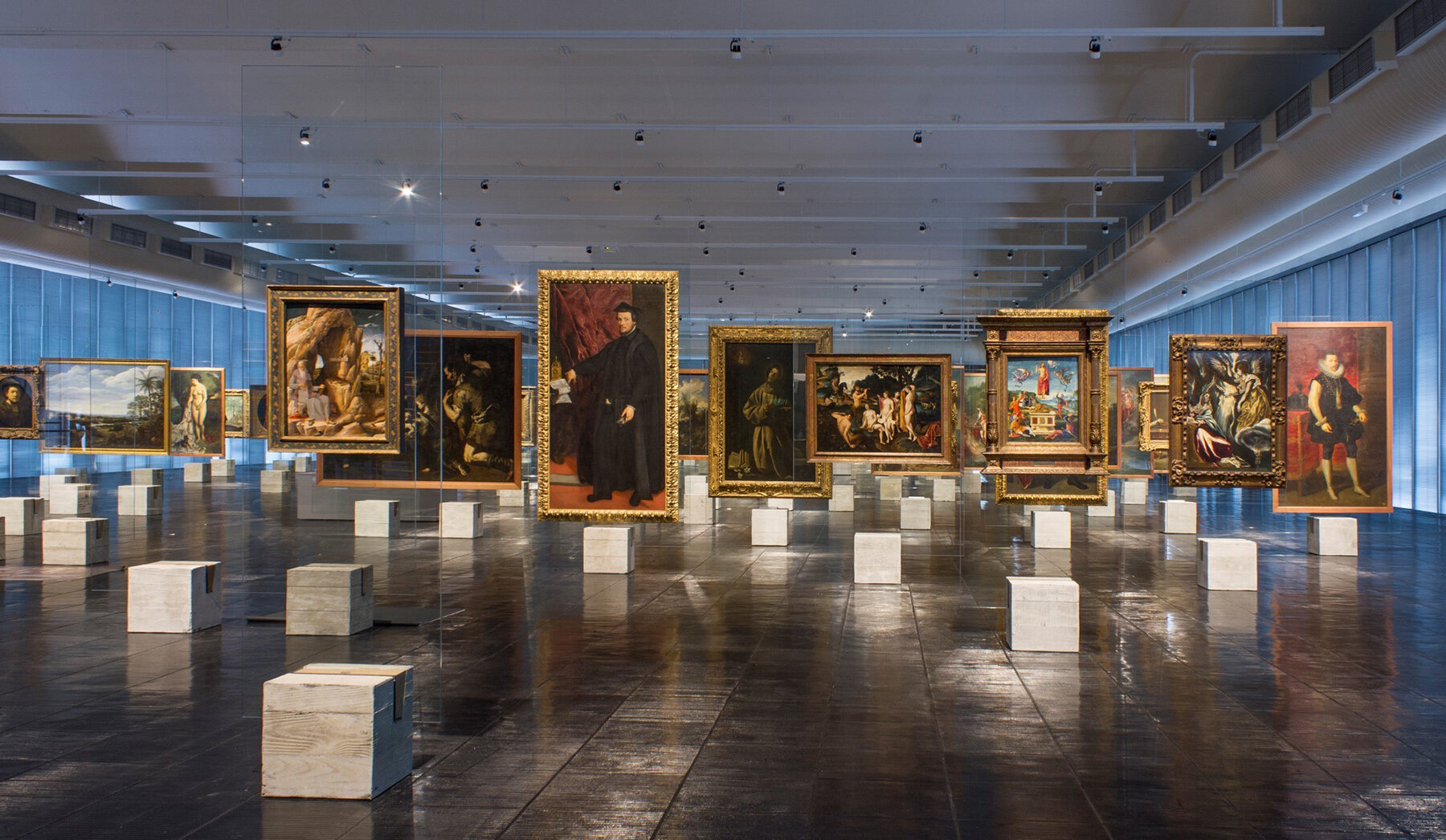
Museu de Arte de São Paulo, Lina Bo Bardi, Brazil | image © Romullo Baratto
SPECTATOR AND SPECTACLE (21)
 Sep 27, 2026
 Sep 26, 2026
 Sep 25, 2026
 Sep 24, 2026
 Sep 25, 2026
 Sep 24, 2026
 Sep 21, 2026