how human history is remembered in coins, silks, and steles at fondazione prada’s global antiquity
ancient trade routes connected distant civilizations through objects, rituals, and visual languages, challenging ideas of cultural boundaries.
prefer designboom on google[FEATURED]
Global Antiquity at Fondazione Prada Milan
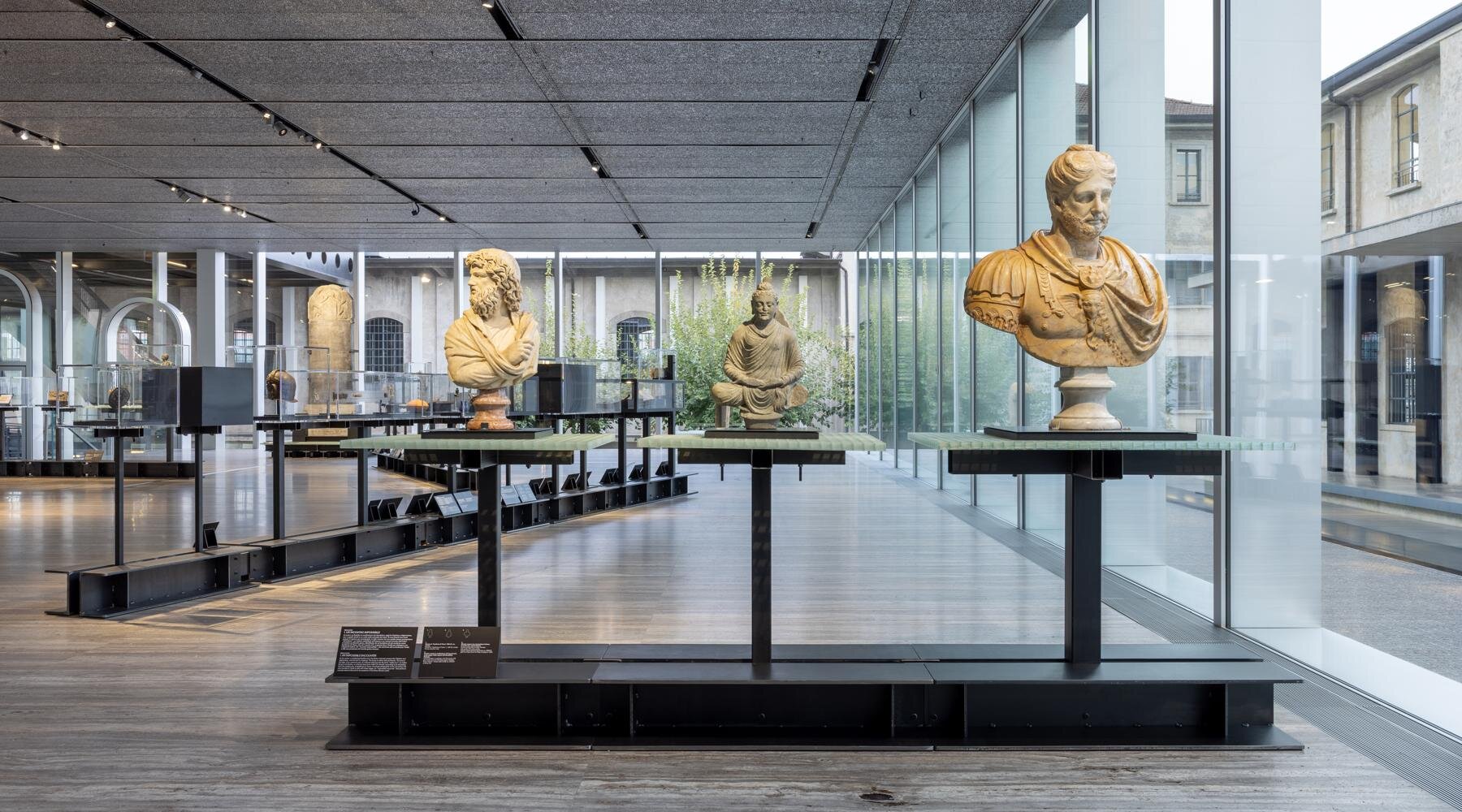
Fondazione Prada Milan, in its exhibition Global Antiquity: Cultural Interactions in Afroeurasian Space 600 BCE–1000 CE, opens with an epilogue called ‘An Impossible Encounter’ in the form of three busts: two (possibly) Roman men and one meditating Buddha from the Gandhara region of Pakistan. Although worlds apart, the occidental forms flanking the Buddha hold a trace of the figure at its center. One has an ‘Indian bun’ carved in marble atop his head. Another depicts a Greek philosopher who encounters Indian sages in the first century CE.
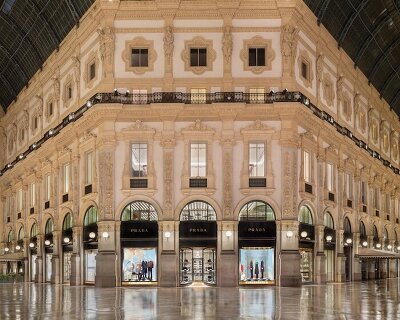
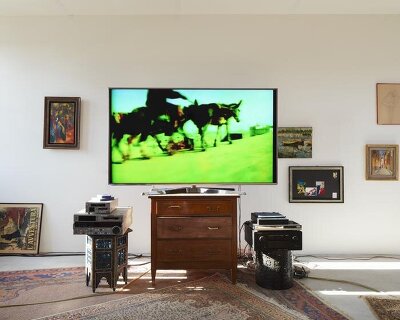
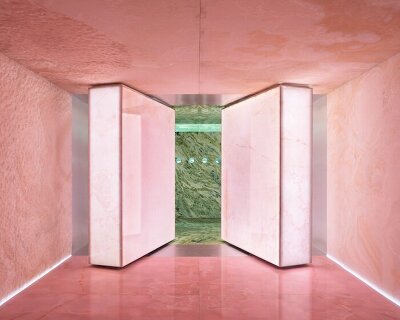
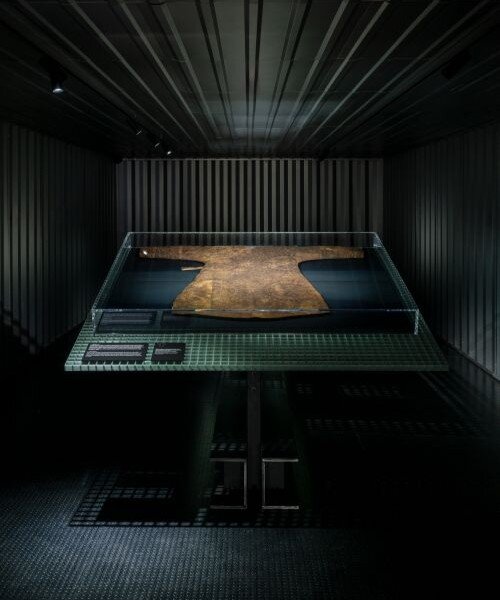
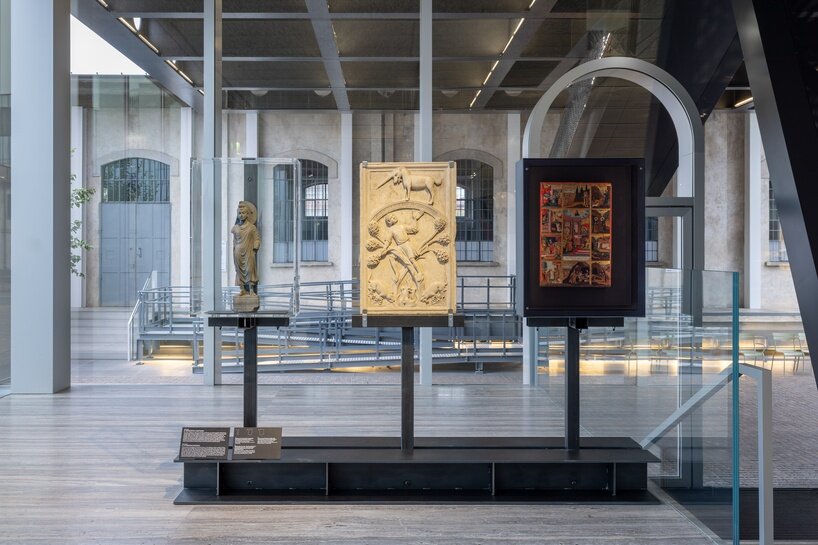
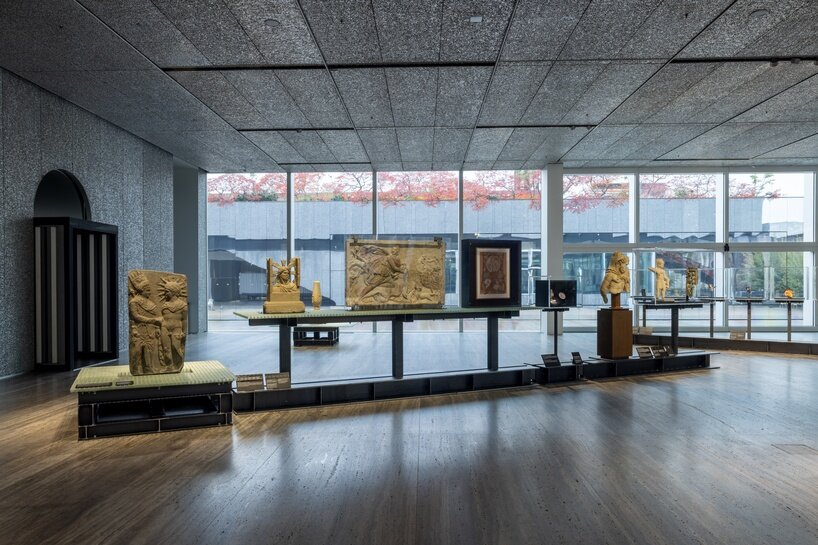
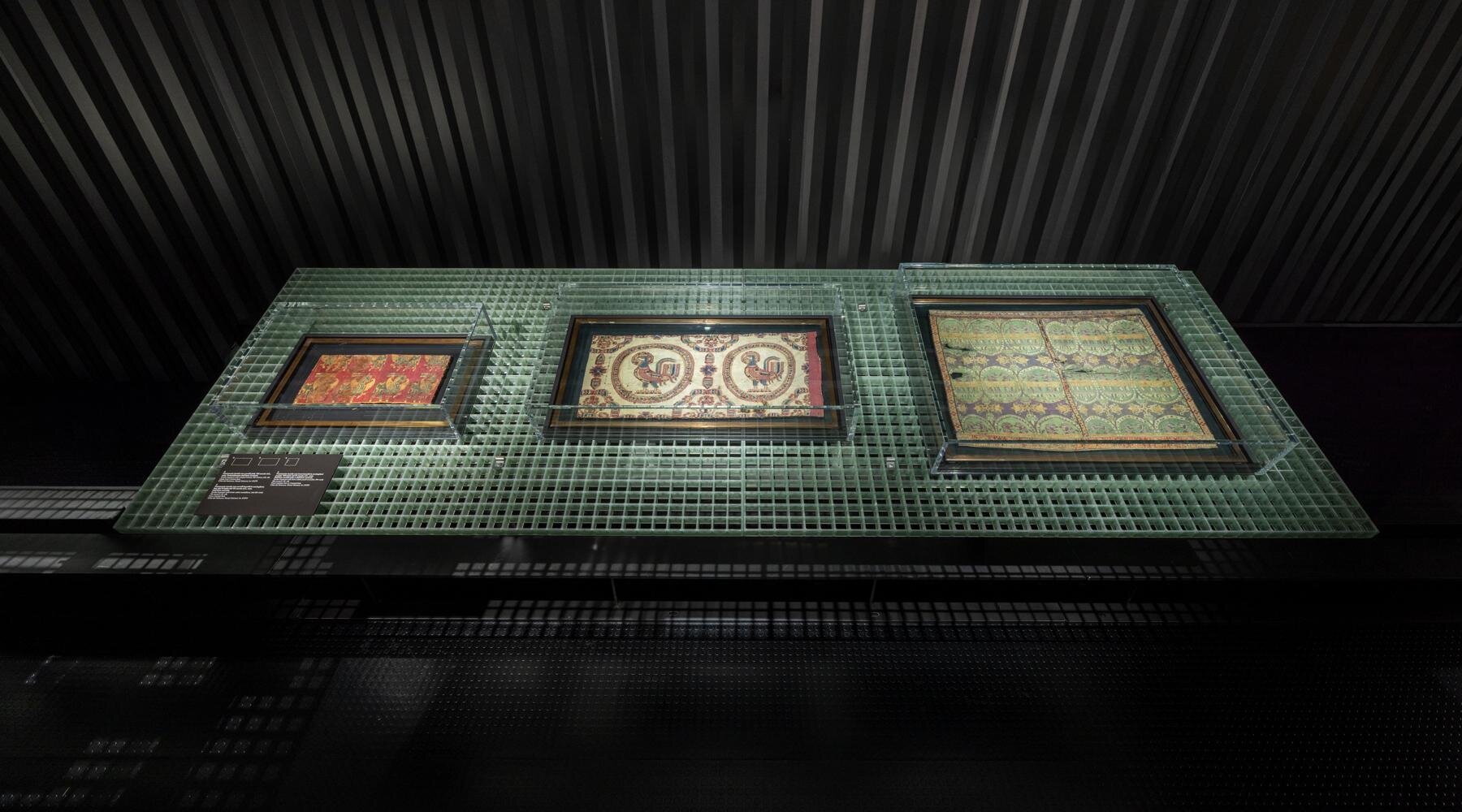
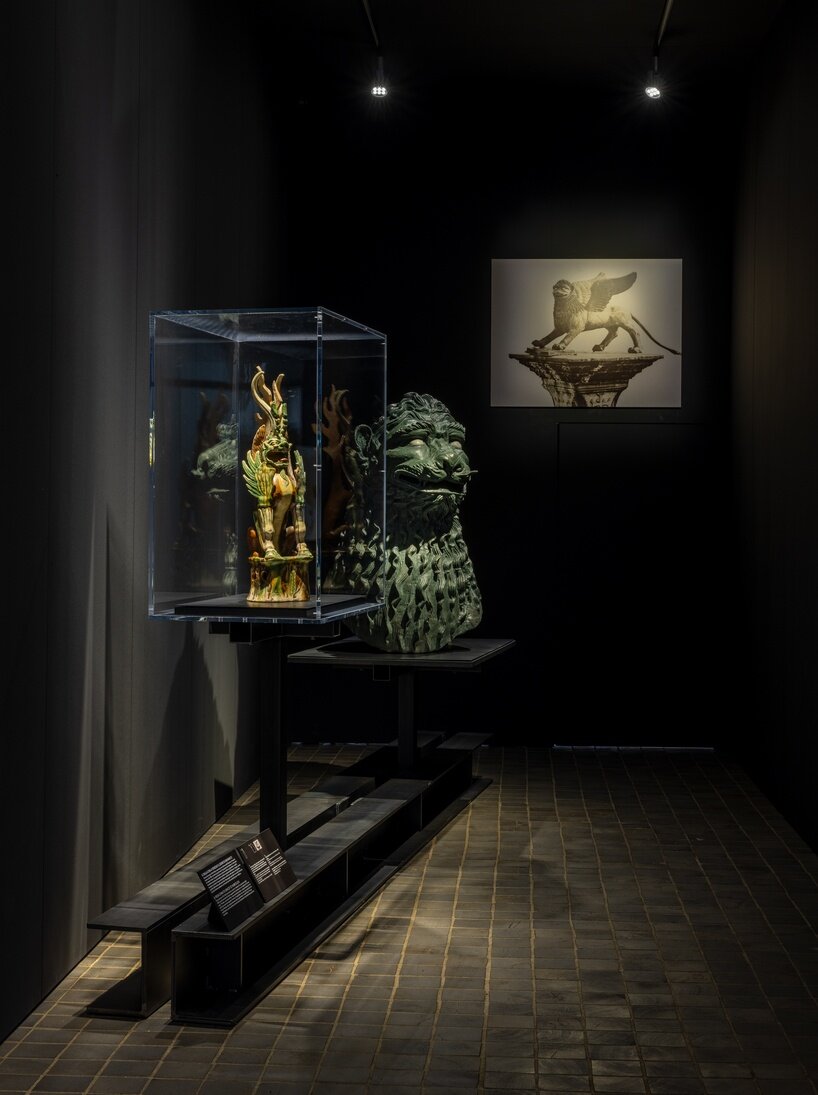
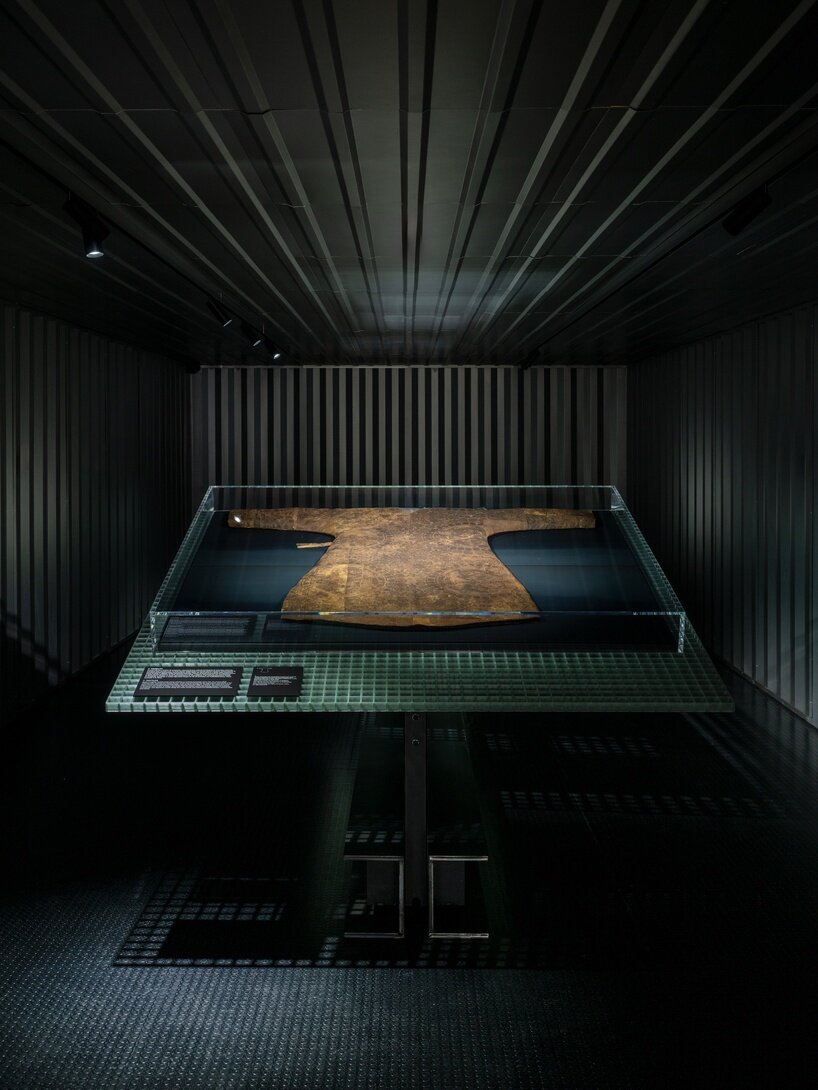
At the exhibition, designed by Rem Koolhaas, with Giulio Margheri and the AMO/OMA team, the architect remarked on the textiles, coins, and steles in the show, saying, ‘each and every object has its own demands and comes with its own protocol and its own complexity,’ pointing to the referential and material density of the objects chosen. The collection brought to Milan, which comes from four continents and spans sixteen centuries of Eurasian and North African history, contains traces of what one might define as an ‘other,’ or a world that, to our contemporary eyes, feels extraordinarily far away, both geographically and experientially. Yet in each of the links built along ancient trade routes, these artifacts reveal a persistent human desire to connect across boundaries, cultures, and time periods.
Édouard Glissant, Globality and Globalism
At the entrance to the exhibition, there’s a quote from theorist Édouard Glissant in which he talks about the difference between globality and globalization. In conversation with Hans Ulrich Obrist in 2011, he said that, while globalization concerns a contemporary idea of international relations and extraction, ‘which standardizes and dilutes,’ globality looks more optimistically at how the meeting of cultures, most often those of antiquity, can be a generative event.
Tracking Wine and Gems Across the Globe
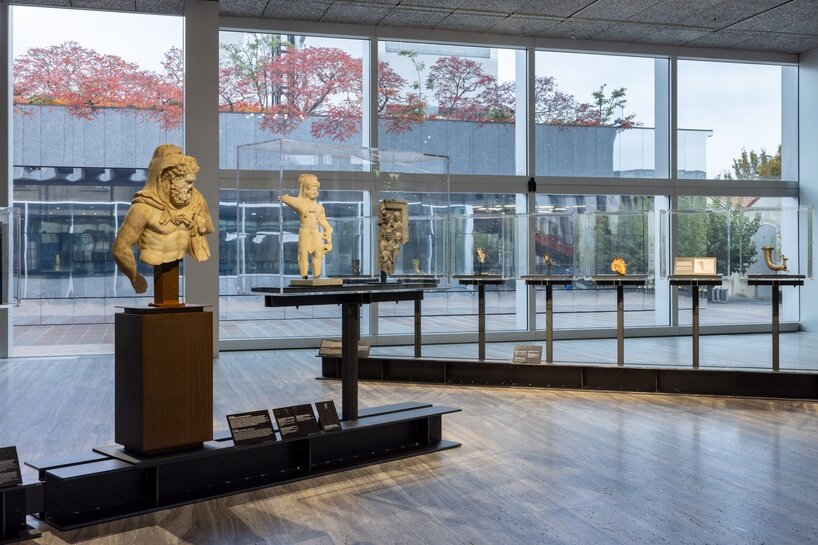
The section on migrations opens with a reference to Greek mythology, saying, ‘escorted by a retinue of satyrs and maenads, Dionysus conquests India.’ Tracing the diffusion of wine across Eurasia, the exhibition displays a selection of drinking vessels that look as though they have come off nearly every table and bar in the continental area. It starts with a rhyton, or conical drinking container, fashioned from pottery and found in an Italian necropolis. As you follow the path of cups to Greece, Ukraine, Iranian Azerbaijan, and China, a familiar horn-like shape and animal form appear on each one. It looks as though not just spirits but a band of forest creatures have also accompanied the traders and travelers across the region.
In an excerpt from the exhibition catalogue essay The Memory of Things and the Fabric of Archaeological Discourse, written by historian Salvatore Settis, who curated the event alongside Anna Anguissola and Chiara Ballestrazzi, he says, ‘it is this memory-laden materiality that reveals itself to be ever more necessary today, as we scrutinize the rubble of the world in order to dig up something worth preserving and handing down.’ In Global Antiquity, objects from Roman funerary sites are laid out in all their bejeweled splendor. Found in the tomb belonging to two young women were ivory dolls and gem-bearing jewelry fashioned in a style typical of the East, suggesting that they came from a Syrian community in second-century Rome. There’s also an ornamental headband with stones from Southeast Asia and Sri Lanka, found with another woman buried near Rome. There is a certain tenderness and glamour to these women, one that suggests a worldliness and a value placed on these globe-spanning objects that were deemed important enough to journey with them into the afterlife.
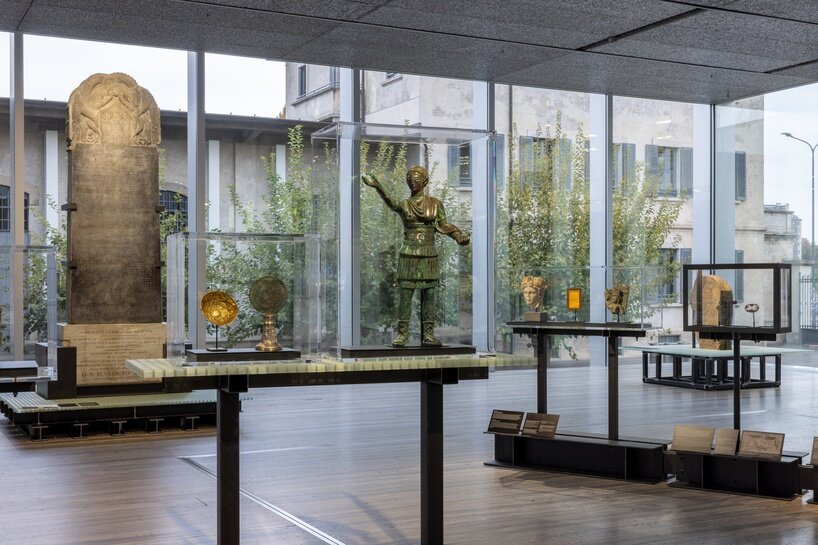
Influence Spread Across Space and Time
Standing in front of this temporally remarkable gathering of objects, there’s an evident ‘contamination’—an experiential stain that has appeared on each of these objects and challenges our perception of the boundaries between these ancient societies. But what’s fascinating is the second case of ‘contamination’ in the Fondazione Prada space: the one between the collective past that unites these objects and the contemporary moment. It’s in this secondary contamination that a certain inoculation of optimism occurs. It’s a reminder that the world, in its near-inconceivable vastness, is actually quite small.
What’s woefully missing from the exhibition, perhaps in order to focus on the generative effects of intercultural exchange, is an acknowledgment of how wars and conquests also contributed to these meetings and clashes of cultures. Instead, the curators privilege framing these exchanges through the historic trade routes throughout the region. Nevertheless, when reflecting on the inclusion of Glissant’s ideas of globality and globalization, there is a subtle acknowledgment of the potential for conflict and destruction.
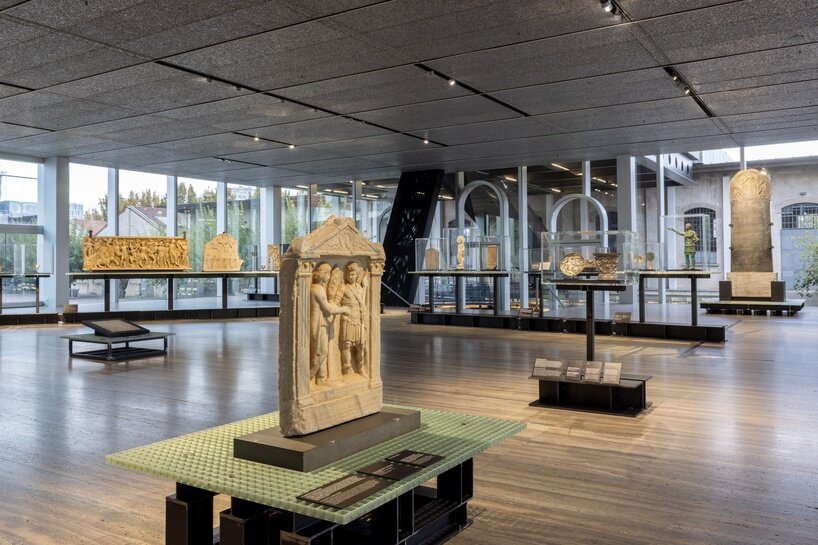
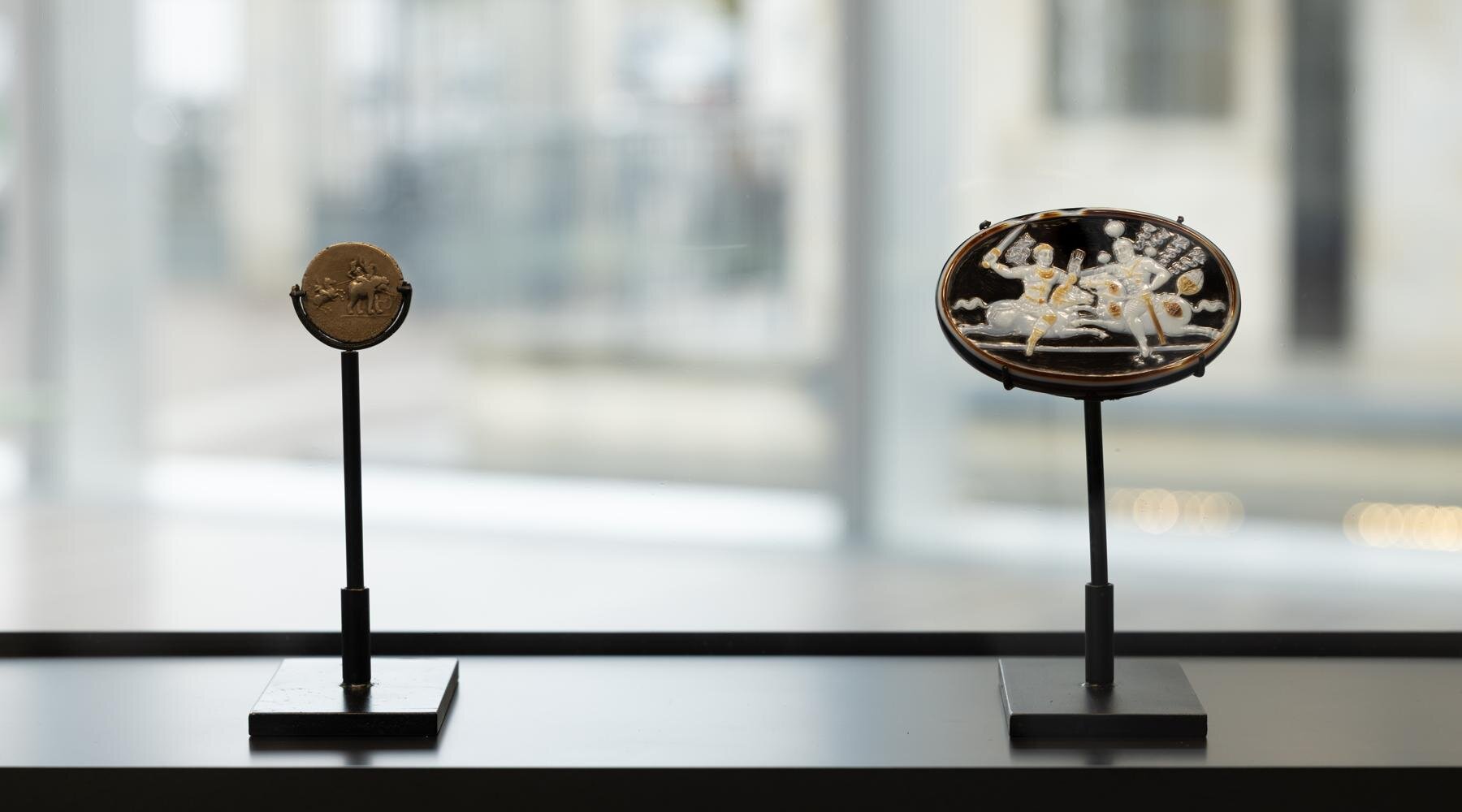
Privileging Globality
In the highlighting of this duality, there’s a sense of duty imparted on the viewer to be cognizant of the ways they move about the world. The evident globality is one side of the proverbial coin. What’s on the other side is something that Glissant warns of in that opening remark: a globalization that ‘reduces communities to a single model, attacking them from the top down, diminishing them.’ This is made even more urgent by the signs within the glass cases that remark on how, despite the institution’s best efforts, it could not manage to bring a selection of objects from Kyiv, Ukraine, to the exhibition.
With all the things that demarcate culture—language, dress, food—there’s a sense that each generation, culture, or empire is its own instantiation of humanity, each with its own parables that get passed on to the future through its material history. We’re in what could be understood as a perpetual state of posthumanism, or a state of humanity that comes after many others. With the fortune of having objects to study, there’s a certain responsibility to continually remind ourselves of the past, not only to avoid making the same errors but also to continue to pursue what makes the human experience rich.
project info:
name: Global Antiquity: Cultural Interactions in Afroeurasian Space 600 BCE–1000 CE
curator: Salvatore Settis, Anna Anguissola, and Chiara Ballestrazzi
designer: Rem Koolhaas, Giulio Margheri, and AMO/OMA
location: Fondazione Prada, Milan, Italy
date: November 5, 2026 – March 1, 2027
This article is part of designboom’s POSTHUMAN UTOPIAS chapter, exploring what happens when humans are no longer the measure of all things. These stories rethink our relationship with the planet through interspecies architecture, living materials, regenerative landscapes and emerging technologies – learn more here! The chapter is presented in partnership with INDX|GLOBAL – a global cultural platform placing Indian architecture, design, and creative intelligence in conversation with the world.
Each designboom editorial series explores one theme in depth through projects, interviews, features and news across architecture, design, art and technology. Discover more chapters here, and get in touch if you’d like to submit a story through our submissions portal or contact form.
shop
your own online design shop — no sales commission collected