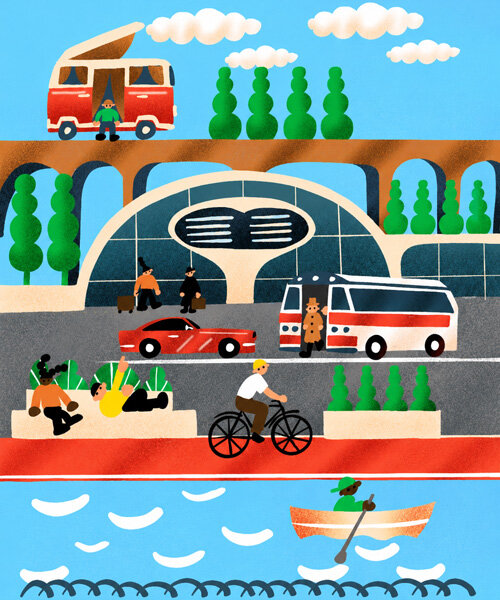
learning to move is how we first construct ourselves, and then everything around us
in states of motion, we follow the people changing how we build for movement: airports turned into places worth staying in, vehicles designed as rooms, lanes taken back from cars, trains running slowly on purpose, transit drawn for bodies it was never drawn for, and corridors stitched together again for the animals whose routes the roads once cut.
prefer designboom on google[FEATURED]
Sometime in the fifth century B.C., Greek sculptors worked out a way to put motion into something that could not move. Contrapposto, as Renaissance artists would later name it, describes a standing figure resting its weight on a single leg, allowing the hips, shoulders, and torso to tilt in opposing directions. Against the stiff, frontal poses of the Archaic statues that came before it, contrapposto introduced a frozen promise of movement.
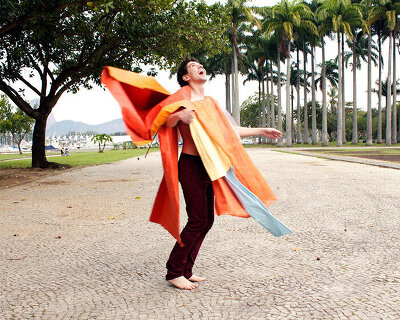
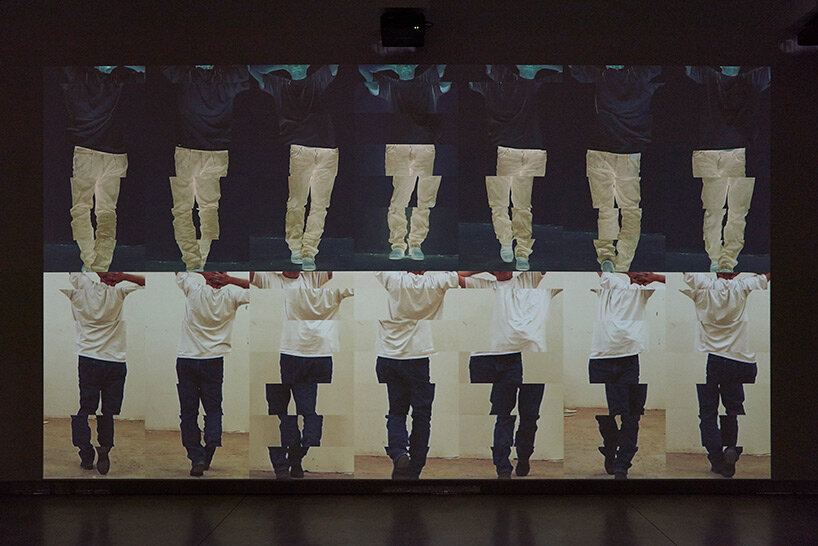
In 1968, Bruce Nauman walked it. Hands clasped behind his neck, hips swaying, he carried the pose up and down a narrow wooden corridor in his studio. That single-channel video became the basis for a series he was still making half a century later, shown in 2021 at Punta della Dogana. What stayed with me was the scale: seven projections, each large enough to make a man in a T-shirt and jeans feel monumental, and the flesh-and-blood performers executing the exact instructions he had written at the end of the sixties.
Watching them inhabit those movements in the same room pulled Nauman’s interrogation of the body out of the abstract; you were no longer just observing a study of human nature from a distance, but suddenly conscious of your own weight and footing beside them. Curators Carlos Basualdo and Caroline Bourgeois described his original video as a confrontation with ‘the simple fact of learning to walk as our first real way of constructing ourselves.’ What is true of the body turns out to be true of almost everything built around it. We make ourselves by moving, and then we remake the world to suit the way we move.
Time itself was remade across entire countries to accommodate a new way of moving. Until the 1840s, every British town kept its own hours, read off its own sun: Oxford ran five minutes behind London, Carnforth eleven, Barrow nearly thirteen. Then the trains arrived, and the clocks had to agree. The Great Western Railway switched to ‘railway time’ in November 1840; the Railway Clearing House ordered Greenwich into every station in 1847; and by 1855, roughly 98 percent of British towns had surrendered their local noon. North America began coordinating its schedules only after two trains running on different clocks collided at Valley Falls in 1853, and it took another three decades to settle the matter nationally. Your phone tells the time it does because movement needed everyone to agree, and almost everything built since has been designed to take time out of the journey.
The shorter word for this is speed. French philosopher and urbanist Paul Virilio, who approached the subject through architecture, spent a career arguing that speed is a political arrangement rather than a technical fact. We live less in a democracy, he wrote, than in a dromocracy: the reign of speed. Yet if speed is a political decision, then pace is something that was decided, and anything that was decided can be decided differently. This chapter is an account of the people doing exactly that.
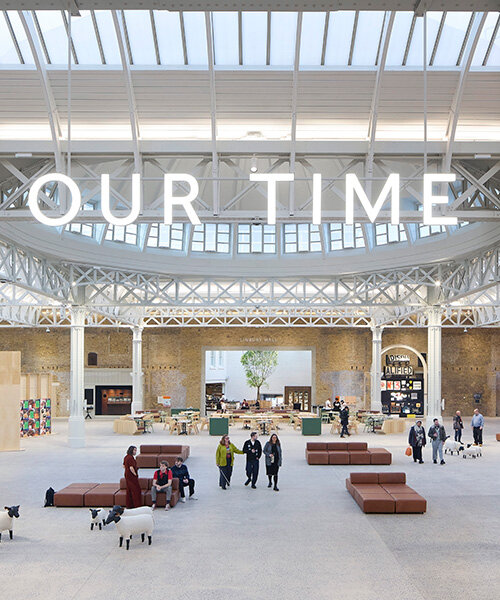
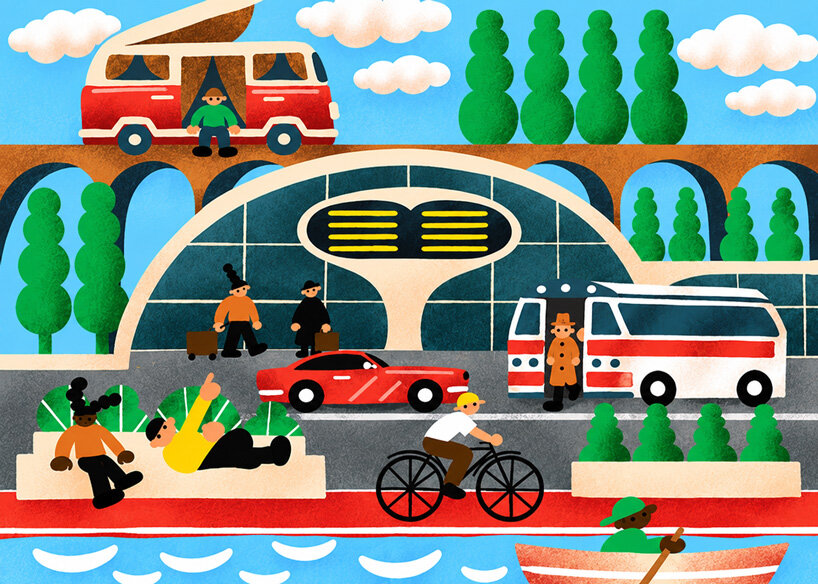
Airports and railway stations are being rebuilt as places with a reason to linger, reversing a century of infrastructure meant only to push crowds through. Inside the vehicle, the engine no longer dictates the form around it, turning the cabin into a room—an idea now spilling off the road into campers, floating homes, and habitats untethered from land altogether. Cities are reclaiming lanes from cars and handing them back to pedestrians; trains are running slowly on purpose again; transit is being drawn for bodies it was never meant to hold; and the corridors that highways once severed are being stitched back together for the wildlife that used them first.
The promise in contrapposto is a step that never arrives. Nauman’s contribution was to finally take it, awkwardly, for an hour, discovering in the process a body and a room he had not quite met before. States of Motion looks into that same interval: the uneasy, productive space between deciding to move another way, figuring out how to do it, and experiencing what takes shape when we actually do.
shop
your own online design shop — no sales commission collected