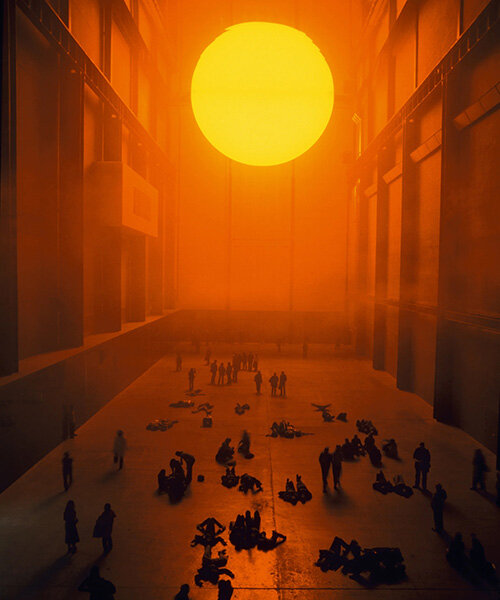
before the digital age, artists were already making color move
across decades of experimentation, artists have used light, movement, and optical illusions to change how we see and experience color.
prefer designboom on google[FEATURED]
color becomes an experience
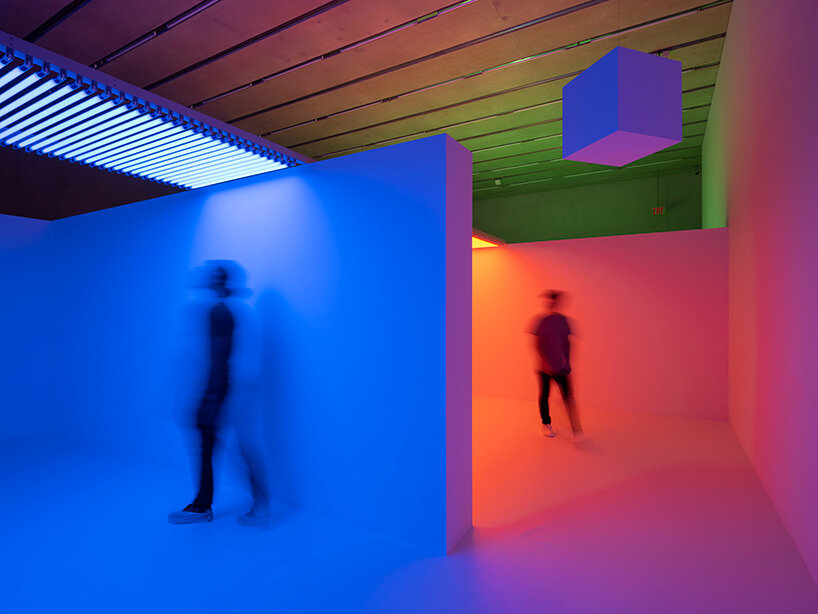
At Pérez Art Museum Miami, Carlos Cruz-Diez’s Chromosaturation fills three connected rooms with red, green, and blue light. Visitors move between the chambers as their eyes adjust to each color, and familiar objects take on unfamiliar hues. The experience changes with every step.
First conceived in 1965, the installation emerged during a period when artists were experimenting with color beyond the fixed image. Paintings appeared to vibrate, fabric sculptures came alive through dance, and suspended materials became environments that visitors could enter.
Over the following decades, these investigations expanded into architecture and atmosphere. Yet the essential mechanisms remained remarkably simple: the movement of the body, changing light, and the act of looking.
bridget riley makes a stationary painting appear to vibrate
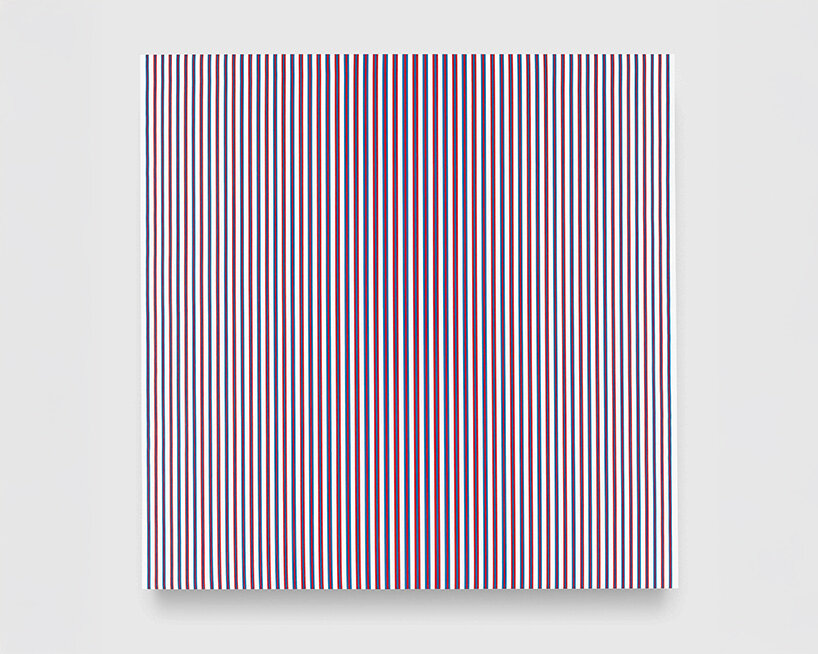
British artist Bridget Riley was among the leading figures of Op Art, or Optical Art, during the 1960s. After experimenting with black-and-white geometric patterns, she began introducing color into her paintings in 1967.
Her Chant 2 (1967) consists of closely spaced vertical stripes of red and blue, separated by narrow intervals of white. Their arrangement creates optical effects that make the surface appear to flicker, with additional colors emerging through visual perception.
Riley presented Chant 2 at the 1968 Venice Biennale, where she became the first woman to receive the International Prize for Painting. Her work demonstrated how a completely stationary image could generate a sensation of movement.
hélio oiticica turns color into something to be worn and danced
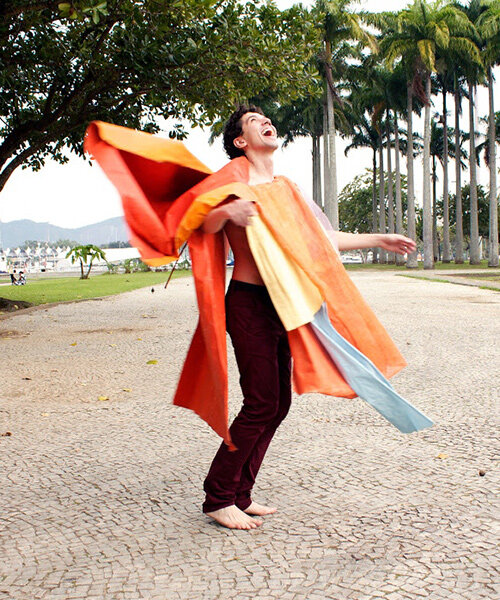
In Rio de Janeiro, Hélio Oiticica began developing his Parangolés in 1964. These wearable capes, banners, and fabric structures emerged through his involvement with the Mangueira samba community.
Made from overlapping layers of colored cloth, the works were activated through dance. As the wearer moved, different sections of fabric appeared and disappeared, transforming the composition through the movements of the body.
The Parangolés also challenged the conventions of the museum. In 1965, dancers from Mangueira were denied entry to the galleries of Rio’s Museum of Modern Art during Opinião 65, and the performance continued outside. Oiticica’s work connected the experience of color to collective participation and the cultural traditions of samba.
Hélio Oiticica, Parangolé worn and performed by the artist, filmed by filmmaker Ivan Cardoso, 1979 | video clip via Youtube
carlos cruz-diez releases color from the surface
Venezuelan artist Carlos Cruz-Diez began investigating color as an independent phenomenon in the late 1950s. His Physichromie series used layered surfaces to produce compositions that changed according to the viewer’s position.
With Chromosaturation, conceived in 1965 and first presented in 1968, he brought these experiments into three-dimensional space. The installation comprises interconnected chambers illuminated in saturated red, green, and blue light, where the eye gradually adapts to each monochromatic environment.
The work developed from Cruz-Diez’s proposed Deconditioning Labyrinth (Labyrinthe de Déconditionnement), an experiment in disrupting habitual perception. Its changing visual effects depend on the relationship between colored light and the person moving through it.
Carlos Cruz-Diez, Chromosaturation, Paris, 1965/2007, Pérez Art Museum Miami (PAMM), Miami, United States | image via the Pérez Art Museum Miami (PAMM)
jesús rafael soto invites visitors inside a field of vibrating color
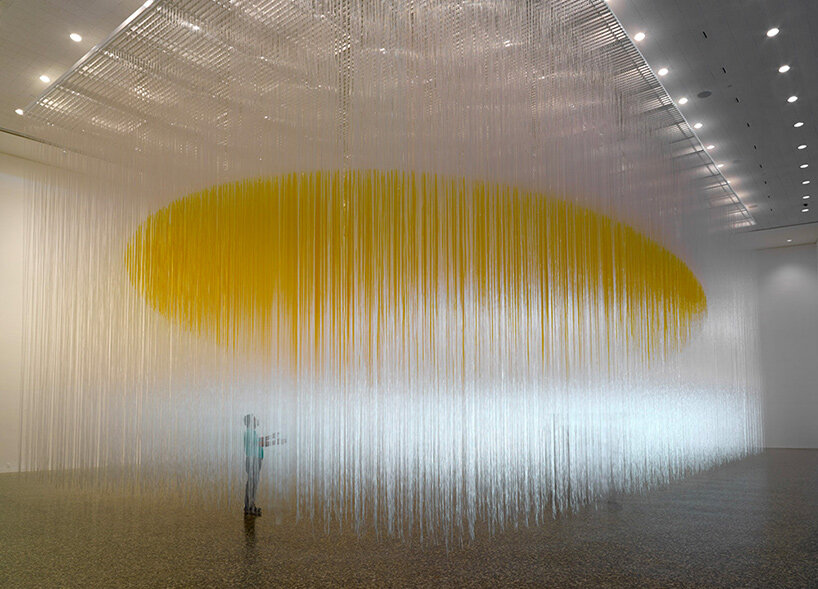
Fellow Venezuelan artist Jesús Rafael Soto began developing his Pénétrables in 1967. Made from thousands of suspended strands, the installations extended his earlier investigations into optical vibration and movement, allowing visitors to pass directly through the compositions.
Houston Penetrable, commissioned in 2004 and completed in 2014, occupies a two-story gallery at the Museum of Fine Arts, Houston. Its 24,000 hand-painted PVC tubes form a large yellow ellipse within a transparent field.
From a distance, the yellow shape appears almost solid. Inside, it dissolves into individual strands that brush against the body. Each step produces a different view through the suspended structure.
olafur eliasson transforms the city through colored glass
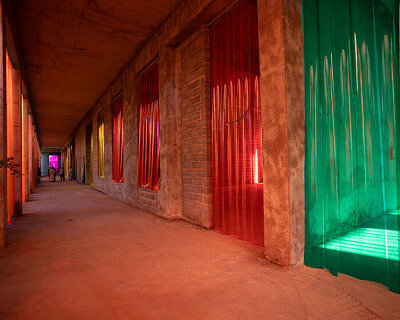
Completed in 2011, Olafur Eliasson‘s Your rainbow panorama turns the roof of the ARoS art museum in Aarhus, Denmark, into a circular walkway enclosed in colored glass.
The 150-meter-long passage offers continuous views across the city, which changes color as visitors walk around the building. Buildings and streets shift through red, orange, green, and blue, while the appearance of the horizon changes with the daylight.
Eliasson’s installation extends the experience of optical art into public architecture. The surrounding city becomes part of the composition, transformed by the visitor’s movement through a simple sequence of colored glass panels.
Olafur Eliasson, Your rainbow panorama, AROS, Aarhus, Denmark | image courtesy the artist
kimsooja fills architecture with refracted sunlight
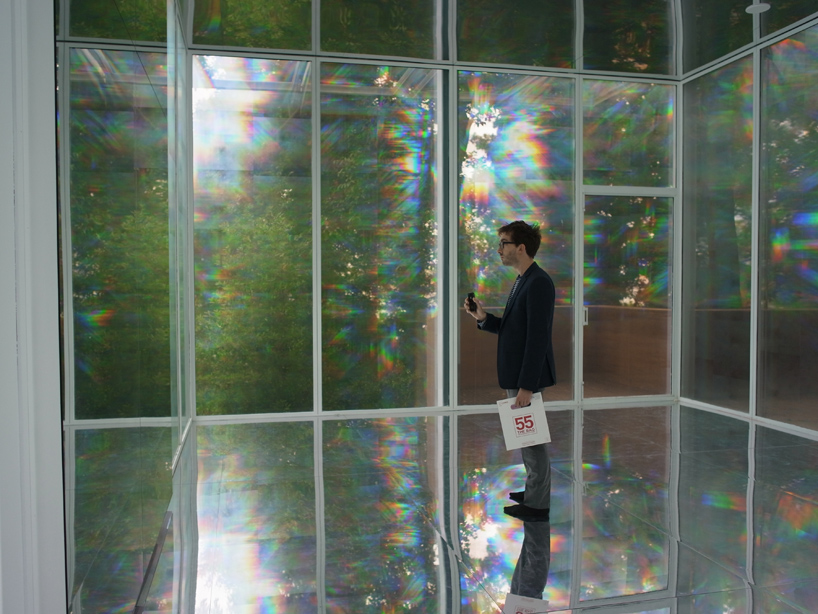
At the 2013 Venice Biennale, Korean artist Kimsooja transformed the Korean Pavilion with To Breathe: Bottari. She applied diffraction film to its glass surfaces, which separated incoming sunlight into bands of rainbow color.
Mirrored surfaces extended these effects across the interior, where visitors encountered their own reflections amid the shifting light. A recording of the artist’s breathing accompanied the installation.
Drawing on the Korean tradition of bottari, or wrapping belongings in fabric, Kimsooja treated the pavilion itself as a wrapped object. As the sunlight changed throughout the day, the existing architecture produced an evolving composition of color. Read designboom’s coverage here!
ann veronica janssens makes color an atmosphere
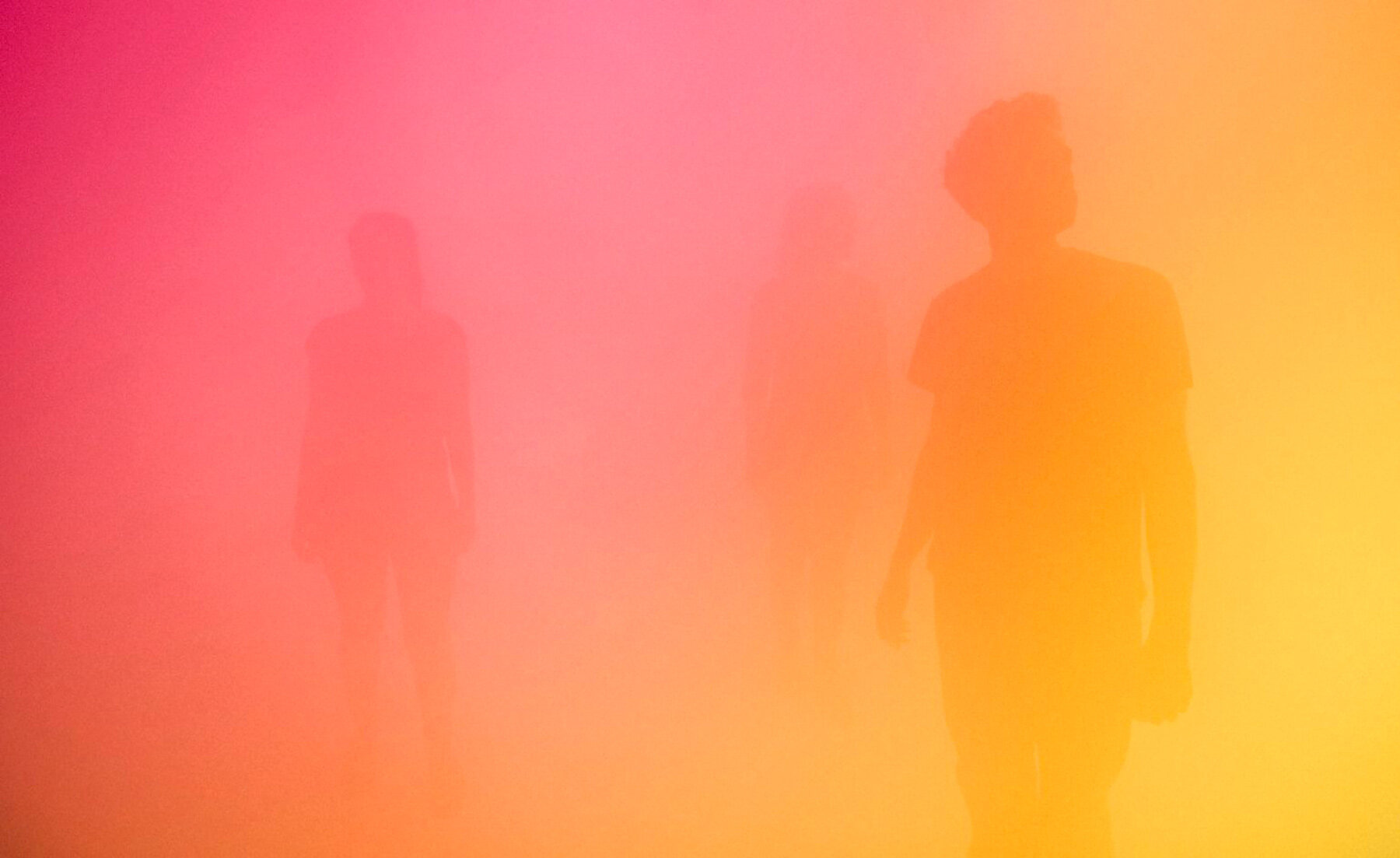
Belgian artist Ann Veronica Janssens took the experience of color into the air itself with yellowbluepink, presented at London’s Wellcome Collection in 2015. The installation filled an enclosed gallery with artificial mist illuminated by colored light.
Visitors entered a dense atmosphere of pink, yellow, and blue, where walls and distances became difficult to distinguish. Figures appeared as silhouettes before disappearing into the colored fog.
The installation pushed Janssens‘ investigations into perception toward an experience of spatial disorientation. From Riley’s vibrating stripes to this room of colored mist, the artwork had expanded into an environment that could be experienced through movement, without a screen in sight.
This article is part of designboom’s STATES OF MOTION chapter, exploring how architecture, design and art are transforming the way we move. These stories rethink the experience of movement through evolving transit spaces, mobile habitats, inclusive infrastructure, slower journeys and kinetic art – learn more here! Each designboom editorial series explores one theme in depth through projects, interviews, features and news across architecture, design, art and technology. Discover more chapters here, and get in touch if you’d like to submit a story through our submissions portal or contact form.