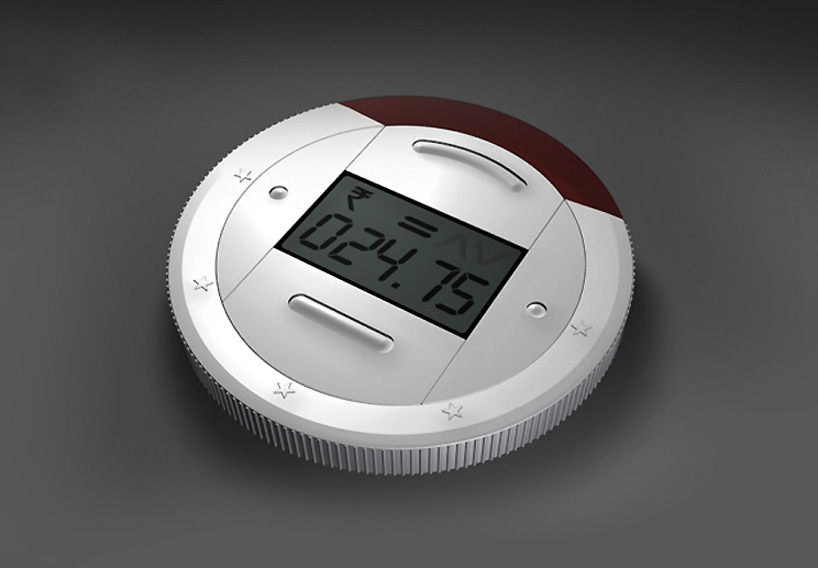
rendering of ‘ecoin,’ designed by abhinav dapke
it is an increasingly digital world, and commerce is no exemption. nonetheless, frequenting small shops or street and market vendors, and paying for taxis or public transit are among the day-to-day situations in which we often still find ourselves needing to pay in cash.
as an alternative to the slow process of searching out exact change, indian industrial designer abhinav dapke has created the ‘ecoin’ concept, a handheld device that electronically stores and transmits small monetary values, without relying on banks or other third-party systems.
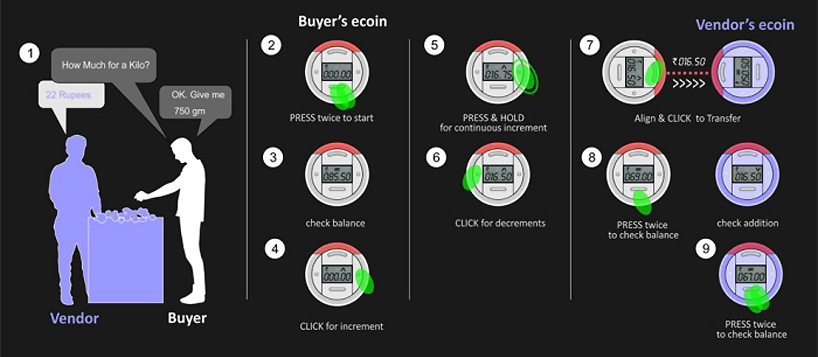 diagram of how ‘ecoin’ is used to exchange funds between a buyer and a seller
a small disc, the device consists simply of a small LCD display and four buttons, powered by a lithium battery. to make a purchase, a customer inputs the desired value into his ‘ecoin,’ aligns his device with the merchant’s, and presses the transfer button. funds are directly transmitted to the merchant’s ‘ecoin’ via infrared technology.
‘ecoins’ would be easily topped up at small shops, by paying cash. dapke imagines variations of the device that include a small, wallet-friendly ecoin, a keychain ecoin, and a waterproof ecoin.
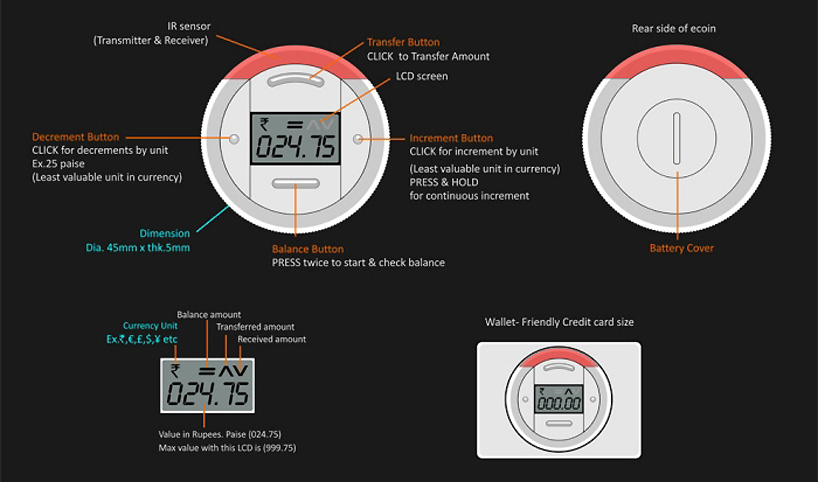 technical detail of ‘ecoin’ interface
of course to implement ‘ecoin’ on a large scale would necessitate overcoming a number of practical barriers. nonetheless, the concept offers a rethinking of the proprietary commerce that characterizes current debit exchanges, and so would be more feasible to the kinds of small business owners that do not accept charge cards because of technical or financial constraints. on the much longer term, its widespread implementation would lower the need for coin production and thus decrease the use of metal resources.
money (64)
 Dec 15, 2023
 May 17, 2022
 Feb 11, 2022
 Sep 03, 2021
 Feb 18, 2026
 Jan 28, 2026
 Jan 02, 2026
 Dec 28, 2025