g station by seoyeon jin from usa
designer's own words:
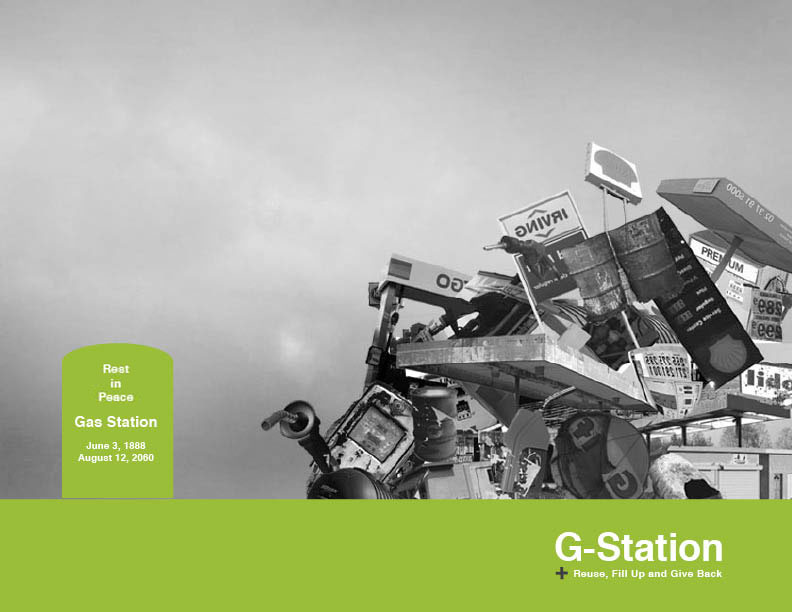
For more than a hundred years, oil was the primary source of energy in the global economy. Heavy consumption and reliance on fossil fuel have caused nearly irreparable damage to the environment including a depletion of resources and global warming. The need to find alternative renewable energies will result in the abandonment of gasoline as a means of energy and subsequently the abandonment of gasoline stations around the world. There are currently 200,000 abandoned gas stations in the United States alone and approximately 3,000,000 around the world. There is no doubt that they will increase even more tomorrow leaving toxic sites that scar the environment worldwide.
In contemplating a future full of abandoned gas stations that creates not only unpleasant landscapes but also social darkness, it is necessary to prepare countermeasures to redeem such harmful structures through adaptive reuse. Emerging from both the physical and symbolic hotbed of energy consumption, we see a huge potential to reuse the gasoline station as a new ‘Green station’;
a station that does not give any harmful effects to our future but gives back energy filled up from free resources we already have, a station that not only benefits the community by providing safe public spaces where everyone can enjoy, but also educates the community on environmental awareness and informs future life style related to energy use.
Each existing element of former gas station is reused through adding modular units on top of it considering its new social function. Such modular solution makes it possible to apply the idea to any other sites.
Introduction is graphically showing the problem we are facing in short future.
 Picking an existing abandoned site in Rhode Island, U.S.A, on top of a photo is a sketch showing basic reuse concept based on social programs. Below is a timeline about specific use throughout a day as an active community venue covering all age.
 Final render, overall look of the G-Station. Icons are placed on each functioning points with a brief calculation of the amount of energy that will actually be produced. Below is the energy concept of each icon.