chinese pavilion: ‘what is to come (jian wei zhi zhu)’ at venice art biennale 09
curated by lu hao and zhao li, the chinese pavilion showcases the work of seven contemporary chinese artists.
prefer designboom on google[FEATURED]
curated by lu hao, zhao li, the theme and title of the chinese pavilion,‘what is to come (jian wei zhi zuh)’ comes from the translation of a chinese idiom derived from the classic text by scholar and philosopher, han fei zi-shuo lin shang, signifying that trends in the future can be gleaned from the development from a tiny detail. representing the realization of new value systems, the derivatives of which will continue to expand into the future, the exhibition shows the chinese society’s integration within the historical process into the multiplex, shifting and interdependent international order, demonstrating the vitality of china in its modernization process and symbolize the differing charms of the chinese way in a new context.
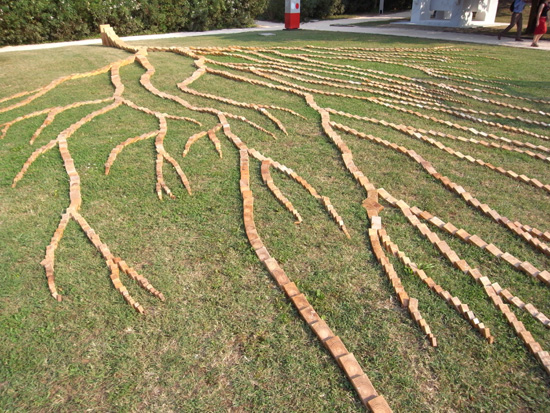
‘the small knocking down the big wood’ by qui zhijie, 2009 image © designboom
 ‘the small knocking down the big wood’ by qui zhijie, 2009 image © designboom
qui zhijie’s installation work is presented in the open space of the giardino delle vergini at the arsenale, and is comprised of a number of wooden dominoes neatly arranged on the lawn, forming a huge tree-like object. the piece that is closest to the root of the tree is the biggest one, while those at the branches dwindle in size. qui zhijie’s work represents the eastern way of interpreting the garden and the chinese way of reformation in a spatial and cultural sense. ‘the small knocking down the big wood’ by qui zhijie, 2009 image © designboom
 ‘the small knocking down the big wood’ by qui zhijie, 2009 image © designboom
 ‘2009.6.7’ by zeng hao, mixed media image © designboom
zeng hao’s installation work ‘2009.6.7’ is specifically created on the spatial condition of the virgin garden. it continues with the artist’s steadfast insistence on small objects versus a big space. by putting men and objects in close range and yet dislocated from each other, he stresses the urgency and necessity of cultural and spiritual exchanges. this work is made up of more than 200 pieces of mundane objects, with models of various modern architecture, newspapers and magazine. the sizes range between 10 cm and 70 cm. these models are hung inside a plexiglass chest (4.5 x 4.5m), forming a coherent and joint spatial structure. there is a door 185cm in height, through which the spectators may go inside and wade through the intertwined installation.
 ‘2009.6.7’ by zeng hao, mixed media image © designboom
 a sofa, building, guitar and airplane are some of the objects which hang inside the box image © designboom
 ‘2009.6.7’ by zeng hao, mixed media image © designboom
 general view of ‘liu ding’s store: the future of the utopia of art and our reality’ by liu ding image © designboom
liu ding’s installation work is called ‘liu ding’s store: the future of the utopia of art and our reality’. the work aims at questioning the essence of art from two perspectives: what is art and what is the value of art? the artistic concept of utopia tells us that art should be unlimited and uncertain. the same applies to the equal exchanges of art. however, in reality, art always tends to move towards the endless pursuit of art for art’s sake or art becoming more art-like; anytime and anywhere.
liu ding’s creation is a rebuttal and reflection of these two questions. liu ding puts artworks, handworks, designs and other works together, mixed in the dominion of the ‘store’. using economic means, such as one-to-one sales or experiential marketing, he gives out more innovative prowess, endowing with it a surreal and infinitely liberal artistic concept. with regard to the second question, he raises doubtsabout and reflects the artistic hierarchy that is born in the global context. in the diversified and complex cultural clashes, to seek the equality of values should be the ceaseless dream and pursuit of contemporary art.
 ‘gold’ image © designboom
 ‘gold’ image © designboom
 ‘container of experience’ image © designboom
 ‘container of experience’image © designboom
 ‘a memory lapse of willpower’ image © designboom
 ‘a memory lapse of willpower’image © designboom
 ‘the perfect sphere’ image © designboom
 ‘the perfect sphere’image © designboom
 ‘the weight of a history book’ image © designboom
 ‘the weight of a history book’ image © designboom
 ‘the changing sensibilities’ image © designboom
 ‘the changing sensibilities’image © designboom
 ‘the world of taiji’ by he sen, oil on canvas image © designboom
‘the world of taiji’ consists of about a dozen small paintings ranging in size from 10cm to 20cm, making up a three dimensional representation that can be hung up and flexibly dismantled. the chinese characters that match the title of the work are the contents depicted (and their respective expressions). on top of a thick layer of flattened pigment, engraved with touches of traditional chinese brushes (wolf hair), are the depiction of images from traditional chinese culture. they address the partiality and affectation or mutual misinterpretation that arises from the amalgamation of multiple cultures in the face of globalization.
 ‘the world of taiji’ by he sen, oil on canvas image © designboom
 ‘is the world before us true?’ by he jinwei image © designboom
‘is the world before us true?’ is based on the artist, he jinwei’s long observation of human migration and survival, changes in the environment and volatility in the information age. the work is comprised of hundreds of 18 cm x 14 cm smaller paintings, which are pieced together and then stitched up by sewing machines, to form a vast world map.
 ‘is the world before us true?’ by he jinwei image © designboom
 he jinwei portrait © designboom
shop
your own online design shop — no sales commission collected