GRACE on revitalizing uzbekistan’s soviet modernist legacy at venice architecture biennale
the pavilion thus presents a dual narrative through fragments of objects from the site, or envisioned for it, that reflects on the heliocomplex's evolving role.
prefer designboom on google[FEATURED]
soviet modernism: uzbekistan pavilion at venice biennale
At the 2025 Venice Architecture Biennale, Uzbekistan turns towards one of the lesser known icons of its modernist heritage: the Sun Institute of Material Science, better recognized as the Heliocomplex. As the protagonist of the nation’s pavilion, titled A Matter of Radiance, the structure’s underlying dualities and ambiguities are embraced and reconstructed by Ekaterina Golovatyuk and Giacomo Cantoni of GRACE to reflect on its potential as a center for sustainable innovation and cultural inquiry.
The pavilion has been commissioned by Gayane Umerova, Chairperson of the Uzbekistan Art and Culture Development Foundation (ACDF) and builds on the long-term research project, Tashkent Modernism XX/XXI, which they launched in 2021. Since then, the architects, guided by ACDF, have been working to document and preserve 24 modernist structures across the city, one of which is the Heliocomplex located just a few hours away in Parkent. In conversation with designboom, Golovatyuk and Cantoni share that across this initiative, the Heliocomplex built in 1987 was the one that best responded to Carlo Ratti’s curatorial theme for the biennale, Intelligens: Natural. Artificial. Collective. As a site conceived to harness solar energy at extreme temperatures for material testing, now evolving to further this scientific research with an embedded social layer, its identity is not fixed. The Heliocomplex, they note, also stands out for its several spatial and conceptual contradictions — monumental yet fragile, futuristic yet obsolete, scientific yet mystical. The pavilion thus interrogates this enduring ambiguity: ‘We decided to decline the conventional narrative of preservation and instead intersect it with one of sustainability. The Heliocomplex allowed us to speak about both,’ Golovatyuk tells designboom. The pavilion thus presents a dual narrative through fragments of objects from the site, or envisioned for it, that reflects on the Heliocomplex’s role in Uzbekistan’s recent modernist legacy.

grace studio reconsiders dualities of the heliocomplex
Situated near Tashkent, the vast structure is one of the last infrastructures built before the collapse of the Soviet Union, designed for scientific experimentation. Today, it stands largely underutilized as one of only two large-scale solar furnaces still in existence globally, yet, for the Milan-based practice GRACE, it remains a powerful symbol of scientific and architectural research that ACDF seeks to revitalize. Although the furnace was operational for just five years, it continued to host scientific work in shifting capacities well into the post-Soviet period, and its monumental scale, typical of late Soviet infrastructural ambition, along with the socio-political background of the time, rendered it both functionally redundant and open to reinvention. The curators take this unresolved quality as a productive tension for the Uzbekistan Pavilion, proposing that the building’s vast, sculptural form and multiple layers is what allows it to adapt to new purposes and meanings over time.
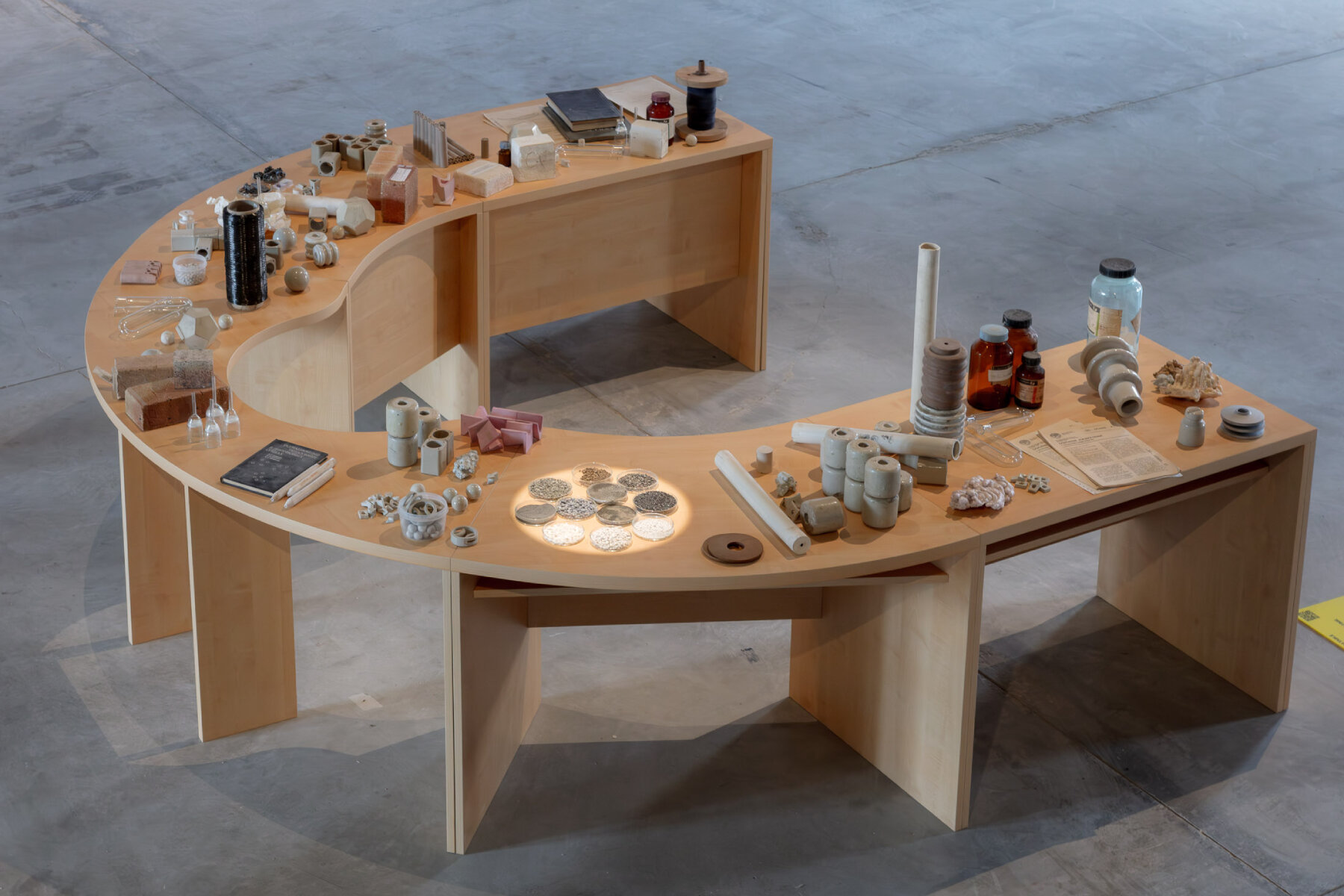
To stage this conversation, the architects have broken the Heliocomplex down into fragments, from scientific relics, and architectural reconstructions to new artistic commissions, that each extend the building’s meaning in a different direction. These include solar reflectors, structural components, and a working solar cooker placed at the pavilion’s entrance.‘One example is a table installation by Esther Sheynfeld who presents this kind of debris of research, putting together pieces that found application, and others that didn’t,’ Ekaterina Golovatyuk tells us. ‘We also brought in a small heliostat, just one-fifth the size of those in Parkent. This one is a newer-generation prototype, and after the Biennale, it will return to Parkent where it can help upgrade the outdated 1980s-era technology. In that sense, the exhibition is also about enabling the site’s future development.’ While some of these objects have been slightly modified, their recontextualization reveals latent meanings, functions, and imaginaries embedded in the original site. Through a sparse but evocative spatial arrangement, the exhibition also poses an embodied reflection on energy, technology, and the narratives we construct around infrastructure and heritage. Read our full conversation below.

interview with grace studio
designboom (DB): Please introduce your journey into this project. How did you come to focus on this particular structure from Tashkent’s modernist heritage, and what drew you to the Heliocomplex as the pavilion’s protagonist?
Giacomo Cantoni (GC): Everything stemmed from a wider research initiative called Tashkent Modernism, about the city’s modernist architectural heritage. This project led us to identify 20 buildings that were later listed as national monuments. Among them, the solar furnace stood out because it aligned most closely with the curatorial statement by Carlo Ratti for this year’s Biennale.
Ekaterina Golovatyuk (EG): We decided to decline the conventional narrative of preservation and instead intersect it with one of sustainability. The Heliocomplex allowed us to speak about both. Preservation is not always sustainable, per se, so we were interested in embracing that ambiguity. We wanted to define sustainability in a more subtle, complex way, than just talking about simply harnessing solar energy.

DB: How does the curation frame these ambiguities and dualities?
EG: We’re not just leaving it open-ended, but we’re embracing the ambiguity as a value in itself. This isn’t unique to the Heliocomplex — all technology is ambivalent, and all technology is a result of social, political, and economic decisions. It’s never absolute or neutral, so this space opens up conversations around this. We explore this by deconstructing the Heliocomplex into a number of fragments. Some parts speak to its scientific values, while others reflect the more triumphant or less successful moments of its existence.

DB: Can you walk us through some of the works in the pavilion that capture these different dimensions of the Heliocomplex — its scientific, symbolic, and architectural layers?
EG: One example is a table installation by Esther Sheynfeld who presents this kind of debris of research, putting together pieces that found application, and others that didn’t. We also brought in a small heliostat prototype, just one-fifth the size of those in Parkent. It helps us speak about the humongous scale of the Heliocomplex, and after the Biennale, it will return to Parkent where it can help upgrade the outdated 1980s-era technology. In that sense, the exhibition is also about enabling the site’s future development. Then there’s the architectural component represented by a one-to-one scale model of the original lab building’s facade, which had been dismantled due to obsolescence. Using original drawings and with support from Italian structural engineers, we reconstructed and optimized it for the pavilion.
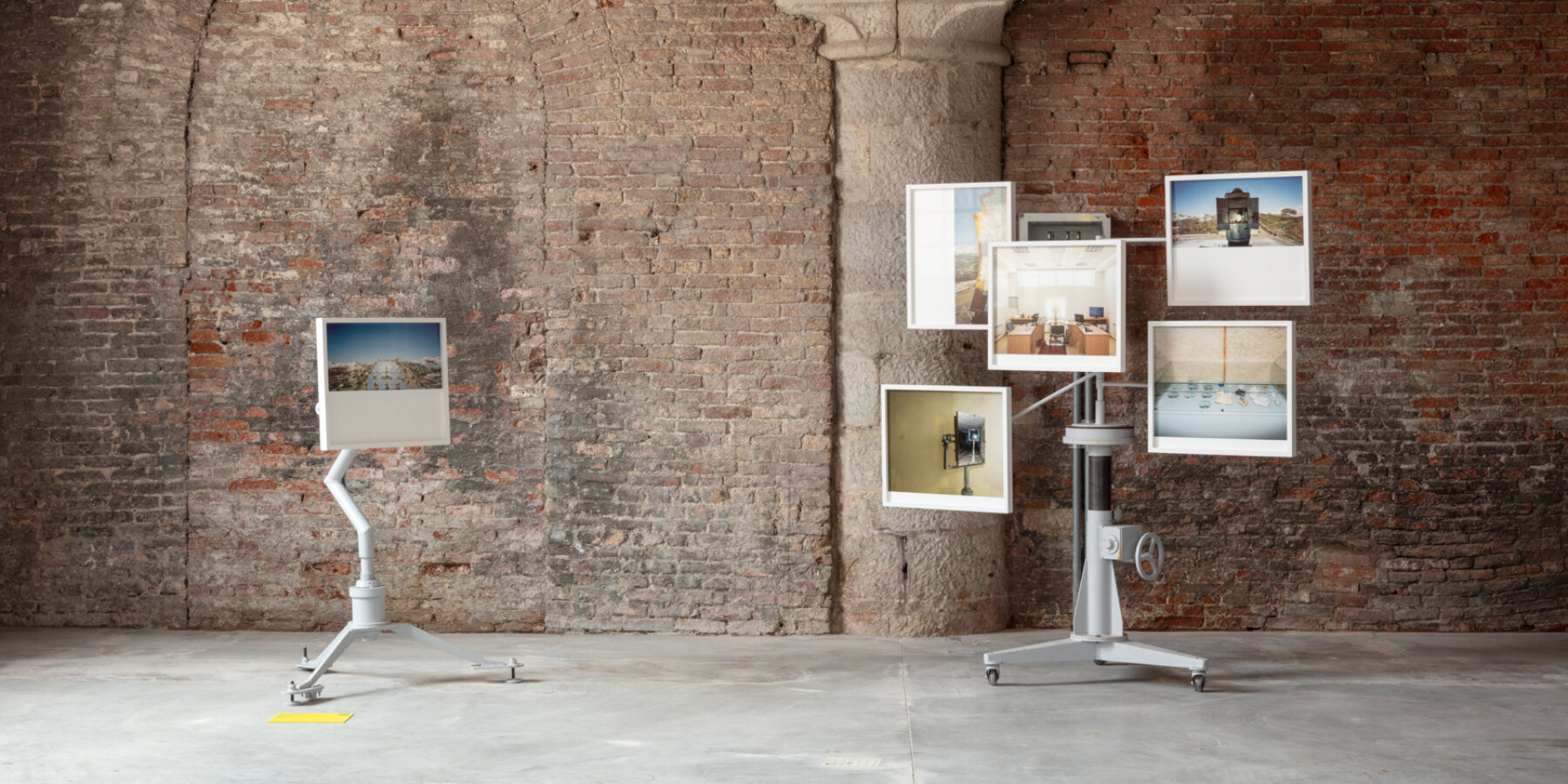
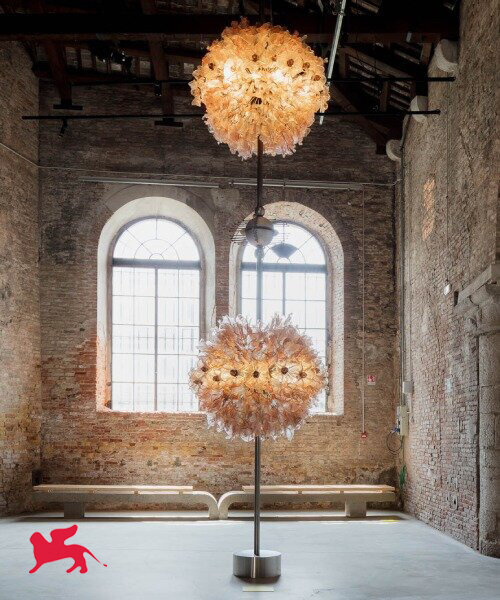
The Heliocomplex itself featured four sculptural works, so we also included a Soviet-era chandelier by Latvian artist Irena Lipiene that reflects the tradition of monumental art in Soviet scientific projects. It is called Parade of Planets, a rare astronomical event when seven planets align. In a way, we see it as a latent declaration of the Soviet Union’s space conquest ambitions. Then we brought in the original model from the late 1970s, which was used to convince government officials to support the construction of the Heliocomplex. And finally, we included a painting depicting the authors of the original project. It shows the human presence behind it all.
GC: And these benches which we are sitting on, they’re also found on-site in Parkent. It’s interesting because the infrastructure was originally restricted and not open to the public, yet the benches are also typical of public space. Including them was a way to reflect on that shift.

DB: Alongside these architectural and scientific elements, how did the new commissions contribute to deepening or reframing the narrative around the Heliocomplex?
EG: Each of the three artists we invited tried to give a more poetic, cultural reading of the Heliocomplex. Mohideen Rizkiyev worked with scientists to create a 40-centimeter ceramic plate which is the same size as the solar furnace’s focal point, and it is an installation for meditation. Azamat Abbasov created a video installation that tries to bind all the pavilion’s different elements into one narrative, and he tries to connect them using the only thing we don’t really see — light.
Many of the original elements are also being reactivated with new meanings in a contemporary context. The Heliocomplex is being reinterpreted from just a scientific monument to a hub for sustainability, which wasn’t part of its original identity. It’s also become an educational infrastructure with a public dimension, so we’re trying to communicate that layered complexity in the pavilion.

DB: Although you speak of these elements as ‘fragments’, they come together to evoke all these interconnected aspects of the building’s identity. How did you approach the spatial arrangement of the pavilion?
EG: Giacomo and I have long been preoccupied with the theme of preservation, and even in our exhibition design, we care deeply about how context interacts with the work. We never want to erase that or dominate the space. At the Arsenale, we wanted to keep the space very open, letting in natural light, so that the existing architecture would interact with the objects we brought in. That context adds richness and complexity to what’s on display.

DB: In terms of context, then, the historic industrial language of the Arsenale contrasts quite sharply with the modernist expressions of the Heliocomplex. Does that juxtaposition creates new layers of meaning, or does it function more like a scenography?
EG: It’s an interesting parallel that adds another narrative layer, I think. The Arsenale was once a piece of utilitarian infrastructure, and in a way, so was the Heliocomplex, though from a very different era and for a very different purpose. Also, it’s always a challenge to curate an architectural exhibition, especially because of scale. Unlike art, when you’re displaying the object itself, here you’re evoking something that’s absent.
GC: That’s why we brought in original elements or built new ones at a one-to-one scale. We deliberately stretched the installation across the pavilion to evoke the scale and presence of the actual Heliocomplex.

DB: You mentioned the heliostat prototype will return to Parkent. Were all the new works and reconstructions conceived with a post-Biennale application in mind?
EG: Yes, we designed the pavilion so that nothing would go to waste. Everything either came from Uzbekistan and will be returned, or was created here to be used there afterward.
The stands that support the commissioned works, for example, are actually mirror-testing tripods used by scientists. We also plan to reinstalled the facade mock-up at the actual site to persuade authorities to restore the original architecture. The heliostat model is fully functional and will be used for future scientific research, and, actually, we also see it as an opportunity to create collaborations between European and Uzbekistan researchers.
Even the bench, the only object that might not return, is made from an organic concrete alternative using rice husk. It can be dismantled and returned to the landscape. And since rice is a key part of Uzbek culture and agriculture, maybe this can stimulate new types of construction typologies that are both sustainable and culturally embedded. The Biennale is a great platform where such connections can take place.



project info:
name: A Matter of Radiance
curator: GRACE | @grace.office
architects: Giacomo Cantoni, Ekaterina Golovatyuk
location: Uzbekistan Pavilion, Arsenale, Venice, Italy
commissioner: Uzbekistan Art and Culture Development Foundation (ACDF)
program: Venice Architecture Biennale | @labiennale
dates: May 10th — November 23rd, 2025
shop
your own online design shop — no sales commission collected