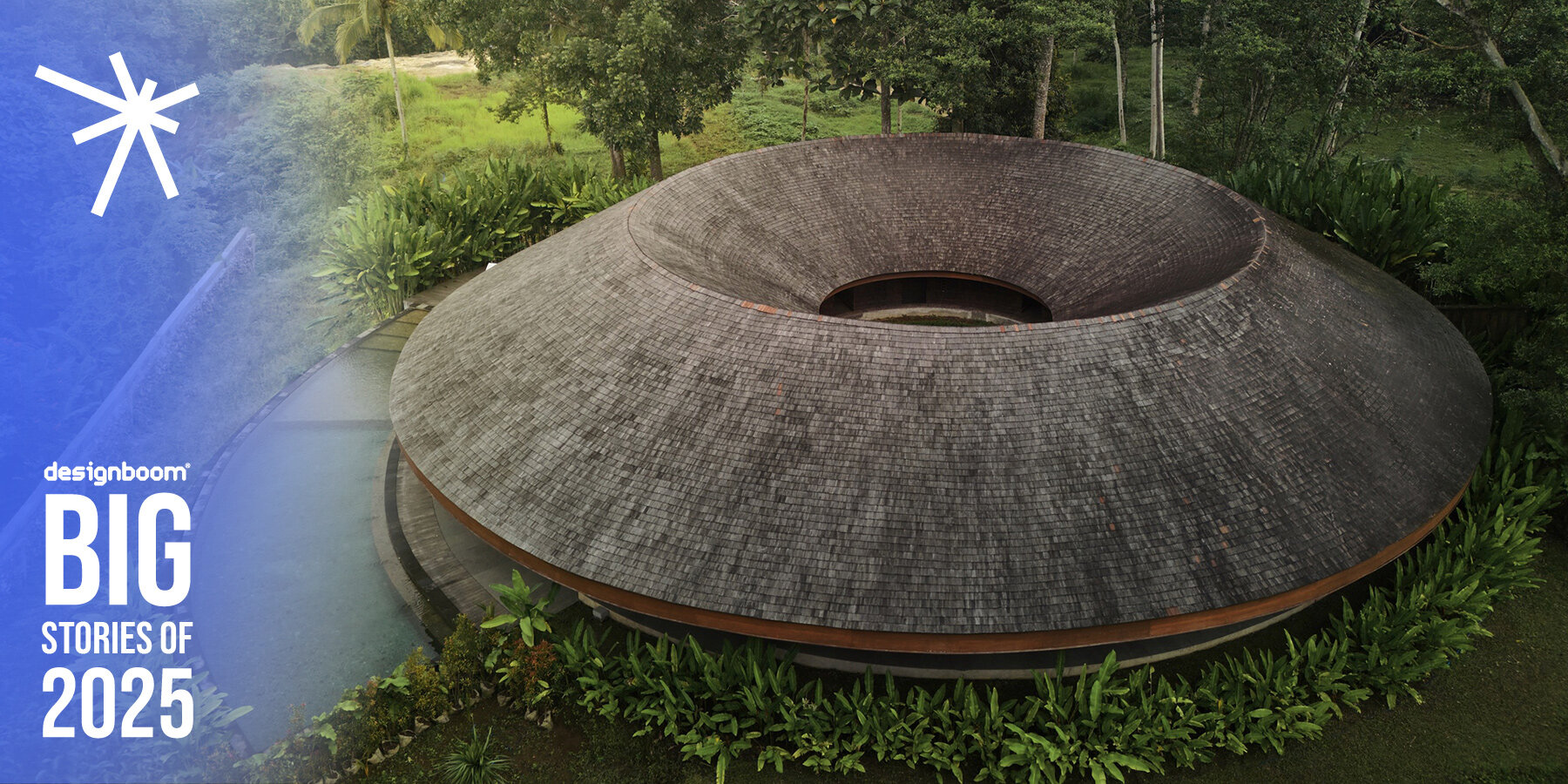
designboom’s top 10 private spaces of 2025
In 2025, architects around the world continue to expand the possibilities of domestic design, presenting a diverse collection of private houses that reconsider how we inhabit landscape, community, and climate. This year’s selection ranges from net-positive, off-grid experimentation in rural Japan to rammed-earth dwellings carved into the terrain of Crete, revealing a field increasingly attuned to resourcefulness, site specificity, and the choreography of indoor–outdoor living.
Shared themes emerge across these works — some occupying their natural context gently, others defined by a bold sculptural form. Florian Busch Architects pioneers an energy-generating modular residence amid agricultural fields in Hokkaido, while Wallmakers suspends a thatched, occupiable bridge over a gorge in India. Social frameworks also come to the fore, with TEN’s collaborative housing for women in Bosnia-Herzegovina proposing new models of care-based living. Explore designboom’s top 10 private houses of 2025 below!
arthur casas builds his own house in the forest of brazil
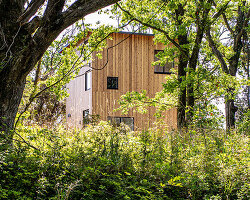
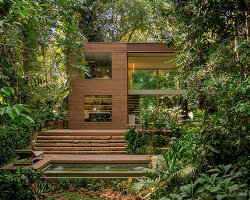
Hidden within the dense greenery of Brazil’s Atlantic forest, the Iporanga House stands as architect Arthur Casas’s own retreat. Conceived as a place to ‘recharge his energies,’ the home sits lightly in a protected natural reserve along the São Paulo coast. Its design is guided by a desire for harmony with the surrounding vegetation, a goal demonstrated by wood cladding that blends with the forest’s shifting tones and textures.
The plan takes the form of two symmetrical cubes framing a lofty central volume. Inside, lofty ceilings rise 11 meters (36 feet), and continuous glass panels draw in light and views, creating a breezy and fluid connection to the trees beyond. ‘The shape is simple, symmetrical, easy,’ Casas notes. He contrasts the home’s subdued form with with the ‘entropic, messy profile’ of the forest that surrounds it.
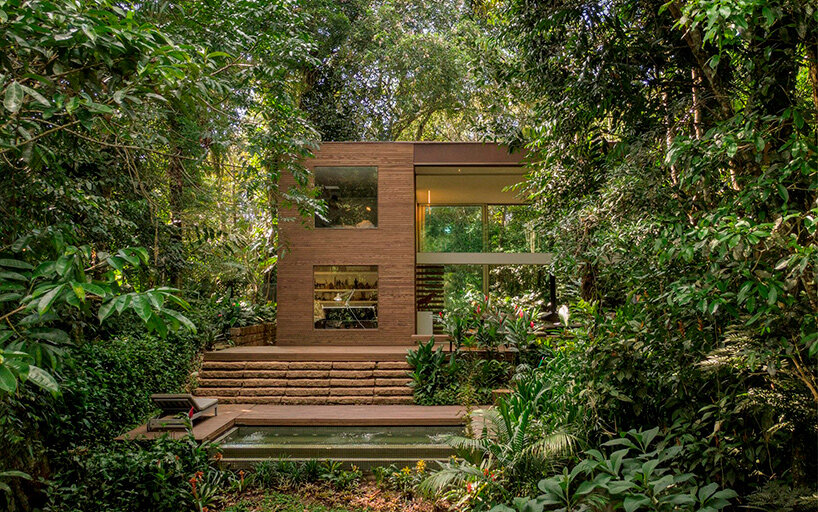
image © Fernando Guerra
florian busch architects’ modular ‘house W’ generates more energy than it consumes
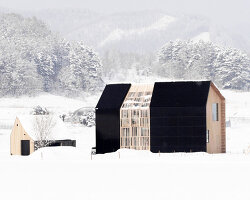
Florian Busch Architects’ (FBA) newly completed House W in Nakafurano, Hokkaido, marks the firm’s first project that generates more energy than it consumes. Rather than achieving this carbon neutrality through compact design, the solution lies in breaking up the structure. The team’s goal was ambitious: to create a building entirely independent from the local power grid, achieving net-zero energy consumption.
In reality, House W surpasses this objective, producing nearly twice the energy it consumes over the course of a year. The family selected a site in the middle of active agricultural land, prioritizing functional farmland use over picturesque countryside aesthetics. The plot was previously home to a farmer’s barn, and the surrounding landscape consists of rice paddies, asparagus fields, irrigation channels, and roads. This setting offers an open, largely man-made natural environment.
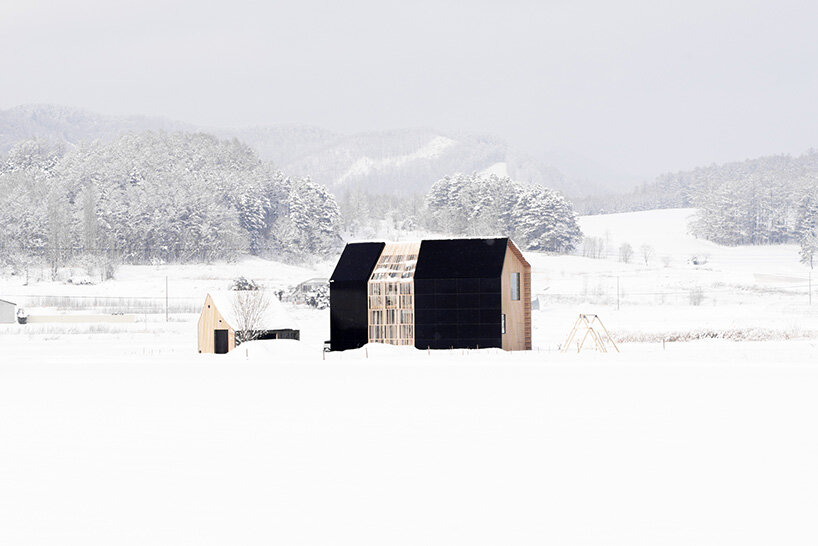
image © Florian Busch Architects
mykonos architects embeds wedge-shaped n’arrow house into terrain of crete
Set to be carved into the olive-dotted hills of Crete, Mykonos Architects designs a home titled N’Arrow to respond directly to the steep topography and slender dimensions of its site. The underground, rammed-earth project is designed to avoid imposition, and instead works with the natural contours of the land, inviting the surrounding environment to shape its form. Olive groves and rolling terrain are not backdrops but rooftops, and but co-authors in the architectural narrative, pushing the residential space toward harmony rather than dominance.
A fifteen-meter setback regulation, typically a limiting factor, sparked the defining concept behind N’Arrow. Mykonos Architects saw not a constraint but a creative opportunity, transforming the elongated form of the plot into a narrow, wedge-like structure that nestles into the hillside. This bold, linear geometry sets the tone for the home’s identity, drawing attention to the power of architectural adaptation when guided by site-specific conditions.
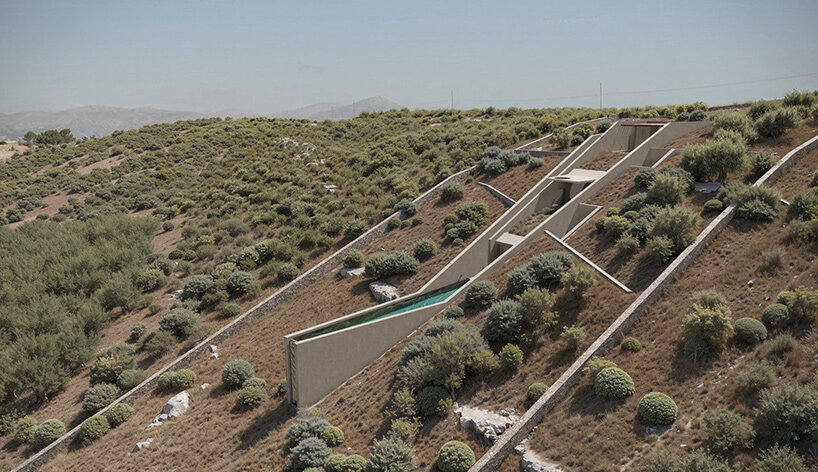
image © Marinkovic Marco
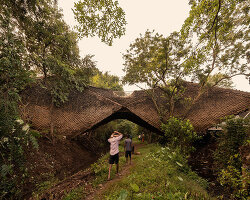
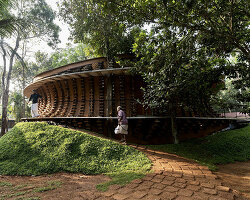
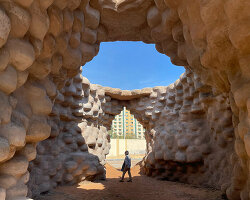
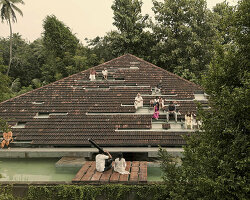
wallmakers wraps its suspended ‘bridge house’ in skin of thatched scales
The Bridge House by Wallmakers, led by architect Vinu Daniel, stands in Karjat, India, where a natural gorge divides the land. A natural stream has carved a seven-meter-deep channel through the site, creating both a challenge and an opportunity. The two parcels of land required a connection, yet no foundations could be placed within the 100-foot width of the spillway. As a result, the dwelling is suspended across this divide as an occupiable bridge.
The structure’s form emerged from constraint. Designed as a 100-foot suspension bridge composed of four hyperbolic parabolas, it uses minimal steel pipes and tendons for tensile strength, while a thatch-mud composite provides compressive resistance. The dialogue between these materials lends a structure that is both taut and flexible.
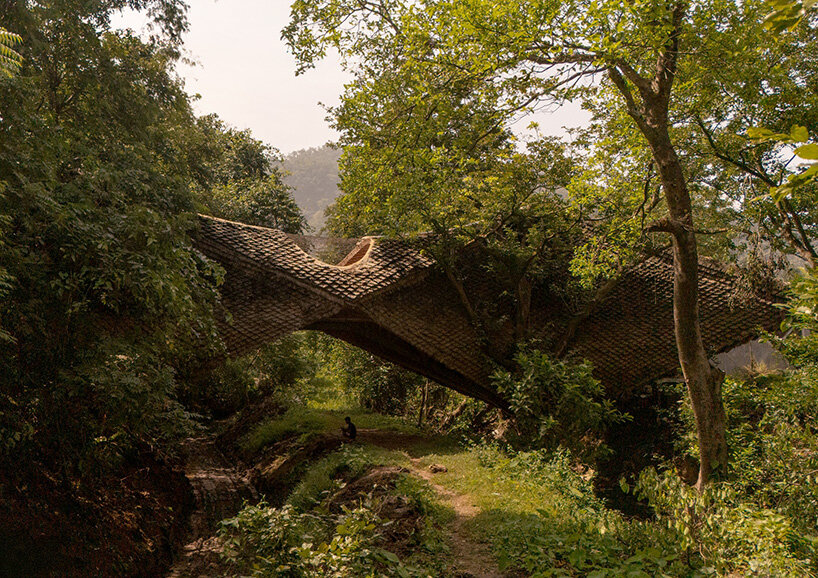
image © Studio IKSHA
ring-shaped home by alexis dornier encircles central garden in bali
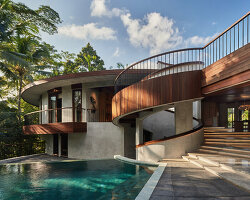
Villa Omah Prana by Alexis Dornier unfolds as a circular retreat that feels absorbed into the landscape of Payangan’s forested slopes, just north of Ubud, Bali. The 475-square-meter residence adopts a compound-like arrangement organized around a lush internal courtyard. Its low, continuous timber roofline and radial plan echo local vernacular geometries.
The project sits like a ring placed over the terrain, with the broad, funnel-like roof forming a shaded perimeter walkway and an introverted core. The shingle texture and earthy tonality of the roof make the building blend with its tropical context, while the inner void admits daylight and natural ventilation.
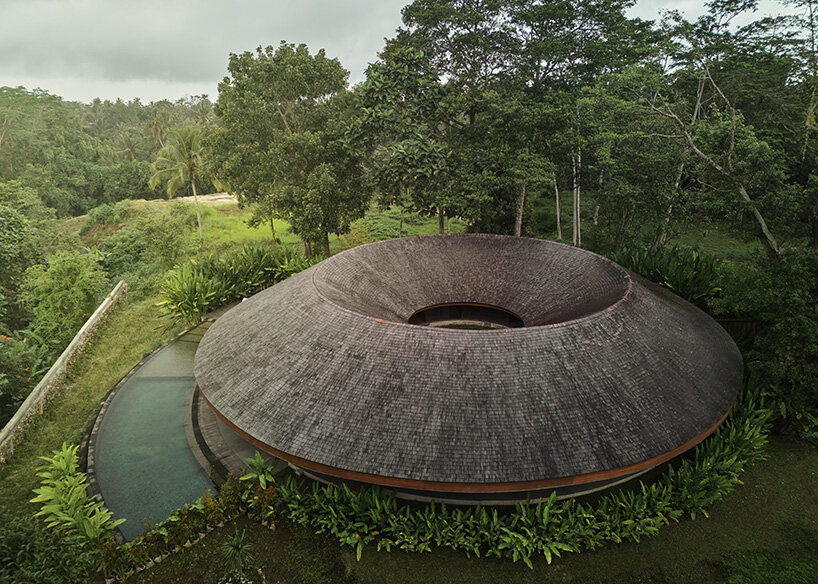
image © KIE
fran silvestre-designed villa zig-zags across the southern spanish landscape
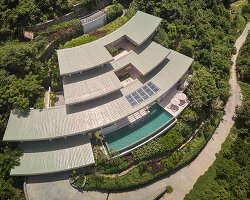
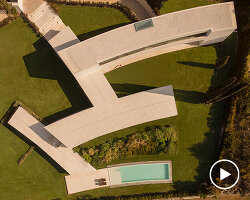
Fran Silvestre Arquitectos designs Villa 95 as part of the real estate developer Cork Oak Mansion project in Sotogrande, crafting a residence that appears to glide across the southern Spanish landscape. Defined by a continuous architectural gesture, the three-story villa unfurls along a sharp diagonal, its elongated form maximizing the buildable area of the 2,317 square meter plot while framing views of Altos de Valderrama area. Developed by DUS Desarrollos Inmobiliarios, the house is part of an exclusive collection of six high-end villas.
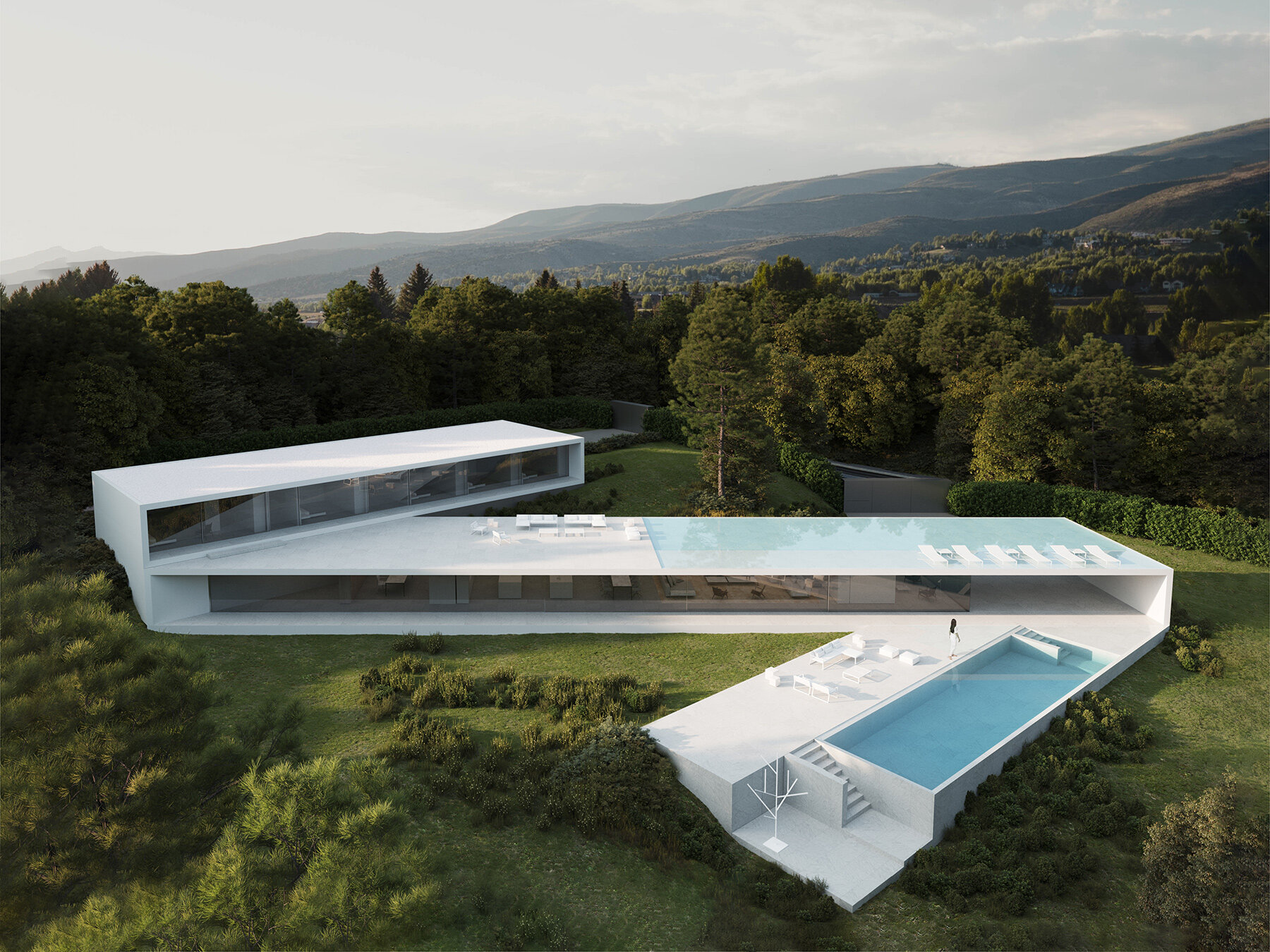
image courtesy Fran Silvestre Arquitectos
curved green roof shields wiki world’s wooden ‘cabin of palette’ in wuhan
Located among a forest outside Wuhan City, The Cabin of Palette is part of the Wiki World Co-Building Plan, which aims to develop a series of nature-integrated homes. This structure follows a series of artistic cabin designs, including past projects such as the Pure Blue Cabin and the Maze Cabin.
The cabin is designed to provide both shelter and openness to the surrounding environment. The climate conditions of the region, characterized by cold winters and hot summers, informed the development of a green elevated, palette-shaped roof that enhances airflow. The canopy is marked with contour lines and supported by light wooden structures.
The home consists of three interconnected volumes — bedroom, living room, and bathroom — arranged in a circular layout to offer varying perspectives of the landscape. Large covered terraces extend from the front and back, providing shaded areas suitable for summer heat and seasonal rains. A private courtyard allows for outdoor activities such as bonfires.
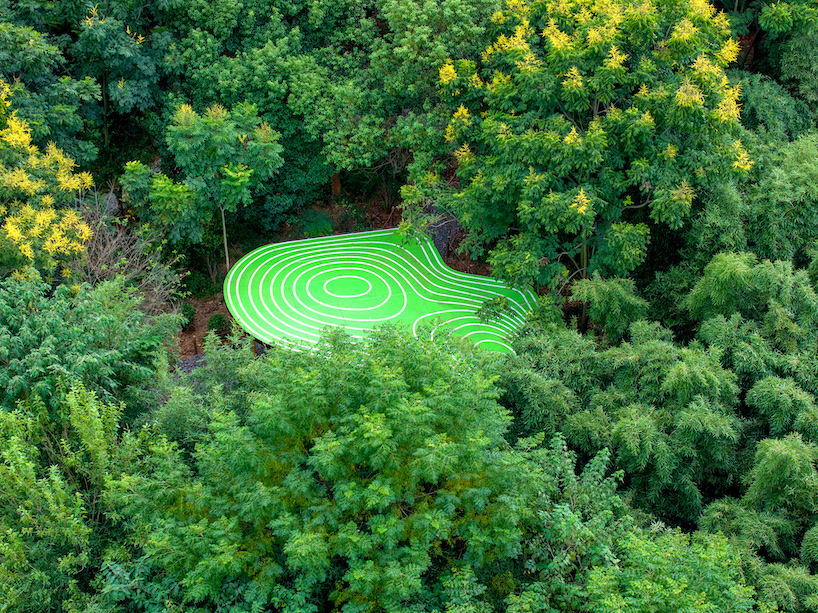
image by Wiki World, Pan Yanjun, Cai Muan
nendo weaves six cottages together with ‘hand-holding’ roofs in japanese forest house
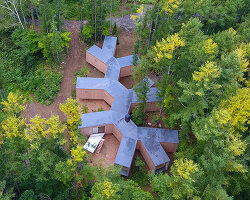
Hidden among a hilly site in Karuizawa, Japan, Nendo completes the Hand-in-Hand House, a weekend residence for a family of four. Positioned amidst verdant greenery with sweeping views of Mt. Asama, the residence takes the form of six compact cottages, each approximately 20 square meters, scattered along an expansive wooden terrace. Elevated on a platform supported by circular black columns, the architecture of the house adapts to the site’s natural slope.
Each of the six cottages is slightly angled in a different direction; their black roofs contrast against the light-colored wooden base. These varying-height roofs, described as ‘holding hands,’ metaphorically unify the structures under a single conceptual canopy, offering intimacy and cohesion.
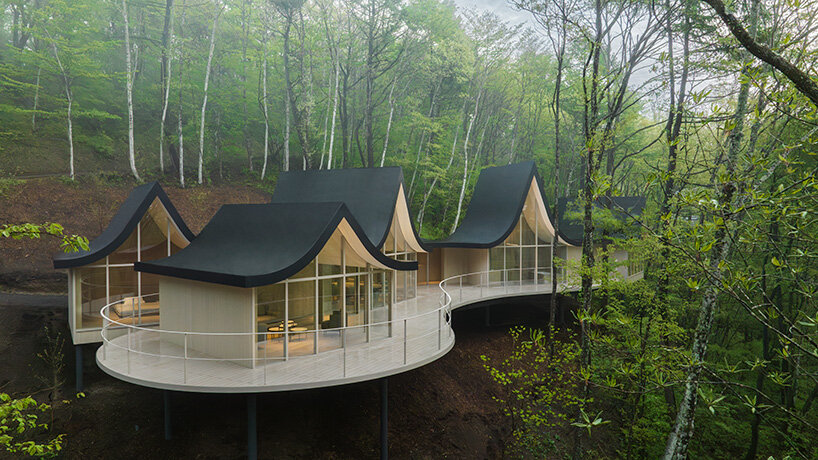
image by Masahiro Ohgami, courtesy of Nendo
arquitectura-G embeds blue concrete core with spiraling staircase in portuguese residence
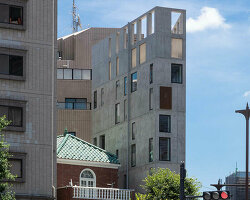
In Sintra, Portugal, Arquitectura-G completes House II, the latest intervention within a long-abandoned quinta de recreio, a rural estate historically devoted to agriculture and leisure. The project forms part of an ongoing sequence of works by the studio’s team, which seeks to conserve and rehabilitate the site’s buildings and reactivate the broader territory.
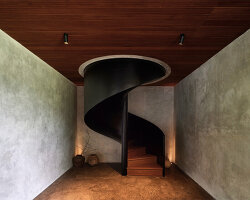
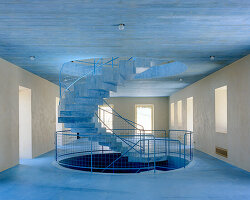
Strict regulations limited any change to the building’s external profile, facades, or roof, so Arquitectura-G responded by hollowing out the existing interior, retaining only the perimeter walls, and inserting a new structural body of blue-pigmented concrete. Rising from the basement cellar, this inserted core incorporates a helical staircase and extends upward to form the slabs of the upper levels. It culminates beneath a skylight on the first floor, where daylight streams into the central void and organizes the surrounding rooms.
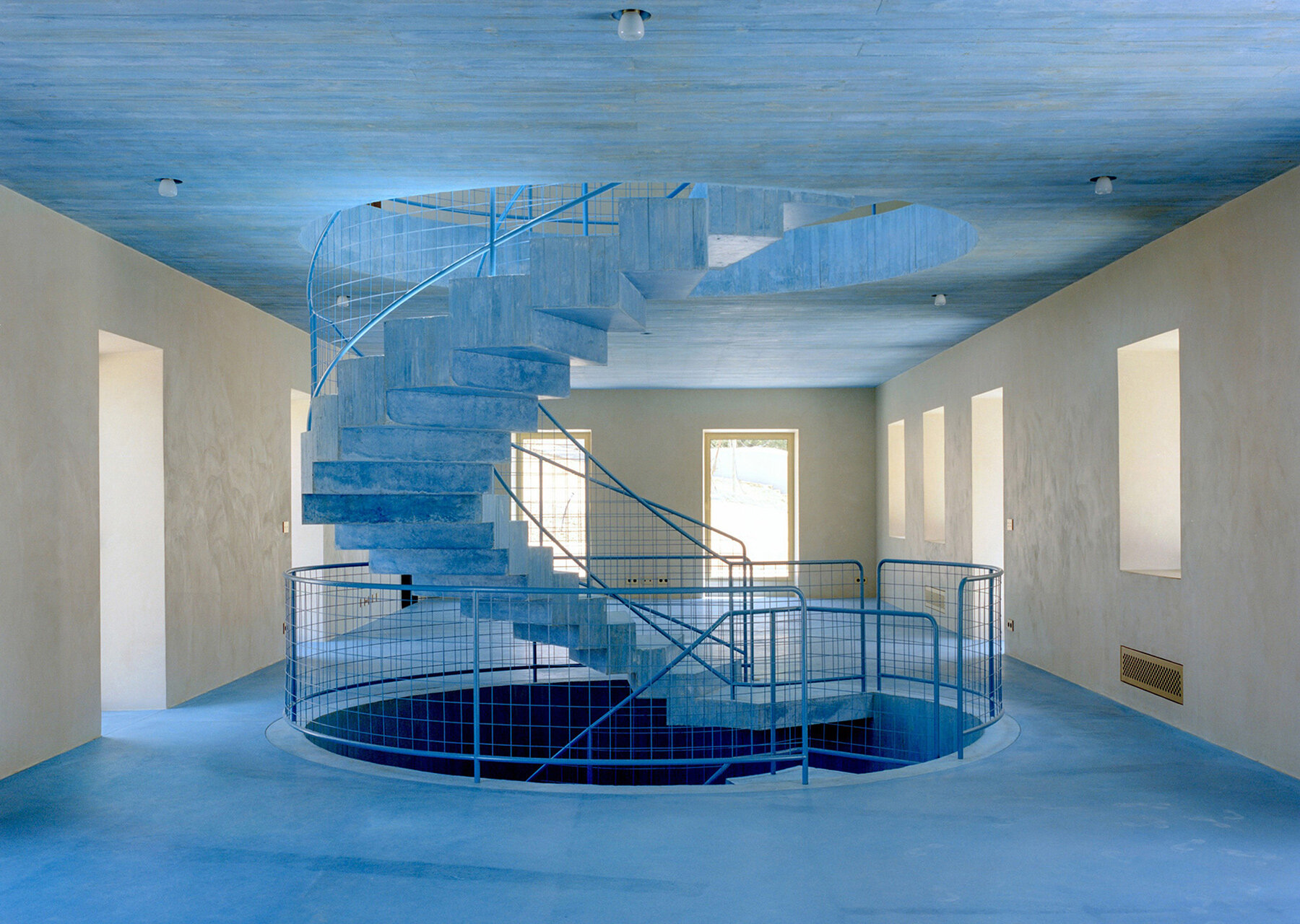
image by Maxime Delvaux
vivid rippled panels envelop TEN’s care-based housing for women in bosnia-herzegovina
On the outskirts of Gradačac, a town in northern Bosnia and Herzegovina, stands The House for Five Women, a vibrant residence by architecture studio TEN. The project rises from the countryside to defy conventional housing models through an architecture of care, resilience, and collective authorship.
Designed with local activist Hazima Smajlović, NGO Naš Izvor, Engineers Without Borders, and the Gradačac municipality, the project provides a permanent home for five single women who have survived war, displacement, and systemic neglect. It’s positioned between privacy and solidarity to propose a new paradigm for cohabitation with five individual living units clustered around communal spaces for gathering, working, and growing food.
Artist Shirana Shahbazi sculpts the facade of the building, composing a vibrant arrangement of large, colored aluminum panels in shades of pink, red, green, and deep blue. Though seemingly spontaneous, the composition is specially calibrated, with each panel being custom-made in a local car painter’s workshop. Their rippled, high-gloss surfaces catch and distort reflections, and transform the shell into a shifting, almost liquid canvas that responds to light and movement.
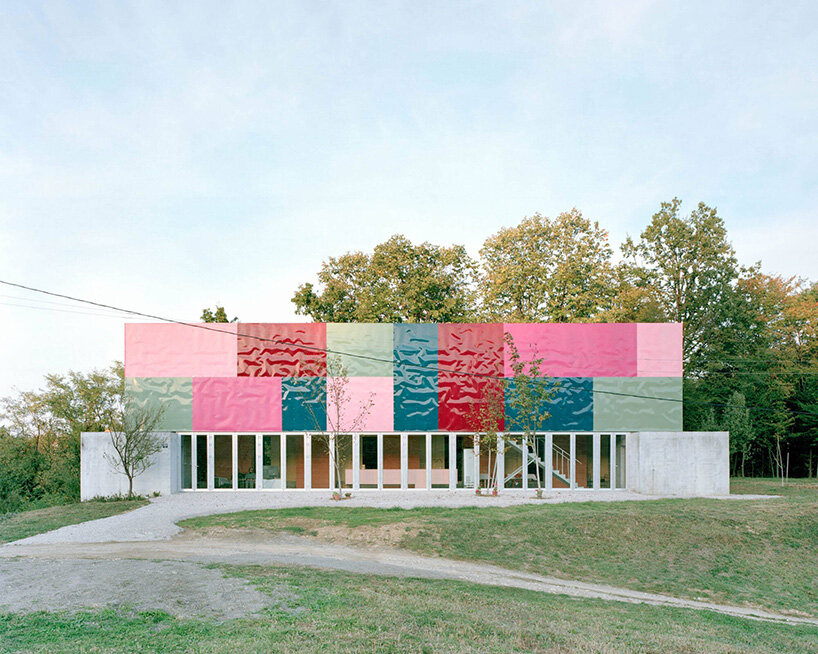
image by Maxime Delvaux, Adrien de Hemptinne
see designboom’s TOP 10 stories archive:
2024 — 2023 — 2022 — 2021 — 2020 — 2019
2018 — 2017 — 2016 — 2015 — 2014 — 2013
alexis dornier (26)
 Nov 13, 2025
 Sep 03, 2025
 Feb 20, 2025
 Aug 23, 2024
 Oct 12, 2023
arquitectura-G (17)
 Dec 20, 2025
 Oct 02, 2025
 Feb 14, 2025
 Apr 23, 2024
 Feb 27, 2023
florian busch architects (13)
 Feb 18, 2025
 Nov 19, 2023
 Jun 23, 2021
 Dec 09, 2020
 Jun 22, 2017
fran silvestre arquitectos (44)
 Feb 17, 2026
 Jan 13, 2026
 Nov 08, 2025
 Jul 17, 2025
 May 22, 2025
nendo (275)
 Apr 14, 2025
 Mar 14, 2025
 Jan 21, 2025
 Jun 06, 2024
 Apr 15, 2024
residential architecture and interiors (4756)
 Feb 20, 2026
 Feb 20, 2026
 Feb 19, 2026
 Feb 19, 2026
 Feb 19, 2026
studio arthur casas (27)
 Sep 14, 2025
 Jul 07, 2025
 Jan 03, 2022
 Aug 17, 2021
 Jun 20, 2021
TOP 10 LISTS OF 2025 - BIG STORIES (11)
 Dec 31, 2025
 Dec 30, 2025
 Dec 29, 2025
 Dec 26, 2025
 Dec 25, 2025
wallmakers (12)
 Jan 22, 2026
 Oct 30, 2025
 Mar 08, 2024
 Jan 11, 2024
 Nov 02, 2023
 Feb 10, 2026
 Feb 04, 2026
 Jan 20, 2026