jane jacobs’ utopia is community
There is a moment, early in The Death and Life of Great American Cities, when activist Jane Jacobs describes a city sidewalk in use: ‘People get advice from the grocer and give advice to the newsstand man, compare opinions with other customers at the bakery and nod hello to the two boys on the stoop.‘
The scene seems trivial, but she explains its importance: ‘The trust of a city street is formed over time from many, many little public sidewalk contacts.‘ It’s this accumulation of daily moments that shapes her version of utopia. Unlike the modernist masterplans and megastructures of Le Corbusier and Paul Rudolph, or the invasive urban interventions of Robert Moses, her vision builds itself over time and trust between people.
During the modernist movement, Jacobs pushed back against the idea of the ideal city as something to be reduced to binaries and managed by experts, arguing instead for an understanding of it as an ever-evolving place shaped by those who inhabit it.
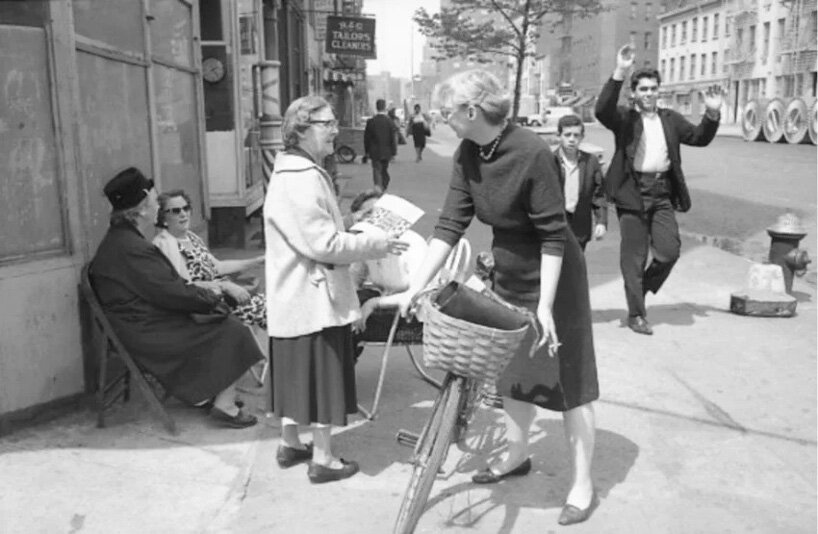
Jane Jacobs handing out brochures and speaking with neighbors on Hudson Street about the proposed West Village Houses affordable housing project, West Village, 1963 | photo courtesy Bob Gomel
an ideal city planned from above?
For centuries, utopia existed as a projection. In Thomas More’s Utopia, published in 1516, the city is a complete and ordered world that’s already resolved. The appeal comes from its distance. It stands apart from the confusion of existing cities, offering a clean arrangement of space and society.
Later into the twentieth century, modernist planning carries forward that impulse with renewed conviction. Take Le Corbusier’s Ville Radieuse as a clear example, where the city is conceived from above as a field of tall cruciform towers set within open green space, arranged along strict axes and separated by function. Housing, work, circulation, and leisure are each assigned their own zones, connected by wide, fast-moving roads designed for efficiency rather than encounter.
The promise is immediate in its logic, as congestion is eliminated and circulation is streamlined. It is a legible vision where complexity is resolved ahead of time, and urban life is organized into a system that can be planned and predicted.
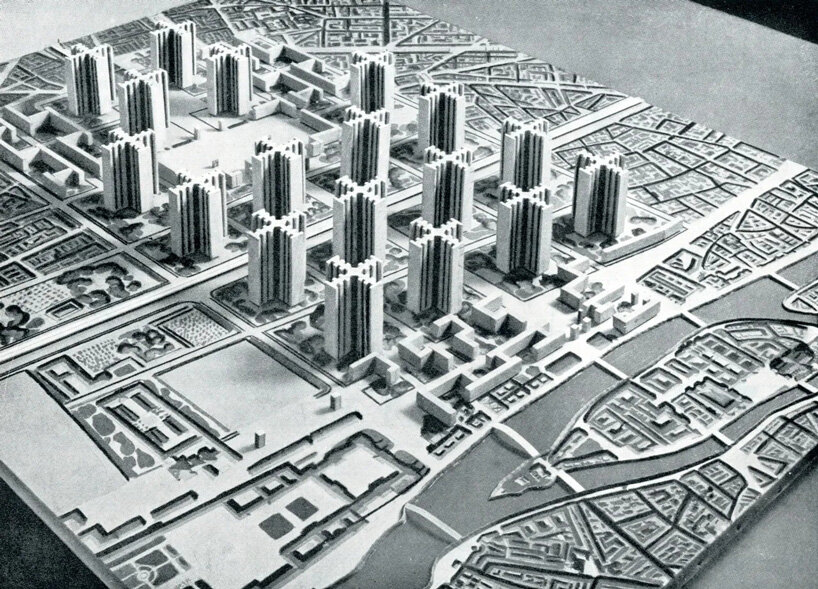
Le Corbusier’s ‘contemporary city’, 1925
orderly visions disconnected from people
Paul Rudolph pushed that logic toward excess with his proposed Lower Manhattan Expressway megastructure. Commissioned in 1967, the proposal stacks highways, streets, and parking into a continuous elevated framework, with triangulated bands supporting new construction above. Circulation moved along elevated ‘people movers,’ and the concept of sidewalk life is overlooked.
While it may seem visionary to some critics, the plan was undoubtably invasive. Ultimately it collapsed when the expressway itself was vetoed in 1969, with Jacobs a major figure in the protests.
Jane Jacobs looks at these proposals and sees something that’s not so optimistic, warning of their soullessness and disconnect from humanity.
She writes of these modernist visions: ‘They appear so orderly, so visible, so easy to understand… like a good advertisement.‘ How does the city work once people begin to use it? How does it hold together across hours, across seasons, across small daily habits made without coordination?
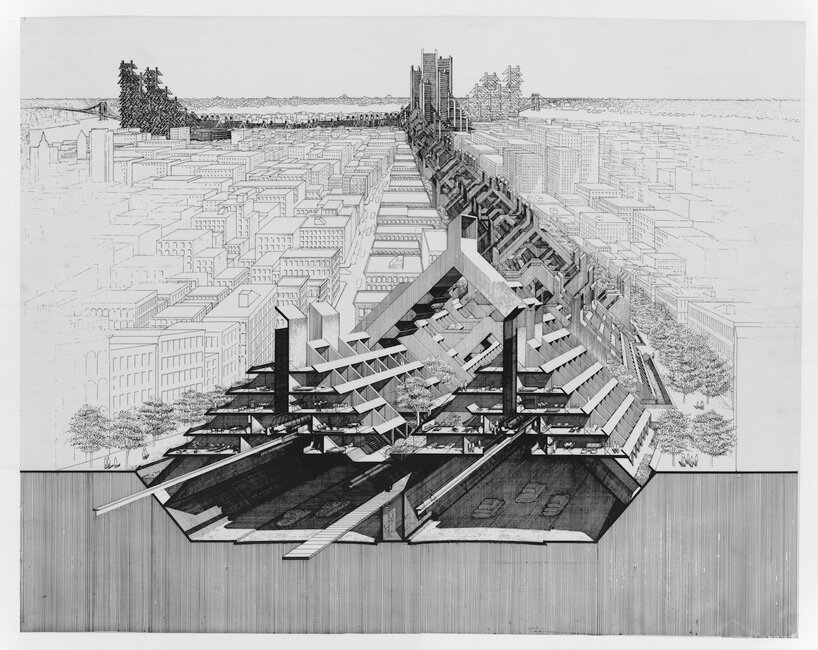
Paul Rudolph’s Lower Manhattan Expressway proposal, 1967
a celebration of sidewalk life
Jane Jacobs’ answer to utopia comes from observation. She writes of stoops, storefronts, sidewalks, and corners because these are real places that never appear in plans.
A sidewalk, she argues, ‘by itself is nothing.‘ It gains its meaning through the buildings that line it and the doors that open onto it, and especially through the overlapping uses that keep it active throughout the day and evening. It’s a city’s main public space and, when it functions well, it supports a shared sense of trust. And trust between people cannot be masterplanned.
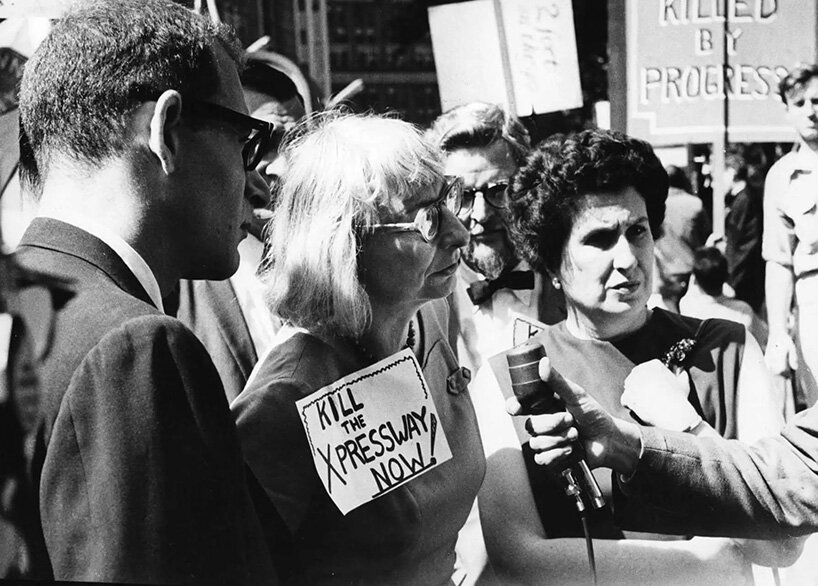
Jane Jacobs at a 1968 protest against the proposed Lower Manhattan Expressway
diversity of use: a city full of life
While Jane Jacobs’ ideas of the urban utopia are born from a neighborhood’s sidewalk life, her argument extends into the structure of the city itself. She writes about ‘diversity of use,’ noting that a neighborhood is most successful when it supports different functions at once. Workplaces bring people during the day, and homes maintain activity during the evenings and weekends. Shops and recreation fill the hours between.
‘The district must serve more than one primary function; preferably more than two.‘ she explains. ‘These must insure the presence of people who go outdoors on different schedules and are in the place for different purposes, but who are able to use many facilities in common.‘
In short, people must arrive to a neighborhood for different reasons at different hours. When its uses overlap, they reinforce one another. When they separate, the place will become a deserted wasteland during large swaths of the day, and will lose the ability to sustain itself.
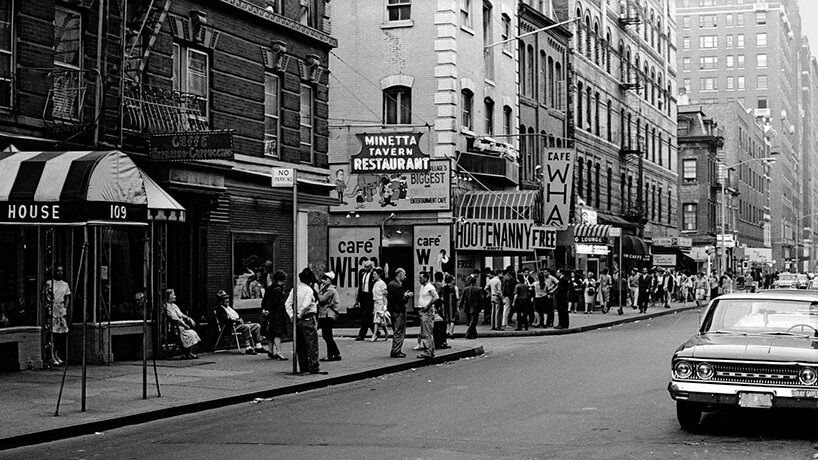
MacDougal Street, New York | image via the Bowery Boys
conditions for the human-centric neighborhood
Other conditions she notes include short blocks, buildings of varied age, and density. Each one addresses a specific behavior. Short blocks allow movement to shift direction, increasing encounters. Older buildings, in some cases, may offer lower rents, making room for small enterprises. Density ensures continual activity across time. While these ideas read as inconsequential on their own, they combine to create a place that’s human-centric.
Jacobs intentionally avoids the language of completion. There is no final state toward which the city moves. Instead, there is a continuous process of adjustment. A neighborhood changes as businesses open and close, as residents arrive and leave, as buildings age and adapt. Progress appears through these shifts rather than through large scale replacement.
This reframes utopia so that the focus moves away from the image of a finished city toward the conditions that allow a city to keep improving. The emphasis falls on participation, with people shaping their surroundings through use and through their daily habits.
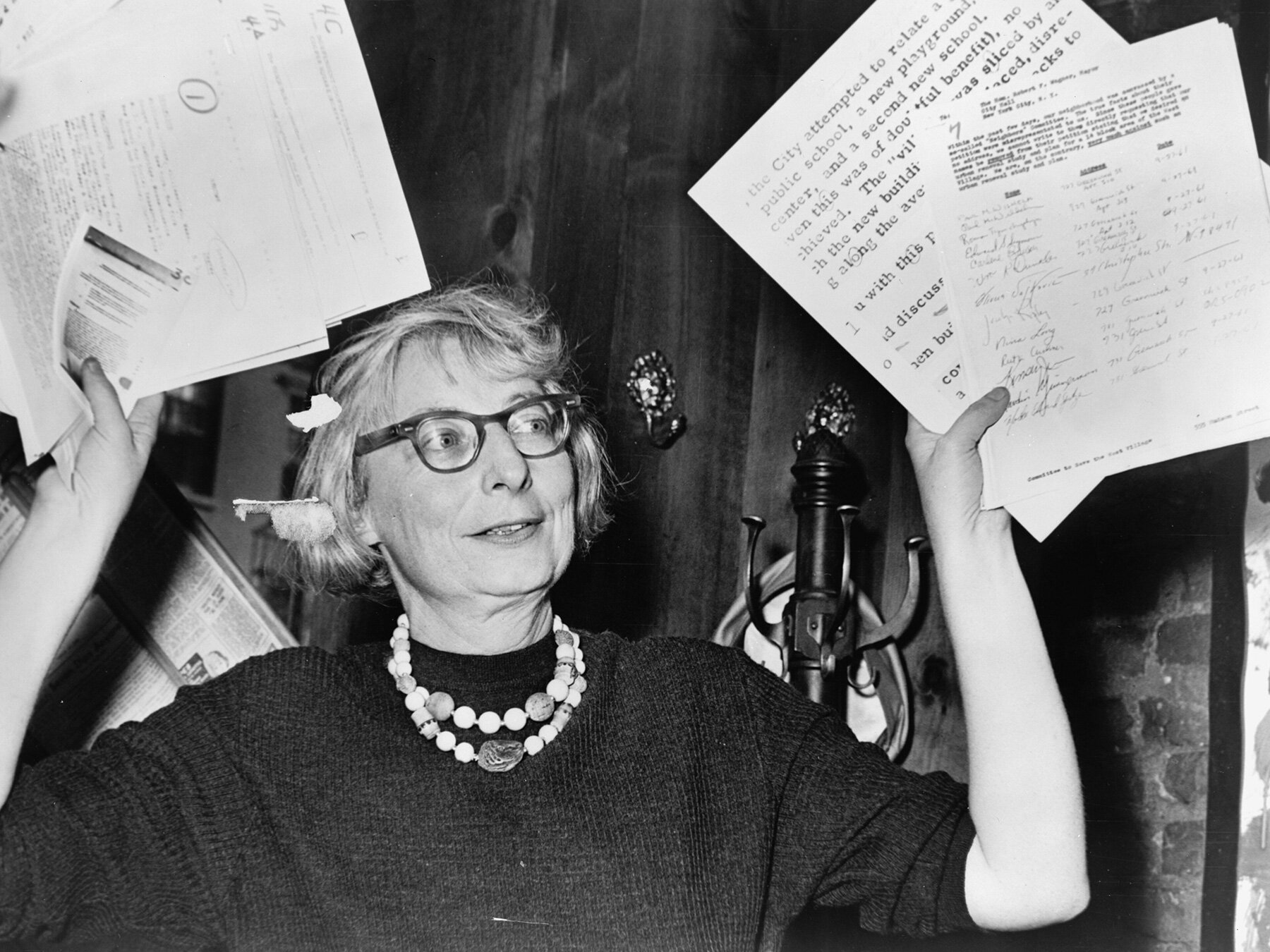
Jane Jacobs, chairman of the Comm. to save the West Village at a press conference, 1961
architecture in new york (664)
 Mar 19, 2026
 Mar 16, 2026
 Mar 03, 2026
 Feb 10, 2026
utopia then and now (14)
 Mar 19, 2026
 Mar 19, 2026
 Mar 19, 2026
 Mar 18, 2026
 Mar 18, 2026
 Mar 18, 2026
 Mar 12, 2026
 Mar 11, 2026