
‘you cannot scroll past a smell’: anicka yi on microbial time and the politics of the senses
the artist reflects on her latest installation 'message from the mud', exploring scent, artificial intelligence, and the invisible exchanges that connect bodies, technologies, and environments.
anicka yi installs a different kind of clock at ny’s king art center
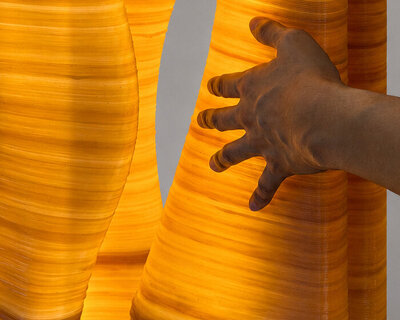
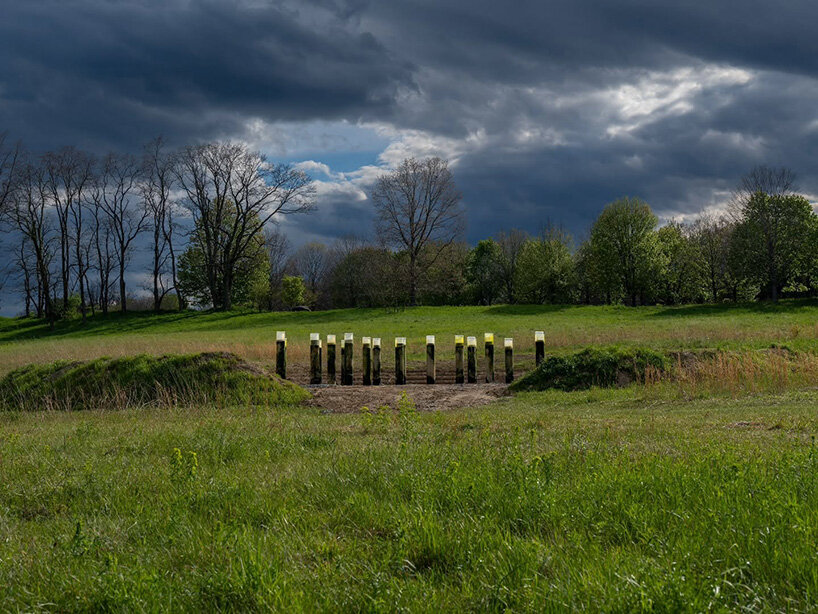
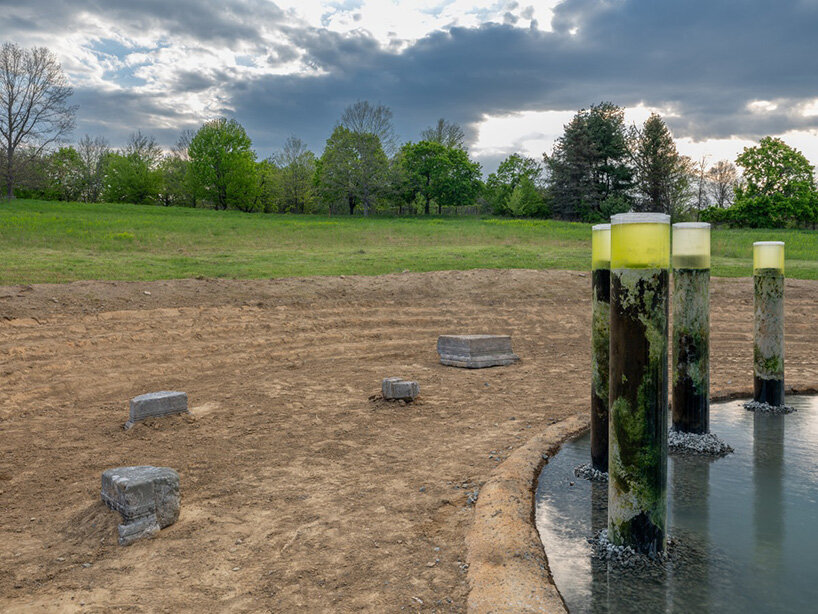
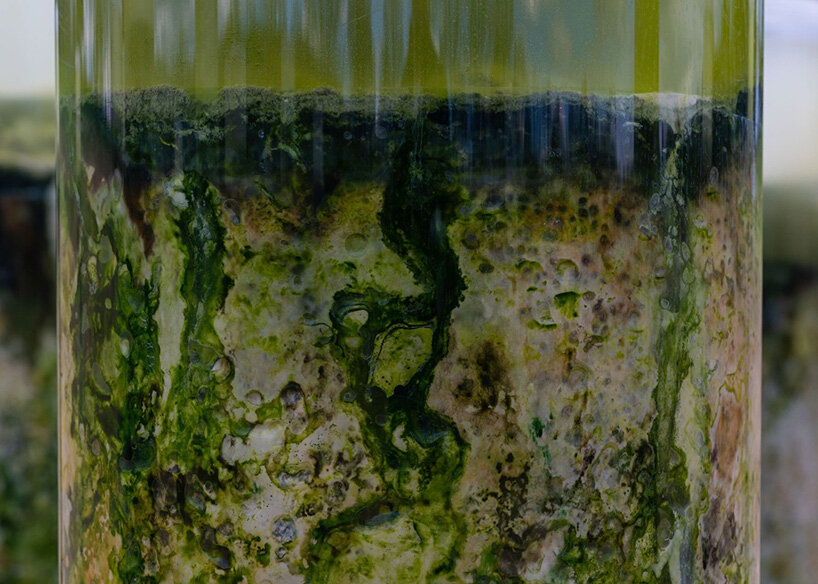
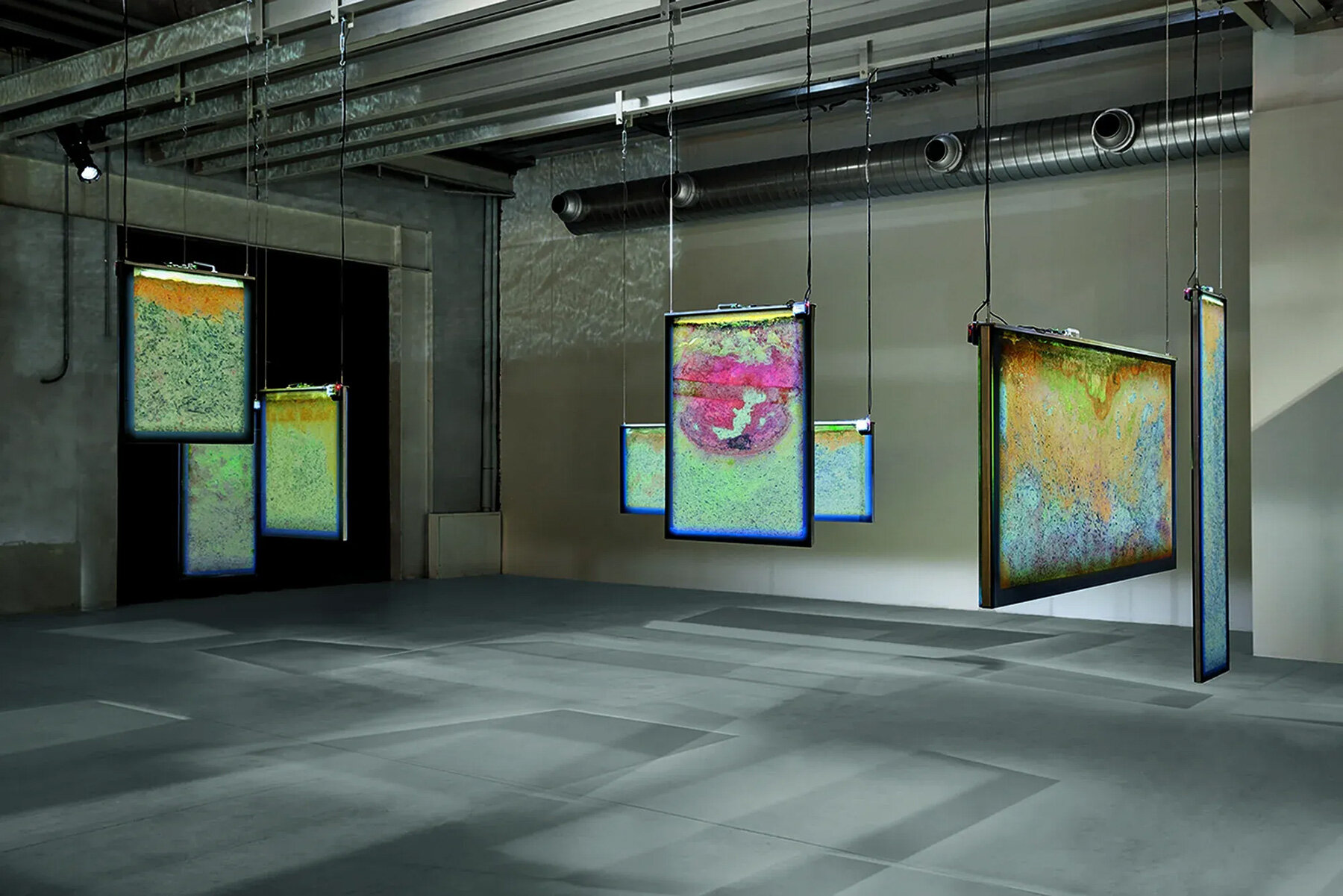
Anicka Yi is asking visitors to listen to the earth with Message from the Mud, a fictional archaeological dig at Storm King Art Center in New York’s Hudson Valley, bringing hidden microbial activity to the surface through a series of living columns installed within the site’s pond. Twenty Winogradsky columns rise from a pond, filled with mud, soil, pond water, egg yolks, and shredded newspaper. Over time, algae, cyanobacteria, and microbial colonies bloom into vivid bands of color, transforming the installation into a living record of environmental activity. For the artist, the project is all about creating the conditions for nature to speak on its own terms. ‘The landscape is the longest archive we have,’ she tells designboom. ‘Geology, soil chemistry, the slow accumulation of microbial sediment, all of it stores information about epochs we will never witness directly.’
The artwork operates according to rhythms that resist contemporary habits of consumption, as the columns gradually change over weeks and months as microbial communities establish themselves and interact. Processes that largely remain invisible shape the work as time passes, asking viewers to attune themselves to forms of activity that exceed human timescales. ‘What draws me to this is that the mud operates on a different clock,’ Anicka Yi says. ‘It runs on microbial time, on geological time, neither of which cedes itself to news cycles or human attention spans. To sit with a Winogradsky column is to step into a temporality that does not reward your impatience.’
The project builds on questions that have shaped Yi’s practice for more than a decade. Whether working with bacteria, scent, artificial intelligence, or atmospheric phenomena, the artist is interested in forms of intelligence and communication that often escape human perception. ‘You cannot scroll past a smell,’ she notes during our interview. ‘An image is something you look at from across the room. An atmosphere is something you stand inside and breathe in. The work enters your body, and you become part of it.’
The idea runs throughout Yi’s practice, which often asks viewers to engage with phenomena that cannot be fully grasped through sight alone.
when materials refuse to sit still
Across installations, sculptures, scents, microbial environments, and more recently artificial intelligence and machine systems, the Seoul-born, New York-based artist has developed a body of work that examines how humans, technologies, and living systems continuously shape one another. Whether working with scent, bacteria, artificial intelligence, or atmospheric conditions, her practice traces the exchanges, dependencies, and forms of coexistence that connect them.
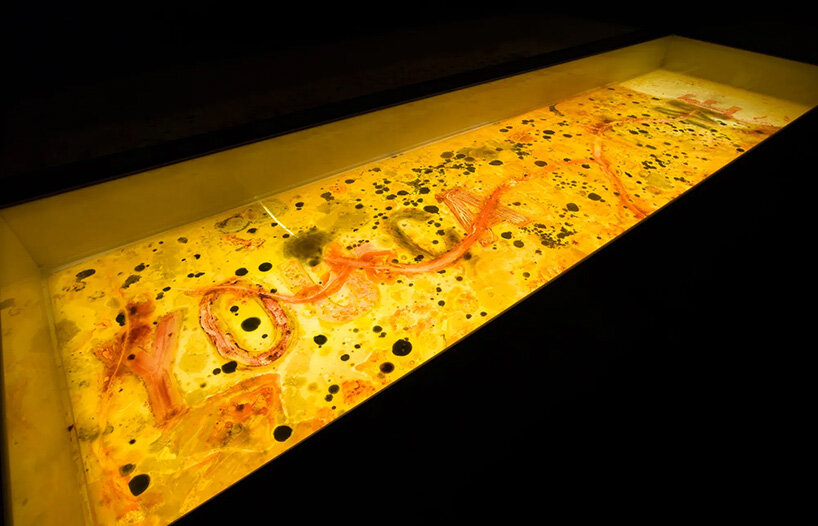
Much of that inquiry began when she realized that the materials she was working with were often less dynamic than the living systems she wanted to understand. Early in her career, Yi became fascinated by biological processes and the unpredictable behaviors of living matter. ‘I was very fascinated by metabolisms: how materials behave, how bodies absorb and release, and how environments shape what we become,’ she recalls. ‘From the earliest days of my practice I was working with bacteria and scent. These materials refused to sit still, they fermented, bloomed, oozed, dried. That instability felt more expressive of how life actually behaves than something static that I could carve or fix in place.’
Those observations gradually broadened her perception of what an artwork could be, and Anicka Yi became increasingly interested in systems, relationships, and exchanges. The installation ceased to be an endpoint and instead became part of a broader ecology connecting bodies, atmospheres, microbes, technologies, and environments. ‘Once you stop seeing the work as a culminating endpoint, the ecosystem it exists in and subsequently informs becomes highly visible.’ she explains.
Smell, atmosphere, biopolitics of the senses
The idea of visibility is particularly significant within Yi’s practice because many of the forces that interest her most cannot be easily seen. Microbial life, chemical communication, atmospheric exchanges, and scent all operate beyond the limits of human visual perception. Her work attempts to render these hidden relationships tangible without reducing their complexity.
This concern has led her to develop what she describes as a ‘biopolitics of the senses,’ an ongoing investigation into how culture determines which forms of sensory knowledge are considered legitimate. In an era increasingly dominated by screens, algorithms, and digital interfaces, Yi argues that contemporary experience privileges distance over intimacy. ‘Screens train us to perceive at a distance,’ the artist tells us. ‘They let us see and hear without absorbing anything, which suits a culture obsessed with control and sterility.’
For Anicka Yi, smell occupies a particularly radical position within this sensory hierarchy. Unlike vision, which allows for detached observation, scent requires physical participation. Odor molecules enter the body regardless of consent, collapsing distinctions between observer and environment. ‘I have always said that the scent of power is no scent at all,’ she adds. ‘The places where authority concentrates all work to neutralize smell, because smell, whether body, food, or waste, punctures the fantasy of the autonomous, sealed body.’
The statement points toward one of the central tensions running throughout her work. Contemporary systems of power often depend upon maintaining boundaries between clean and contaminated, self and other, human and nonhuman. Smell disrupts those categories, reminding us that bodies are permeable and entangled with the world around them. ‘To work through smell and atmosphere is to refuse that fantasy,’ Yi says. ‘A molecule enters you before you can decide whether to let it in, landing in the limbic system before language catches up.’
For this reason, many of her installations function as environments to be inhabited, where air becomes sculptural, atmosphere becomes material and scent becomes a medium through which relationships are formed.

the artist positions kinship over dominance
Asked whether her work imagines possible futures or reveals conditions that already exist, Yi rejects the distinction altogether. ‘Both, and honestly the split between future and present is part of what I am trying to take apart,’ she answers. Science fiction has long informed her work, yet she is less interested in predicting the future than using speculative thinking to reveal overlooked realities. For Yi, many of the conditions we associate with the future are already here, taking shape through the invisible relationships between bodies, microbes, machines, and their environments. ‘The microbes already inside us, the chemical signals passing between species, the way our bodies and our machines are already entangled, all of this is happening right now, not in some speculative future,’ the artist notes.
That perspective also shapes Yi’s engagement with artificial intelligence and machine systems. While her recent projects incorporate advanced technologies, she resists narratives that frame AI as either humanity’s ultimate triumph or its existential threat. ‘We are still recovering from an intellectual hangover from the Industrial Revolution,’ she comments. ‘We picture machines as cold, dry, mechanistic things made of gears and running on binary logic.’
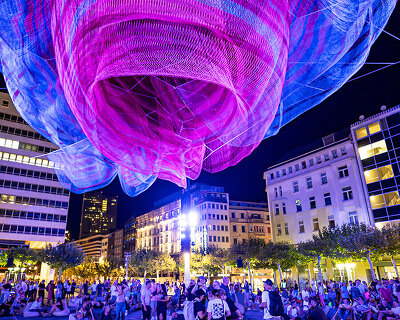
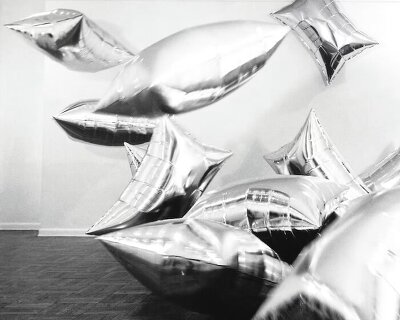
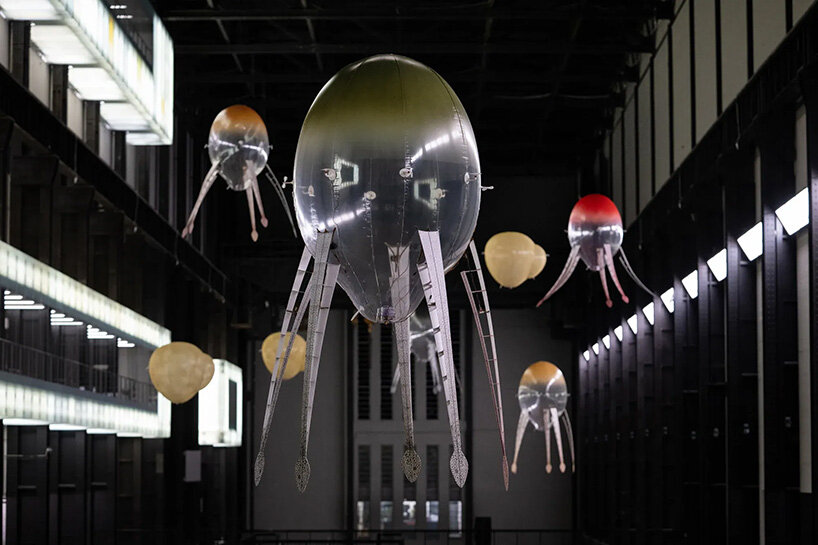
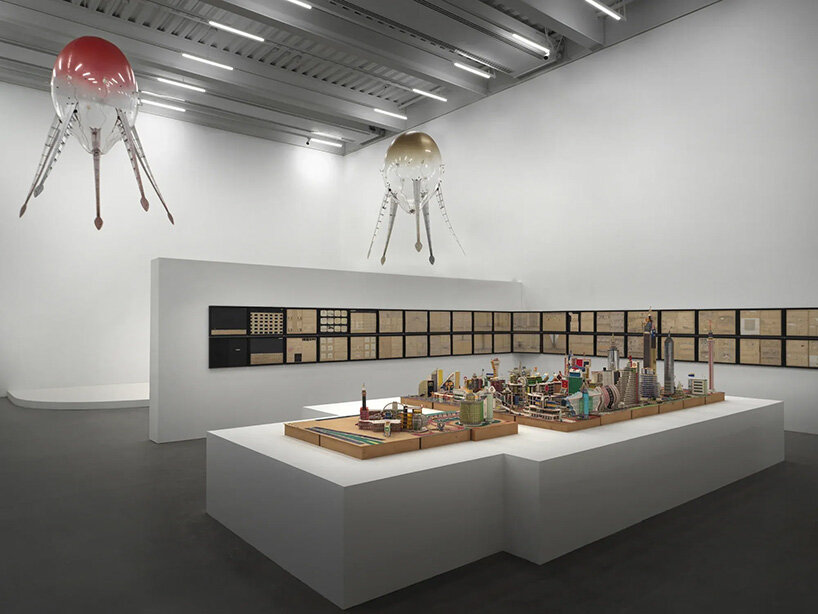
Her monumental Aerobes, first presented in In Love With The World at Tate Modern, emerged from an effort to imagine technological intelligence differently. Floating through the vast Turbine Hall, the sculptures behaved like machines drifting through space, responding to environmental conditions, and appearing powerful and vulnerable at the same time. ‘They are massive but fragile. They move slowly, search the air, drift toward people. You can see how delicate they are. That fragility is what allows visitors to feel something for them, a kind of pathos,’ the artist describes.
authorship as an ecosystem
Rather than emphasizing domination, Yi imagines relationships built on coexistence. ‘The future I envision is not one where humans master machines, or where machines master humans,’ she shares. ‘I am more interested in kinship than dominance.’
That language of kinship resonates across her entire practice. Whether working with microbes, scent, AI systems, landscapes, or living materials, Yi seeks forms of intelligence that challenge human exceptionalism, proposing a world populated by multiple agencies working together, each shaping the others in ways that remain only partially visible. This understanding also informs her collaborative methodology. Over the years, Yi has worked closely with synthetic biologists, perfumers, roboticists, software engineers, chemists, and researchers. ‘Collaboration has reorganized my sense of what authorship is,’ the artist highlights.
Scientists, engineers, microbes, machines, materials, and environmental forces all play a role in shaping the final work, leading Yi to think of her practice as a process of cultivating relationships. ‘What this taught me is that artistic control was always a bit of a fiction,’ she reflects, describing her studio as an ecosystem composed of multiple actors influencing one another. ‘My role is closer to setting conditions and tending to relationships than to imposing form. My studio operates more like an ecosystem than a workshop, and I am one node inside it, alongside scientists, machines, microbes, and materials, all of us shaping each other.’
older registers: bringing the invisible to the surface
The same principle extends to the installations, in which environmental forces transform her works and biological processes generate unforeseen outcomes. In this sense, Anicka Yi’s latest work, Message from the Mud may be understood as a culmination of many of the ideas that have animated her practice for years, including microbial life, geological time, environmental agency, collaboration with natural systems, and the limits of human perception.
The installation asks visitors to consider forms of knowledge that exist beyond the ways we usually define intelligence.
‘Reclaiming that knowledge is partly aesthetic and partly political,’ Yi says when discussing smell and embodied perception. ‘It resists the idea that the only legitimate forms of cognition are linguistic, optical, or computational.’ Across bacteria, scent, atmosphere, machines, and landscapes, the artist directs attention toward ways of knowing that remain difficult to quantify yet profoundly shape human experience.
‘There are older registers available to us,’ she points out, ‘more universal, shared with almost every other living thing, and much of my practice is about creating the conditions where those registers can come forward again.’
At Storm King, Yi turns to mud, water, microbes, and time to reveal processes that are usually hidden from view. They have always existed beneath the surface of the landscape; the work simply invites us to pay attention.



project info:
name: Message from the Mud
artist: Anicka Yi | @anickayi_studio
location: Storm King Art Center | @stormkingartcenter
opening date: May 17th – November 9th, 2026
shop
your own online design shop — no sales commission collected