This interview is part of designboom’s Crafting the Future chapter, exploring what it means to be a maker in today’s world and the future of craftsmanship. Discover more related stories here.

‘break away from a functional approach to making’: absurdist basket maker lewis prosser
the british artist uses basketry as a way of asking larger questions about labor, locality, materials, and the future of making.
prefer designboom on google[FEATURED]
absurdist basket makeR lewis prosser in conversation
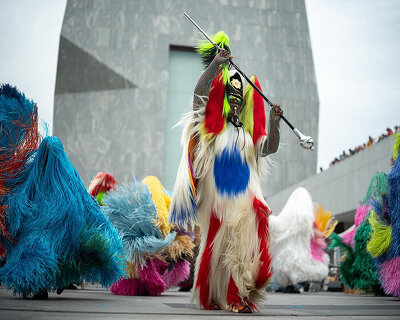
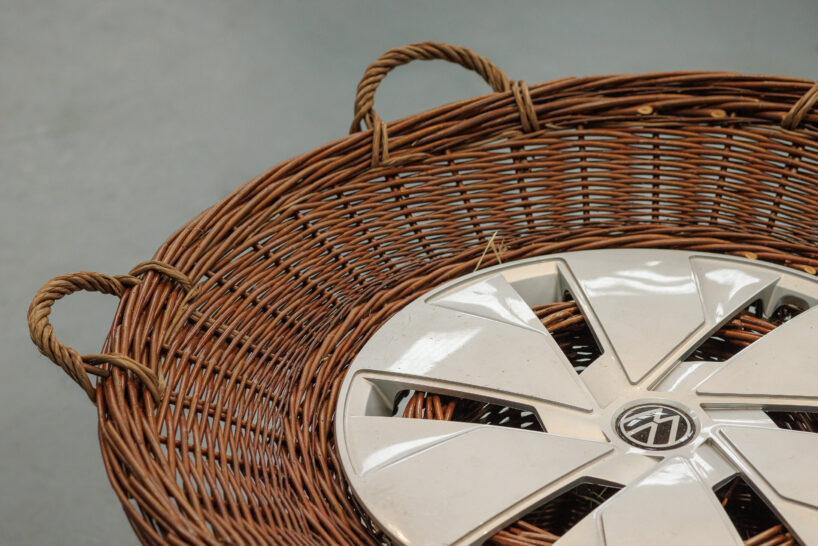
British artist Lewis Prosser describes himself as an ‘absurdist basketmaker,’ a title that feels both playful and surprisingly precise. His oversized willow sculptures, wearable costumes, monumental heads, and performative objects rarely function as baskets in the conventional sense. Instead, they use basketry as a way of asking larger questions about labor, locality, materials, and the future of making.
‘As a basket maker I feel too much like an artist, and as an artist I’m too much of a basket maker. Being an “absurdist” gives me permission to apply traditional techniques to unlikely contexts, to move away from utility without losing a sense of discipline.’
That tension runs throughout his practice. Basketry becomes less a craft tradition to preserve than a living methodology capable of adapting to contemporary culture. Humor, performance, sculpture, and public participation all become ways of testing just how far an ancient technique can stretch without losing the intelligence embedded within it.

basketmaking becomes a contemporary design language
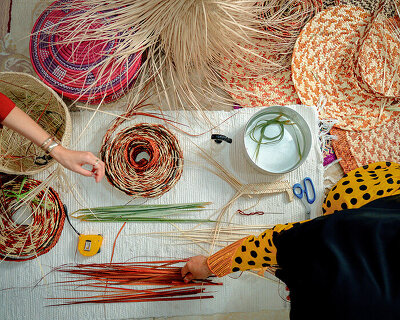
Prosser’s relationship with basketry began after leaving the city for rural Wales, where spending time outdoors led him towards traditional crafts and locally foraged materials. ‘I am self-taught, so it was a slow process of observation and learning through mistakes. In basketry, your hands are the most important tool, and that embodied relationship with willow really hooked me.’
That physical dialogue with willow gradually shifted his attention away from the object itself.
‘It became less about learning to make baskets, and more about understanding what basketry reveals about the people that use them.’ Basketry itself became the subject. Prosser often describes it as ‘plastic before plastic,’ a material with enormous untapped potential that has been overlooked precisely because of its familiarity.

absurdity allows tradition to evolve
Rather than treating heritage as something fixed, Prosser sees it as a framework that invites experimentation.
‘Laughter is a big part of how I relate to the world. Absurdity lets me hold contradictions without needing to resolve them. It gives me space to be playful, critical, and provocative at the same time.’ Understanding tradition comes first.
‘You can’t really push a technique somewhere meaningful without first understanding it properly.’ He compares basketry to poetry. ‘Once you understand the fundamentals of the language, you can begin to adapt it from your own perspective.’ Innovation, in Prosser’s practice, comes through fluency rather than disruption. Learning the rules allows him to bend them without losing what makes the craft meaningful in the first place.

craft offers another model for the future
For Prosser, basketmaking offers something contemporary production increasingly struggles to provide. ‘Basketmaking is a really empowering way of working. It resists capitalist production models, not in a revolutionary or oppositional sense, but because it operates on a different logic altogether.’ That logic places knowledge inside the body rather than the machine. ‘It is a way of making where knowledge sits in the body and in the maker’s hand, and is passed on through contact across generations.’
Prosser sees no contradiction between tradition and innovation.‘Basketry allows you to do both comfortably. You can imagine a future informed by the past, provided you’re willing to compromise and improvise with the material.’ His hope is for future making practices that are ‘weird, hyper-local, embodied, and shaped by the people and places they come from.’

performance keeps craft alive
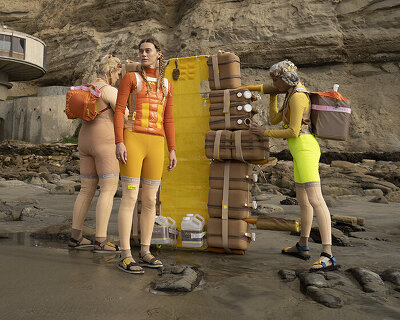
Prosser’s sculptures rarely remain static. Many are worn, carried, performed, or activated through public events that allow them to continue evolving beyond the studio. ‘I don’t really like the idea of my work existing in a sanitised white cube gallery where it can’t be touched. Basketry is inherently tactile, and it even lasts longer through contact with people.’
For him, performance completes the object rather than simply displaying it. ‘The objects function like tools for play. They establish a set of possibilities, and the event is where those possibilities are stress tested.’ The same philosophy shapes his making process. ‘I set the stage, and then the object is worked out through the act of making itself.’

lewis prosser sees basketry as a living technology
Perhaps the most striking aspect of Prosser’s work is that it never feels nostalgic. His sculptures borrow the visual language of laundry baskets, shopping baskets, folk traditions, and rural craft, yet they consistently point forward.
‘Basketry is, at its core, a solutions-based craft. It’s spent hundreds of thousands of years adapting to different landscapes and needs, and I think it still has enormous potential to help shape how we make stuff in the future.’
In Prosser’s hands, willow becomes more than a material. It becomes evidence that the future of making may not depend on abandoning traditional knowledge, but on allowing it to evolve. Basketry survives precisely because it has never stopped adapting.
project info:
artist: Lewis Prosser | @clovisvosser
shop
your own online design shop — no sales commission collected