
‘nature becomes the choreographer’: janet echelman on a sky full of hope in frankfurt
janet echelman suspends 'a sky full of hope' over frankfurt, where wind and public use continually reshape the work and the space beneath it.
a sky full of hope moves above frankfurt
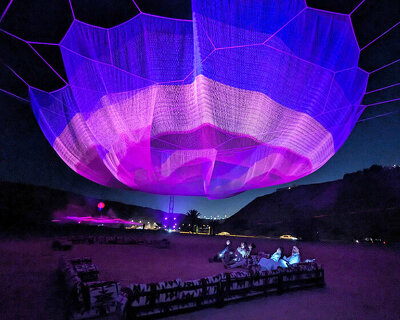
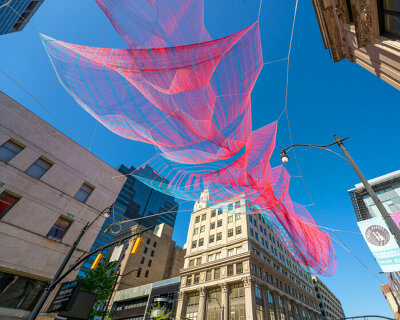
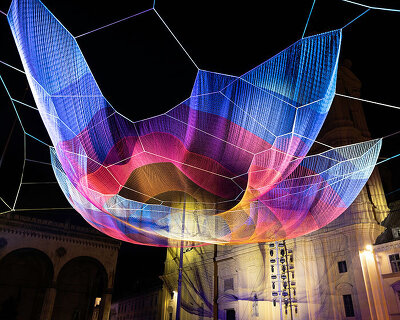
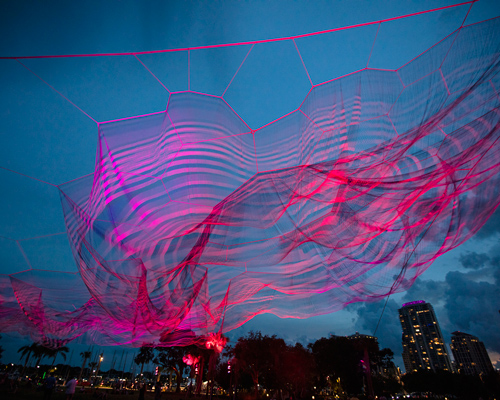
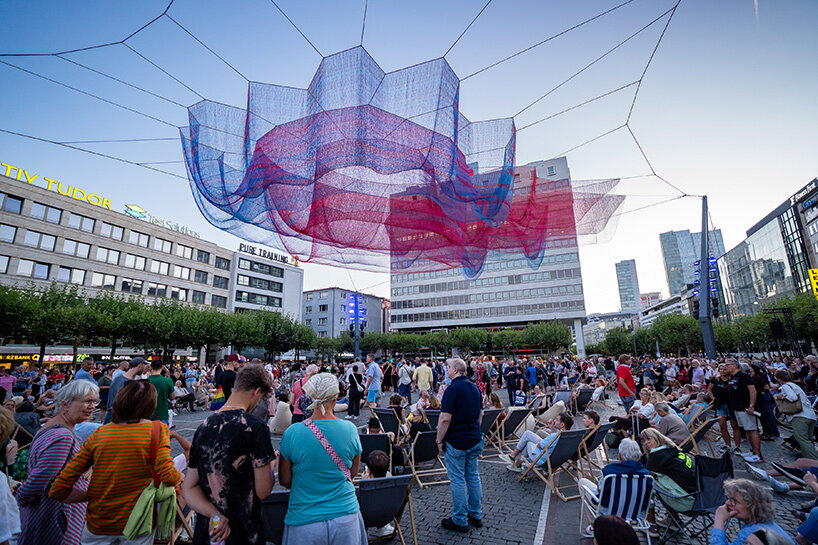
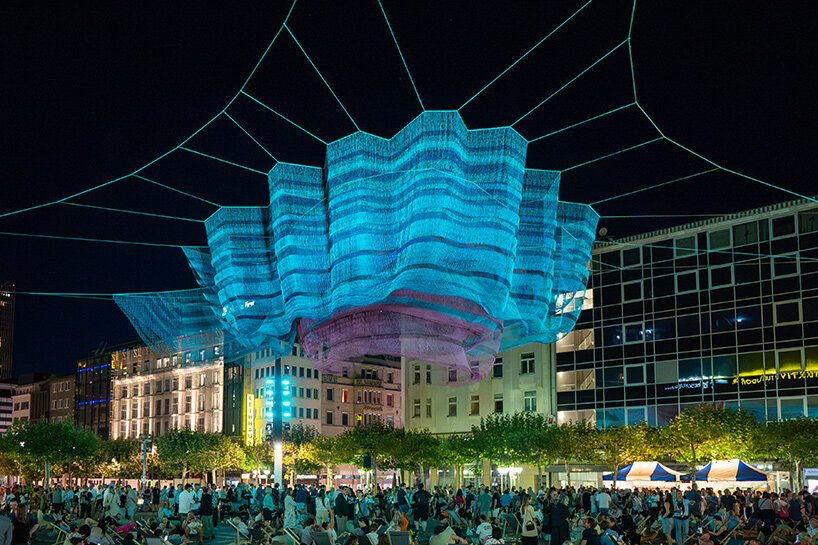
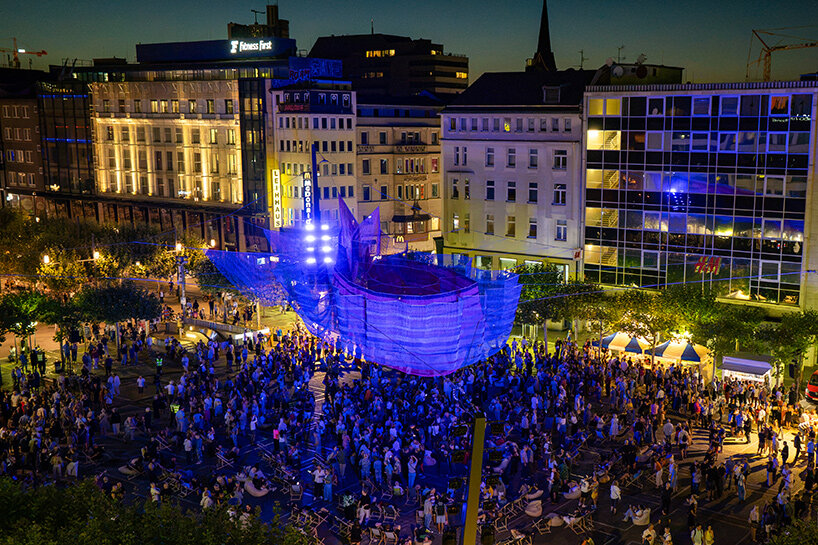
Janet Echelman has spent much of her career persuading cities to look up. Her newest public artwork hangs over Konstablerwache, a broad central square in Frankfurt where commuters pass through and a market takes over twice a week. A Sky Full of Hope – Earthtime 1.78 Frankfurt stretches a field of colored fiber more than seven meters overhead, moving with the wind through the day and illumination after dark.
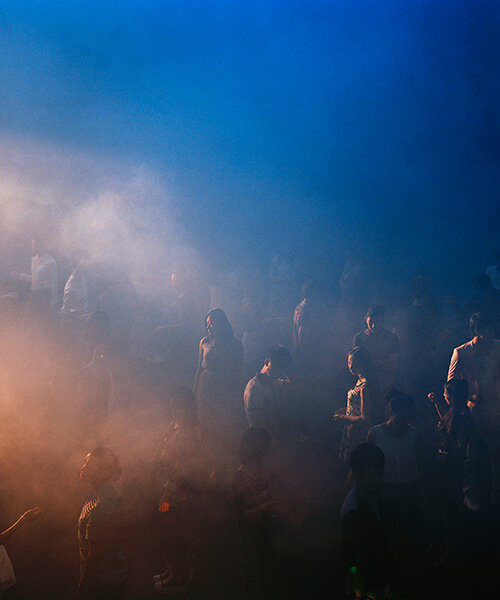
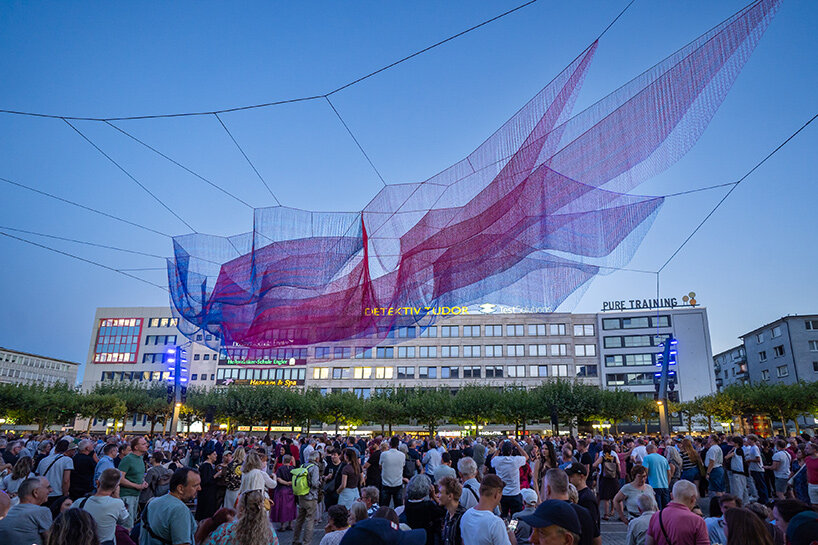
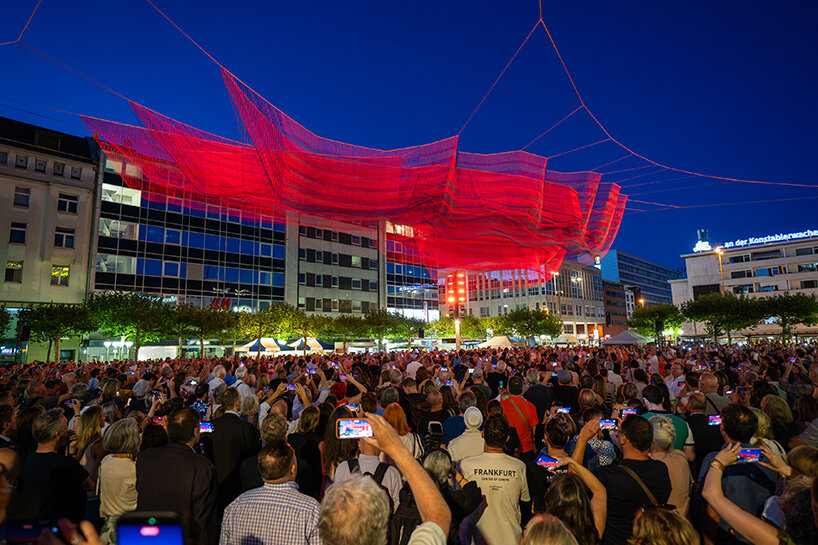
More than 3,000 people gathered beneath it for its August 11th unveiling, filling the square and occupying nearly every deck chair by the afternoon. The scene offered an early version of the question Echelman has built into the commission: can a work in the air change what happens on the ground?
Following designboom’s coverage of Echelman’s work over the years, the Frankfurt commission brings her familiar interest in softness and monumental scale into a more explicitly civic conversation. Konstablerwache drew her attention precisely because its character changes so sharply across the week. Outside market days, she heard from residents who experienced the square as empty or unsafe, while its postwar surfaces offered little of the texture of the city that preceded them.
‘I felt the site asking for color, light, softness, and fluid movement to rejuvenate life there,‘ Echelman tells designboom. Here, the sculpture begins with that reading of the square, then leaves plenty of room for Frankfurt to decide what happens next.
wind takes over the composition
Up close, the apparent weightlessness comes from a structure built around some fairly serious engineering by Studio Echelman. A flexible load-bearing net made from high-strength polymer fibers supports colored net sections extending up to 4.5 meters, with approximately 103 kilometers of twine running through the piece. The fabrication combines materials used in aerospace engineering with traditional fishing-net knotting techniques.
Echelman describes the aesthetic and technical work as intertwined throughout the process, from digital modeling and engineering reviews to decisions about proportion, density, color, and suspension. Once the structure reaches the square, though, the calculus changes.
‘I compose the conditions for the sculptural intervention, but I never compose its final outcome,‘ the artist says. ‘Once it enters the public space, nature becomes its choreographer.‘
Wind pulls one section and the movement travels through the network. Sunlight changes its depth. Shadows move across the paving below. The title places the Frankfurt work within Echelman’s Earthtime series, where 1.78 refers to the microseconds by which the 2011 Tōhoku earthquake altered the length of a day, with Pacific wave data informing the sculpture’s sweeping form. For this commission, Echelman also connects the work to the 178 nations represented among Frankfurt’s residents, thus drawing the global idea back toward the city beneath it.
who gets to shape the square?
The connection between the art and the community gives the sculpture its place within World Design Capital Frankfurt RheinMain 2026, organized under the theme Design for Democracy. Atmospheres for a Better Life. Echelman approaches the theme through access first.
‘For me, Design for Democracy means creating work above public streets and plazas because these are places where every person feels entitled to walk and enter into the public conversation,‘ Echelman explains. Her net becomes a structural metaphor as well. When one knot moves, the rest respond. Individual strands keep their colors while gaining strength through their connection.
What happens beneath the sculpture may ultimately tell more than its form. Echelman hopes people will linger there, make plans beneath it, play music, or invent uses the project team never anticipated. ‘I invite Frankfurters to take ownership of the space and use it in their own ways,‘ she continues. ‘In that sense, it becomes their sculpture.‘
The installation is scheduled to remain at Konstablerwache for an initial three-year period, coming down during the winter months, which gives that experiment time to develop far beyond opening night. Frankfurt gets the structure overhead. The open question is what its residents decide to do underneath it.
interview with janet echelman
designboom (DB): What first struck you about Konstablerwache, and what makes this work specific to the site?
Janet Echelman (JE): I was first struck by the contrast between Konsti’s multilayered history and its present-day use. Outside of the lively activity during the two weekly market days, many residents told me it can feel empty or even unsafe. Its postwar reconstruction also replaced much of its rich historic patina and texture with expanses of unadorned grey concrete.
I felt the site asking for color, light, softness, and fluid movement to rejuvenate life there. The project is also conceptually rooted in Frankfurt, as A Sky Full of Hope: Earthtime 1.78 refers to the 178 nations that live in Frankfurt, a city known for its openness, diversity, and international solidarity. In that sense, the work could only belong to this particular place.
DB: How do you design for people who may only glimpse the sculpture in passing?
JE: Public art becomes part of the rhythm of daily life, so depending on the time of day, it needs to offer something different at varying levels of attention. A person passing through the square might first register a flash of color, a movement overhead, or a shifting shadow. That brief interruption can bring their eyes upward to momentarily changes their experience of a familiar place.
For those who stop or return, the sculpture continues to reveal itself through changing wind, light, weather, and perspective. I never prescribe a single interpretation, because each person completes the artwork through their own experience of it — whether that experience lasts a few seconds, minutes, or longer.
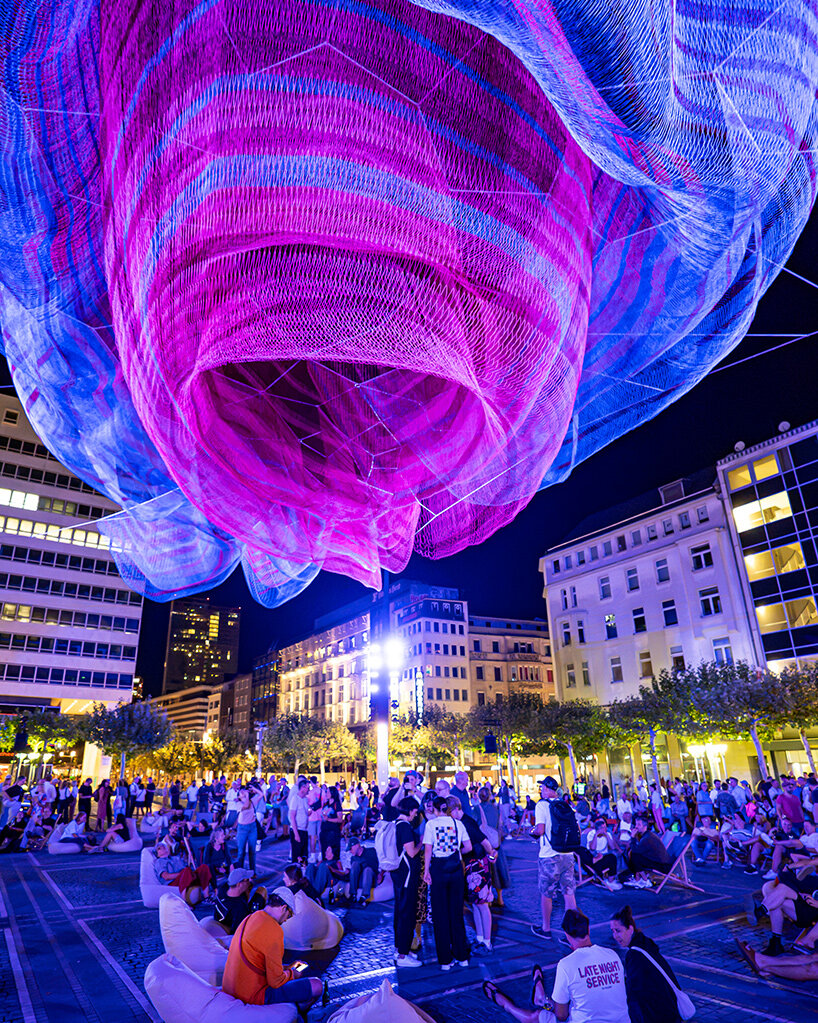
DB: Wind and weather continually reshape the work. When do you stop composing and let the atmosphere take over?
JE: I compose the conditions for the sculptural intervention, but I never compose its final outcome. My team and I make deliberate decisions about form, scale, color, material, and how the sculpture is suspended, but once it enters the public space, nature becomes its choreographer. Wind and light create patterns far more complex and unpredictable than any fixed composition I could design.
That’s something I love about art in the public sphere — I get to work alongside nature, not against it. Even a slight shift in any single knot impacts every other knot in the sculpture, so the entire work is continually responding to its atmosphere. For me, relinquishing that control is not the end of the creative process; it is an essential part of the work.
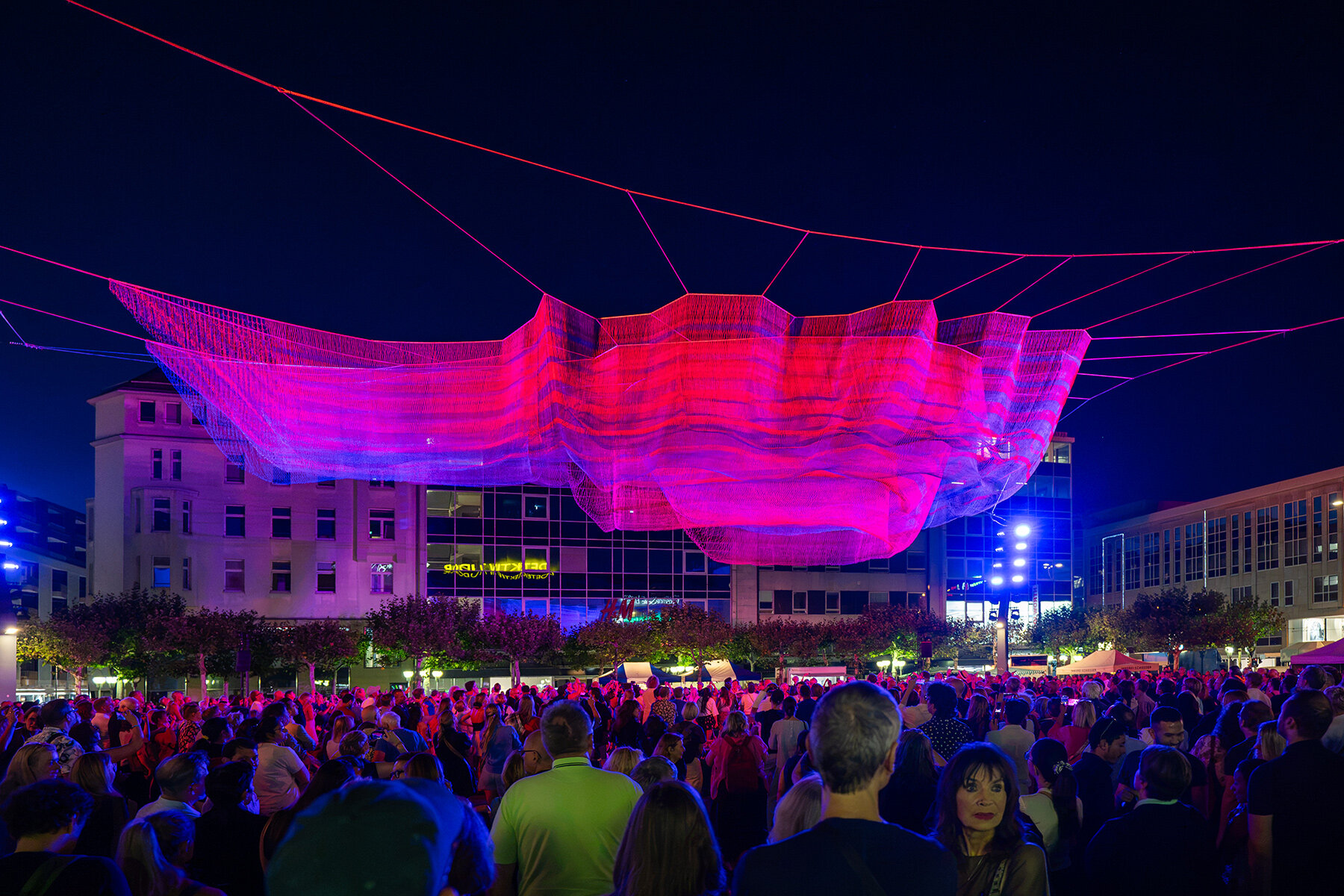
DB: Where do the key aesthetic decisions happen within such a technical, collaborative process?
JE: Our aesthetic and technical decisions are deeply intertwined from start to finish. At the scale of a public square like Konsti, the work requires intensive planning, digital modeling, engineering, fabrication, lighting design, and review to ensure that it performs safely in its specific environment and receives official permits. Within that process, aesthetic decisions happen continuously: the sculpture’s proportions, the density and movement of the net, the relationships among its colors, and the way the work is perceived from different angles.
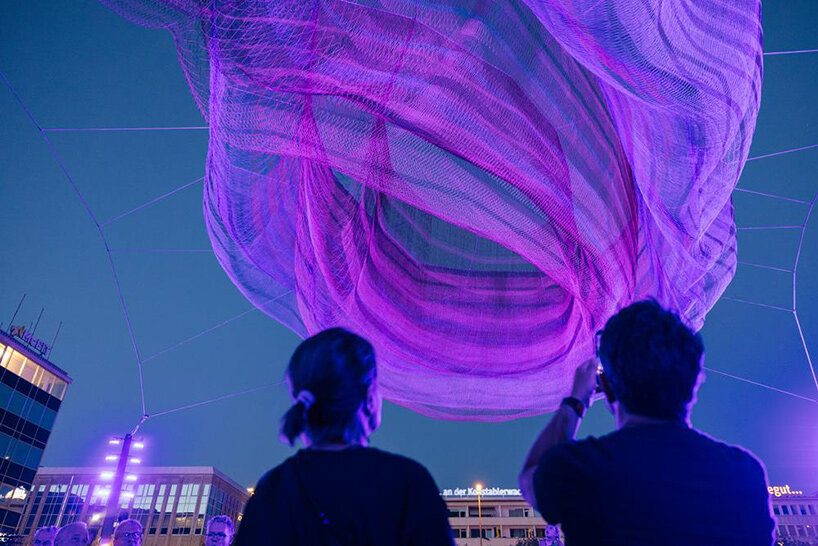
DB: What can a suspended artwork meaningfully contribute to the WDC guiding theme of ‘Design for Democracy’?
JE: For me, Design for Democracy means creating work above public streets and plazas because these are places where every person feels entitled to walk and enter into the public conversation. This artwork can be experienced as free as the air we breathe, without a ticket, specialized knowledge, or an invitation.
Its physical structure also offers a metaphor for democracy and interdependence: when one knot shifts, every other knot is affected. The multiple strands retain their individual colors while becoming stronger through their connection to one another. By transforming a functional transit space into a shared visual and social experience, the work suggests that our public environment and the status quo it represents are not fixed.
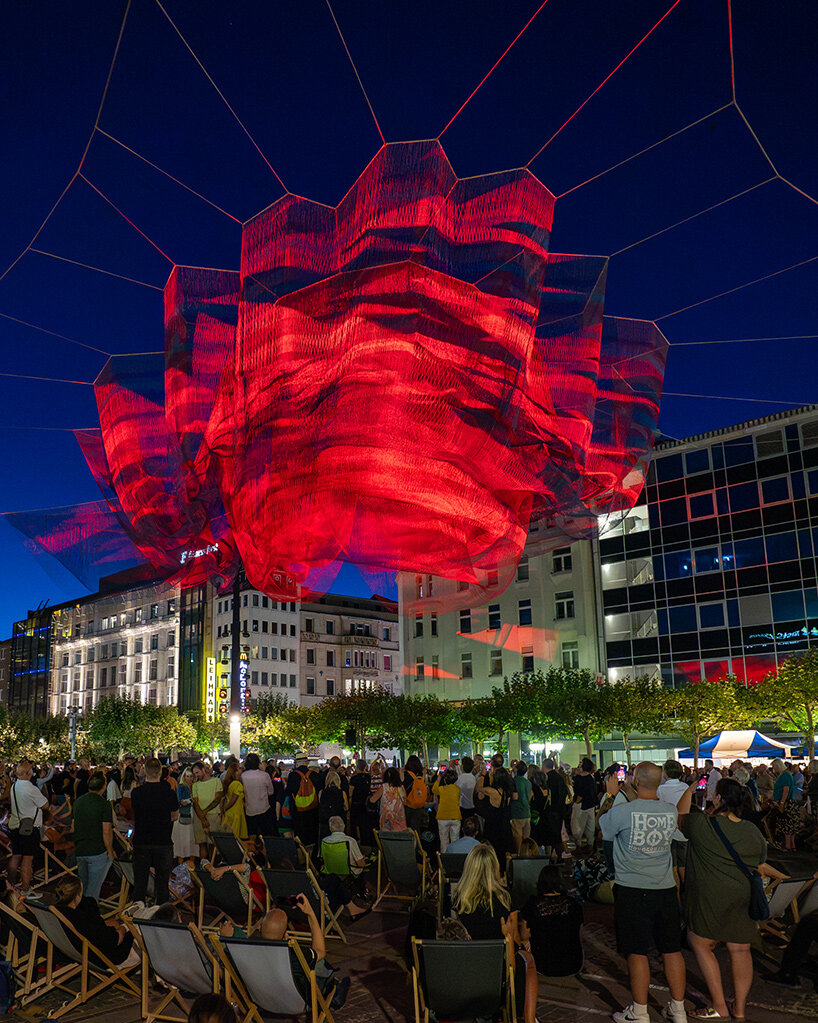
DB: What would convince you that the sculpture had changed how people use the square, rather than only how it looks?
JE: If people start to linger, to gather beneath the sculpture at different times of day, or choose it as a space to meet up, play and listen to music, and other forms of community life that surprise us, it will fulfill my wildest hopes. I invite Frankfurters to take ownership of the space and use it in their own ways. I like giving control over to nature to choreograph it, and to the people who encounter the work to shape its use. In that sense, it becomes their sculpture.
DB: What makes a public space feel alive, and what do you hope people feel when they look up?
JE: A public space feels alive when it’s inhabited by people. I invite people to inhabit the space beneath this billowing sculpture above their heads. By lingering, gathering, encountering and imagining new possibilities for how Konsti might be used, each person changes the space. I bring an element of unpredictability from nature, where wind and light and movement enliven the work, causing people to look up.
My dream is to invite you into a tiny moment of wonder, encountering softness at the scale of the city, and witnessing a physical manifestation of interconnectedness: to the natural forces animating the sculpture, to the people beside us, and to the larger web of life into which we are all inextricably linked.
project info:
name: A Sky Full of Hope – Earthtime 1.78 Frankfurt
artist: Studio Echelman | @janetechelman
location: Konstablerwache, Frankfurt am Main, Germany
program: World Design Capital Frankfurt RheinMain 2026
completion: August 11th, 2026
photography: © Holger Menzel, © Ben Kuhlmann
shop
your own online design shop — no sales commission collected