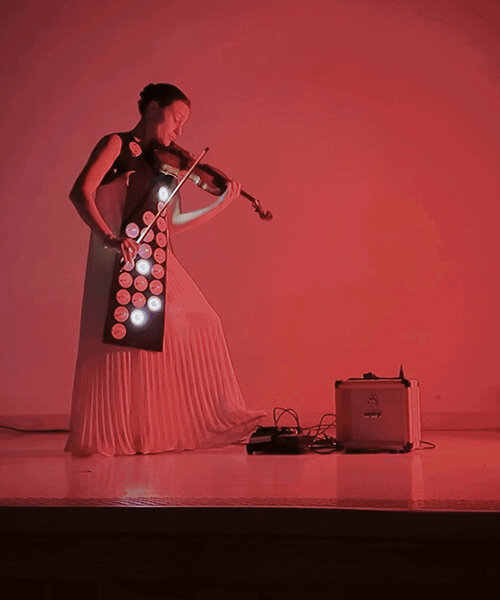
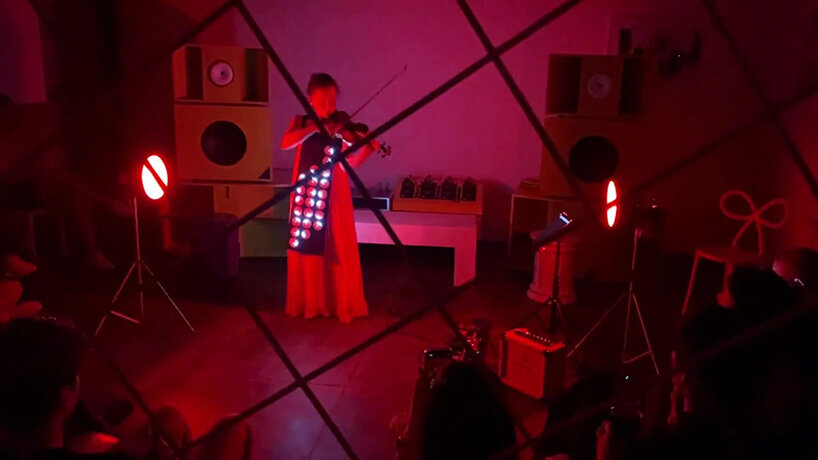
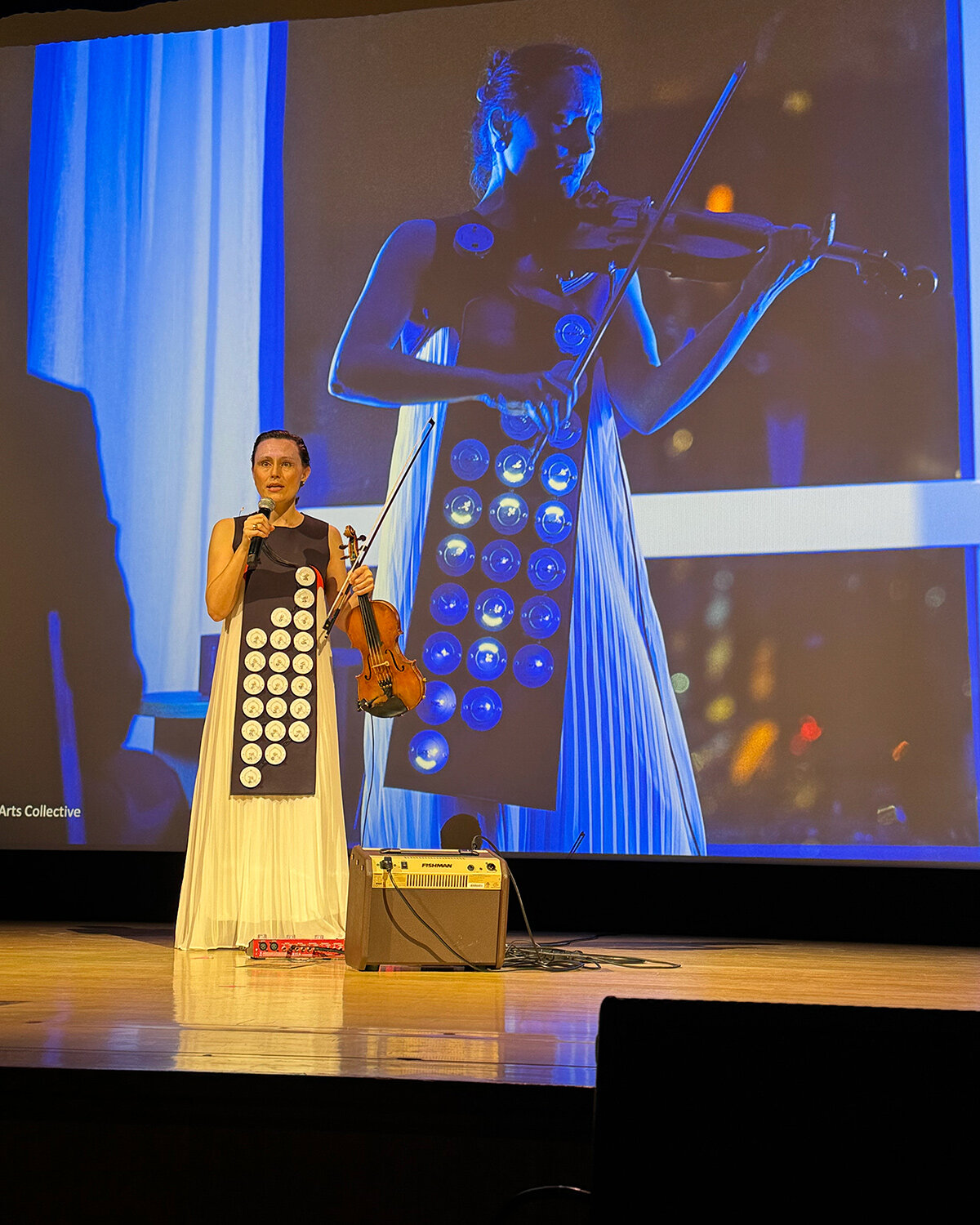
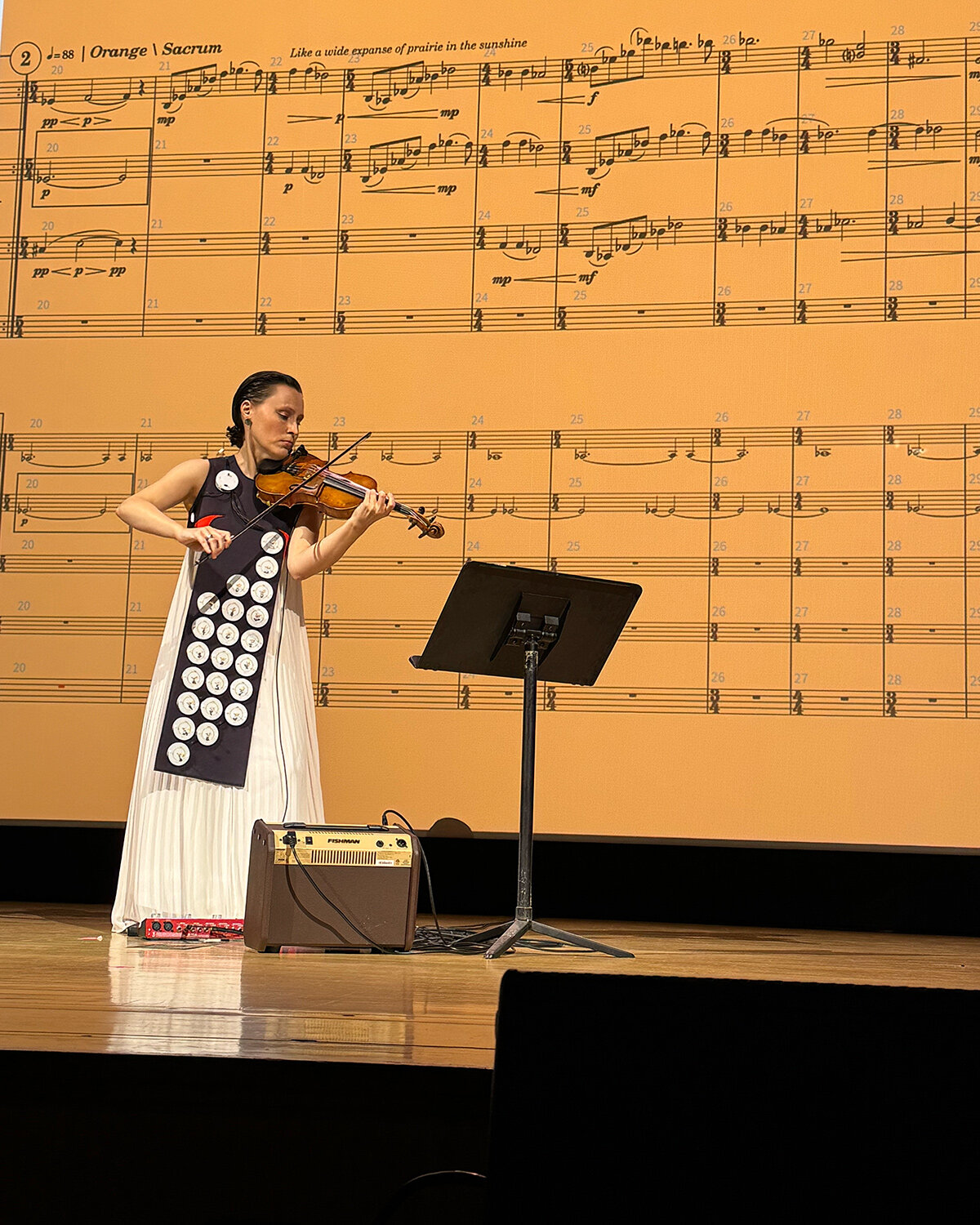
At The Metropolitan Museum of Art, violinist Audrey Wright wears a field of electronics across her body while her husband and creative partner Geoff Robertson stands nearby with a tablet. As Wright plays, Robertson moves through visual programs that send light across the wearable display.
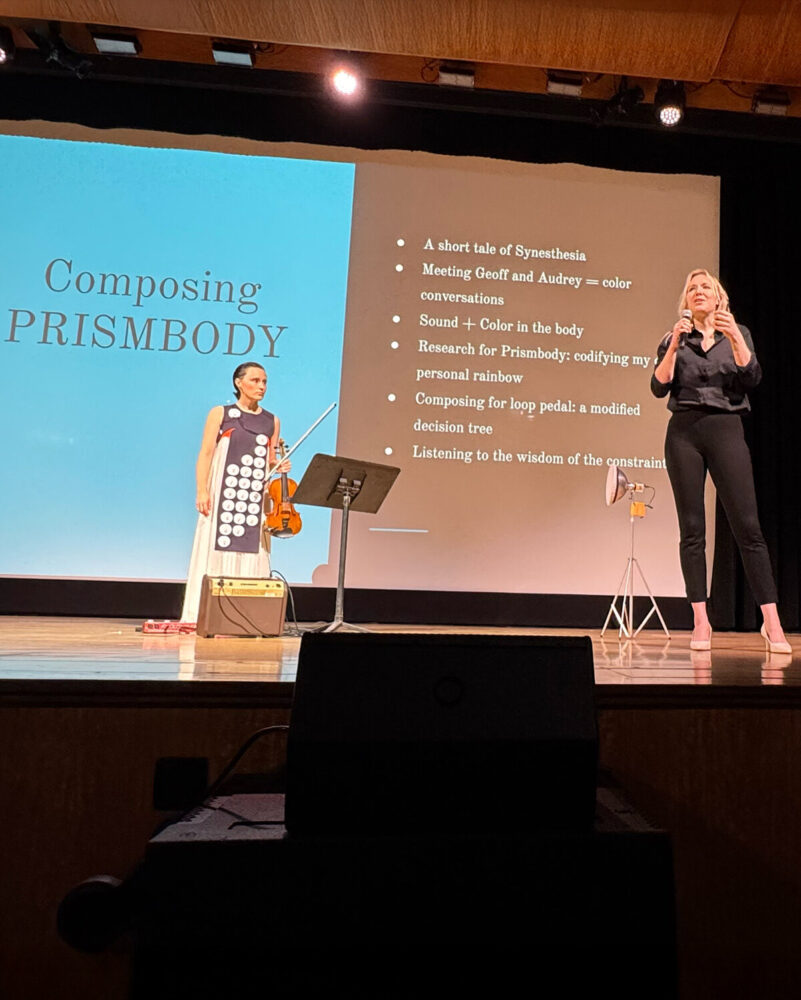
The setup comes from Luminous Being, the project the pair began performing in 2024, but the presentation soon shifts toward something still being built. Together with composer Stephanie Ann Boyd, they are developing PRISMBODY, a new work that takes Boyd’s synesthetic experience of music as its starting point and asks how some part of that personal perception might become visible to everyone else.
designboom spoke with Robertson ahead of the performance, when he described the idea through a surprisingly familiar comparison. ‘It’s like subtitles along with audio on a screen,’ he tells us. The lights are meant to communicate information paired with the music, drawing from Boyd’s own associations between sound and color.
Speaking at the Met, he goes on: ‘Audrey is the audio, and the garment has to be the color version of the subtitles.‘ What begins inside Boyd’s perception passes through a violinist’s body before arriving in front of an audience as light.
image courtesy Audrey Wright, Geoff Robertson
the garment becomes an instrument
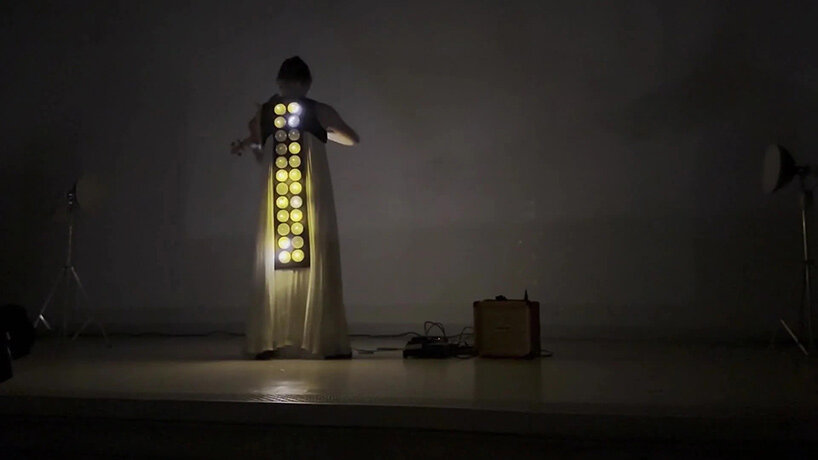
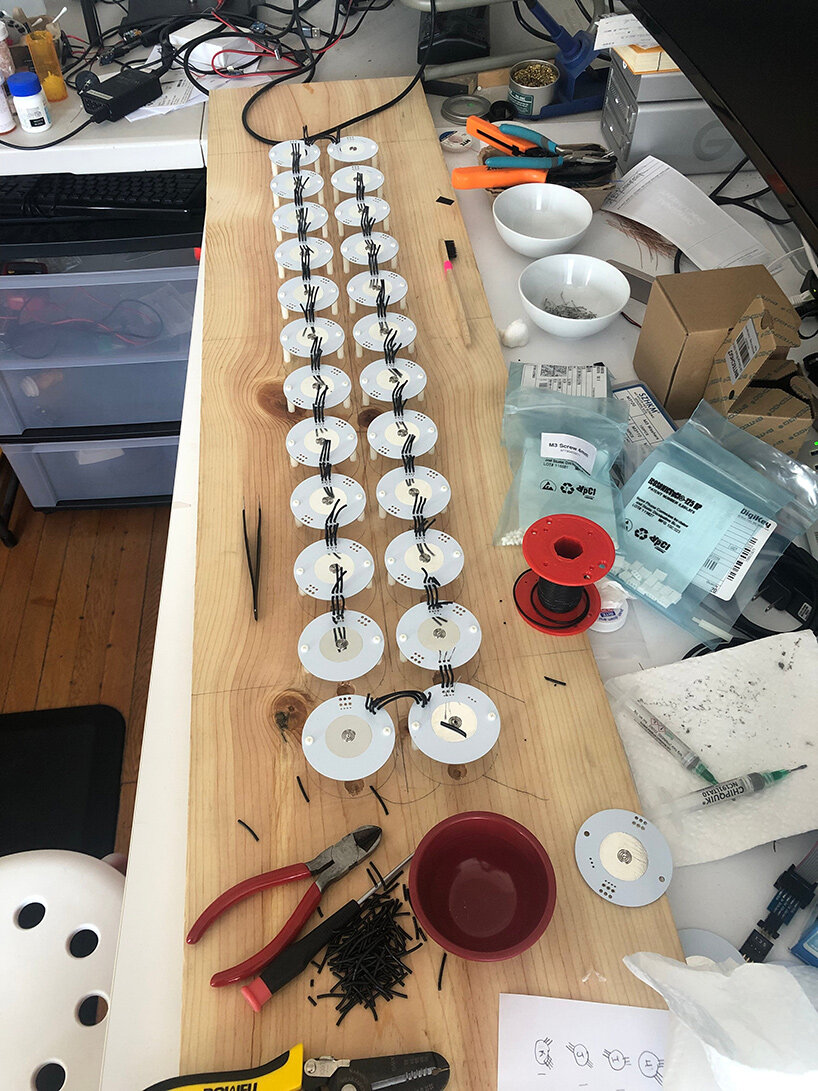
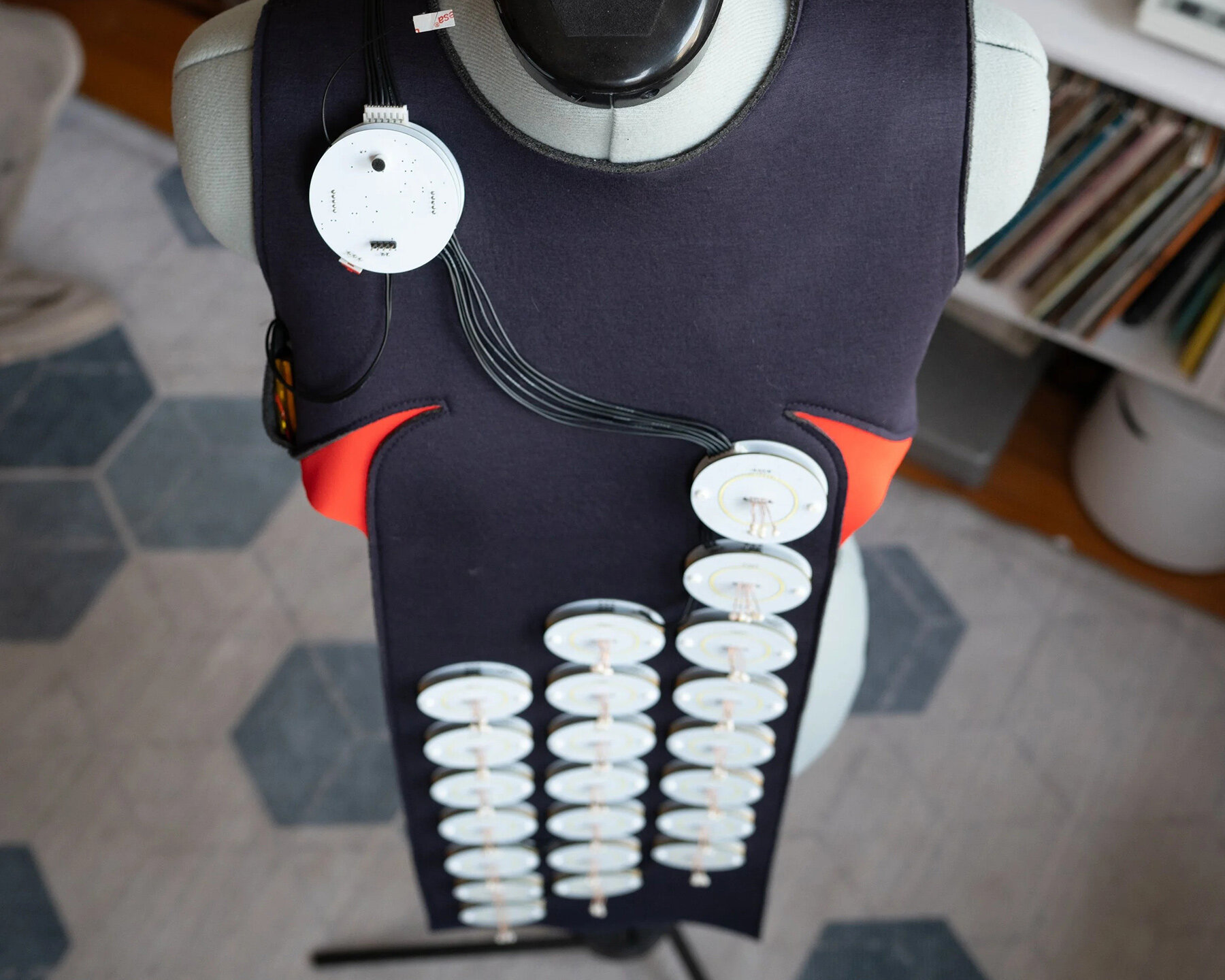
Robertson built the first Garment himself, teaching himself electrical engineering and programming along the way. Its 46 display panels sit across Wright’s front and back, with more than 3,000 LEDs distributed across the wearable system.
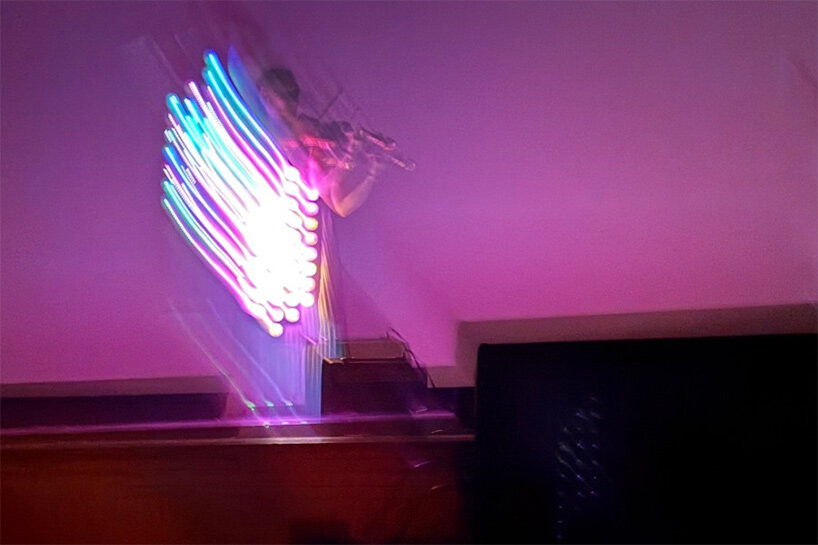
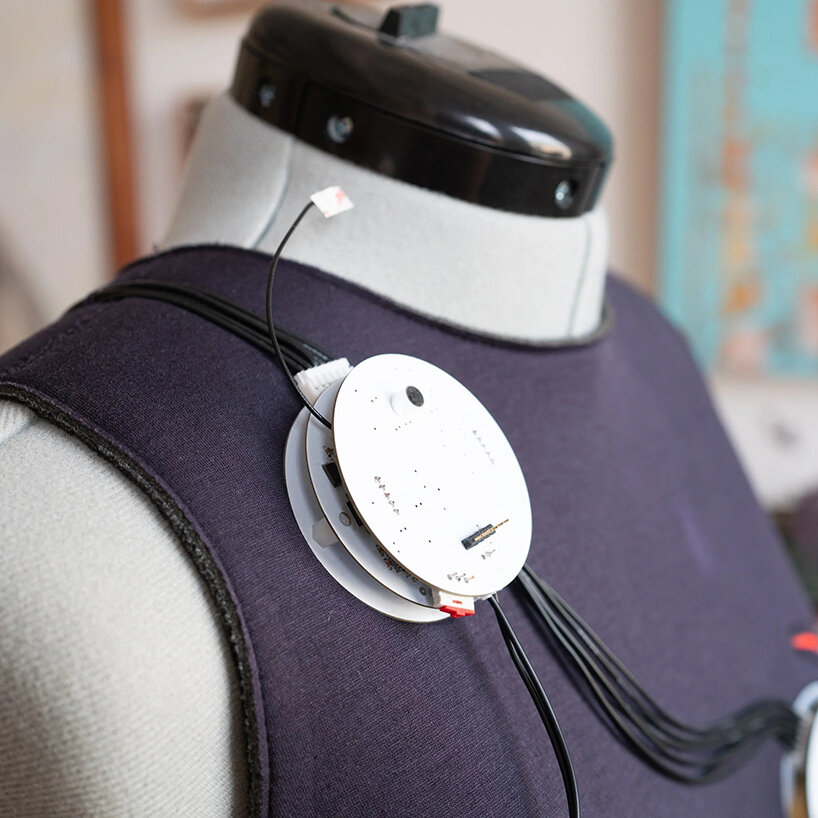
The Garment carries 47 batteries and generates its own Wi-Fi network, allowing Robertson to connect through a tablet and trigger different visual programs during a performance. An onboard microphone also listens to Wright’s playing and feeds audio values into some of those effects. The whole thing runs at roughly 30 frames per second.
Wright calls the wearable ‘a sensory musical instrument itself,’ and Robertson sees his own role in similar terms. ‘There is a bit of that where I’m actually playing the instrument, kind of in tandem with Audrey,‘ he tells us. His tablet sits at the edge of the performance, yet his timing becomes part of what the audience sees. Wright plays the violin while Robertson plays the visual system around her.
image courtesy Audrey Wright, Geoff Robertson
from multisensory to multimodal
PRISMBODY begins with Boyd’s synesthesia. During the Met presentation, the composer recalls realizing in graduate school that color had always been inseparable from the way she understood music. ‘The color was there all the time, like omnipresent,‘ she says. ‘I couldn’t take them apart.‘
For the new work, she has begun turning those associations into a compositional structure, describing PRISMBODY as ‘a codifying of my synesthesia.’ Different passages move through color fields tied to her own perception, while Wright builds layers of violin through loop pedals.
image courtesy Audrey Wright, Geoff Robertson
For Robertson, this changes what the wearable needs to do. The original Garment has five fixed LED colors on each display panel, which leaves little room for the subtle hues Boyd associates with particular sounds. Garment 2.0 introduces RGB LEDs capable of producing a far broader range.
‘The garment transitions from something that is multisensory to something that is more multimodal,‘ Robertson explains at the Met. His subtitle analogy returns here. The goal is to communicate related information through sound and image at the same time, with enough chromatic precision for Boyd to recognize something of her own perception in what appears on Wright’s body.
image courtesy Audrey Wright, Geoff Robertson
a screen that wraps around the body
The second Garment also expands physically. Robertson is developing transparent display panels that will wrap fully around Wright, replacing the clearer front-and-back orientation of the first version with a continuous visual surface. Each panel will contain individually controlled white LEDs alongside an RGB layer, while additional lights cast color inward across Wright as she plays. The external spotlights are evolving too, becoming sculptural extensions of the wearable display and moving the image farther into the room.
That 360-degree view has been on Robertson’s mind since the first Garment. ‘You have a 360 kind of viewing experience,‘ he tells us, recalling the project’s beginnings during the COVID era, when he imagined performances taking place beyond conventional stages. PRISMBODY takes that idea further.
Boyd’s color associations enter the score, then Wright and Robertson move that material into sound and light. The audience receives an interpretation shaped through each person along the way. At the Met, the work was still visibly in progress. That made its central question easier to see: how do you turn somebody else’s way of perceiving music into an image a room full of people can experience?
This article is part of designboom’s SPECTATOR AND SPECTACLE chapter, asking how wonder gets built, and how it might return some mystery to a world that has measured most of it away. Presented in partnership with SolidNature, the stories in this chapter turn onlookers into participants, alter perception and disrupt the everyday – learn more here!
Each designboom chapter explores one theme in depth through projects, interviews, features and news across architecture, design, art and technology. Discover more chapters here, and get in touch if you’d like to submit a story through our submissions portal or contact form.