working with tin jingles and reclaimed blankets, marie watt revisits ancestral craft
through sewing circles and seneca knowledge, the artist turns shared stitching into a living archive of memory.
prefer designboom on googleMarie Watt’s circle stitches collective memory
The work of artist Marie Watt often begins with people sitting together, hands moving across fabric as stories pass from one voice to another.
While the setting can range from a museum, a school, a community space, or the artist’s studio, the gesture stays close and direct. Needles thread through wool as lines of stitching follow handwriting and a shared space gathers the presence of many hands.
Watt’s practice offers a deeply human view into the question of what craft can become. The Seattle-born artist, a member of the Turtle Clan of the Seneca Nation of Indians, works across printmaking, painting, textiles, and sculpture.
She draws from Haudenosaunee protofeminism — a centuries-old matrilineal social structure — and Indigenous teachings while tracing the meeting points between community and storytelling, all while moving through inherited materials and contemporary forms.

blankets become living archives
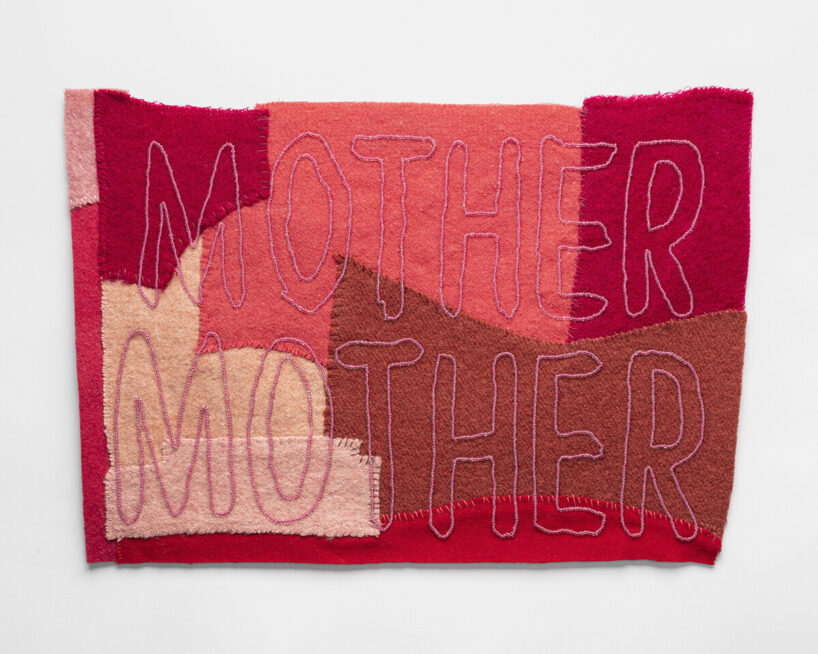
Across Marie Watt’s studio, reclaimed blankets appear again and again, carrying the weight of use before they enter the artwork. They bring associations of warmth, protection, gifting, and exchange, while their surfaces hold the marks of previous lives.
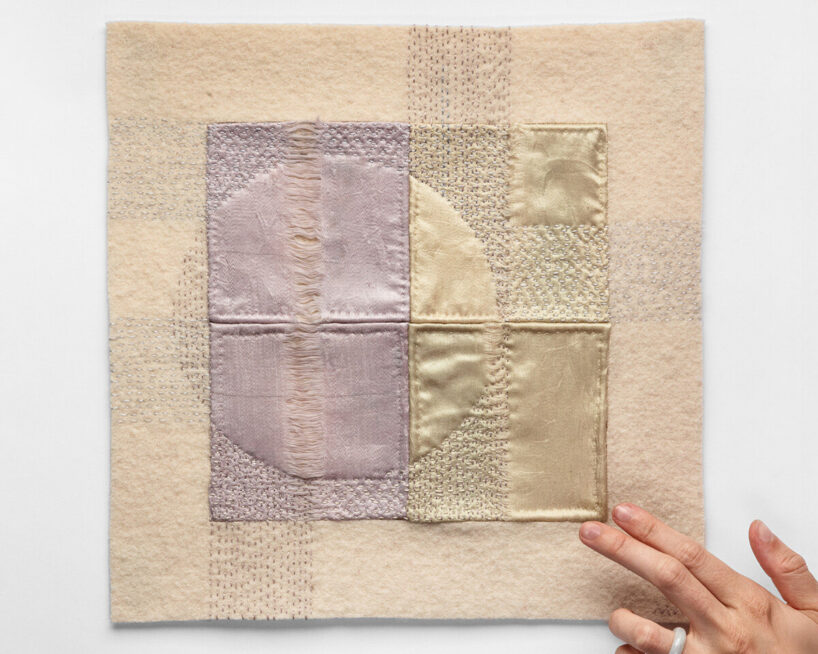
In Long Night Eclipsed (Winter Solstice), a compact 2025 work made from reclaimed wool, satin bindings, thread, and embroidery floss, the blanket becomes a concentrated field of touch. Its scale is intimate, but the material memory feels much larger.
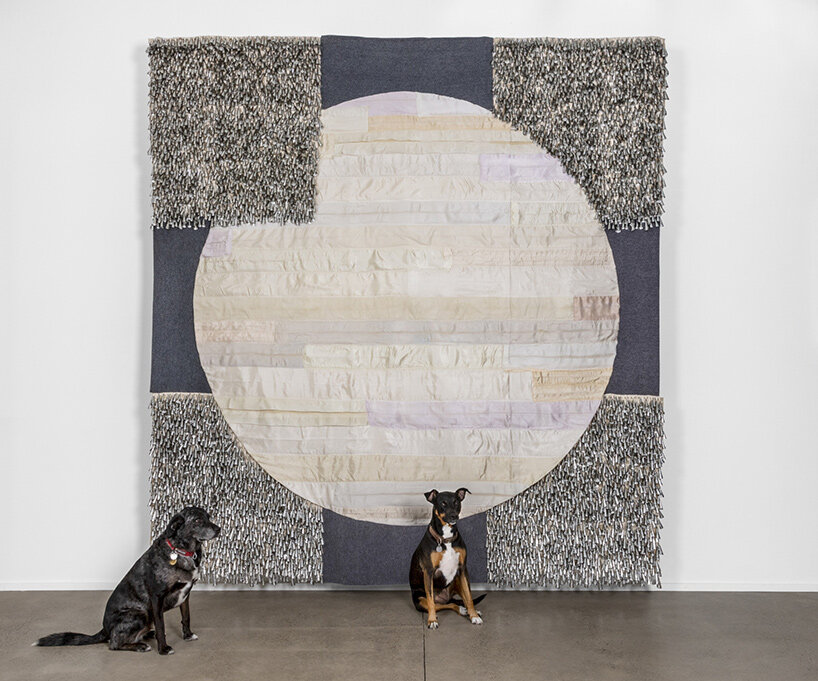
In Solstice, also from 2025, Watt expands that language into a larger composition made with reclaimed satin bindings, reclaimed wool blankets, canvas, tin jingles, cotton twill tape, and thread.
These pieces carries the softness of textile with a firmer sense of structure. Here, craft both preserves technique and gives used materials a way to keep speaking.

many hands turn a question into a chorus
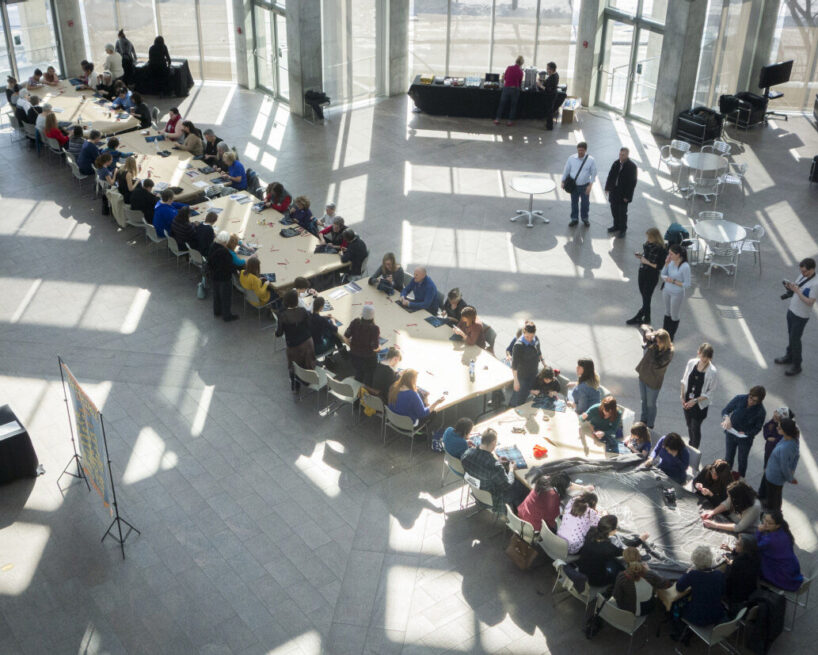
At the center of Marie Watt’s collaborative practice are her sewing and printing circles, which the artist describes as an integral part of the work itself.
These gatherings take place across studios, schools, community spaces, and institutions, creating a setting where participants exchange stories while working by hand. The circle becomes a social form as much as a process, expanding and contracting to hold different voices.
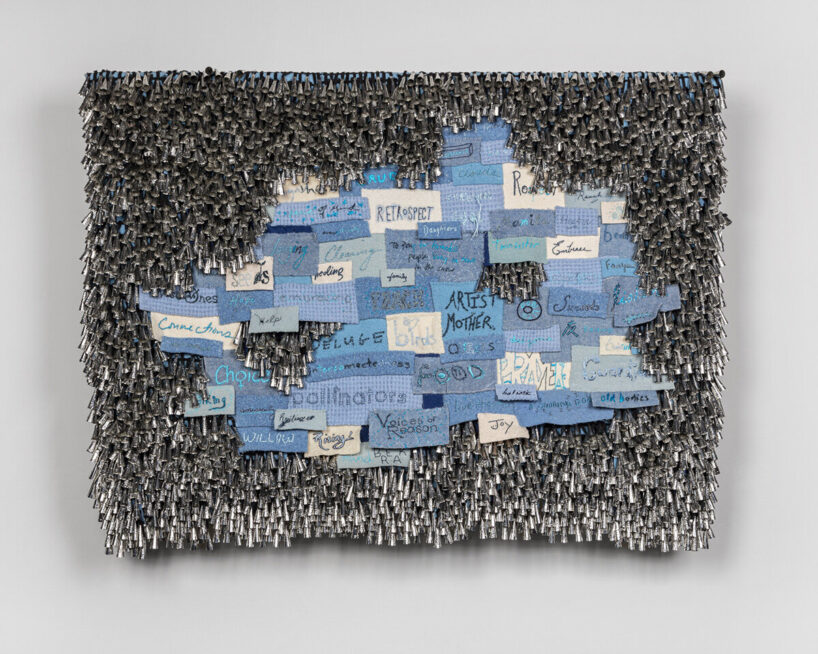
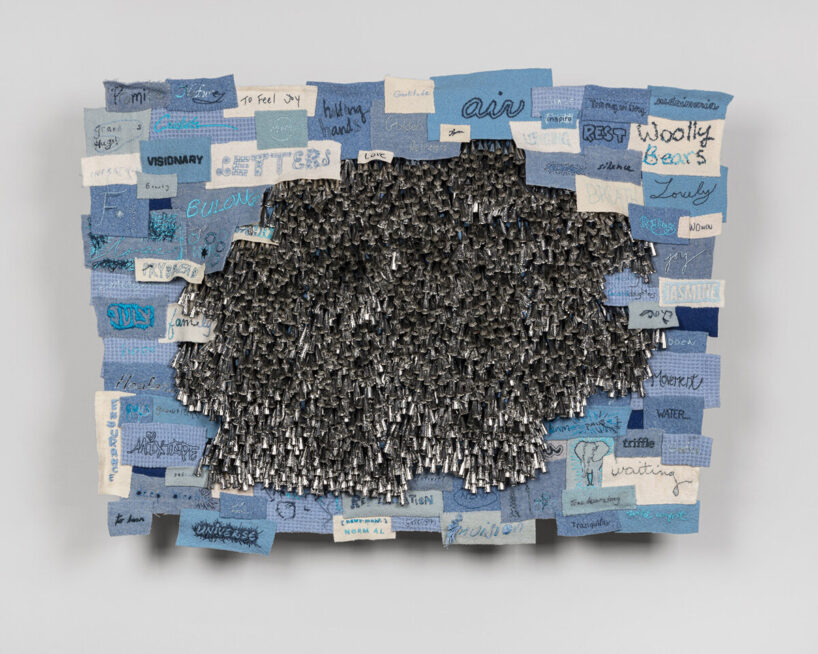
That structure comes sharply into view in Singing Everything: Crescendo (Staccato), a 2023 work made from reclaimed wool blankets, tin jingles, embroidery floss, and thread. Developed with the Whitney Museum of American Art, the project began with a question sent to communities: ‘What do you want to sing a song for in this moment?‘
Participants responded by hand, and Watt’s studio translated those marks across more than one hundred panels before the embroidery circles brought over 300 people together in March 2022. The finished work carries handwriting, stitch, and voice into a single textile field.

sound moves through the material
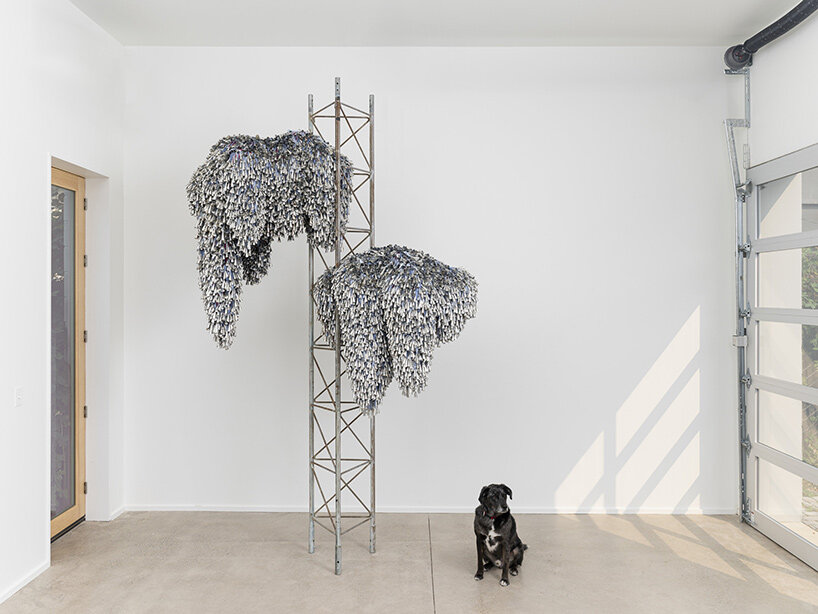
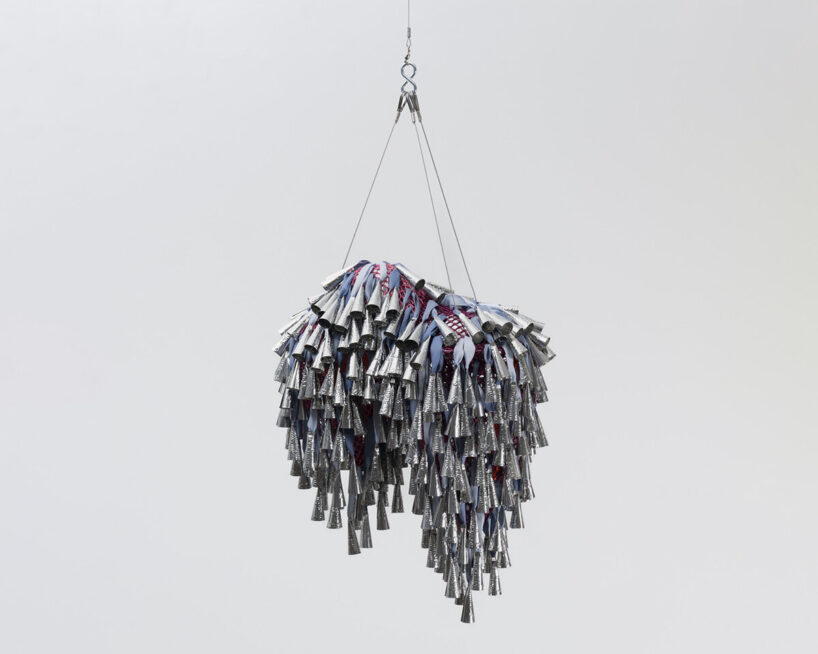
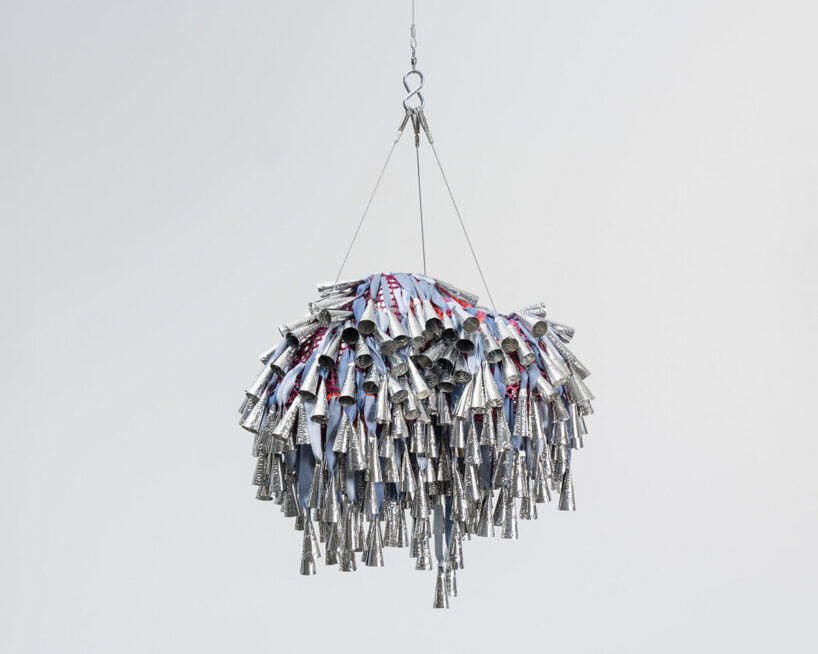
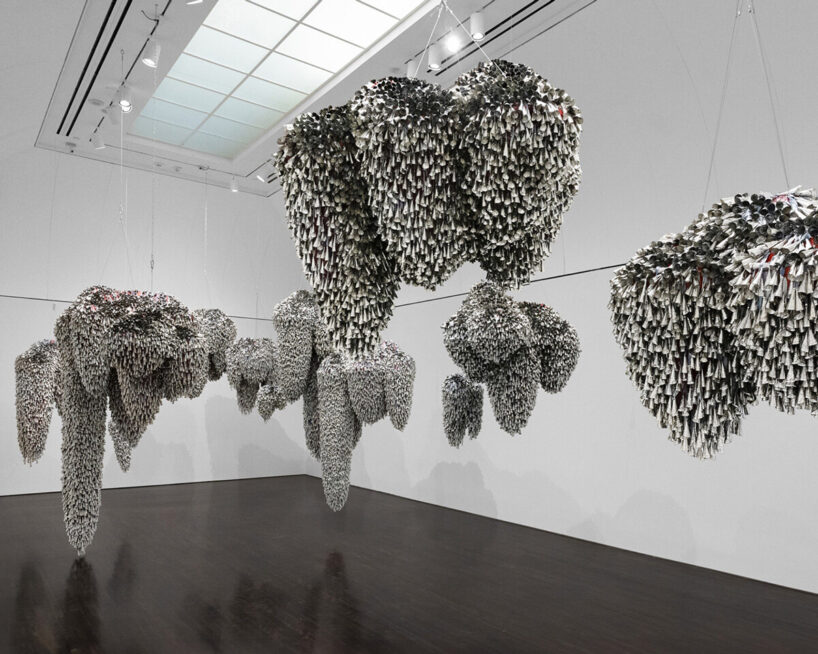
Marie Watt’s use of tin jingles opens the work beyond the visual surface. In Sky Dances Light, installed in 2024, thirteen jingle clouds bring together selections from the Forest, Chorus, Kin, and Solo series, while also incorporating works from Vivid Dream: Awakening.
Suspended in space, the forms hover between sky and ground, their small metal cones touching and sounding when air moves through them.
The jingles carry deep histories of making, adornment, ritual, and healing. Watt’s studio connects them to the Jingle Dress Dance, which began within Ojibwe tradition in the early 1900s during the influenza pandemic, and continued to circulate through Indigenous communities through a long period when ceremonial gatherings were banned in the United States.
In Watt’s installation, that history enters the gallery through a soft metallic murmur. The work asks the viewer to listen with the body.

steel and wool meet in vertical space
Watt’s material vocabulary reaches toward the built environment in Skywalker/Skyscraper (Quiver), a 2023 sculpture made from reclaimed blankets, tin jingles, and a steel I-beam. Standing 108 inches high, the work brings textile into contact with the language of construction.
The I-beam gives the sculpture a vertical charge, while the blanket and jingles pull the eye back toward touch, warmth, and sound.
The title points toward Indigenous ironworkers and the histories carried into city skylines. Steel, in Watt’s hands, does not overpower the textile. It becomes another material with memory inside it. The sculpture holds labor, risk, and inherited skill in one upright form, bringing craft into conversation with urban infrastructure.

craft becomes relation
In Companion Species (Call and Response), Watt returns to reclaimed wool blankets, embroidery floss, thread, cotton twill tape, and tin jingles in a paired work from 2022.
The title frames the two panels as a conversation, where one form calls and the other answers. The exchange feels close to the structure of the sewing circle itself, where listening shapes the next gesture.
This sense of relation runs across Watt’s practice. Her studio describes exchange as a way to understand and strengthen connections to place, to one another, to animals, and to the universe.


1/8
project info:
artist: Marie Watt
This article is part of designboom’s Crafting the Future chapter, exploring what it means to be a maker in today’s world and the future of craftsmanship. Discover more related stories here.
shop
your own online design shop — no sales commission collected